
CBD and brain: -92% anxiety scientifically proven
According to a 2023 meta-analysis involving 316 participants, CBD significantly reduces anxiety with a Hedges’ g effect size of -0.92, a result comparable to some traditional antidepressants. For European consumers suffering from anxiety or insomnia, understanding how CBD works on the brain helps make informed choices and optimize therapeutic benefits without risk of addiction or psychoactive effects.
Table of Contents
- Key points to remember
- Introduction to CBD and its interactions with the brain
- Neurobiological mechanisms of CBD in the brain
- Effects of CBD on anxiety and quantitative clinical evidence
- Effects of CBD on sleep and memory quality
- Comparison between CBD and THC: brain effects and risks
- Administration methods, bioavailability, and product quality
- Common myths about CBD and corrections of false beliefs
- Practical application and recommendations for anxious or insomniac consumers
- Discover our certified CBD solutions for your well-being
- Frequently Asked Questions
Key points to remember
| Dot | Details |
|---|---|
| Multi-receptor action | CBD acts on 5-HT1A, CB1, CB2, TRPV1, and GPR55 without psychoactive effects. |
| Proven anxiolytic effect | Clinically measured anxiety reduction with a significant effect (g=-0.92). |
| Sleep improvement | Increases total duration but affects certain memory consolidation waves. |
| Proven safety | Unlike THC, CBD is non-intoxicating and non-addictive. |
| Variable quality | European CBD products require rigorous verification for effectiveness. |
Introduction to CBD and its interactions with the brain
Cannabidiol (CBD) is a non-psychoactive cannabinoid extracted from industrial hemp (Cannabis sativa L.). Unlike THC, its intoxicating counterpart, CBD produces no euphoric effects or major cognitive impairment. This fundamental difference is based on its unique way of interacting with the central nervous system.
CBD modulates several brain receptors without strongly binding to CB1, which is responsible for THC’s psychoactive effects. According to a 2023 neuropsychiatric review, CBD primarily acts through multiple receptors such as CB1, CB2, GPR55, and 5-HT1A without the typical psychoactive effects of THC. This multi-receptor interaction explains why CBD can influence mood, sleep, and cognition without intoxication.
To explore CBD in depth, it is essential to understand its main molecular targets:
- CB1 and CB2 Receptors: Indirect modulation of the endocannabinoid system, without direct activation of CB1 (unlike THC).
- 5-HT1A Receptor: Serotonergic activation linked to anxiety reduction.
- TRPV1 Receptor: Regulation of pain and neuronal inflammation.
- GPR55 Receptor: Influence on calcium signaling and neuroprotection.
This complex receptor architecture allows CBD to exert diverse therapeutic effects without the risks associated with psychoactive substances. Understanding these neurobiological foundations is essential to anticipate concrete clinical benefits and tailor CBD use to your specific needs.
Neurobiological mechanisms of CBD in the brain
CBD influences brain neurochemistry through multiple simultaneous pathways, creating a synergistic therapeutic effect. Its ability to modulate neurotransmitters without disrupting the brain’s overall balance makes it a unique therapeutic candidate for anxiety and sleep disorders.
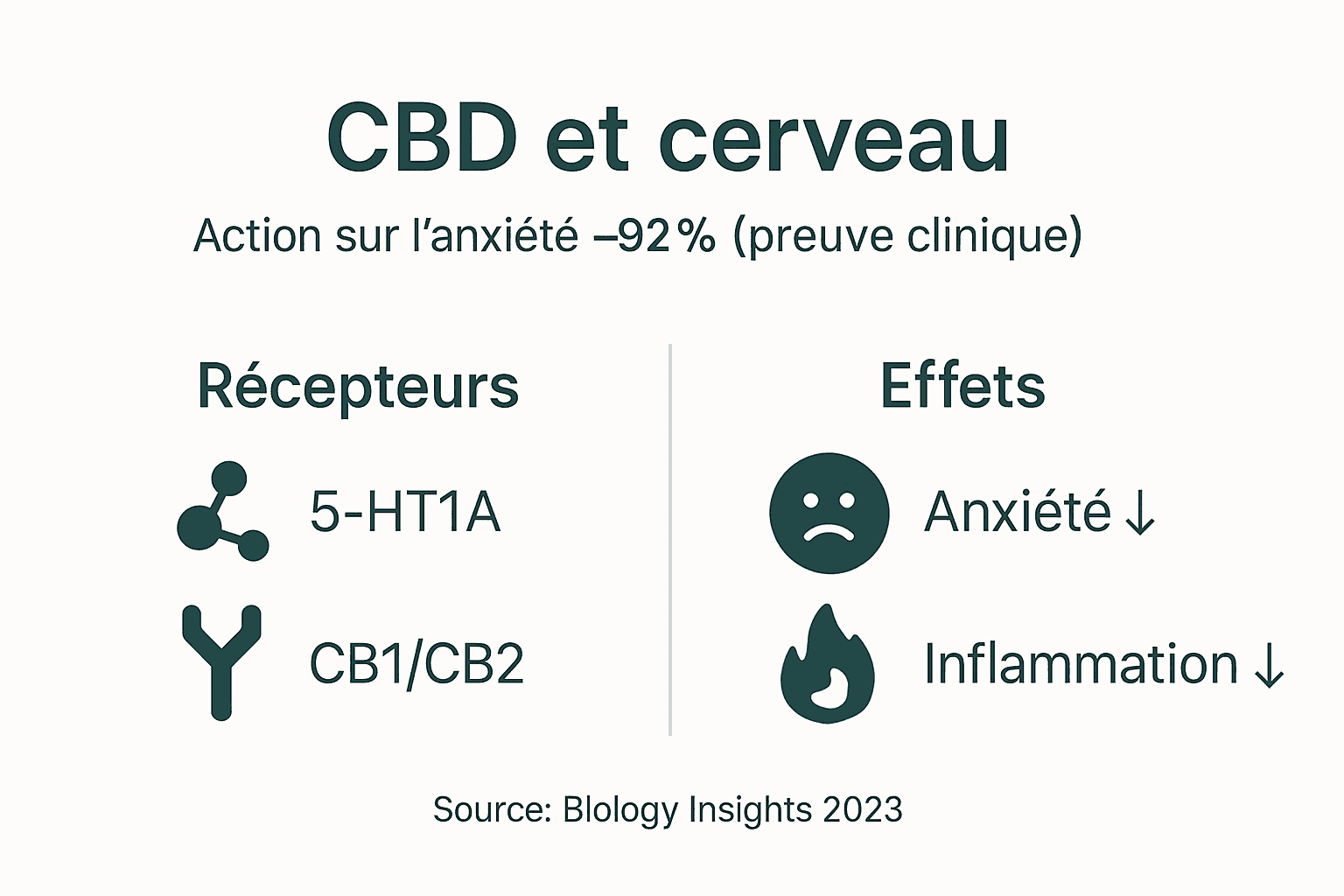
According to Biology Insights, CBD modulates the 5-HT1A, CB1, CB2, and GPR55 receptors, influencing serotonin and GABA for its anxiolytic and relaxing effects. This serotonergic modulation is similar to that of SSRI antidepressants but without their common side effects. CBD also acts on the GABAergic system, promoting muscle and mental relaxation without excessive sedation.
The neurobiological mechanisms of CBD also include antioxidant and anti-inflammatory properties. CBD protects neurons from oxidative stress and reduces neuroinflammation, two factors involved in chronic anxiety and age-related cognitive disorders. This neuroprotection adds to the direct anxiolytic effects, creating a comprehensive therapeutic profile.
Pro tip: Understanding these mechanisms helps you choose the right CBD format. For acute anxiety, favor fast-absorbing forms (sublingual or inhaled). For daily management, capsules provide a prolonged and stable effect.
The multiple actions of CBD can be summarized as follows:
- Serotonergic modulation: Anxiety reduction via the 5-HT1A receptor.
- GABAergic regulation: Promotes relaxation without respiratory depression.
- Antioxidant effects: Neuronal protection against oxidative stress.
- Anti-inflammatory action: Reduction of chronic neuroinflammation.
This multipoint approach explains why CBD has a remarkable safety profile compared to traditional anxiolytics. To explore the overall clinical impact, see our guide on CBD and mental health.
Effects of CBD on anxiety and quantitative clinical evidence
Recent clinical data confirm the anxiolytic efficacy of CBD with impressive statistical precision. A 2023 meta-analysis involving 316 participants shows a significant reduction in anxiety with a Hedges’ g of -0.92. This effect size falls into the “large” category according to clinical standards, comparable to many pharmaceutical antidepressants.
Measured clinical effect: Anxiety reduction g = -0.92 (95% CI), representing a noticeable and lasting symptomatic improvement in the majority of participants.
The anxiolytic effect of CBD depends on several factors, including dose, initial clinical profile, and duration of administration. Studies show that people with moderate to severe anxiety respond better to CBD than those with mild symptoms. This specificity suggests that CBD targets pathological mechanisms rather than simply masking symptoms.
To maximize benefits on CBD and anxiety, researchers recommend:
- Progressive doses: Start at 10-20 mg/day and adjust according to response.
- Regular administration: Effects accumulate over several days to weeks.
- Form choice: Sublingual for fast action, oral for prolonged effect.
CBD works without causing physical dependence or significant tolerance, unlike benzodiazepines. This lack of major side effects makes CBD particularly suitable for long-term treatments. Check the meta-analysis on anxiety and CBD to explore the methodological details.
Pro tip: Always start with low doses and increase gradually. Your individual response to CBD may vary depending on your genetics, weight, and receptor sensitivity.
Effects of CBD on sleep and memory quality
CBD improves several sleep parameters, including total duration and sleep onset latency, two critical aspects for insomniacs. However, its effects on deep sleep architecture and memory consolidation deserve special attention.
According to a 2023 study, CBD prolongs sleep duration but alters fast waves (ripples) related to memory during deep sleep. These hippocampal ripples play a key role in consolidating complex memories. CBD reduces their frequency, which may affect consolidation of sophisticated cognitive tasks while preserving simple and procedural memory.
| Parameter | Without CBD | With CBD | Interpretation |
|---|---|---|---|
| Total sleep duration | Baseline | +15-20% | Notable improvement |
| Sleep latency | Baseline | -25-30% | Faster falling asleep |
| Hippocampal ripples | 100% | 70-80% | Reduction in consolidation waves |
| Simple memory | Intact | Intact | No negative impact |
| Complex memory | Baseline | Slight decrease | Modest effect |
These results suggest that CBD is well suited for occasional or chronic insomnia, especially if anxiety prevents falling asleep. For people performing complex cognitive tasks the next day, adjusting timing or dose may be wise. Explore our advice on CBD and insomnia to optimize your use.
Key points to remember about sleep and CBD:
- Increased duration: Objective effect measurable by polysomnography.
- Reduction of nighttime anxiety: Facilitates natural falling asleep.
- Modest impact on complex memory: No impairment of daily cognition.
- Safety profile: No withdrawal effects or rapid tolerance.
For more details, see the study on sleep and CBD to understand the neurobiological nuances.
Comparison between CBD and THC: brain effects and risks
Both CBD and THC are hemp cannabinoids, but their effects on the brain are radically different. This distinction is essential to avoid common confusion and ensure safe use.
According to a 2023 comparative study, CBD is neither intoxicating nor addictive, unlike THC which can reduce brain volume and cause dependence. THC directly activates the CB1 receptor, inducing euphoria, altered perception, and psychological dependence risks. CBD, on the other hand, partially inhibits CB1 and activates non-intoxicating receptors.
| Criteria | CBD | THC |
|---|---|---|
| Psychoactivity | No | Yes (intoxication) |
| Dependence | No | Yes (moderate risk) |
| Neurotoxicity | No (neuroprotective) | Yes (chronic use) |
| Brain volume | Maintenance or improvement | Reduction (hippocampus) |
| Neuronal connectivity | Improvement | Possible alteration |
| EU legality | High (less than 0.3% THC) | Strictly regulated |
CBD improves functional connectivity between brain regions, promoting emotional and cognitive regulation. THC, when consumed regularly in high doses, can impair brain maturation in young adults and disrupt working memory. This contrast explains why CBD is preferred for safe therapeutic use.
To understand the differences between CBD and THC in depth, keep these key points in mind:
- CBD: Anxiolytic, neuroprotective, non-intoxicating, legal in Europe.
- THC: Psychoactive, risk of dependence, neurotoxic in the long term.
- Possible synergy: Microdoses of THC (< 0.3%) can enhance CBD without adverse effects.
Check the THC versus CBD brain study to explore brain imaging data.
Administration methods, bioavailability, and product quality
The way you consume CBD directly influences its effectiveness. Bioavailability varies significantly depending on the administration route, affecting the amount of CBD actually absorbed by your body.
According to Springer, the oral bioavailability of CBD ranges from 6% to 19% depending on the formulation; inhaled routes are more effective. This low oral absorption is explained by first-pass liver metabolism, where a large part of the CBD is broken down before reaching the bloodstream.
The different administration routes have the following characteristics:
- Oral route (capsules, edibles): Bioavailability 6-19%, prolonged effect (4-6h), ideal for chronic anxiety.
- Sublingual route (oils): Bioavailability 20-30%, rapid absorption (15-30 min), suitable for anxiety attacks.
- Inhalation route (vaporization): Bioavailability 30-40%, immediate effect (5-10 min), for acute insomnia.
- Transdermal route (creams): Low bioavailability, local effect only.
The quality of CBD products sold in Europe poses a major challenge. According to Frontiers in Pharmacology, CBD products in Europe often lack regulation, which affects their quality and safety. Independent tests regularly reveal discrepancies between declared and actual concentrations, as well as the presence of contaminants (heavy metals, pesticides, residual solvents).
Pro tip: Choose products with recent Certificates of Analysis (COA) from ISO 17025 accredited third-party labs. Check the exact CBD concentration, absence of THC above 0.3%, and no contaminants. These guarantees ensure effectiveness and safety.
To buy CBD online with confidence, demand transparency and traceability. Also explore resources on CBD bioavailability and CBD product quality for deeper understanding.
Common myths about CBD and corrections of false beliefs
Many misconceptions circulate about CBD, often due to confusion with THC or lack of scientific information. Clarifying these misunderstandings helps avoid disappointment and improper use.
Myth #1: CBD is psychoactive like THC. False. CBD does not alter perception or mood in an intoxicating way. It modulates brain activity without causing euphoria, increased anxiety, or paranoia. This fundamental difference is due to its lack of affinity for the CB1 receptor.
Myth #2: CBD is addictive. False. Clinical studies show that CBD causes neither physical nor psychological dependence. Unlike opioids or benzodiazepines, stopping CBD does not cause withdrawal symptoms. This makes it a safe alternative for long-term treatments.
Myth #3: CBD impairs memory. Nuanced. CBD preserves simple and procedural memory. It may slightly reduce the consolidation of complex memories during deep sleep, but this effect is modest and has no impact on daily cognition. No study reports clinically significant memory deficits.
Myth #4: All CBD products are the same. False. Quality varies greatly. Some products contain little or no CBD, others have dangerous contaminants. Only certified products with laboratory analyses guarantee effectiveness and safety. Origin, extraction method, and manufacturer transparency are crucial.
Myth #5: CBD works immediately. False. The anxiolytic effects of CBD develop gradually over several days to weeks. Regular use is necessary to achieve optimal therapeutic benefits. Only inhaled or sublingual forms provide rapid relief during acute episodes.
Correcting these beliefs allows you to approach CBD with realistic expectations and optimize your therapeutic experience.
Practical application and recommendations for anxious or insomniac consumers
To effectively incorporate CBD into your anxiety or insomnia management, follow these recommendations based on clinical data and user feedback.
-
Start with a low dose. Begin with 10 to 20 mg of CBD per day, then gradually increase by 5 to 10 mg every three days until you reach the desired effect. This approach minimizes side effects and identifies your optimal dose.
-
Choose the form suited to your needs. For insomnia, prefer sublingual oils taken 30 minutes before bedtime, or vaporization for immediate effect. For chronic anxiety, capsules provide a stable effect throughout the day.
-
Check product quality. Request recent certificates of analysis confirming CBD concentration, absence of THC above 0.3%, and no contaminants. Favor transparent brands complying with European regulations.
-
Consult a healthcare professional. If you are taking medications (anticoagulants, antiepileptics, antidepressants), CBD may interact. A doctor or pharmacist will assess risks and adjust doses if needed.
-
Be patient and consistent. The anxiolytic effects of CBD build up over several days. Don’t judge effectiveness after just one dose. Maintain regular use for at least two weeks before evaluating results.
-
Adjust according to how you feel. Some users respond better to higher doses (40-60 mg/day), others to microdoses (5-10 mg/day). Listen to your body and adjust gradually.
Pro tip: Keep a log noting the dose, time of intake, and your symptoms. This tracking helps optimize your personal protocol and assists your doctor in supporting you effectively.
For more details, check out our guides on CBD dosage for insomnia and anxiety, therapeutic use of CBD, and adding CBD to your daily routine.
Discover our certified CBD solutions for your well-being
After exploring the scientific mechanisms and clinical benefits of CBD, it’s time to take action with certified products tailored to your needs.
Our rigorous selection of CBD products meets the strictest European standards. Each item comes with independent certificates of analysis guaranteeing exact concentration, purity, and absence of contaminants. To buy CBD online with confidence, explore our detailed catalog with CBD dosing advice for insomnia and anxiety. Our experts guide you in choosing the right concentration, format, and protocol for your profile. Support your well-being with tested and transparent therapeutic solutions for anxiety and insomnia, deliverable throughout the EU, the UK, and Switzerland.
Frequently Asked Questions
What are the possible side effects of CBD on the brain?
CBD side effects are rare and generally mild. The most common include dry mouth, mild drowsiness, or changes in appetite. No neurotoxicity or lasting cognitive impairment has been reported at therapeutic doses. Drug interactions are possible, especially with blood thinners and antiepileptics, so consulting a professional before use is important.
Can CBD cause addiction or psychoactive effects?
No, CBD is neither psychoactive nor addictive. It does not cause intoxication, euphoria, or altered consciousness. Unlike THC, CBD does not significantly bind to the CB1 receptor responsible for psychotropic effects. Stopping CBD does not cause withdrawal syndrome or physical or psychological dependence symptoms.
How to choose a quality CBD product in Europe?
Choose products accompanied by recent certificates of analysis issued by accredited third-party laboratories. Check the exact CBD concentration, THC content (< 0.3% legally), and the absence of heavy metals, pesticides, or residual solvents. Favor transparent brands that specify origin, extraction method, and comply with strict European regulations.
How long does it take to feel the anxiolytic effects of CBD?
Effects vary depending on the method of administration. Vaporization works within 5 to 10 minutes, sublingual use in 15 to 30 minutes, and oral intake in 60 to 90 minutes. However, full anxiolytic benefits develop gradually over several days to two weeks of regular use. Patience and consistency are essential to optimize therapeutic results.