
CBD and Migraines: Understanding Its Mechanism of Action
In brief:
- CBD acts on migraine by modulating several neurobiological targets, notably 5-HT1A, TRPV1, and FAAH receptors.
- It reduces neurogenic inflammation and may help decrease attack frequency with prolonged use.
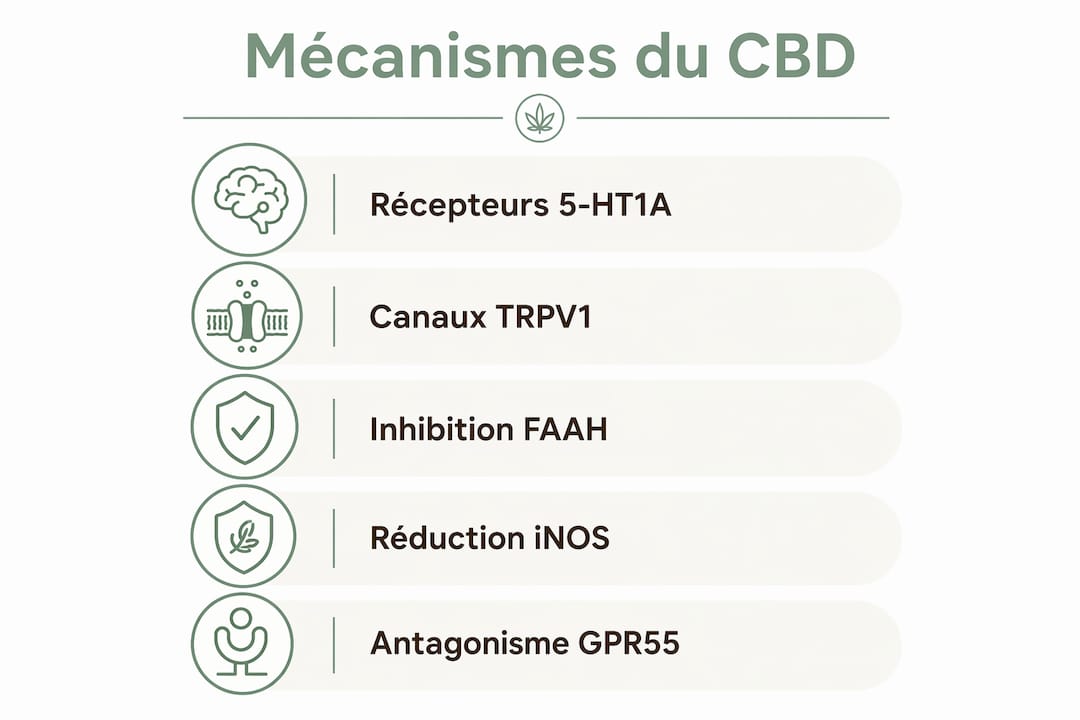
CBD acts on migraine through multiple simultaneous neurobiological targets, which sets it apart from classic analgesics. Specifically, it modulates 5-HT1A receptors to regulate serotonin, blocks TRPV1 channels to reduce nociception, inhibits FAAH enzyme to increase endogenous anandamide, and decreases the expression of inflammatory mediators like CGRP and iNOS. This multi-target action profile explains why research is interested in it, even though clinical evidence is still being consolidated.
Key points to remember right away:
- 5-HT1A receptors: CBD stimulates these serotonin receptors, helping to reduce attack frequency
- TRPV1 channels: by blocking them, CBD decreases CGRP release and slows the trigeminal inflammatory cascade
- FAAH enzyme: its inhibition by CBD increases anandamide, a naturally analgesic endocannabinoid
- CGRP and iNOS: two key mediators of migraine inflammation whose expression is reduced by CBD
- Cerebral anti-inflammatory effect: CBD acts on the trigeminovascular system rather than as a simple painkiller
- Tolerance: side effects are generally mild, which supports long-term use
What is migraine? Origins and biological mechanisms
Migraine is not just a simple headache. It is a complex neurological disorder characterized by recurrent attacks of intense pain, often unilateral and pulsating, lasting from a few hours to several days. It affects a significant proportion of the global population, with a clear female predominance.
At the heart of the migraine mechanism is the trigeminovascular system: nerve fibers from the trigeminal ganglion innervate the meningeal vessels and release pro-inflammatory neuropeptides during an attack. The most studied of these is CGRP (Calcitonin Gene-Related Peptide), which causes vasodilation of the cranial arteries and sustains neurogenic inflammation. At the same time, serotonin plays a central role: a drop in its plasma level often precedes the onset of an attack, while triptans, the standard treatment, act precisely on serotonin receptors to counteract this.
Typical symptoms and most frequent triggering factors:
- Pulsating pain, often unilateral, of moderate to severe intensity
- Nausea, vomiting, photophobia, and phonophobia
- Visual or sensory aura in about 30% of cases
- Triggering factors: stress, hormonal variations, lack of sleep, certain foods (aged cheeses, alcohol), weather changes
- Cortical hyperexcitability as an underlying neurological condition
What is CBD? Properties and available forms
Cannabidiol (CBD) is one of the main active compounds of hemp (Cannabis sativa), but it produces no psychoactive effects. Unlike THC (tetrahydrocannabinol), it does not directly bind to CB1 receptors in the brain to cause euphoria or altered consciousness. It is precisely this property that opens the way for therapeutic uses without the legal constraints and side effects associated with psychoactive cannabis.
CBD interacts with the endocannabinoid system, a network of receptors (CB1, CB2) and signaling molecules present throughout the body, involved in regulating pain, mood, sleep, and inflammation. To learn more about this system, the endocannabinoid system and pain is detailed on the Cbd-certified blog. But CBD goes beyond just the CB1 and CB2 receptors: it also acts on receptors like TRPV1, GPR55, and PPARγ, which explains its particularly broad pharmacological profile.
Available forms, with their practical specificities:
- Sublingual oil: rapid absorption (15–45 minutes), precise dosage, the most used form for daily use
- Capsules and pills: convenient, fixed dosage, but longer onset time (1–2 hours)
- Flowers and pre-rolled joints: almost immediate effect by inhalation, but less recommended for people sensitive to respiratory pathways
- Topicals (balms, creams): local action, useful for cervical muscle tension associated with migraines
- Infusions: lower bioavailability, but appreciated for their ritualistic and relaxing aspect
To choose between oil and flowers based on your profile, the CBD forms guide from CBD-Certified.com offers a practical comparison.
How exactly does CBD act on migraine?
This is where biochemistry becomes truly interesting. CBD does not target a single mechanism: it modulates several neurobiological pathways simultaneously, giving it potential effects on different phases of a migraine attack.

Action on 5-HT1A receptors and serotonin
CBD binds to 5-HT1A receptors, serotonin receptors involved in pain and mood regulation. By partially activating them, it modulates serotonin release, helping to stabilize the neurochemical fluctuations that precede and accompany attacks. This mechanism is similar in principle to that of triptans, although CBD acts less specifically and less strongly on this receptor.
Blocking TRPV1 channels and reducing CGRP
TRPV1 channels (capsaicin receptors) play a central role in trigeminal nociception. When activated on dural nerve fibers, they trigger the release of CGRP, initiating the inflammatory cascade characteristic of migraine. CBD is an antagonist of TRPV1 channels: by desensitizing them, it reduces CGRP release and slows the resulting vasodilation and inflammation.
FAAH inhibition and increased anandamide
The FAAH enzyme (fatty acid amide hydrolase) breaks down anandamide, the main endogenous endocannabinoid. By inhibiting this enzyme, CBD increases anandamide levels in the brain, thereby enhancing natural pain regulation. Anandamide acts on CB1 receptors to produce analgesic and anti-inflammatory effects without the psychoactive effects of THC.
Reduction of iNOS and neurogenic inflammation
An animal study showed that CBD reduces the expression of CGRP and pro-inflammatory cytokines in brain structures involved in migraine, including iNOS. Less iNOS means less nitric oxide produced, resulting in reduced vasodilation and less intense pain.
GPR55 receptor antagonism
CBD also acts as a GPR55 receptor antagonist, a receptor highly expressed in the brain. By blocking this receptor, CBD promotes an increase in inhibitory neuronal activity, which could help reduce the hyperexcitability characteristic of the migraine brain.
Modulation of the meningeal immune system
CBD can also influence immune cells in the meninges that express CB1 and CB2 receptors, thus regulating neurogenic inflammation at its source. This immunomodulatory action completes the picture of a compound acting on multiple fronts simultaneously.
Summary of key mechanisms: CBD modulates migraine pain by blocking TRPV1 channels, modulating 5-HT1A receptors, and inhibiting FAAH to increase anandamide, while reducing inflammatory mediators like CGRP and iNOS. Its action on the trigeminovascular system is more brain anti-inflammatory than direct analgesic.
What does scientific research say about CBD and migraine?
The state of knowledge in 2026 is promising but still incomplete. Preclinical studies, especially on animal models, confirm that CBD mainly acts on the trigeminovascular system by modulating neuronal excitability and inflammation, with a brain anti-inflammatory action profile rather than a simple painkiller effect. These results are consistent with the biochemical mechanisms described above.
From the patients’ side, the feedback is insightful. According to La Voix des Migraineux, a leading French association for migraine sufferers, patients mainly notice a decrease in the frequency of attacks in the long term with CBD, while the immediate pain-relieving effect remains more limited. In other words, CBD does not replace a triptan during an acute attack but can help reduce recurrence over several weeks.
“The beneficial effect of CBD often lies in the regularity and duration of the treatment, requiring several weeks or even months to observe a noticeable reduction in attacks.” Source: data from studies on the chronic effects of CBD in migraine.
The question of CBD alone versus combined THC-CBD preparations is central in the medical literature. Recommendations from the Swiss Society of Cephalology indicate that combined THC-CBD preparations are preferred in medical practice for migraine, with CBD alone having limited clinical evidence but good tolerance. European experts agree on this point: pure CBD works better as a complement than as a standalone treatment.
How to use CBD for migraine: dosage and administration routes
The lack of a standardized protocol is one of the practical challenges of CBD in migraine. No universal dose exists, as the response varies according to weight, individual sensitivity, the form used, and the severity of attacks. The golden rule remains progressive titration.
Recommended step-by-step approach:
- Start with a low dose, around 5 to 10 mg per intake, one to three times a day
- Maintain this dose for 7 to 10 days before evaluating effects
- Increase gradually by 5 mg if results are insufficient, without exceeding doses recommended by a healthcare professional
- Keep a migraine diary to objectively track the frequency, intensity, and duration of attacks before and during CBD use
Administration routes according to the goal:
- Sublingual (oil): preferred route for daily preventive use, absorption in 15–45 minutes
- Oral (capsules): convenient for fixed dosage, but with a longer onset time
- Inhalation (flowers): reserved for acute attacks requiring rapid effect, with precautions related to the respiratory route
- Topical (balm): useful for relieving associated cervical and cranial tension, without systemic effect
For a structured approach to pain management with CBD, Cbd-certified offers a practical guide detailing dosage adjustment steps.
Potential side effects are generally mild: dry mouth, slight drowsiness, or transient digestive issues. CBD has excellent tolerance in the context of migraines, making it a reasonable candidate for prolonged use under medical supervision.
Pro Tip: Note in your diary not only the frequency of attacks but also their duration and intensity on a scale of 1 to 10. Without this tracking, it is very difficult to distinguish a real effect of CBD from natural remission, especially since migraine shows strong spontaneous variability.
Does CBD interact with your antimigraine treatments?
The issue of drug interactions is serious and often underestimated. CBD is metabolized by cytochrome P450 enzymes, notably CYP3A4 and CYP2C19. These same enzymes metabolize many drugs commonly used in migraine. By inhibiting them, CBD can alter the plasma concentrations of these treatments, either increasing or decreasing them.

Interactions with cytochrome P450 notably concern triptans, certain antidepressants (used in migraine prevention), antiepileptics, and beta-blockers. A useful analogy: grapefruit inhibits the same CYP3A4 enzymes. If your doctor has already advised against grapefruit with a medication, CBD deserves the same caution.
Pro Tip: Before combining CBD with a baseline antimigraine treatment (topiramate, amitriptyline, propranolol), be sure to consult your neurologist or primary care physician. Self-medication without medical advice in this context exposes you to unpredictable variations in efficacy or tolerance.
What are the current limitations of studies on CBD in migraine?
Let's be clear: clinical research on CBD specifically for migraine remains limited in 2026. Preclinical studies on animal models are solid and consistent, but randomized controlled clinical trials in humans are still few and often small in size. This imbalance between promising preclinical data and insufficient clinical evidence is the main obstacle to official recommendations in France.
Specialists point out several methodological gaps: study durations too short, heterogeneous populations, lack of standardization of tested CBD products, and difficulty controlling the placebo effect in a condition as variable as migraine. European recommendations, notably those of the Swiss Society of Cephalology, emphasize the need for cautious titration and rigorous clinical monitoring.
Key precautions and recommendations to remember:
- Do not substitute CBD for baseline treatments prescribed by a neurologist
- Always inform your doctor of any CBD use, especially in cases of polypharmacy
- Avoid CBD during pregnancy and breastfeeding due to insufficient safety data
- Prefer products whose composition is certified and traceable (verified CBD and THC levels)
- Accept that the effect, if any, will take several weeks to manifest
- Do not increase doses abruptly in the absence of rapid results
Pure CBD or therapeutic cannabis: what are the differences for migraine?
Confusion between CBD and therapeutic cannabis is common and has real practical consequences. The following table summarizes the essential differences.
| Criterion | Pure CBD | Therapeutic cannabis (including THC) |
|---|---|---|
| Psychoactive effect | None | Yes (depending on THC content) |
| Legal status in France | Legal | Authorized only within the framework of national experimentation |
| Effect on acute pain | Limited | More pronounced, notably via CB1 |
| Anti-inflammatory action | Yes, via TRPV1, FAAH, iNOS | Yes, enhanced by the THC-CBD synergistic effect |
| Side effects | Mild (drowsiness, dry mouth) | More frequent (anxiety, tachycardia, possible dependence) |
| Recommended use in migraine | Preventive supplement | Combined preparations under medical supervision |
| Long-term tolerance | Good | Variable depending on THC content |
Pure CBD is not a direct substitute for triptans in an acute attack. Its potential lies more in prevention and reducing the frequency of attacks over the long term. Combined THC-CBD preparations, on the other hand, show a more comprehensive effect on acute pain, but their use in France remains regulated under the early access program for medical cannabis, reserved for specific indications and by prescription.
What European experts say about CBD’s mechanisms in migraine
European neurologists and specialized centers agree on several points. CBD does act on the trigeminovascular system, but its effect is more modulatory than curative. The modulation of 5-HT1A receptors, inhibition of FAAH, and blocking of TRPV1 are the best-documented mechanisms and most consistent with known migraine pathophysiology.
“CBD primarily acts on the trigeminovascular system by modulating neuronal excitability and inflammation, with a cerebral anti-inflammatory effect rather than a simple analgesic effect.” Source: data from the characterization of cannabidiol’s biochemical and behavioral effects in migraine.
One point experts regularly emphasize: CBD interacts with receptors far beyond just CB1 and CB2, notably GPR55, TRPV1, and PPARγ. This multi-receptor action complicates understanding the mechanisms but also explains why CBD can act on multiple aspects of migraine simultaneously, from inflammation to nociception and vascular regulation. To explore how CBD affects the nervous system, Cbd-certified’s resources offer accessible additional reading.
In European clinical practice, the current consensus recommends considering CBD as a complementary tool, integrated into a comprehensive migraine management plan, not as a first-line treatment. Medical practice in Europe favors combined THC-CBD preparations with personalized dosage adjustments, with pure CBD used as a supplement and never as a sole treatment.
Pro Tip: If you want to include CBD in your migraine management, discuss your approach with your neurologist using a detailed diary. A healthcare professional can help distinguish a real effect from natural disease variability and adjust your preventive treatment accordingly.
Discover Cbd-certified’s CBD Products

Want to explore CBD as part of your migraine management? Cbd-certified offers a selection of certified CBD products, rigorously tested with verified CBD and THC levels to ensure quality and legal compliance. Deliveries available in France, the European Union, the United Kingdom, and Switzerland.
Key Points
CBD acts on migraine through several complementary neurobiological mechanisms, including FAAH inhibition, TRPV1 blockade, and modulation of 5-HT1A receptors, with a primarily preventive rather than immediate analgesic effect.
| Point | Details |
|---|---|
| Main Mechanism | CBD inhibits FAAH, increasing endogenous anandamide to reduce migraine pain and inflammation. |
| Multiple Targets | TRPV1, 5-HT1A, GPR55, and iNOS are all modulated by CBD, explaining its action on multiple phases of the migraine attack. |
| Primarily a Preventive Effect | Patients mainly notice a reduction in the frequency of attacks over the long term, not immediate relief. |
| Drug Interactions | CBD inhibits the enzymes CYP3A4 and CYP2C19, which can alter the effectiveness of triptans and other preventive treatments. |
| Complementary Use | European experts recommend CBD as a supplement, never as a substitute for prescribed antimigraine treatments. |