
Practical CBD Pain Management Guide 2026: Full Process
Chronic pain affects millions of Europeans seeking natural alternatives to conventional medications. CBD emerges as a scientifically validated, non-psychoactive, and legally accessible solution throughout the European Union. This guide presents a step-by-step process to integrate CBD into your daily pain management, based on the latest research from 2025 and 2026.
Table of contents
- CBD mechanisms of action for pain management
- Prerequisites before starting CBD use
- Starting and gradually dosing CBD
- Choosing suitable products and administration methods
- Monitoring, adjustments, and common mistakes
- Evaluation of results and realistic expectations
- Discover our certified CBD solutions for your pain management
- Frequently Asked Questions
Key points to remember
| Point | Details |
|---|---|
| Validated mechanism | CBD works through specific receptors without psychoactive effects, with recent clinical studies confirming its effectiveness on chronic pain. |
| Gradual dosing | Start with 5 to 10 mg daily and increase slowly every 7 days according to your tolerance and needs. |
| Certified products | Choose only CBD tested by third-party labs, suitable for the type of pain you want to treat. |
| Careful monitoring | Keep a journal to record doses, effects, and pain progression to optimize your personal protocol. |
| Patience required | Evaluate results after 4 to 6 weeks of regular use before adjusting your approach. |
Introduction to CBD and natural pain management
Chronic pain is a major public health challenge in Europe, affecting the quality of life of millions of people. Faced with the limitations and side effects of conventional treatments, many Europeans turn to natural solutions.
CBD is gaining increasing popularity for managing pain, anxiety, and insomnia thanks to its favorable safety profile. Unlike THC, which remains banned in most European countries, CBD is legal and completely free of psychoactive effects. It does not alter consciousness or cognitive abilities.
Cannabidiol mainly works through the endocannabinoid system, a biological network that naturally regulates pain, mood, and inflammation. The scientific foundations supporting its use grow stronger each year with new clinical publications.
Here are the essential points to understand before starting:
- CBD is a plant compound extracted from European industrial hemp
- It interacts with several cellular receptors involved in pain transmission
- Its legal status in Europe requires a THC content below 0.3%
- Pharmaceutical-grade products are now available with certification
CBD mechanisms of action for pain management
Understanding how CBD acts biologically helps better grasp its therapeutic potential. Research from 2025 revealed precise mechanisms explaining its effectiveness against chronic and neuropathic pain.
A major discovery from Yale University shows that cannabidiol reduces Nav1.8 activity, a key protein in transmitting pain signals at sensory neurons. This specific inhibition explains why CBD is particularly effective in relieving neuropathic pain that often resists conventional analgesics.
CBD also interacts with several other biological targets:
- TRPV1 receptors involved in the perception of pain and inflammation
- 5HT1A receptors that modulate anxiety often associated with chronic pain
- CB1 receptors of the endocannabinoid system without directly activating them like THC
- Anti-inflammatory pathways that reduce tissue inflammation causing pain
Pro tip: CBD produces scientifically validated analgesic and anti-inflammatory effects without causing dependence or psychoactive effects. This fundamental difference from THC explains why it is legal and suitable for prolonged daily use.
Recent clinical studies confirm these mechanisms and demonstrate measurable effectiveness on various forms of chronic pain. This solid scientific foundation justifies its integration into natural pain management protocols.
Prerequisites before starting CBD use
Careful preparation ensures a safe and optimal experience with CBD. Several essential steps precede the actual start of treatment.
The selection of CBD products certified and tested by third-party laboratories is the top priority. These analyses verify the exact concentration of cannabinoids, the absence of contaminants, and compliance with European standards. Absolutely avoid products without certification or from questionable sources.
Then identify your specific type of pain:
- Neuropathic pain (diabetes, shingles, sciatica)
- Inflammatory pain (arthritis, tendinitis)
- Muscle pain (fibromyalgia, tension)
- Mixed pain combining several mechanisms
Familiarize yourself with the different available formulations. Sublingual oils offer systemic absorption, creams target specific areas, while sprays allow easy dosing. Each form has advantages depending on your situation.
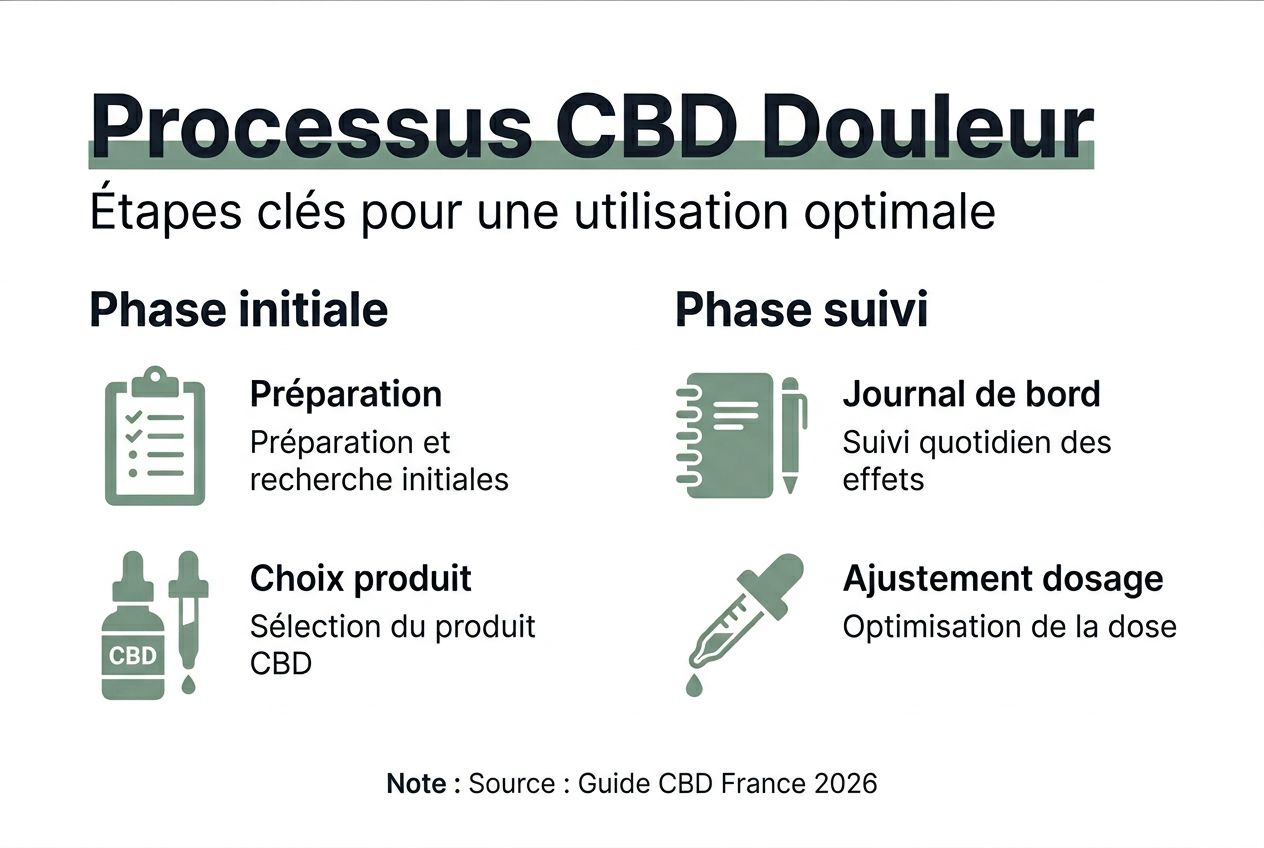
Prepare a rigorous tracking system, ideally a paper notebook or a mobile app. You will record daily the dose taken, time of intake, pain intensity on a scale of 1 to 10, and any observed side effects.
Pro tip: Consult a healthcare professional before starting if you take regular medications, are pregnant or breastfeeding, or have liver conditions. CBD can interact with certain treatments and then requires medical supervision.
This preparatory phase, although sometimes seen as tedious, largely determines the success of your approach and minimizes the risk of costly mistakes.
Gradual start and dosing of CBD
The gradual CBD start-up protocol follows a fundamental principle: start low and increase slowly. This methodical approach maximizes effectiveness while minimizing side effects.
Low-THC CBD products moderately improve pain according to 29 clinical trials, without serious adverse effects. This evidence of efficacy and safety justifies adopting a structured protocol.
Follow these steps in order:
- Start with a daily dose of 5 to 10 mg of CBD, preferably in the morning after breakfast to observe daytime effects.
- Maintain this initial dose for a full 7 days, noting your observations daily in your logbook.
- If no relief appears and no side effects occur, increase by an additional 5 mg.
- Repeat this cycle of 7 days of observation followed by gradual increases until satisfactory relief is achieved.
- Once the optimal dose is identified, maintain it for at least 4 weeks before making any new adjustments.
- Carefully monitor mild side effects like drowsiness or nausea, which often indicate a relative overdose.
- Adjust the timing of intake according to your needs: some prefer taking it in the evening to improve sleep disrupted by pain.
Patience is key during this phase. Maximum benefits usually appear after 4 to 6 weeks of regular use, allowing your endocannabinoid system to balance.
Choosing suitable products and administration methods
Each form of CBD has distinct characteristics that make it more or less suitable depending on the type of pain to relieve. Understanding these differences helps optimize your protocol.
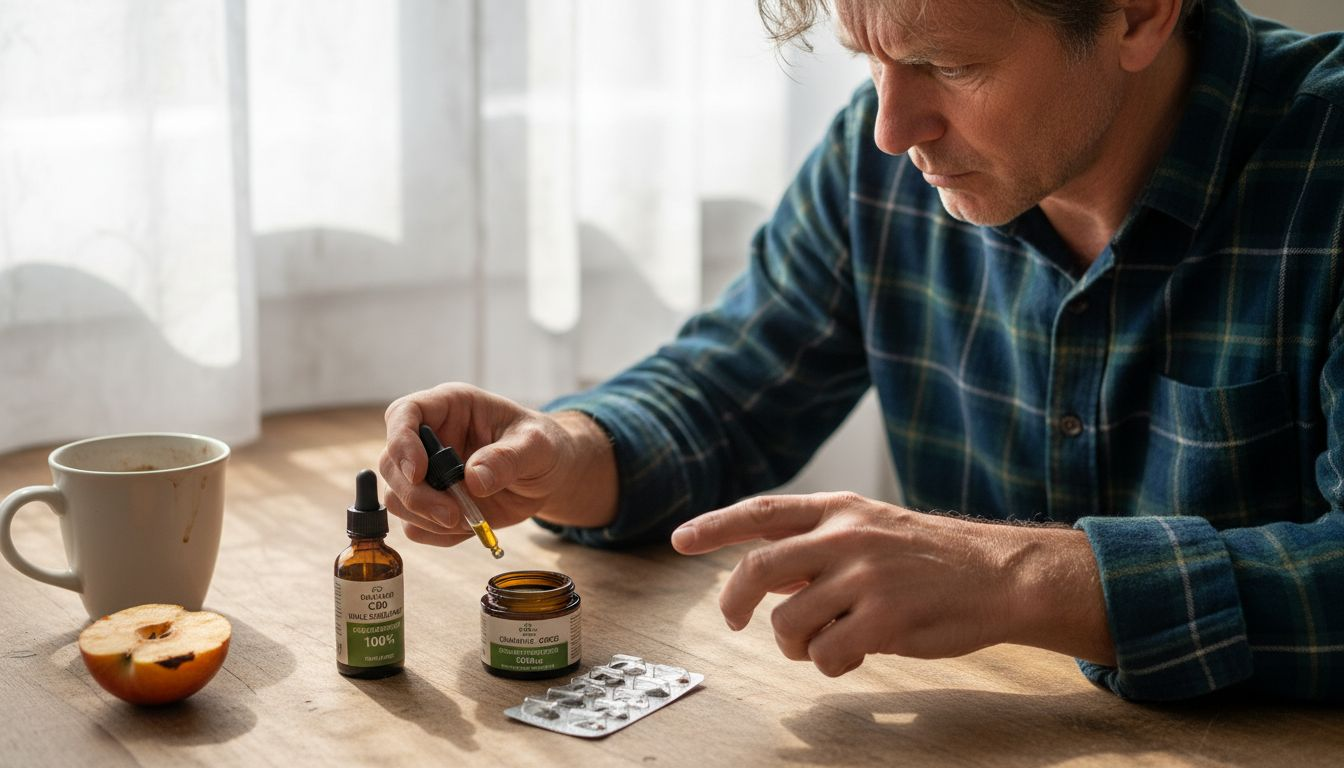
Sublingual oils offer ideal systemic action for diffuse neuropathic pain or fibromyalgia. Placed under the tongue, they pass directly through the oral mucosa and reach the bloodstream within 15 to 30 minutes.
Topical creams and balms effectively target localized joint or muscle pain. Applied directly to the painful area, they act locally without significant blood passage, reducing potential drug interactions.
A recent innovation deserves attention: CBD nanoformulations improve bioavailability and provide rapid relief without side effects. These nano-micelles increase CBD absorption, allowing lower doses for equivalent effectiveness.
| Product type | Bioavailability | Onset time | Duration of effect | Suitable for |
|---|---|---|---|---|
| Sublingual oil | 20 to 30% | 15 to 30 min | 4 to 6 hours | Diffuse, neuropathic pain |
| Topical cream | 5 to 10% topical | 30 to 60 min | 3 to 5 hours | Localized joint and muscle pain |
| Nanoformulation | 40 to 60% | 10 to 20 min | 6 to 8 hours | Need for rapid and prolonged relief |
| Full spectrum | Variable | By form | By form | Entourage effect sought |
| CBD isolate | Variable | By form | By form | Sensitivity to other cannabinoids |
Always prioritize certified European products that comply with the legal THC limit below 0.3%. This compliance guarantees no psychoactive effect and the product's legality throughout the European Union.
Monitoring, adjustments, and common mistakes
The rigorous monitoring with a logbook remains vital to adjust doses and ensure the protocol's success. This discipline distinguishes satisfied users from those who give up prematurely.
Several mistakes frequently compromise results and deserve special attention.
Increasing doses too quickly is the most common mistake. Some users double or triple the dose after a few days without improvement, causing excessive drowsiness or nausea. Strictly follow the weekly increase rate of 5 mg.
Using non-certified products exposes you to real health risks: inaccurate CBD concentration, presence of THC beyond legal limits, contamination by pesticides or heavy metals. These dubious products explain many reported failures and adverse effects.
Here are the pitfalls to absolutely avoid:
- Abandoning the protocol after 2 weeks without visible results
- Neglecting the logbook, which alone allows identification of effective patterns
- Combining multiple CBD products simultaneously without supervision, making individual evaluation impossible
- Expecting immediate complete relief comparable to opioids
- Ignoring possible interactions with anticoagulant or sedative medications
Pro tip: If you notice persistent side effects beyond 48 hours, disabling daytime drowsiness, or no improvement at all after 6 weeks at the optimal dose, consult a professional trained in CBD. Adjusting the pharmaceutical form or protocol may unlock the situation.
Diligence in tracking your pain management turns a random attempt into a personalized scientific protocol. This discipline makes all the difference between success and failure.
Evaluation of results and realistic expectations
Setting measurable criteria allows for an objective evaluation of CBD’s effectiveness on your pain. Unrealistic expectations are the main cause of premature discontinuation.
Clinical studies show a pain reduction between 40% and 65%, accompanied by improved sleep and anxiety. These figures represent averages across large populations; your personal experience may vary.
Wait 4 to 6 weeks of regular use before making a final judgment on effectiveness. This period allows the endocannabinoid system to adapt and for cumulative effects to fully manifest. Benefits appear gradually, rarely overnight.
| Evaluation criteria | Expected improvement | Observation period |
|---|---|---|
| Pain intensity | Reduction of 40 to 65% on a 1-10 scale | 4 to 6 weeks |
| Sleep quality | Easier falling asleep, fewer night awakenings | 2 to 4 weeks |
| Anxiety level | Reduction of anxiety symptoms related to pain | 3 to 5 weeks |
| Functional mobility | Improvement in daily activities | 4 to 8 weeks |
| Side effects | Mild drowsiness, occasional nausea | Mainly first week |
The secondary benefits deserve attention: mood improvement, reduction of fatigue related to chronic pain, better tolerance to physical exercise. These qualitative gains significantly contribute to overall quality of life.
CBD is not a miracle solution that replaces all treatments. It ideally fits into a multimodal approach combining adapted physical activity, stress management, anti-inflammatory diet, and appropriate medical follow-up.
A supervised use following a progressive protocol with regular monitoring maximizes the chances of satisfactory results in 2026. This methodological rigor distinguishes a serious approach from a mere risky experiment.
Discover our certified CBD solutions for your pain management
You now have a complete protocol to integrate CBD into your daily pain management. The next step is to obtain certified products that meet European quality standards.
We list exclusively certified shops recognized for their reliability in Europe, guaranteeing products tested by third-party laboratories. Whether you are looking for oils for neuropathic pain or creams for painful joints, these stores offer the full range adapted to your specific needs.
Discover our carefully selected trusted CBD shops: the best CBD shops in Eindhoven for the Netherlands, the best CBD shops in London for the United Kingdom, or the best CBD shops in Edinburgh for Scotland. These establishments offer personalized support to tailor your protocol to your unique situation.
Frequently Asked Questions
What are the possible side effects of CBD?
The side effects of CBD are generally mild and temporary: daytime drowsiness, occasional nausea, dry mouth, or mild digestive issues. These symptoms mostly appear at the start of treatment or with too rapid dose increases. They usually disappear within a few days without needing to stop treatment. Absolutely avoid use during pregnancy or breastfeeding as a precaution, since safety data remain insufficient for these populations.
How long does it take to feel the effects of CBD on pain?
Subtle initial effects can appear within 2 to 3 weeks, but a full assessment requires 4 to 6 weeks of regular use at an optimal dose. This patience is due to CBD’s mechanism of action, which gradually modulates the endocannabinoid system rather than abruptly blocking pain like traditional analgesics. Maintain the protocol without interruption during this observation period before concluding inefficacy. Maximum benefits often develop between the 4th and 8th week.
Which types of CBD products are best suited depending on the pain?
Sublingual oils are ideal for widespread neuropathic pain such as fibromyalgia or diabetic neuropathies due to their systemic action. Topical creams and balms effectively target localized joint pain, osteoarthritis, or tendinitis by acting directly on the affected area. Recent nanoformulations offer superior bioavailability for fast and prolonged relief, especially useful during acute painful flare-ups. Combining a daily oil with a supplementary cream on critical areas often optimizes results.
Does CBD have a psychoactive effect like THC?
CBD is completely free of psychoactive or euphoric effects, unlike THC. It works through entirely different biological mechanisms, not activating the CB1 receptors responsible for cannabis’s psychotropic effects. You retain all your cognitive abilities, alertness, and mental clarity. This fundamental difference explains why CBD is legal in the European Union with a strict THC limit below 0.3%, ensuring no consciousness-altering effects.