
Indica or sativa: what is the difference for CBD?
In short:
- Indica and sativa varieties differ in their terpene profiles and their effects, relaxing or stimulating.
- CBD is non-psychoactive and does not cause intoxication, unlike THC.
Indica promotes relaxation and sleep, sativa stimulates energy and mental clarity. This is the essential distinction to remember when exploring the indica sativa CBD difference. These two major cannabis families differ in their morphology, terpene profile, and the effects they produce, which concretely guides the choice according to your current needs.
In practice, here is how the two varieties position themselves:
- Indica: relaxing, sedative effects, promoting sleep and muscle relaxation. Ideal in the evening or after a busy day.
- Sativa: stimulating, energizing effects, conducive to concentration and creativity. More suited for daytime use.
- Key terpenes: myrcene dominates in indica (relaxant, sedative), while limonene characterizes sativa (energizing, anti-stress).
- CBD vs THC: CBD, present in both varieties, is not psychoactive. THC is.
- Personal choice: stress and anxiety lean towards indica; need for concentration or creativity, towards sativa.
Pro tip: Always start with a small dose, regardless of the variety chosen. Reactions to CBD vary from person to person, and observing how you feel over a few days remains the best way to find what suits you.
1. What are the botanical differences between indica and sativa?
Geographical origins explain a lot. Indica comes from the mountainous regions of Central Asia, such as the Himalayas or Hindu Kush, where seasons are short and temperatures cool. Sativa, on the other hand, developed under the tropical climates of Central America, equatorial Africa, and Southeast Asia.
This environmental adaptation is directly visible on the plant. Indica is stocky, with broad leaves and dense flowers, and rarely grows taller than one and a half meters. Sativa can reach a significant height, with thin leaves and airy flowers. Its flowering cycle is also longer than that of indica, which is characterized by a shorter flowering time.
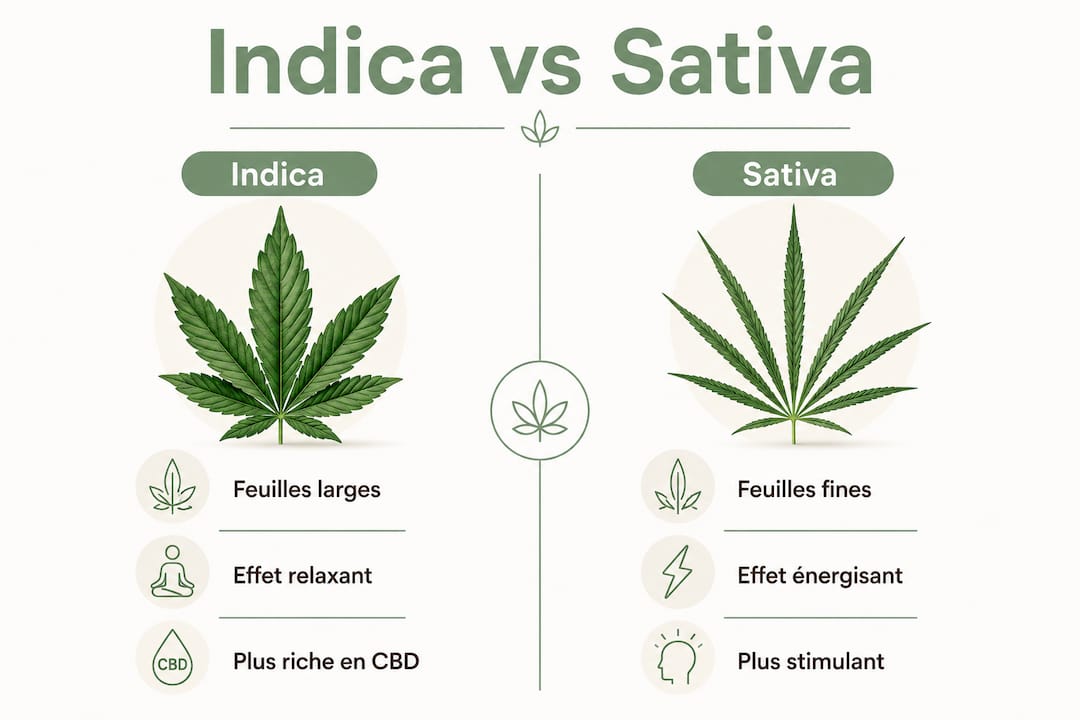
Chemically, terpenes play a central role in the effects experienced:
| Terpene | Properties | Associated variety |
|---|---|---|
| Myrcene | Relaxant, sedative | Indica |
| Linalool | Soothing, calming | Indica |
| Limonene | Energizing, anti-stress | Sativa |
| Pinene | Concentration, liveliness | Sativa |
The relative concentration of CBD also varies according to strains: indicas tend to have a higher CBD content relative to THC, which enhances their calming profile. Sativas often have a higher THC/CBD ratio, although CBD-dominant strains exist in both families. To learn more about these distinctions, the sativa vs indica guide from Cbd-certified details the key points in 2026.
2. CBD and THC: why CBD does not cause intoxication
Both CBD and THC are present in cannabis, but their effects on the brain are radically different. THC strongly binds to CB1 receptors in the brain, producing the well-known psychoactive effect. CBD, on the other hand, has a very low affinity for these same receptors, which explains why it does not cause euphoria or altered perception.
However, CBD is not pharmacologically inert. It acts on several brain receptors: serotonin (5HT1A), dopamine D2, GABA, and TRP channels. Through these pathways, it can induce mild sedation or drowsiness and produces its documented anticonvulsant effects. The National Academy of Medicine and INRS recognize that CBD does not present addictive or psychoactive effects comparable to THC.
Documented therapeutic effects of CBD include:
- Antiepileptic: the only medical indication approved by a marketing authorization in France (Epidyolex®).
- Moderate anxiolytic: observational data suggest a calming effect, without robust clinical evidence for all forms of anxiety.
- Anti-inflammatory: anti-inflammatory properties have been identified, notably through CB2 receptors of the immune system.
- Mild sedative: drowsiness is a documented side effect, useful for sleep but to be monitored when driving.
CBD reduces seizures in certain rare forms of epilepsy, without intoxicating effects, according to studies on pure cannabidiol.
3. What is the legal and medical framework for CBD in France?
In France, CBD-based products are legal as long as their THC content does not exceed 0.3%. This limit, set by the decree of December 30, 2021, applies to Cannabis sativa L. varieties listed in the official European catalog. The sale of raw flowers and leaves, once prohibited, was reinstated by the Council of State in December 2022.
Medically, only one CBD-based medication has marketing authorization in France: Epidyolex®, prescribed in combination with clobazam to treat certain rare epilepsies (Lennox-Gastaut syndrome, Dravet syndrome) in patients aged 2 years and older. Any other therapeutic claims remain, to date, speculative according to the Interministerial Mission for the Fight Against Drugs and Addictive Behaviors.
The Geneva University Hospitals (HUG) provide a nuanced perspective on the common use of CBD. Professor Barbara Broers, head of the HUG Addiction Unit, emphasizes that CBD has "calming, even antipsychotic properties, as well as anti-inflammatory, antiepileptic, and antispasmodic effects," while reminding that its effectiveness remains limited and variable depending on the individual. For chronic pain in particular, multidisciplinary care is often still necessary.
Regarding CBD oils, a recent measure requires their denaturation to limit oral consumption, with the oil reserved for external use. Cannabinoids prescribed by doctors contain a significant concentration of CBD and a THC content below the legal threshold.
4. What precautions should be taken with CBD and medications?
CBD can interact with certain medications by blocking their elimination from the body. Professor Marie Besson, a pain treatment specialist at the HUG, clearly states: CBD "has the property of blocking the elimination of other medications such as certain antidepressants, which are frequently prescribed." The National Agency for the Safety of Medicines (ANSM) has also warned about these interactions, especially for drugs with a narrow therapeutic margin.
Essential precautions to know:
- Prior medical consultation: essential if you are on chronic treatment, especially antidepressants, anticoagulants, or antiepileptics.
- Driving: sedation induced by CBD can impair reflexes; the INRS recommends not driving until the personal effect is well assessed.
- Vaping: burning CBD can generate pyrolysis products, including THC, with potential health consequences.
- Flowers smoked with tobacco: nicotine addiction develops if CBD flowers are consumed with tobacco, reminds Pre Broers.
Pro tip: If you are new to CBD, start with a low dose and gradually increase according to how you feel. This is the method recommended by the HUG to adjust dosage empirically and safely.
5. What side effects occur depending on indica or sativa variety?
CBD side effects do not depend solely on the botanical variety, but the terpene profile of each family influences the overall experience. With a myrcene-rich indica, drowsiness and muscle relaxation are the most common side effects, especially at high doses. A limonene-dominant sativa can, on the other hand, cause slight agitation or racing thoughts in sensitive individuals.
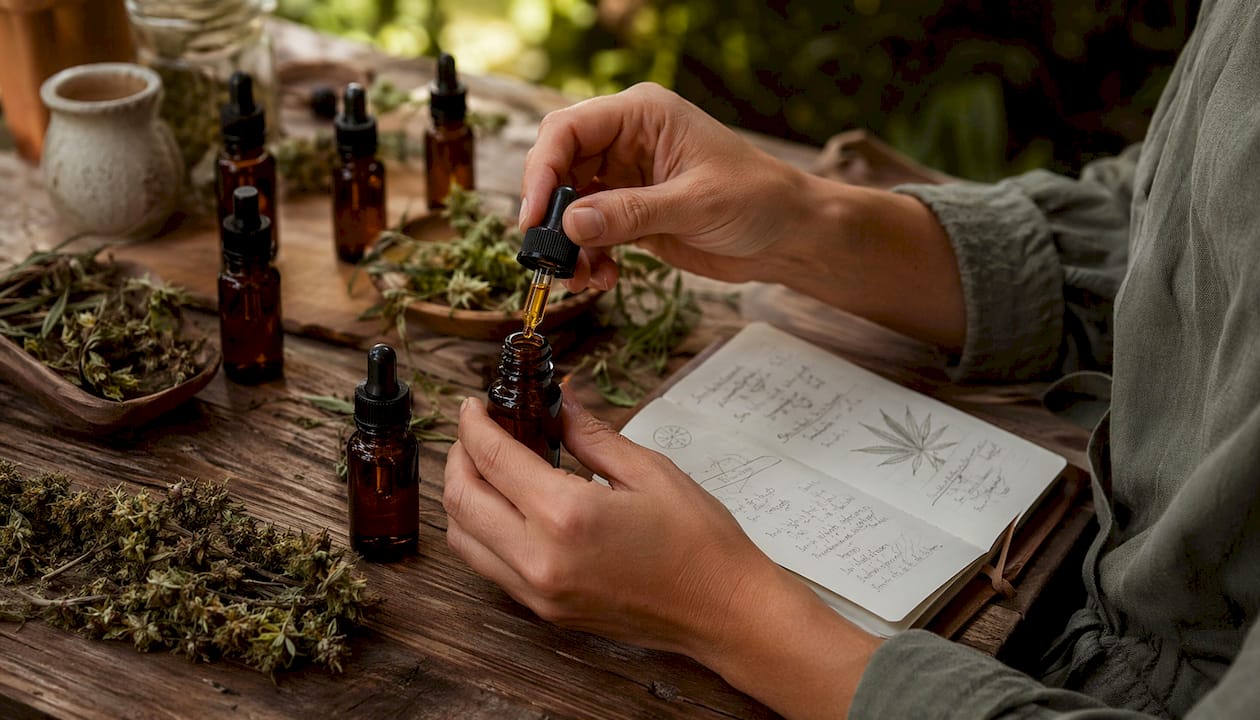
Common side effects for both varieties include dry mouth, a slight drop in blood pressure, and, in some cases, digestive issues with oral consumption. The INRS notes that drowsiness-type effects seem less pronounced in people who regularly consume CBD, suggesting a form of gradual adaptation. To choose your CBD flowers and resins considering these parameters, practical guides are available.
6. How does CBD extraction influence the final composition?
The extraction method determines which cannabis compounds end up in the final product and in what proportions. Supercritical CO₂ extraction is now the standard: it preserves terpenes and cannabinoids without solvent residues, allowing the distinctive aromatic profile of an indica or sativa to be maintained. An indica flower extracted by this method will retain more of its relaxing myrcene than an ethanol extraction, which tends to homogenize profiles.
Ethanol extraction, more accessible and less costly, remains common for mainstream CBD oils. It effectively extracts CBD but can also capture chlorophyll and plant waxes that alter taste and sometimes digestive tolerance. Full-spectrum extracts, whether from indica or sativa, retain all the cannabinoids and terpenes of the original plant, enhancing what researchers call the entourage effect: the synergy between molecules often matters more than simple botanical classification.
Where to find quality CBD products in Europe?
Cbd-certified selects flowers, oils, and pre-rolls from controlled indica and sativa varieties, with THC levels below 0.3% to comply with European regulations. Deliveries are available throughout the European Union, the United Kingdom, and Switzerland. To discover the full range and place an order, visit the best CBD shops in Europe page or explore the 25 g CBD flower pack to test several varieties.
Key points
Indica and sativa varieties differ in their terpene profiles and effects, while CBD remains non-psychoactive in both cases and only has validated medical indications in France for certain rare epilepsies.
| Point | Details |
|---|---|
| Indica vs sativa | Indica promotes relaxation and sleep; sativa stimulates energy and concentration. |
| Role of terpenes | Myrcene (indica) is sedative; limonene (sativa) is energizing and anti-stress. |
| Non-psychoactive CBD | CBD induces neither euphoria nor dependence, unlike THC. |
| Legal framework in France | CBD is legal if the THC level does not exceed 0.3%; only Epidyolex® has medical marketing authorization. |
| Drug interactions | CBD can block the elimination of certain medications; medical consultation is required before combined use. |