
Differences between CBD oils: choosing one for pain or anxiety
The European CBD market offers three distinct types of oils: full spectrum, broad spectrum, and isolate. Each formulation has a unique composition of cannabinoids and terpenes, directly influencing its effectiveness against chronic pain, insomnia, or anxiety. European consumers often get lost in these technical distinctions, sometimes choosing an oil that is unsuitable for their symptoms. This guide clarifies the fundamental differences between these oils and helps you identify the one that precisely matches your therapeutic needs.
Table of contents
- Overview of key points
- The main types of CBD oils and their compositions
- Extraction methods and their impact on oil quality
- What effects does it have on pain, anxiety, and insomnia?
- How to choose your CBD oil according to your specific needs
- Discover our selection of certified CBD oils
- What are the main differences between CBD oils?
Overview of key points
| Point | Details |
|---|---|
| Full spectrum | Contains all cannabinoids, terpenes, and traces of THC <0.3% for a maximal entourage effect |
| Broad spectrum | Offers cannabinoids and terpenes without THC, ideal for avoiding any trace of psychoactive substances |
| CBD isolate | Provides 99% pure CBD without other compounds, preferred for absolute purity |
| Pain effectiveness | Full spectrum shows 20 to 25% improvement compared with 10 to 15% for isolate according to meta-analyses |
| Choice according to symptoms | Full spectrum for pain and insomnia, broad spectrum for anxiety, isolate for sensitivity to compounds |
The main types of CBD oils and their compositions
CBD oils differ by their spectrum: full spectrum contains all cannabinoids with traces of THC below 0.3%, broad spectrum removes THC while retaining the other compounds, and isolate provides CBD that is more than 99% pure. This classification is based on the final molecular composition after extraction and purification. The presence or absence of THC and terpenes determines not only the product's legality in Europe, but also its therapeutic profile.
European legislation imposes a strict THC limit of a maximum of 0.3% for marketed CBD products. This regulation ensures that full-spectrum oils remain non-psychoactive while benefiting from the entourage effect. Broad-spectrum oils undergo additional purification to completely remove THC, meeting the needs of consumers concerned about drug tests or wishing to avoid any trace of a controlled substance.
| Oil type | THC present | Cannabinoids | Terpenes | CBD purity |
|---|---|---|---|---|
| Full spectrum | <0.3% | All (CBG, CBN, CBC) | Yes | 60-80% |
| Broad spectrum | 0% | Multiple | Yes | 70-85% |
| Isolate | 0% | CBD only | No | >99% |
The effective CBD types vary according to the desired molecular synergy. Here are the key differentiators:
- Full spectrum preserves the entire hemp phytochemical profile, including flavonoids and fatty acids
- Broad spectrum maintains cannabinoid diversity without the risk of THC detection
- Isolate guarantees CBD administration without any other plant compounds
- The color ranges from dark gold for full spectrum to transparent for isolate
- The herbal taste characterizes full and broad spectrum, while isolate remains neutral
Pro tip: Always check the certificate of analysis from a third-party laboratory, which states the exact spectrum and THC level. Certified products display this information transparently on the label.
Extraction methods and their impact on oil quality
Extraction methods determine the final composition: full and broad spectrum use supercritical CO2 or ethanol extraction to preserve the compounds, while isolate requires additional purification through crystallization. Supercritical CO2 extraction operates at low temperatures, protecting volatile terpenes and heat-sensitive cannabinoids. This costly technique produces premium-quality oils with a complete profile.
Ethanol extraction offers a cost-effective alternative while maintaining good retention of active compounds. The solvent effectively dissolves cannabinoids and terpenes, then evaporates completely during purification. Responsible manufacturers conduct residual testing to ensure the absence of solvent traces in the final product. This method is particularly suitable for large-scale production of full and broad spectrum oils.

Crystallization transforms the crude extract into pure isolate. The process involves multiple cycles of dissolution, filtration, and recrystallization to remove all non-CBD compounds. Each cycle increases purity until reaching 99% or more crystalline cannabidiol. This extreme purification sacrifices the entourage effect but guarantees a predictable and standardized composition.
The impact on compound retention varies considerably:
- CO2 extraction preserves 85 to 95% of the original hemp terpenes
- Ethanol extraction retains 70 to 85% of minor cannabinoids
- Crystallization intentionally eliminates 100% of non-CBD compounds
- Extraction temperature directly influences the degradation of sensitive molecules
- Process duration affects oxidation and final quality
Pro tip: Favor brands that clearly indicate their extraction method on the packaging. Supercritical CO2 extraction represents the quality standard for full- and broad-spectrum oils intended for the practical CBD pain management guide.
What effects does it have on pain, anxiety, and insomnia?
Scientific data reveal that full spectrum improves pain by 20 to 25% compared with 10 to 15% for the isolate, thanks to the entourage effect amplifying analgesia. This molecular synergy multiplies CBD’s effectiveness when it interacts with other cannabinoids and terpenes. The CB1 and CB2 endocannabinoid receptors respond differently to full-spectrum formulations compared with isolated CBD.
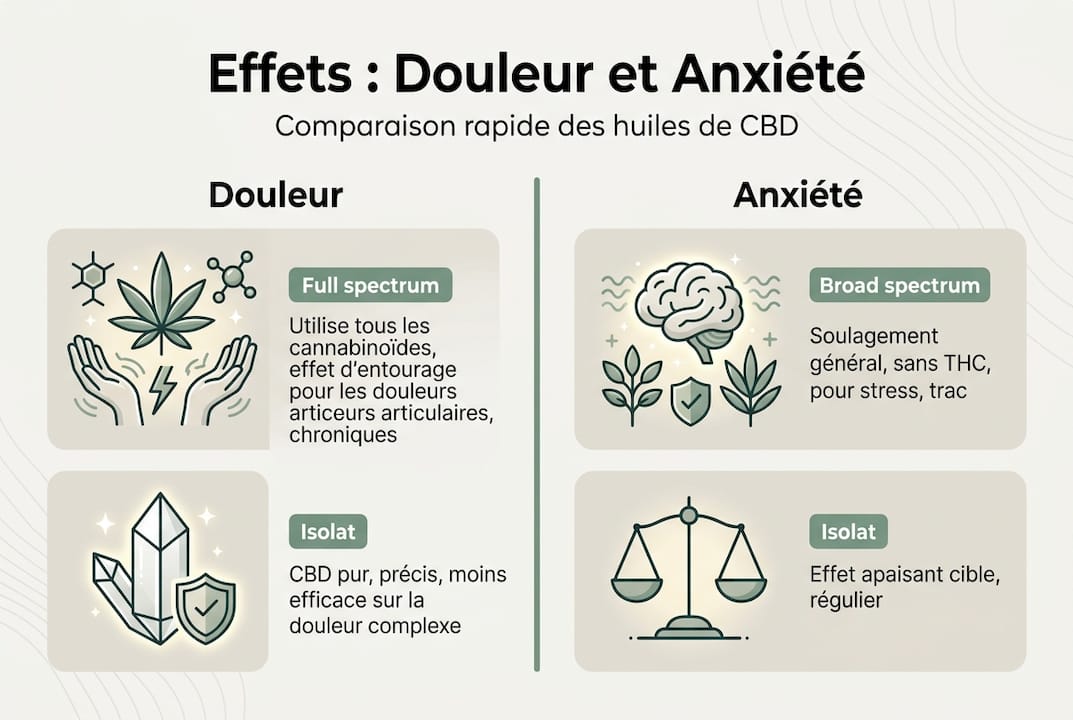
The entourage effect explains why full spectrum offers maximum benefits for pain and insomnia, while broad spectrum remains preferred for anxiety without THC. Myrcene and linalool, terpenes found in full-spectrum products, enhance the sedative properties of CBD. This natural combination creates a more robust therapeutic profile than cannabidiol alone.
For anxiety, broad spectrum offers a significant psychological advantage. Consumers who are sensitive to the effects of THC or subject to professional drug testing choose this option without compromising effectiveness. Clinical studies show comparable anxiety reductions between full and broad spectrum, with dosage and regularity of administration being the determining factors.
Meta-analyses from 2018 to 2023 show that full-spectrum formulations produce a 15-point greater reduction in neuropathic pain on the visual analog scale compared with isolates at equivalent doses.
| Condition | Full spectrum | Broad spectrum | Isolate |
|---|---|---|---|
| Chronic pain | High effectiveness 20-25% | Moderate effectiveness 15-18% | Low effectiveness 10-15% |
| Anxiety | Very effective | Very effective | Moderately effective |
| Insomnia | Optimal with a sedative effect | Good but less powerful | Varies according to sensitivity |
| Inflammation | Superior thanks to CBG/CBC | Good with cannabinoids | Limited to CBD alone |
Practical considerations for choosing include:
- Individual sensitivity to minor cannabinoids and terpenes
- Need to completely avoid THC for professional or personal reasons
- Severity of symptoms requiring the maximum entourage effect
- Tolerance for the pronounced herbal taste of full-spectrum products
- Available budget, as full spectrum generally costs 20 to 30% more
Pro tip: For pain relieved by CBD, start with full spectrum administered sublingually. If anxiety is your priority, try broad spectrum to benefit from the synergy without THC. Isolate is suitable for people who have already tried full-spectrum products without success or who are sensitive to terpenes. Research on CBD and anxiety: scientific evidence confirms the effectiveness of all three types at appropriate doses.
How to choose your CBD oil according to your specific needs
The optimal selection starts by identifying your primary symptom. Full spectrum is suitable for pain and insomnia, broad spectrum for anxiety without THC, and isolate for absolute purity. This prioritization simplifies the decision when faced with the multitude of products available on the European market.
Here is the structured approach to choosing:
- Rate the intensity of your symptoms on a scale of 1 to 10
- Determine whether you absolutely need to avoid THC for professional or personal reasons
- Check the products’ certificates of analysis to verify their exact composition
- Start with a moderate concentration of 10 to 15% CBD
- Test for 2 to 3 weeks before adjusting the dosage or type of oil
- Document your results in a journal to identify effectiveness patterns
The dosage varies according to body weight, symptom severity, and the type of oil. A person weighing 70 kg with moderate pain generally starts with 20 to 25 mg of CBD per day in two doses. Full-spectrum oils sometimes require slightly lower doses thanks to the entourage effect, while isolate may require 30 to 40% more CBD to achieve comparable results.
Product purity can be verified through several indicators:
- Certificate of analysis from an independent laboratory accredited to ISO 17025
- Absence of heavy metals, pesticides, and residual solvents
- CBD content matching the labeling exactly, with a maximum margin of 10%
- Transparency regarding the origin of the hemp and agricultural practices
- Presence of the batch number enabling complete traceability
The benefits of hemp CBD in 2026 include strict regulation guaranteeing the quality of products marketed in Europe. Systematically check these elements before purchasing to avoid underdosed or contaminated formulations.
For CBD dosage for insomnia and anxiety, adopt the progressive method:
- Week 1: 10 mg morning and evening to assess tolerance
- Week 2: Increase to 15 mg if there are no adverse effects
- Week 3: Adjust up to 25 mg according to the symptomatic response
- Maintenance: Keep the minimum effective dose to limit costs
- Reassessment: Every 2 months to optimize the protocol
Pro tip: Take your CBD oil 30 minutes before meals for optimal absorption. Sublingual administration, holding the oil under your tongue for 60 to 90 seconds, maximizes bioavailability. Store your bottle away from light and heat to preserve the integrity of the cannabinoids and terpenes for 12 to 18 months.
Discover our selection of certified CBD oils
You now understand the fundamental differences between full spectrum, broad spectrum, and isolate. European CBD Shop offers a certified range precisely suited to the needs identified in this guide. Each product has transparent certificates of analysis and complies with the strictest European standards.
Our selection includes full spectrum oils for managing chronic pain and sleep disorders, as well as broad spectrum formulations that are ideal for anxiety without traces of THC. The best CBD shops in Europe guarantee complete traceability from hemp cultivation through delivery. Explore our Stilla full spectrum CBD oil to benefit from the maximum entourage effect, or our HexaPure broad spectrum CBD oil for a THC-free formulation. Delivery is available throughout the EU, the United Kingdom, and Switzerland.
What are the main differences between CBD oils?
What is the difference between full spectrum, broad spectrum, and isolate?
Full spectrum contains all the cannabinoids in hemp, including traces of THC below 0.3%, creating the entourage effect. Broad spectrum completely removes THC while retaining the other cannabinoids and terpenes. Isolate provides 99% pure CBD without any other plant compounds. The choice depends on your tolerance for THC and the molecular synergy sought for your specific symptoms.
Is THC legal in CBD oils in Europe?
European regulations allow a maximum of 0.3% THC in CBD products sold commercially. This concentration remains non-psychoactive and legal in all EU countries. Full spectrum oils that comply with this limit are fully compliant. Consumers wishing to avoid THC completely can choose broad spectrum or isolate, which guarantee 0% tetrahydrocannabinol.
What is the entourage effect, and why is it important?
The entourage effect refers to the synergy between cannabinoids, terpenes, and flavonoids, which amplify one another’s therapeutic properties. This molecular interaction explains why full spectrum shows 20 to 25% greater effectiveness than isolate for chronic pain. Terpenes such as myrcene enhance sedative effects, while limonene strengthens CBD’s anxiolytic action.
How should I use my CBD oil correctly?
Administer the oil sublingually by placing the drops under your tongue and holding them there for 60 to 90 seconds before swallowing. This method maximizes absorption through the oral mucous membranes. Start with 10 to 15 mg of CBD twice a day, then gradually adjust according to your results. Take your dose 30 minutes before meals for optimal bioavailability. Consult our guide to effective types of CBD for more information.
Which CBD oil is best suited for relieving chronic pain?
Full spectrum is the optimal choice for chronic pain thanks to the entourage effect, which maximizes analgesia. Studies show an improvement of 20 to 25% compared with 10 to 15% for isolate at equivalent doses. The synergy between CBD, CBG, CBC, and anti-inflammatory terpenes such as beta-caryophyllene amplifies the analgesic properties. Choose a concentration of 15 to 20% for moderate to severe pain.
The minor cannabinoids present in full spectrum target different pain receptors simultaneously. This multimodal action explains its therapeutic superiority over isolated formulations. For pain relieved by CBD, favor regular administration morning and evening rather than occasional use.
Which CBD oil should you choose to reduce anxiety without the risk of THC?
Broad spectrum is the ideal choice for anxiety, completely avoiding THC while retaining the entourage effect. This THC-free formulation is perfectly suited to people subject to professional drug tests or sensitive to psychoactive effects. Anxiolytic terpenes such as linalool and limonene remain present to enhance CBD’s action.
Its effectiveness for anxiety remains comparable to full spectrum according to clinical studies, with regular administration being the determining factor. Start with 15 to 20 mg of CBD twice a day to observe significant results after 2 to 3 weeks. Research on CBD and scientific evidence for anxiety confirms the effectiveness of broad-spectrum formulations.
How do you choose the best CBD oil for insomnia?
Full spectrum offers the best results for insomnia thanks to the combined sedative properties of CBD, CBN, and terpenes such as myrcene. Take your dose 60 to 90 minutes before bedtime to synchronize peak absorption with your sleep time. A concentration of 20 to 25% produces more pronounced effects for severe disorders.
Dosage for insomnia often requires a gradual approach. Start with 25 mg in the evening and increase in 5 mg increments until you achieve easier sleep onset and restorative sleep. Consult our guide on CBD dosage for insomnia to customize your protocol according to your weight and the severity of your sleep problems.