
Meditation and CBD: 2026 guide to anxiety and pain
You experience persistent anxiety, disrupted sleep, or chronic pain that affects your daily life. You are looking for effective natural solutions without relying solely on medication. Combining meditation and CBD is attracting growing interest as a holistic way to manage these issues. This guide explains how to integrate these two complementary approaches, their scientifically documented benefits, and the essential precautions for optimizing your well-being. You will discover a practical protocol, expert advice, and clear answers to help you get started with confidence.
Table of Contents
- Preparing Your Experience: Understanding Meditation and CBD
- How to Integrate Meditation and CBD: Key Steps in the Process
- Optimizing and personalizing your practice: tips and mistakes to avoid
- Expectations and results: what can you really expect?
- Discover Our CBD Products to Complement Your Meditation
- Frequently Asked Questions About Meditation and CBD
Key Points
| Point | Details |
|---|---|
| Scientifically Validated Meditation | Mindfulness meditation significantly reduces chronic pain intensity according to several clinical studies. |
| CBD with Variable Effects | CBD alone shows mixed results for pain and anxiety but may be more helpful for sleep and situational anxiety. |
| Promising Combination | Combining meditation and CBD offers promising potential but requires medical caution and personalization. |
| Starting Gradually | Start with a low CBD dosage and practice meditation regularly to assess your individual responses. |
| Recommended Comprehensive Approach | A holistic approach incorporating a healthy lifestyle, medical monitoring, and regular practices maximizes the benefits. |
Preparing Your Experience: Understanding Meditation and CBD
Before combining these two approaches, understanding their respective effects allows you to create an effective personalized strategy. Mindfulness meditation has strong evidence for relieving chronic pain. A meta-analysis of randomized controlled trials demonstrates that mindfulness meditation reduces chronic pain intensity with a significant standardized mean difference. This practice changes the perception of pain by training the brain to observe sensations without judgment, creating psychological distance that reduces suffering.
CBD has a different profile. Clinical studies on cannabidiol show mixed results, particularly for pain and anxiety. Some people report moderate relief, while others notice no significant change. CBD acts on the endocannabinoid system, which regulates inflammation, mood, and sleep. For neuropathic and inflammatory pain, results vary considerably from person to person.
The areas where CBD shows greater consistency involve sleep and situational anxiety. Several users report improved sleep quality and reduced occasional stress. For mental health, including anxiety and sleep disorders, CBD may provide complementary support alongside conventional approaches. The potential synergy between meditation and CBD lies in their distinct but converging mechanisms of action.
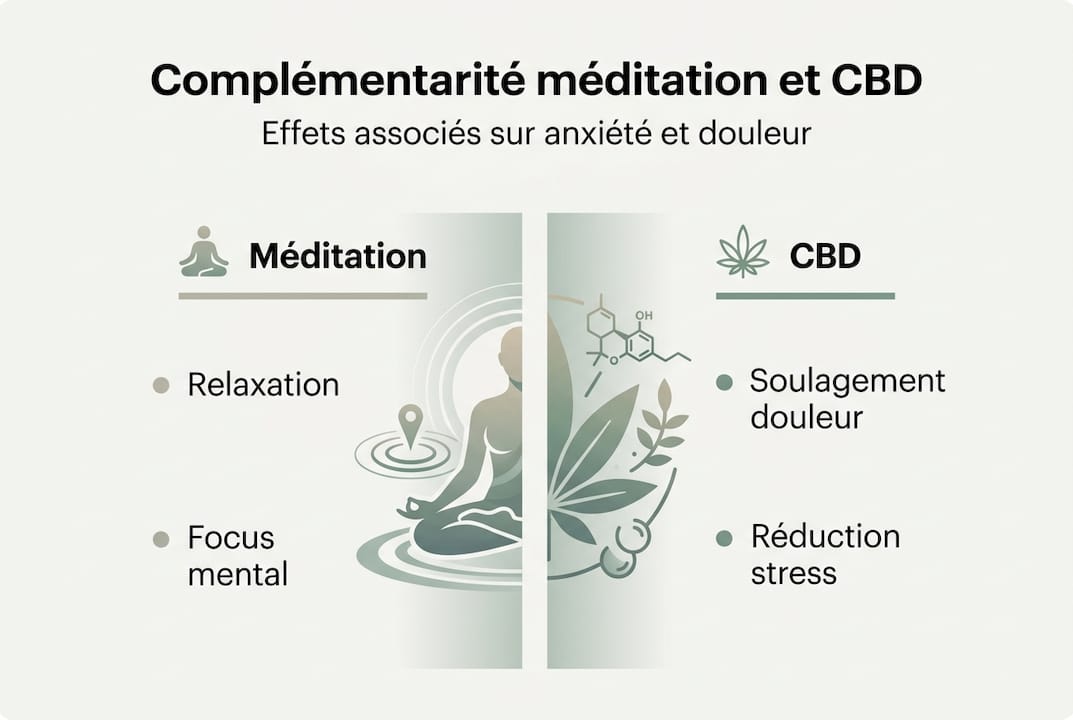
Meditation acts directly on perception and emotional regulation, while CBD influences the physiological systems involved in the stress and inflammation response.
This theoretical complementarity still needs to be validated by further specific research. Essential precautions include mandatory medical consultation if you take medication, as CBD interacts with certain treatments. Avoid CBD if you are pregnant or breastfeeding. Always start with low doses to assess your personal tolerance.
Pro tip: Keep a detailed journal during the first few weeks to record your CBD doses, meditation durations, and perceived changes in your anxiety, sleep, and pain.
How to integrate meditation and CBD: key steps in the process
Here is a simple six-step protocol for combining meditation and CBD safely and gradually. This structured approach helps you identify what works for your unique situation.
-
Consult a healthcare professional before starting, especially if you take medication or have pre-existing medical conditions. This step ensures that CBD does not interfere with your current treatments.
-
Start with meditation alone for one to two weeks to establish a stable routine. Practice for 10 to 15 minutes daily, preferably at the same time. This foundation makes it possible to distinguish the effects of CBD later.
-
Introduce CBD at a low dose by starting with 5 to 10 mg per day. Take CBD 30 to 60 minutes before your meditation session to allow time for absorption. This timing optimizes the potential synergy.
-
Adjust gradually your dosage by increasing it by 5 mg every three to four days if necessary. Carefully observe your reactions. To add CBD to your daily routine, patience remains crucial for finding your optimal dose.
-
Establish a regular routine by meditating daily, ideally morning and evening. Consistency amplifies the neurological benefits of meditation. Some people prefer to use CBD only in the evening to promote sleep.
-
Evaluate and adapt after four weeks of combined practice. Analyze your journal to identify patterns. If you notice no improvement, consult a professional again to adjust your approach.
Pro tip: The optimal time to take CBD varies according to your goals. For daytime anxiety, take CBD in the morning before meditation. For insomnia, take it in the evening 60 to 90 minutes before bedtime.
The CBD dosage for insomnia and anxiety requires personalization based on your weight, metabolism, and individual sensitivity. No universal formula exists. Listen to your body and adjust according to your responses. On some days, you may feel the need to meditate longer or adjust your CBD dose. This flexibility is an integral part of a sustainable practice.

Optimizing and personalizing your practice: tips and mistakes to avoid
Maximizing the benefits of this combination requires avoiding common pitfalls and refining your personal approach. Here are the frequent mistakes that compromise results.
- Starting with too high a CBD dose can sometimes cause excessive drowsiness or digestive side effects that interfere with meditative concentration.
- Neglecting meditation consistency drastically reduces its neurological effectiveness. The benefits accumulate with consistent practice.
- Expecting immediate results leads to frustration and premature abandonment. Meditation-induced neuroplasticity requires several weeks.
- Ignoring CBD drug interactions exposes you to serious risks, particularly with anticoagulants and certain antidepressants.
- Choosing poor-quality CBD products compromises effectiveness and safety. Always favor certified sources with third-party analyses.
Adapting the duration and frequency of your sessions optimizes results according to your constraints. Beginners should start with 10 minutes daily, then gradually increase to 20 or 30 minutes. Two short daily sessions often outperform one long weekly session. Quality of presence matters more than sheer duration.
| Type of meditation | Main focus | Expected effects | Recommended duration |
|---|---|---|---|
| Mindfulness | Neutral observation of sensations | Reduced pain perception, mental calm | 15-30 min |
| Guided | Guided visualizations | Deep relaxation, anxiety management | 10-20 min |
| Breathing | Controlled breathing techniques | Calmer nervous system, better sleep | 5-15 min |
| Body scan | Systematic body scan | Body awareness, tension release | 20-40 min |
Pro tip: Keep a practice journal detailing the date, time, CBD dose, type and duration of meditation, and anxiety/pain level before and after on a scale of 1 to 10. This self-assessment reveals patterns that would otherwise remain invisible.
Managing pain with CBD requires realism and patience. Individual variability remains high according to empirical data. Meditation alone produces validated effects, while combinations with CBD still require personalized evaluation. Allow at least four to six weeks to observe significant changes. Some people report subtle improvements as early as the second week, while others need two to three months of consistent practice.
Expectations and results: what can you really expect?
Clarifying the scientifically observed benefits allows you to set realistic goals and avoid disappointment. Meditation has robust clinical evidence for reducing chronic pain, improving emotional regulation, and decreasing generalized anxiety. Neurological mechanisms include changes in activity in the brain regions that process pain and emotions. These changes become measurable after eight weeks of regular practice.
CBD alone presents a more nuanced profile. For pain, results remain mixed, with highly individual responses. For sleep and situational anxiety, more users report moderate improvements. CBD acts on the endocannabinoid system, which regulates homeostasis, inflammation, and stress responses. This physiological action complements meditation’s psychological effects.
Meditation has been proven effective for chronic pain. CBD alone shows mixed results. Their combination appears promising but requires caution and personalized monitoring.
This summary of research on anxiety and sleep highlights the importance of a measured approach. Psycho-emotional benefits include better management of daily stress, increased resilience in the face of challenges, and an improvement in overall quality of life. These qualitative changes matter just as much as quantitative measures of pain reduction.
The essential warnings concern prolonged CBD use without medical supervision. Some studies suggest possible tolerance over time, requiring increasing doses. Combining it with THC significantly changes the effects and remains inadvisable without strict medical supervision. CBD never replaces a prescribed treatment for serious conditions.
Feel free to personalize your meditation and CBD combination according to your unique responses. Some people find that meditation alone is enough after a few months, using CBD only during periods of intense stress. Others maintain both practices indefinitely for ongoing support. Your journey remains entirely personal and evolving.
The recommended holistic approach also incorporates sleep hygiene, regular physical activity, a balanced diet, and social support. Meditation and CBD work best as components of an overall lifestyle that promotes well-being, not as isolated miracle solutions. This realistic perspective encourages lasting and satisfying results.
Discover our CBD products to support your meditation
You now have the knowledge to begin your combined practice safely. Our shop offers certified, laboratory-tested CBD products specially selected to support your natural well-being. Explore our range of premium CBD oils formulated to promote relaxation and serenity during your meditation sessions.
We are recognized among the best CBD shops in Europe thanks to our commitment to quality, transparency, and customer satisfaction. Every product includes comprehensive third-party analyses guaranteeing purity and cannabinoid concentration. Our deliveries and returns cover the European Union, the United Kingdom, and Switzerland with fast delivery times and responsive customer service. Begin your journey toward natural well-being with reliable products and expert guidance.
Frequently asked questions about interactions between meditation and CBD
What immediate effects can I expect when combining meditation and CBD?
Immediate effects vary considerably between individuals. Some people feel increased relaxation and better meditative concentration from the first sessions. Others need several weeks of regular practice before noticing significant changes in their anxiety or sleep quality. Patience remains essential.
Can CBD replace medication for anxiety?
No, CBD should never replace a prescribed treatment without strict medical supervision. It may serve as a supplement under medical advice for certain forms of mild to moderate anxiety. Any change to anti-anxiety treatment requires gradual professional support to avoid withdrawal symptoms or relapse. Always discuss it with your doctor before incorporating CBD.
How do I choose the best CBD dose to accompany meditation?
Start with 5 to 10 mg daily and gradually increase in 5 mg increments every three to four days. Carefully observe your physical and emotional reactions. The optimal dose varies according to your weight, metabolism, and specific goals. Some people find their balance at 15 mg, while others need 30 mg or more. Self-assessment guided by a practice journal makes this discovery easier.
Which types of meditation are best for relieving chronic pain?
Mindfulness meditation and body scanning show the most promising results for chronic pain. These techniques involve neutrally observing painful sensations without an amplifying emotional reaction. Guided meditation focused on progressive muscle relaxation can also help. Try different approaches to identify the one that resonates best with your personal experience of pain.
Are there any risks associated with combining CBD and meditation?
Meditation alone presents very few risks for most people. CBD carries risks of drug interactions and mild side effects such as drowsiness or digestive problems. Combining them does not increase these risks if you follow the recommended dosages and consult a healthcare professional. Avoid CBD if you are pregnant, breastfeeding, or taking certain medications without prior medical advice.