
CBD COA Tracker: A Practical Guide for Consumers 2026
TL;DR:
- The certificate of analysis (COA) is essential for verifying the compliance and safety of CBD products, particularly by examining the cannabinoid profile and total THC. Accurately interpreting THC requires calculating total THC by incorporating THCA and complying with the European regulatory threshold of 0.3%. Verifying the laboratory’s accreditation, matching the batch, and prioritizing recent COAs ensure informed and compliant consumption.
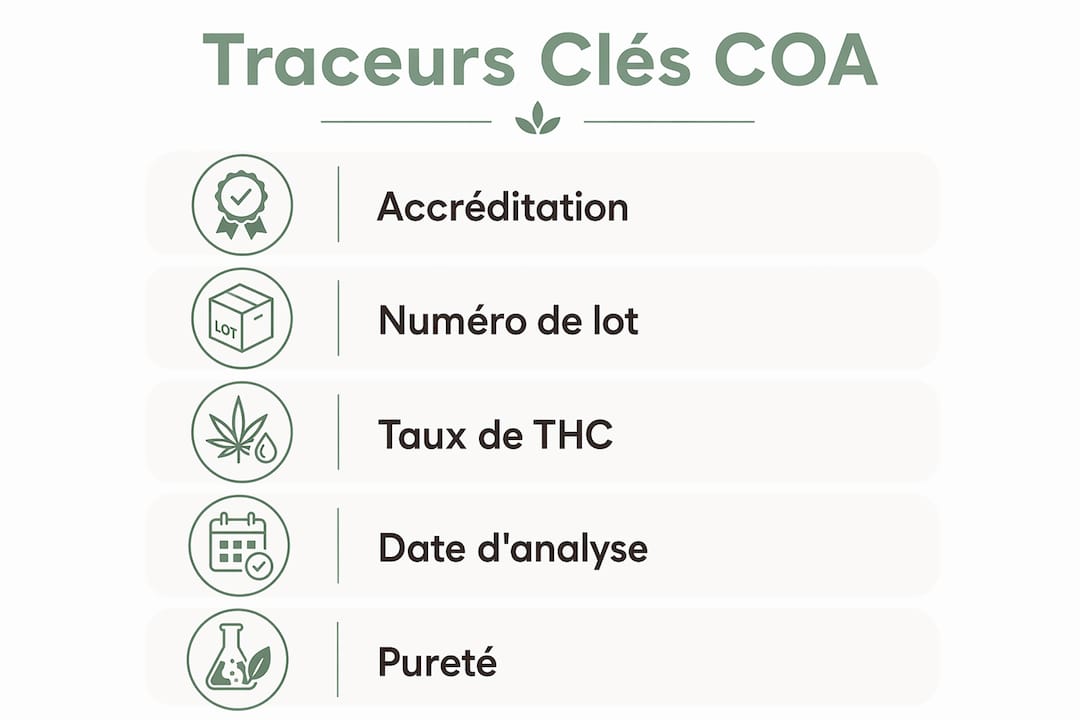
The certificate of analysis (COA) is an official analytical report that reveals the exact composition and safety of a CBD product. This document, issued by an accredited independent laboratory, is the only verifiable proof that a product complies with legal standards and poses no health risks. For any European consumer seeking to use CBD for pain, insomnia, or anxiety, understanding CBD COA markers is an essential skill. A reliable COA must include the product’s complete identification, batch number, analysis date, and the laboratory’s accreditation according to the ISO/IEC 17025 or COFRAC standard.
What are the key markers to know in a CBD COA?
Understanding COA markers begins with the cannabinoid profile. Every credible COA details the concentrations of CBD, delta-9 THC, THCA, CBG, and CBN. These values help assess both the product’s potential effectiveness and its legal compliance.
The essential markers to examine on any CBD COA are as follows:
- Cannabinoid profile: concentrations of CBD, delta-9 THC, THCA, CBG, and CBN expressed as a percentage or in mg/g.
- Total THC: value calculated according to the regulatory formula (delta-9 THC + THCA × 0.877), essential for assessing compliance with the legal threshold.
- Pesticides: the presence or absence of pesticide residues, with regulatory limit values.
- Heavy metals: lead, cadmium, mercury, and arsenic, whose concentrations must remain below the permitted limits.
- Mycotoxins and residual solvents: traces of mold or extraction solvents that may pose a real health risk.
- Batch number: unique identifier linking the physical product to its specific COA. Without batch-to-COA traceability, compliance cannot be guaranteed.
The presence of COFRAC or ISO/IEC 17025 accreditation on the document indicates that the laboratory meets strict analytical quality requirements. A COA produced by a non-accredited laboratory has no legal or scientific value.
Pro tip: Always check that the COA matches the batch number shown on your packaging. A generic COA without a matching batch number guarantees nothing about the product in your hands.
How to interpret the THC content on a CBD COA?
Reading THC is the most technical and most frequently misunderstood step in understanding the markers on a COA. Many consumers look only at free delta-9 THC, which can lead to a serious evaluation error.
Here are the four steps for correctly reading the THC content on a COA:
- Identify free delta-9 THC: this is the raw value of the psychoactive THC present in the unheated product.
- Identify THCA: THCA is the non-psychoactive precursor to THC. It converts into THC when heated through decarboxylation, with a conversion coefficient of 0.877.
- Calculate total THC: apply the formula total THC = delta-9 THC + (THCA × 0.877). This is the value that determines legal compliance.
- Compare with the European threshold: European regulations impose a maximum of 0.3% total THC in the finished product.
A product displaying 0.2% delta-9 THC may appear compliant. But if its THCA reaches 0.15%, the calculated total THC exceeds 0.33%, placing it outside the legal limits in Europe. Ignoring THCA often leads to non-compliant purchases.
Analytical tolerances add an extra layer of caution. Accredited laboratories work with margins of error of ±10 to 20%, meaning that a product measured at 0.28% total THC could actually reach 0.34% depending on the measurement conditions. For a safer purchase, choose products whose measured total THC remains well below 0.3%, ideally below 0.2%. Also consult the legal CBD guide in France to understand the current regulatory nuances.
What therapeutic benefits does CBD actually offer?
CBD interacts with several biological systems, including serotonin, GABA-A, opioid, vanilloid, and dopamine receptors. This multidimensional pharmacology explains why the observed effects vary depending on the individual and the conditions being treated.
The scientific data available in 2026 present a nuanced picture:
- Sleep: the signals of efficacy are the strongest. A recent meta-analysis indicates a measurable effect on sleep duration, with an SMD of approximately 0.54, representing a moderate but documented benefit. This is the indication for which the scientific evidence is most consistent to date.
- Anxiety: the results are mixed. No significant effect is documented in the consolidated data, which calls for a critical reading of marketing claims. Positive studies exist, but their methodological quality varies greatly.
- Pain: the data remain heterogeneous. Some uses, particularly for neuropathic or inflammatory pain, show promising results, but no strong clinical consensus has been established for the general population.
To explore these uses in detail, the effects of CBD on pain and sleep are documented using the latest available data. Dosage and regularity of use influence the results, and possible side effects (drowsiness, digestive problems) should be monitored from the outset.
What are the regulatory issues surrounding CBD foods in Europe?
The European legal framework for foods containing CBD is strict and often misunderstood by consumers. Regulation (EU) 2015/2283 on novel foods classifies CBD as an ingredient requiring prior authorization before it can be placed on the food market.
| Product category | Legal status in the EU | Examples |
|---|---|---|
| Hemp seeds | Authorized | Whole seeds, seed oil |
| Hemp flower infusions | Tolerated under certain conditions | Herbal teas, hemp teas |
| CBD-enriched foods | Not authorized | Candy, beverages, food capsules |
| CBD oils (wellness use) | Status varies by country | Sublingual oils |
Food products containing CBD are not authorized in the EU due to the lack of a complete safety assessment. Since 2024, controls have been strengthened, and alerts have been issued following reported intoxications after consuming CBD-enriched products. EFSA has confirmed that the safety of these products has not been demonstrated under current conditions of use.
Pro tip: Beware of CBD products presented as food supplements or functional foods. Without European authorization, their sale is illegal and their composition is not subject to any mandatory official controls.
How can CBD use be made safe in light of liver risks?
CBD liver safety is a major concern, particularly for people taking other medications. Current EFSA data indicate that marked elevations in liver enzymes (aminotransferases) are observed in 6 to 7% of people consuming high doses of CBD. This figure means that approximately one in fifteen people may show signs of liver stress at a high dose.
Good safety practices to follow:
- Start with a low dose: begin with 5 to 10 mg per day and increase gradually according to individual tolerance.
- Consult a doctor before any use if you take anticoagulants, antiepileptic drugs, or immunosuppressants, because CBD inhibits certain liver enzymes (CYP450) involved in drug metabolism.
- Avoid high doses without monitoring: EFSA cannot define a precise safe dose in relation to liver toxicity, and drug-induced hepatitis is possible from 300 to 400 mg per day.
- Monitor warning signs: unusual fatigue, mild jaundice, or abdominal pain should lead to immediate discontinuation and medical consultation.
The liver risk associated with CBD remains a major area of uncertainty, especially at high doses and in cases of drug interactions. A cautious approach, with moderate doses and regular monitoring, remains the recommendation most consistent with the available data in 2026.
Key points
Batch-by-batch COA verification, carried out by an ISO 17025-accredited laboratory, is the only reliable method to guarantee the legal compliance and safety of a CBD product.
| Point | Details |
|---|---|
| Read total THC, not just delta-9 | Apply the formula total THC = delta-9 THC + (THCA × 0.877) to assess compliance with the 0.3% threshold. |
| Verify the laboratory’s accreditation | Require a COA issued by an ISO/IEC 17025- or COFRAC-certified laboratory, dated less than 12 months ago. |
| Match the COA to the batch number | A COA without a matching batch number guarantees nothing about the physical product received. |
| CBD and sleep: documented moderate benefit | Scientific data support a measurable effect on sleep, but remain mixed for anxiety and pain. |
| Caution at high doses | Liver risks appear from 300 to 400 mg per day; consult a doctor if taking other treatments concurrently. |
What I learned from reading hundreds of CBD COAs
After analyzing numerous certificates of analysis for CBD products sold in Europe, one mistake keeps recurring: consumers look at free delta-9 THC and stop there. This is understandable, because it is often the value highlighted by sellers. But confusing delta-9 THC with total THC is the main mistake to the consumer’s detriment, and it regularly leads to non-compliant purchases.
What also strikes me is the absence of a date or batch number on some COAs presented as valid. A COA without this information is not a COA. It is a disguised marketing sheet. Choosing a recent COA, less than 12 months old, issued by an accredited laboratory, should be an automatic step before any purchase.
When it comes to therapeutic effects, I remain cautious about overly broad claims. The data on sleep is encouraging. The evidence on anxiety is far less convincing than the marketing suggests. And EFSA’s recommendations regarding high-dose liver risks deserve to be taken seriously, not ignored. Buying CBD in an informed way means accepting that the science is still evolving and that caution remains the best ally.
— Rod
Discover CBD products with transparent and traceable COAs
Cbd-certified selects each product with an individualized certificate of analysis, accessible by batch number and issued by accredited laboratories. Whether you are looking for a moment of relaxation or sleep support, the Cbd-certified range offers verified options that comply with European regulations, with delivery to the EU, the United Kingdom, and Switzerland.
The CBD Amnesia Haze pre-roll is ideal for an aromatic introduction, with a complete COA available. For a more targeted approach to relaxation, the Super Relax CBD and CBG oil combines two complementary cannabinoids with guaranteed traceability. Every purchase from Cbd-certified comes with complete transparency regarding the product’s composition and compliance.
FAQ
What is a COA marker for CBD?
A COA marker is an analytical indicator appearing on the certificate of analysis of a CBD product, such as the total THC level, cannabinoid profile, or presence of contaminants. These markers make it possible to assess the product’s quality, safety, and legal compliance.
Why is total THC different from delta-9 THC on a COA?
Total THC includes THCA, the precursor to THC that converts into THC when heated. The regulatory formula is: total THC = delta-9 THC + (THCA × 0.877). It is this value that must remain below 0.3% to comply with European regulations.
How can you verify that a CBD COA is reliable?
A reliable COA mentions the batch number corresponding to the product, the analysis date (less than 12 months old), and the laboratory’s accreditation according to ISO/IEC 17025 or COFRAC. A document without these elements does not guarantee the product’s compliance.
Is CBD authorized in foods in Europe?
No. Under Regulation (EU) 2015/2283, CBD-enriched foods are not authorized in the EU due to the lack of a complete safety assessment. Only hemp seeds and certain infusions remain tolerated under specific conditions.
At what dose does CBD become risky for the liver?
Elevated liver enzymes were observed in 6 to 7% of subjects at doses of 300 to 400 mg per day. The EFSA cannot define a precise safe dose, which justifies starting with low doses and consulting a doctor in case of concomitant medication.