
Legal CBD in France 2026: complete guide and nuances
CBD is freely sold in hundreds of French stores, yet confusion about its legality persists in 2026. Many consumers still do not know what is actually permitted, what is risky, and what remains formally prohibited. Between annulled orders, controversial roadside tests, and incorrectly labeled products, navigating this legal framework requires careful reading. This guide explains the current rules, the practical pitfalls to avoid, and what you can actually do with CBD in France, whether for everyday use or to explore its calming effects.
Table of contents
- Current situation of CBD in France in 2026
- What you are allowed or prohibited from doing with CBD
- Usage nuances: recreational, medical, and roadside perceptions of CBD
- CBD quality controls, compliance, and regulatory patchwork
- What most people forget about CBD legality: nuance and reality on the ground
- Where can you find compliant and certified CBD in France?
- Frequently asked questions about the legality of CBD in France
Key Points
| Point | Details |
|---|---|
| Legality subject to conditions | CBD is legal in France if the product contains less than 0.3% THC and complies with traceability requirements. |
| Clearly listed prohibited actions | Sales to minors, home cultivation, and medical claims are subject to penalties. |
| Frequent inspections | The authorities monitor compliance, and the majority of tested products are non-compliant. |
| Beware of roadside tests | Even though it is legal, CBD can result in positive THC roadside tests. |
| Consume safely | Buying from a certified store protects you from unpleasant surprises and non-compliance risks. |
Current situation of CBD in France in 2026
After years of legal uncertainty, the legal framework for CBD in France has gradually stabilized. CBD is legal in France for sale, possession, and consumption, provided that the products come from hemp varieties listed in the European catalogue, contain less than 0.3% THC in the finished product, and comply with traceability and labeling standards. This clarification follows the Council of State's annulment of the 2021 order banning CBD flowers and leaves, a decision that reopened the market to sellers and consumers.
The European legislation on CBD plays a central role in this framework, as France is gradually aligning itself with EU standards. The CBD wellness products currently available on the market include flowers, resins, oils, cosmetics, and food supplements, provided they comply with the THC threshold.
Here is a summary of the essential points:
- Sale: permitted for registered professionals
- Possession: legal for all adult consumers
- Consumption: permitted without restrictions on recreational use
- Importation/delivery: permitted from the European Union under certain conditions
- Labeling: mandatory, with the THC level indicated
| Item | Legal status |
|---|---|
| Sale of CBD flowers (<0.3% THC) | Permitted |
| Possession for personal use | Permitted |
| CBD cosmetic products | Permitted |
| Medical claims on packaging | Prohibited |
| Growing at home | Prohibited |
| Sales to minors | Prohibited |
“The post-2022 legal clarification has enabled the French CBD market to develop around clear rules, even though grey areas remain in practice.”
To learn how to use CBD effectively in your daily life, it is useful to first understand these legal basics.
What you are allowed or prohibited from doing with CBD
Having established the context, let’s clarify what the law concretely allows or prohibits. The CBD sales regulations clearly distinguish acceptable practices from those that may lead to penalties.
What you can legally do in France:
- Buy CBD products from a physical or online store
- Possess CBD products for your personal use
- Consume CBD in all its legal forms (oil, flower, cosmetics)
- Receive a delivery from a certified European seller
- Give CBD products to an adult, without a commercial transaction
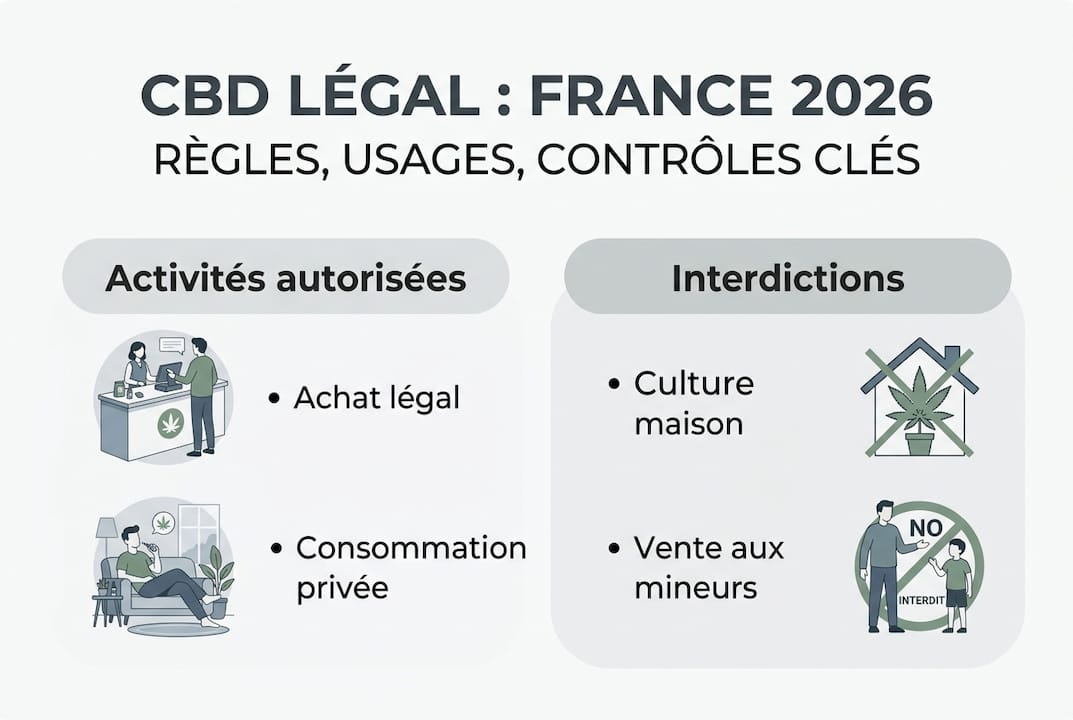
On the other hand, certain practices remain formally prohibited. Therapeutic or medical claims about CBD products are prohibited by the ANSM, sales to minors are strictly prohibited, and growing at home remains illegal, even for personal use.
| Action | Status |
|---|---|
| Buy in-store or online | Permitted |
| Consume at home | Permitted |
| Grow at home | Prohibited |
| Sell to a minor | Prohibited |
| Make health claims | Prohibited |
| Import from the EU | Permitted under certain conditions |
The legislation on CBD flowers also specifies that the sale of raw flowers remains regulated, particularly to avoid any confusion with illicit cannabis.
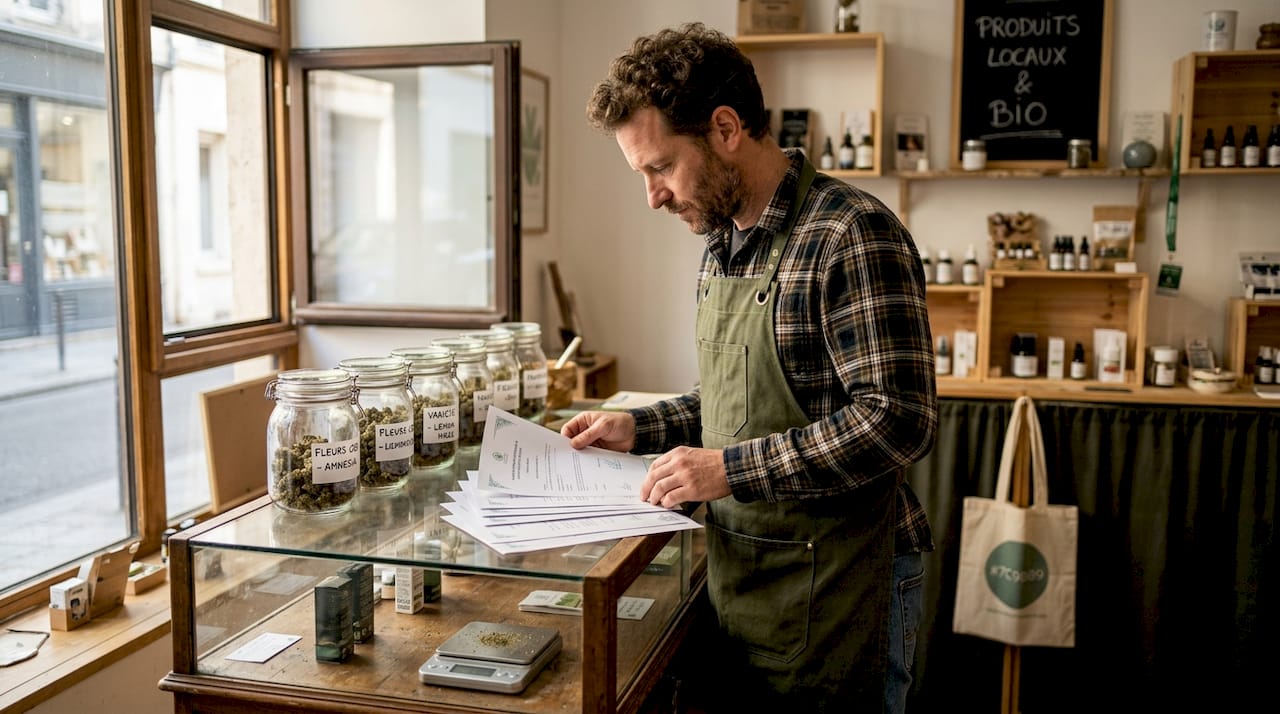
Pro tip: Before making any purchase, check that the product clearly displays its THC content and the plant's origin. Incomplete labeling is often a sign of a non-compliant product, even if the shop appears reputable. Consult the best CBD shops in France for reliable options.
Usage nuances: recreational, medical, and roadside perceptions of CBD
Let's now clarify the difference between permitted uses and their practical limitations. Recreational CBD use is permitted in France, since the product does not contain significant amounts of psychoactive THC. But this apparent legality conceals a real pitfall: roadside saliva tests can be positive for THC even if the product consumed was legal, because residual traces of THC below 0.3% are sometimes enough to trigger a positive result.
The saliva detection threshold is set at 1 ng/ml in the blood according to 2023 case law. This means that regular CBD consumption, even when legal, can technically expose you to a traffic offense. Consumers often underestimate this risk.
Here are the key points to remember about these uses:
- Recreational use: permitted, but beware of roadside checks
- Medical use: no official medicinal product status for standard CBD
- Therapeutic experiment: the trial of medical cannabis has been extended until March 2026, but concerns only patients under a strict medical protocol
- Driving after consumption: real risk even with a legal product
The Council of State's opinion confirmed that the legality of CBD does not automatically protect you from being stopped during a traffic check if traces of THC are detected.
Pro tip: If you drive regularly, choose isolate-spectrum CBD products (zero THC) rather than full-spectrum products. You benefit from the health benefits of CBD without risking a positive test. Numerous CBD user testimonials confirm this cautious approach.
CBD quality controls, compliance, and regulatory patchwork
To avoid unpleasant surprises, let’s examine how inspections are conducted and which developments to monitor. ANSM and DGCCRF are the two authorities responsible for monitoring the compliance of CBD products in France. They primarily check the actual THC level in finished products, the quality of the ingredients, and labelling compliance.
An alarming figure: 81% of the products tested were found to be non-compliant in the 2022-2023 MILDECA study. This means that the majority of products circulating on the market did not comply with French standards, whether regarding dosage, labelling, or traceability.
“CBD product non-compliance remains a structural problem in France, despite a clearer legal framework since 2022.”
From a tax and regulatory perspective, several important developments should be monitored:
- Excise tax of 25.7% on smokable CBD products planned in the 2026 Finance Bill
- Potential reprotoxic classification assessed at European level by ANSES
- Increased inspections by the DGCCRF concerning health claims
- Progressive European harmonization of thresholds and standards
| Type of inspection | Authority | Risk in the event of non-compliance |
|---|---|---|
| THC level | ANSM / DGCCRF | Product withdrawal, fine |
| Labelling | DGCCRF | Formal notice, seizure |
| Health claims | ANSM | Sales ban |
| Origin traceability | DGCCRF | Suspension of activity |
To identify quality CBD, it is essential to request the CBD certificates of analysis issued by independent laboratories. A reputable seller provides them systematically. Also consult CBD product inspections to understand the compliance issues.
What most people forget about CBD legality: nuance and reality on the ground
Many consumers think that the legality of CBD protects them from every risk. This is a misinterpretation. Legality governs the sale and possession of CBD, but it does not guarantee the quality of the product you buy or your safety during a roadside check.
The real challenge in 2026 remains threefold: market volatility, insufficient transparency from some sellers, and the rapid evolution of tax and health regulations. A product that is legal today may no longer be legal tomorrow if thresholds change or a tax affects the available supply.
Our recommendation is clear: do not make legality your only purchasing criterion. Demand a certificate of analysis, verify the legal origin of the CBD, and beware of unrealistic health claims. A certified, tested, and traceable product is your best protection, far beyond mere legal compliance.
Where can you find compliant and certified CBD in France?
To ensure that your CBD purchases comply with regulations, it is essential to choose a store that publishes its certificates of analysis and selects its products according to strict traceability criteria. European CBD Shop offers a carefully selected range of laboratory-tested products, available for delivery throughout the European Union, the United Kingdom, and Switzerland.
Whether you are looking for the best CBD shops in Europe or specific products such as the CBD Pre-roll Amnesia Haze or the Super Relax CBD oil, you will find products that comply with current French and European standards. Each product comes with its certificate of analysis, so you can consume with confidence.
Frequently asked questions about the legality of CBD in France
Can CBD be delivered to your home in France in 2026?
Yes, provided you purchase authorized products containing less than 0.3% THC from a legally registered seller. Delivery from the European Union is also permitted under the same conditions.
What are the risks of being stopped by the police after consuming CBD?
Saliva tests may be positive for THC even when using a legal product, because residual traces are enough to trigger a positive result, which may lead to a penalty.
Can CBD hemp be grown at home for personal use?
No, growing it at home is prohibited in France. Only registered and approved farmers may grow CBD hemp within a strict legal framework.
Is the sale of CBD to minors permitted?
No, sales to minors are strictly prohibited. Every professional seller is required to verify the buyer's age before any transaction.
What is the risk of buying a non-compliant CBD product?
The main risk is purchasing a product that is incorrectly dosed or mislabeled: according to the MILDECA study, 81% of the products tested were non-compliant, which may expose consumers to a THC level above the legal threshold.