
CBD oil versus pain capsules: which should you choose in 2026?
In brief:
- CBD oil offers rapid absorption and greater precision for relieving acute pain, while capsules provide a prolonged effect and stability for managing chronic pain. The choice depends on your pain profile, lifestyle, and the need for an adjustable dose or discreet administration.
CBD oil and CBD capsules are two forms of cannabidiol administration recognized for relieving chronic pain, but they work differently in the body. The CBD oil versus capsules for pain debate comes down to one central question: do you need fast, adjustable relief, or a prolonged, stable effect over time? Sublingual oil acts within 15 to 45 minutes thanks to a bioavailability of 35–40%, while capsules release CBD gradually over 6 to 8 hours. These two formats are complementary, and the right choice depends on your pain profile.
How does CBD oil and CBD capsules work on pain?
CBD interacts with the endocannabinoid system, a network of receptors found in the brain, spinal cord, and peripheral tissues. This system regulates pain perception, inflammation, and the immune response. CBD does not bind directly to CB1 and CB2 receptors, but modulates their activity, thereby reducing pain signals transmitted to the brain.
Sublingual oil: rapid absorption through the mucous membranes

CBD oil placed under the tongue passes directly into the bloodstream through the oral mucous membranes. This route avoids first-pass hepatic metabolism, which explains its high bioavailability of 35–40%. The effect is felt 15 to 45 minutes after taking it. This speed is valuable during an occasional pain flare-up.
The capsules: gradual release and long-lasting effect
The capsules pass through the digestive system before being absorbed. This journey extends the onset of action to 45–90 minutes, but produces an effect that lasts 6 to 8 hours. The bioavailability of the capsules is lower, between 6 and 20%, due to hepatic metabolism. However, they maintain a more consistent CBD level in the blood, which is useful for regular maintenance treatment.
Professional tip: Take your capsules with a meal containing healthy fats, such as avocado or olive oil. Dietary fats increase the intestinal absorption of CBD and improve the bioavailability of capsules.
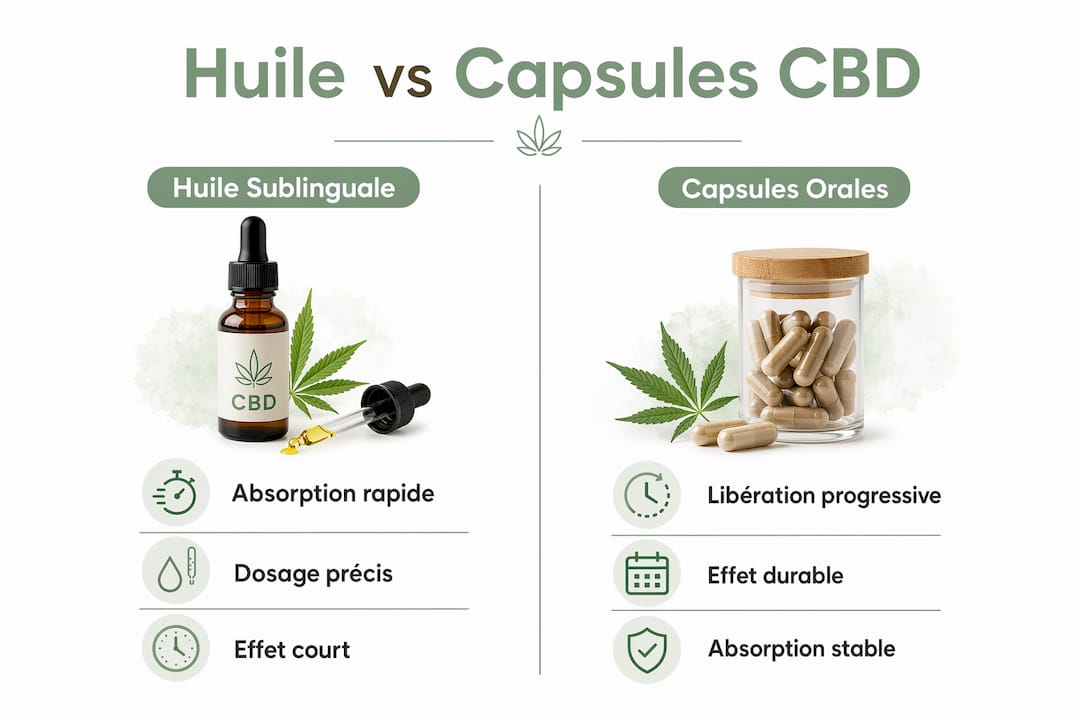
Bioavailability, dosage, and duration of effect: direct comparison
Here are the practical differences between the two formats for managing chronic pain.
| Criterion | Sublingual oil | Oral capsules |
|---|---|---|
| Bioavailability | 35–40 % | 6–20 % |
| Time to take effect | 15–45 minutes | 45–90 minutes |
| Duration of effect | 3–5 hours | 6–8 hours |
| Dosing precision | High (drop by drop) | Fixed per capsule |
| Discretion | Moderate | Very high |
The recommended initial dose for chronic pain is 5 to 10 mg per day. This starting dose makes it possible to assess individual tolerance before gradually increasing it. The goal is to reach an effective dose of 25 to 50 mg per day, increasing by 5 mg every two weeks.
Oil allows for fine drop-by-drop titration, which is ideal at the start of treatment for finding the minimum effective dose. Capsules, on the other hand, provide a fixed, reproducible dose with each intake. This stability reduces the risk of dosing errors, especially for people managing several medications simultaneously.
Key points to remember about CBD capsule effectiveness:
- Consistent absorption: capsules prevent sharp fluctuations in CBD levels in the blood, according to Dr. Pierre Moreau, a medical cannabis expert.
- Flexibility: oil adapts to changing needs from one day to the next.
- Convenience: capsules fit easily into an existing medication routine.
- Taste: oil has a pronounced herbal taste that some consumers find unpleasant.
Practical advantages and disadvantages: oil vs. capsules
The choice between CBD oil or capsules depends as much on lifestyle as on the pain profile. 70% of consumers prefer capsules for their simplicity and discretion. This preference is explained by how easily they fit into a daily routine, without any additional equipment or taste to manage.
What Oil Offers That Capsules Cannot
Oil remains superior in one specific respect: dosage customization. You can increase or reduce the dose by a single drop depending on the intensity of the pain you feel that day. This flexibility is particularly useful for people whose pain fluctuates, such as those with fibromyalgia or rheumatoid arthritis. Oil is also better suited for rapid relief during occasional painful episodes.
What capsules offer that oil cannot
Capsules ensure more stable absorption, without the peaks and troughs in plasma concentration associated with oil. For chronic pain requiring a constant level of CBD in the body, this consistency is a decisive advantage. Capsules are also odorless, tasteless, and discreetly easy to carry in a bag or medicine kit.
Professional tip: Combine the two formats depending on the time of day. Take a capsule in the morning for lasting baseline protection, and keep the oil close at hand for pain spikes during the day. This approach maximizes the benefits of both formats without doubling the doses.
The differences between CBD oil and capsules therefore come down to a trade-off between speed and lasting effects, and between flexibility and simplicity. No format is universally superior.
How do you choose based on the type and intensity of pain?
The best CBD for pain is not the same depending on whether you suffer from chronic neuropathic pain or post-exercise muscle pain. Here is a structured approach to guide your choice.
-
Chronic background pain (osteoarthritis, neuropathy, persistent lower back pain): choose capsules for their prolonged effect and regular absorption. They maintain a stable level of CBD throughout the day, reducing painful fluctuations. The types of pain relieved by CBD include neuropathy, with studies showing a significant reduction in symptoms.
-
Acute painful episodes (inflammatory flare-ups, migraines, post-operative pain): sublingual oil is the appropriate format. Its action in under 45 minutes provides rapid relief for intense, sudden pain.
-
Mixed or complex pain: a hybrid strategy combining CBD topicals and oral doses is recommended by experts to achieve both local relief and a systemic effect. A CBD balm applied to a painful joint, combined with a capsule in the morning, addresses both dimensions of pain.
-
Starting treatment: always start with oil. It allows you to adjust the dosage gradually and identify your minimum effective dose before switching to fixed-dose capsules.
-
Stabilized treatment: once you have found your optimal dose, full-spectrum capsules take over for consistency. Full-spectrum capsules preserve the entourage effect, that is, the synergy between cannabinoids and terpenes, which enhances their effectiveness against chronic pain.
What field experience has taught me about CBD oil and capsules
After years of observing European consumers manage their chronic pain with CBD, one conclusion is clear: most mistakes result from misunderstanding the format, not from CBD itself.
People who stop taking capsules after two weeks often do so because they have not waited for the cumulative effect. Capsules do not work like a conventional single-dose painkiller. Their effectiveness builds over several days of regular use. This is a fundamental difference from oil, whose effects are noticeable from the first dose.
What also strikes me is how underused the entourage effect is. Many consumers choose isolate products to avoid any trace of THC, but in doing so they sacrifice the synergy between cannabinoids. A properly dosed full-spectrum product, with less than 0.3% THC as required by European regulations, offers significantly greater effectiveness for complex chronic pain.
My practical recommendation: start with a 10% full-spectrum oil for four weeks, note your effective dose, then switch to equivalent full-spectrum capsules for consistency. Keep the oil for bad days. And always consult a doctor before adjusting an existing treatment. CBD interacts with certain medications, including blood thinners and antidepressants.
— Rod
Discover Cbd-certified's certified CBD oils and capsules
Cbd-certified offers a selection of laboratory-tested CBD oils and capsules that comply with European standards, with a THC content below 0.3%. Each product comes with its certificate of analysis to guarantee the stated purity and concentration.
Whether you are looking for oil to manage a pain flare-up or capsules for ongoing treatment, Cbd-certified delivers across the European Union, the United Kingdom, and Switzerland. The delivery and return terms are clear and straightforward. For localized muscle pain, the Swiss FX Dragon 450 mg CBD balm is an effective complement to oral intake. Start with a low dose, increase gradually, and always choose a certified product.
Key points
CBD oil works faster and allows precise dosing, while capsules provide a prolonged effect and stable absorption, ideal for managing chronic baseline pain.
| Point | Details |
|---|---|
| Oil bioavailability | Sublingual oil reaches 35–40% bioavailability, compared with 6–20% for capsules. |
| Duration of capsule effects | Capsules work for 6 to 8 hours, twice as long as the oil. |
| Recommended gradual dosing | Start with 5–10 mg per day and increase by 5 mg every two weeks. |
| Hybrid strategy | Combining capsules in the morning with oil during a flare-up addresses both dimensions of pain. |
| Full-spectrum for chronic pain | Full-spectrum products preserve the entourage effect, making them more effective against complex pain. |
Frequently asked questions
Which form of CBD works fastest against pain?
Sublingual oil takes effect within 15 to 45 minutes due to direct absorption through the oral mucous membranes. Capsules require 45 to 90 minutes before producing an effect.
Are CBD capsules effective for chronic pain?
Yes. Capsules maintain a stable level of CBD in the blood for 6 to 8 hours, making them particularly suitable for ongoing treatment of persistent chronic pain.
What dose of CBD should you take for pain?
The recommended initial dose is 5 to 10 mg per day, with a gradual increase of 5 mg every two weeks until reaching 25 to 50 mg per day, depending on individual needs.
Can CBD oil and capsules be combined?
Yes, and it is even recommended for complex pain. A capsule in the morning provides a stable baseline, while the oil manages occasional pain flare-ups during the day.
Should you choose a full-spectrum product or an isolate for pain?
Full-spectrum is preferable for chronic pain. It preserves the synergy between cannabinoids and terpenes, known as the entourage effect, which enhances CBD's overall effectiveness.