
CBD bioavailability: optimize absorption and effects
Many CBD users do not realize that the amount of cannabidiol absorbed by their bodies varies widely depending on the consumption method they choose. CBD bioavailability represents the proportion that is actually available in your bloodstream after administration, and this proportion can range from 6% to 56% depending on the route of administration. Understanding these differences helps optimize your therapeutic results for chronic pain, anxiety, or insomnia. This guide details the mechanisms of bioavailability, compares administration routes, identifies influencing factors, and offers practical strategies to maximize CBD effectiveness according to your specific needs.
Table of contents
- Key points to remember
- What is CBD bioavailability?
- Comparing CBD administration routes and their bioavailability
- Factors influencing bioavailability: diet, formulations, and the individual
- Optimizing the use of CBD for chronic pain, insomnia, and anxiety
- Discover our selection of CBD products optimized for you
- Frequently asked questions about CBD bioavailability
Key Points
| Point | Details |
|---|---|
| Low oral bioavailability | The oral bioavailability of CBD is low and varies according to the liver and metabolism, which limits absorption after ingestion. |
| Rapid sublingual and inhalation routes | These routes offer faster and greater absorption than direct ingestion, with bioavailability ranging from 12 to 56 percent depending on the case. |
| High individual variability | Metabolism and genetics strongly influence CBD absorption and effects. |
| Exposure and relief | Higher blood levels are associated with better relief from pain and anxiety and improved sleep. |
| Adapt according to your needs | Choose the route based on the need for rapid or prolonged relief to optimize effectiveness. |
Key points to remember
| Aspect | Essential information |
|---|---|
| Oral bioavailability | 6 to 20%, significantly increased with a high-fat meal or advanced formulations |
| Rapid routes | Sublingual: 12 to 35%; inhalation: 31 to 56% for greater absorption |
| Individual factors | Metabolism, genetics, and digestive health create substantial variability between individuals |
| Therapeutic correlation | Increased systemic exposure improves relief from pain and anxiety and improves sleep quality |
| Practical optimization | Choose the administration method according to your needs: rapid relief for an anxiety attack, prolonged relief for chronic pain |
What is CBD bioavailability?
Bioavailability refers to the proportion of CBD that reaches your bloodstream after administration and becomes available to act on your receptors. This pharmacological measure directly determines the intensity and duration of the therapeutic effects you experience. Contrary to what many people think, swallowing a CBD capsule does not guarantee that your body will absorb all of the cannabidiol it contains.
CBD has low water solubility, which complicates its passage through the biological membranes of your digestive system. This lipophilic characteristic explains why a large portion of ingested CBD simply passes through your intestine without being absorbed. The molecules that cross the intestinal barrier must then face a major obstacle.
The hepatic first-pass effect is the main obstacle to the oral bioavailability of CBD. After intestinal absorption, CBD travels directly to your liver via the portal vein before reaching the general circulation. Hepatic enzymes, primarily CYP3A4, metabolize and break down a substantial portion of cannabidiol during this first pass. Only a small fraction escapes this initial degradation.
Several physiological factors determine final bioavailability:
- Lipid solubility limiting intestinal absorption in aqueous environments
- Variable permeability of digestive membranes depending on their condition
- Intensive hepatic metabolism reducing the amount in circulation
- Gastrointestinal transit speed affecting absorption time
- Presence of other substances that modify enzymatic activity
These biological mechanisms explain why two people taking the same dose of CBD may experience very different effects. Your unique physiology, current digestive state, and interactions with other compounds create significant variability. Understanding these fundamentals helps you anticipate and adjust your intake for more predictable and satisfactory results.
Comparing CBD administration routes and their bioavailability
Each route of administration offers a distinct profile in terms of bioavailability, speed of action, and duration of effect. Choosing the method suited to your situation helps optimize therapeutic efficacy while minimizing product waste. Scientific data reveal major differences between approaches.
| Route of administration | Bioavailability | Onset of action | Duration of effect |
|---|---|---|---|
| Oral (capsules, foods) | 6 to 20% | 60 to 120 minutes | 6 to 8 hours |
| Sublingual (oils) | 12 to 35% | 15 to 45 minutes | 4 to 6 hours |
| Inhalation (vaporization) | 31 to 56% | 2 to 5 minutes | 2 to 4 hours |
| Topical (creams, balms) | Low systemic | 15 to 30 minutes | 2 to 4 local hours |
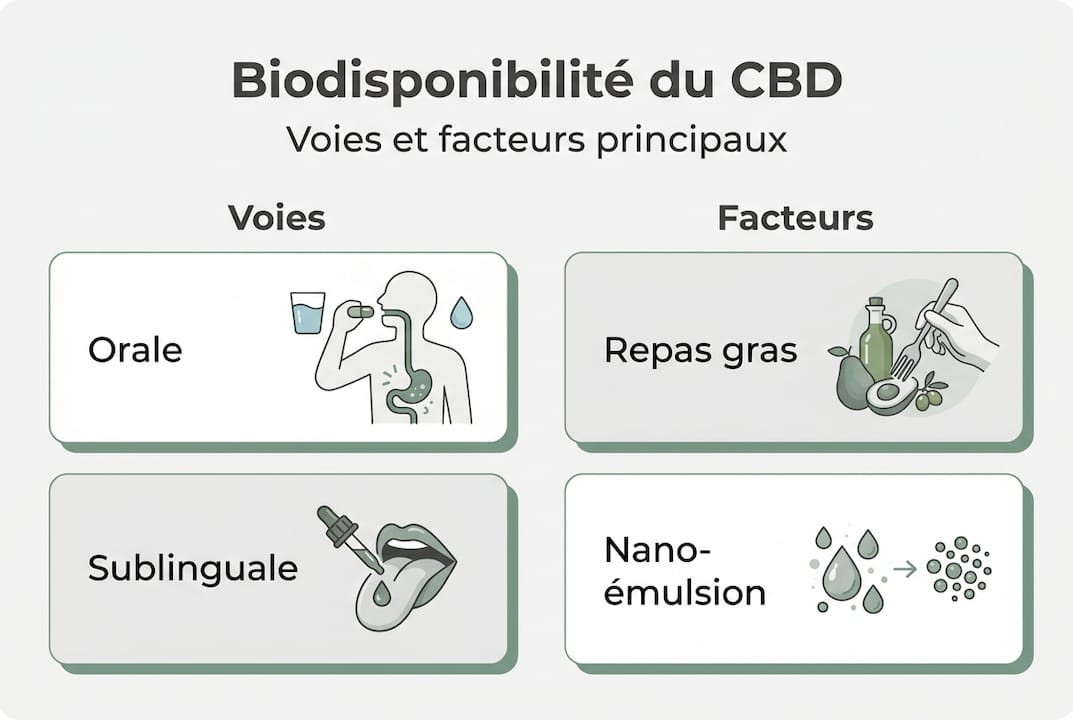
The sublingual route partially bypasses hepatic metabolism by enabling direct absorption through the richly vascularized oral mucosa. You place a few drops of oil under your tongue and hold them there for 60 to 90 seconds before swallowing. This method approximately triples bioavailability compared with direct ingestion, while also significantly accelerating the onset of action.

Vaporized inhalation provides the highest bioavailability and the fastest action. Vaporized CBD enters your lungs directly, crosses the alveolar membrane, and reaches your bloodstream within seconds. This speed is particularly suitable for acute anxiety attacks or pain spikes requiring immediate relief. The trade-off is a shorter duration of effect.
Oral administration remains popular despite its low bioavailability thanks to its convenience and discretion. CBD capsules and infused foods offer prolonged release, ideal for maintaining stable levels throughout the day. This approach is better suited to chronic conditions requiring continuous coverage rather than occasional relief.
Topical applications deserve special mention because their purpose differs from that of other routes. Although systemic bioavailability remains low, CBD creams and balms penetrate locally into the underlying skin and muscle tissues. This targeted action is valuable for joint pain, muscle inflammation, or dermatological conditions without requiring generalized effects.
Pro tip: Combining several routes of administration according to the time of day optimizes your therapy. Use inhalation or sublingual administration to manage an acute anxiety attack, then maintain it with an oral dose for prolonged coverage against chronic pain or nighttime insomnia.
Factors influencing bioavailability: diet, formulations, and the individual
Beyond the route of administration, several modifiable and individual factors determine how much CBD is actually absorbed by your body. Mastering these variables allows you to significantly improve the effectiveness of your supplementation without necessarily increasing the dose.
The impact of food on the oral bioavailability of CBD is far greater than most users imagine. Taking your CBD with a high-fat meal can increase absorption by 4 to 17 times, depending on the study. Dietary lipids promote the solubilization of lipophilic CBD, facilitate its passage through the intestinal wall, and stimulate bile production, which improves emulsification. A breakfast including avocado, eggs, or nut butter can radically transform the effectiveness of your morning capsule.
Advanced formulation technologies are revolutionizing the oral bioavailability of CBD. Nanoemulsions and SNEDDS reduce the size of CBD particles to the nanoscale, dramatically increasing the contact surface with biological membranes. These sophisticated formulations can multiply bioavailability by 2 to 5 times compared with standard oils. Controlled-release capsules and liposomes represent other promising innovations for maximizing absorption.
| Individual factor | Impact on bioavailability |
|---|---|
| CYP3A4 enzyme activity | Fast or slow metabolism alters blood concentration |
| Genetic polymorphisms | Genetic variations create distinct individual responses |
| Age and sex | Metabolism is generally slower in older people |
| Digestive system status | Inflammation or dysbiosis reduces intestinal absorption |
| Drug interactions | Some medications inhibit or accelerate CBD metabolism |
Your personal metabolism may be the most influential factor. CYP3A4 liver enzymes vary considerably from person to person depending on genetics, age, and environmental exposures. Some individuals metabolize CBD quickly, requiring more frequent doses, while others maintain high concentrations for longer. This variability explains why your friend gets excellent results with a dose that seems insufficient for you.
Drug interactions deserve particular attention because many common medications share the same metabolic pathways as CBD. Proton pump inhibitors, certain antibiotics, and antifungals can slow CBD metabolism, inadvertently increasing its effects. Conversely, some anticonvulsants accelerate the breakdown of cannabidiol. This reality underscores the importance of consulting a professional before incorporating CBD into an existing therapeutic regimen.
Pro tip: Keep a journal detailing your CBD intake, timing in relation to meals, perceived effects, and their duration. This documentation quickly reveals personal patterns and allows you to adjust your protocol to maximize benefits according to your unique physiology.
Optimizing the use of CBD for chronic pain, insomnia, and anxiety
Turning theoretical knowledge of bioavailability into a concrete therapeutic strategy requires adapting your approach to your specific symptoms. Clinical data demonstrate that increased systemic exposure directly correlates with improvements in symptoms of chronic pain, anxiety, and sleep disorders. Maximizing bioavailability therefore increases your chances of therapeutic success.
To manage anxiety, favor fast-acting routes during critical moments. Inhalation or sublingual administration provides relief within 2 to 45 minutes, making it ideal for countering a surge of anxiety before an important presentation or an anticipated stressful situation. The speed of action also makes it easy to adjust the dosage: start low and increase gradually until you achieve the desired effect. This flexibility is lacking in oral forms, whose effects emerge too slowly for acute episodes.
Chronic pain benefits more from an extended-release approach that maintains constant therapeutic levels. Take your capsules or oral oils with a meal containing healthy fats to maximize absorption. The advanced formulations offer superior bioavailability without requiring precise timing in relation to meals. Divide your daily dose into two or three spaced doses to maintain continuous coverage rather than taking a single massive dose that creates peaks and troughs.
Insomnia requires a combined strategy that takes timing and duration of action into account. Take an oral dose 60 to 90 minutes before your desired bedtime so that the effects peak at the right time. Combine this dose with a light snack containing fats, such as a few nuts or a square of dark chocolate. If you wake frequently, an extended-release formulation maintains CBD levels throughout the night.
Practical steps to optimize your personal protocol:
- Identify your primary symptom and its temporal pattern
- Select the route of administration that matches your need for speed
- Start with a conservative dose and increase gradually
- Document the effects, timing, and food interactions
- Adjust the frequency and timing of doses according to the results observed
- Consult a professional to assess potential drug interactions
Professional consultation becomes essential if you are already taking medication or suffer from liver conditions. A doctor familiar with CBD dosing can adjust your protocol based on your metabolic profile and existing treatments. This medical supervision maximizes safety while optimizing therapeutic outcomes.
Optimizing bioavailability is not limited to choosing the right route of administration. It encompasses a holistic understanding of your body, eating habits, and specific symptomatic needs. Users who take the time to refine their approach consistently achieve better results than those who blindly follow generic recommendations.
Discover our selection of CBD products optimized for you
Now that you understand how to maximize CBD bioavailability, it is time to explore products designed specifically to optimize your absorption and therapeutic outcomes. European CBD Shop offers a carefully selected range of advanced formulations developed according to the latest scientific research.
Our online store ranks among the best CBD shops in Europe thanks to our commitment to quality, transparency, and innovation. We offer fast-absorbing sublingual oils, CBD energy and vitality capsules formulated for optimal bioavailability, and inhalation options for immediate relief. Each product is tested by an independent laboratory to guarantee its purity and stated concentration.
Our shipping and returns cover the entire European Union, the United Kingdom, and Switzerland, with fast delivery times and responsive customer service. Explore our catalog to find products suited to your needs and put into practice the bioavailability strategies you have just discovered.
Frequently asked questions about CBD bioavailability
What is the average oral bioavailability of CBD?
The oral bioavailability of CBD typically ranges from 6% to 20% of the ingested dose. This low proportion is explained by its limited solubility in water, incomplete intestinal absorption, and, above all, the first-pass effect in the liver, which breaks down a large portion of the cannabidiol before it reaches the systemic circulation. Taking CBD with fatty foods can significantly improve this rate.
How does a fatty meal improve CBD absorption?
Dietary fats increase the solubilization of lipophilic CBD in your digestive system, facilitating its passage through the intestinal membranes. Fats also stimulate bile production, which emulsifies CBD and improves its absorption. A meal containing healthy fats can increase bioavailability by 4 to 17 times, depending on the studies, radically transforming the effectiveness of your dose.
Why is the sublingual route more effective than ingestion?
Sublingual administration allows CBD to be absorbed directly through the richly vascularized oral mucosa, partially bypassing destructive liver metabolism. This route also avoids degradation in the acidic stomach. The result is double or triple the bioavailability compared with direct ingestion, with a much faster onset of action in 15 to 45 minutes instead of 60 to 120 minutes.
Which formulations increase CBD bioavailability?
Nanoemulsions reduce the size of CBD particles to the nanometer scale, dramatically increasing the contact surface area with biological membranes. SNEDDS create spontaneous microemulsions upon contact with digestive fluids. Liposomes encapsulate CBD in protective lipid vesicles. These advanced technologies can increase bioavailability by 2 to 5 times compared with standard oils, delivering superior results with reduced doses.
How does individual metabolism influence the response to CBD?
The activity of your liver enzymes, particularly CYP3A4, determines how quickly your body breaks down CBD. Genetic variations create fast metabolizers who require more frequent doses and slow metabolizers who maintain higher concentrations for longer. Your age, sex, digestive health, and concomitant medications also modify this equation. This variability explains why two people taking the same dose can experience very different effects, highlighting the importance of personalized adjustment.