
How to reduce anxiety: natural and therapeutic methods
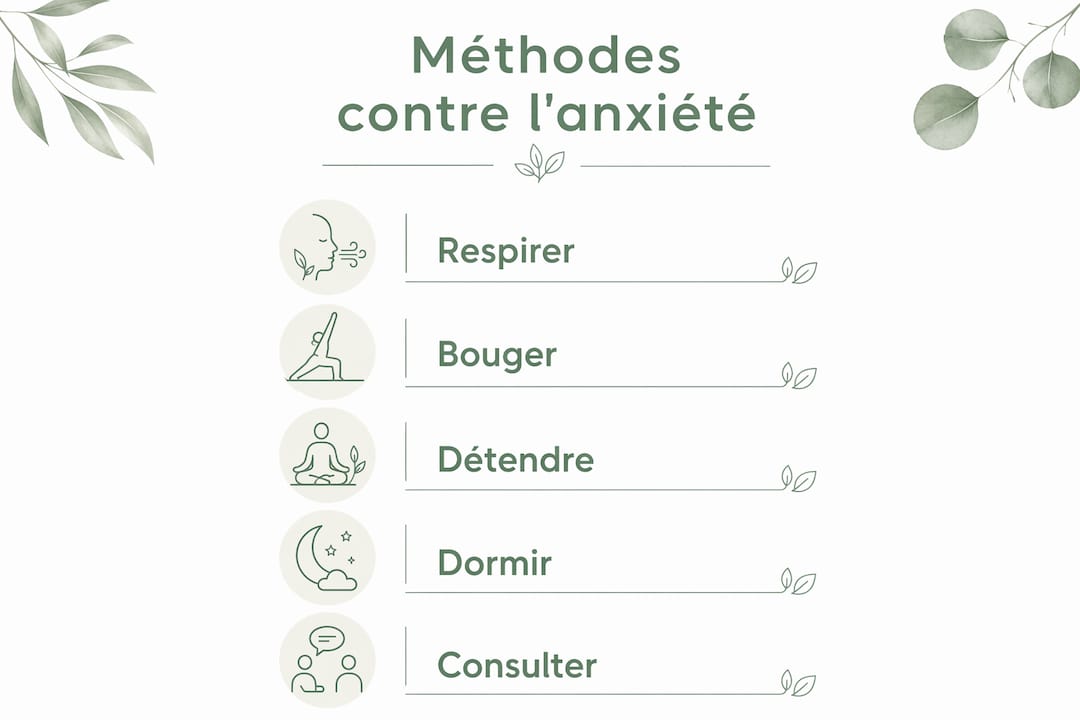
Reducing anxiety relies on a combination of scientifically validated techniques: breathing exercises, cognitive behavioral therapy (CBT), regular physical activity, and lifestyle adjustments. No single method is sufficient on its own. It is their combination, practiced consistently, that produces lasting results. The recommendations of the Haute Autorité de Santé (HAS) and recent meta-analyses converge on this point: a multidimensional approach combining cognitive work, physical practices, and social support offers the best chance of regaining balance.
Here are the recognized pillars for managing stress and calming the mind on a daily basis:
- Cardiac coherence: 3 sessions of 5 minutes per day, at a rate of 6 breaths per minute
- Cognitive behavioral therapy (CBT): recommended as a first-line treatment by the HAS for anxiety disorders
- Physical activity: 30 minutes of exercise, 3 to 5 times a week
- Journaling: 15 to 20 minutes of expressive writing, 3 to 4 times a week, is enough to regulate emotions
- Healthy lifestyle: regular sleep, a balanced diet, reduced caffeine intake
- Natural remedies: magnesium, adaptogenic plants, Bach flowers for mild forms
Professional tip: Consistency matters more than intensity. Ten minutes of cardiac coherence every morning for three weeks does more to transform the stress response than an hour of meditation practiced once a month.
1. What techniques can be used immediately to calm anxiety?
Cardiac coherence is one of the best-documented methods for quickly reducing anxiety. It involves breathing at a rate of 6 cycles per minute for 5 minutes, ideally 3 times a day, which regulates the parasympathetic nervous system and lowers blood pressure. Specifically: inhale for 5 seconds, exhale for 5 seconds, without pausing. The effect can be felt from the first session.
Abdominal breathing follows a similar principle. Place one hand on your stomach and the other on your chest: only the hand on your stomach should rise as you inhale. This technique activates the vagus nerve and signals to the brain that the danger has passed, even when the anxiety is purely mental.
For situations where breathing alone is not enough, the STOP method offers a quick grounding technique:
- S : Stop what you are doing
- T : Take a deep breath
- O : Observe what is happening in your body and thoughts
- P: Proceed with intention
| Technique | Duration | Ease | Immediate effectiveness |
|---|---|---|---|
| Cardiac coherence | 5 min | Easy | Very high |
| Abdominal breathing | 2–3 min | Very easy | High |
| STOP method | 1 min | Easy | Moderate to high |
| Sensory grounding (5-4-3-2-1) | 3–5 min | Easy | High |
Sensory grounding, or the 5-4-3-2-1 technique, involves naming 5 things you see, 4 you hear, 3 you touch, 2 you smell, and 1 you taste. This brings attention back to the present and short-circuits the spiral of anxious thoughts.
Professional tip: Set three daily alarms for your cardiac coherence sessions: upon waking, before lunch, and in the late afternoon. After a few weeks, the body anticipates these moments of calm and the stress response gradually subsides.
2. How can your lifestyle reduce anxiety in the long term?
Sleep is the first often-overlooked lever. An irregular schedule or nights that are too short keep the nervous system in a state of chronic alertness, making each anxiety trigger more difficult to manage. The World Health Organization emphasizes that poor lifestyle habits maintain this state of constant vigilance. Going to bed and getting up at fixed times, even on weekends, stabilizes morning cortisol and improves the quality of deep sleep.
Moderate physical activity produces effects comparable to those of certain anti-anxiety medications by releasing endorphins and lowering cortisol. Regular activities such as brisk walking, swimming, or cycling can improve mood and resilience to stress.
Here are the daily habits that really make a difference:
- Limit caffeine after 2:00 p.m.: it stimulates the sympathetic nervous system and can intensify palpitations and agitation
- Reduce exposure to the news to one or two defined time slots, as the continuous flow of anxiety-provoking information maintains a diffuse state of alertness
- Eat at regular intervals to prevent hypoglycemia, which triggers symptoms similar to anxiety (tremors, irritability)
- Prioritize magnesium-rich foods: almonds, spinach, dark chocolate with more than 70% cocoa, legumes
- Incorporate omega-3s through oily fish (sardines, mackerel, salmon) or flax seeds, as a deficiency is associated with greater reactivity to stress
Note on nutrition: B vitamins, particularly B6 and B12, play a role in the synthesis of neurotransmitters such as serotonin and GABA. A diet low in green vegetables, whole grains, and animal proteins can weaken these regulatory mechanisms.
Digital hygiene deserves particular attention. Checking social media or the news in the hour before bedtime disrupts melatonin secretion and keeps the brain in reactive mode. Replacing this screen time with ten minutes of reading or breathing exercises noticeably improves sleep quality.
3. Which therapeutic approaches are recommended for treating anxiety?
Cognitive behavioral therapy is the treatment recommended by the HAS as the first-line approach for anxiety disorders. It is based on two complementary approaches: identifying and restructuring negative automatic thoughts, then gradually facing avoided situations. A course of 12 to 20 sessions is often enough to achieve significant and lasting results.

Graded exposure deserves to be properly understood. It does not mean confronting what is frightening abruptly, but building a hierarchy of situations, from the least to the most anxiety-provoking, and addressing them one by one until anxiety naturally decreases. This mechanism is called habituation.
Mindfulness meditation effectively complements CBT. Studies document its impact on reducing rumination and improving long-term emotional regulation. Sophrology, which combines dynamic relaxation and positive visualization, can also serve as an entry point for people who are unfamiliar with meditation.
Medication treatments, including anxiolytics and antidepressants, have a place in care, but only under strict medical supervision. Benzodiazepines provide rapid relief, but prolonged use causes dependence and tolerance. Selective serotonin reuptake inhibitors (SSRIs) are more appropriate for chronic anxiety disorders, with an onset of action taking several weeks.
- CBT: the standard treatment, partially reimbursed depending on the practitioner
- Mindfulness (MBSR, MBCT): structured 8-week programs, available in groups
- Sophrology: useful as a complementary approach, not covered by health insurance
- Anxiolytics: effective in the short term, to be avoided without medical supervision
- Antidepressants (SSRIs): indicated for generalized anxiety disorders, by prescription
Professional tip: Before looking for a therapist, check that they are registered with the AFTCC (French Association for Cognitive and Behavioral Therapy) or a recognized federation. A practitioner trained in CBT will work with validated protocols, not just attentive listening.
4. What natural remedies can help soothe anxiety?
Natural treatments for anxiety have a genuine place in managing mild to moderate forms, provided they are not overestimated. Bach flowers, particularly the Rescue Remedy blend, are widely used during moments of acute stress. Their effectiveness is mainly based on a documented placebo effect, which does not make them useless: for mild situational anxiety, this effect may be enough to break the cycle of tension.
Certain plants have stronger supporting evidence. Valerian, passionflower, and hawthorn have shown moderate but real effects on mild anxiety in several clinical studies. They act mainly on the GABAergic system, the same mechanism as benzodiazepines, but with much lower intensity and without a risk of dependence at the recommended doses.
Magnesium deserves special mention. Magnesium deficiencies are common among the French population, particularly among people under chronic stress, who excrete more of it in their urine. Supplementation with magnesium glycinate or malate may reduce irritability, muscle tension, and sensitivity to stress, especially if the diet is low in legumes and nuts.
- Journaling: expressive writing stimulates the prefrontal cortex and helps regulate the amygdala, the brain's fear center. Fifteen to twenty minutes, three to four times a week, is enough to observe an effect on the intensity of anxious feelings.
- True lavender essential oil: a few drops on the wrists or in a diffuser; true lavender (Lavandula angustifolia) is one of the few essential oils supported by clinical studies for mild anxiety.
- Bach flowers: to be reserved for situations of temporary stress, without replacing therapeutic care in cases of an established disorder.
For those wishing to explore natural relaxation methods, certain CBD-based supplements are also attracting growing interest for their effects on the nervous system.
Professional tip: Before starting a supplement containing herbs or magnesium, talk to your doctor or pharmacist. Some herbs interact with common medications, particularly blood thinners and antidepressants.
5. Normal anxiety or anxiety disorder: how can you tell the difference?
Anxiety is a normal and useful response of the nervous system to a perceived threat. The amygdala triggers a hormonal cascade (adrenaline, cortisol) that prepares the body to react. The problem arises when this alarm is triggered without any real danger, repeatedly, or when it never switches off.
“Anxiety becomes pathological when it lasts for more than six months, causes disabling avoidance, or persistently interferes with daily functioning at work, in the family, or in social relationships.” Source: Légifrance, medical framework for anxiety disorders
Signs that warrant prompt consultation:
- Persistent anxiety for more than six months without an identifiable cause
- Repeated panic attacks (palpitations, a feeling of suffocation, fear of dying)
- Avoidance that gradually narrows the scope of life (transportation, public places, work)
- Chronic sleep disorders linked to nighttime rumination
- Dark thoughts or suicidal thoughts
Social support plays an often underestimated protective role. Sharing your concerns with trusted loved ones reduces activation of the sympathetic nervous system and strengthens the sense of safety. Isolation, by contrast, intensifies rumination and perpetuates anxiety.
To find a suitable professional in France, several options are available: a general practitioner for an initial assessment and referral, Centres médico-psychologiques (CMPs) for free follow-up care, or the directories of the AFTCC and the Fédération française de psychothérapie for a private therapist trained in CBT.
Professional tip: If you are unsure about seeking help, start by speaking with your primary care physician. They can perform an initial assessment, rule out an organic cause (thyroid problems, iron deficiency), and refer you to the right specialist without unnecessary delay.
6. How can you prevent anxiety attacks before they occur?
Preventing anxiety episodes relies on knowing your own triggers and establishing routines that stabilize the nervous system before tension rises. Identifying your early warning signs, whether shoulder tension, shorter breaths, or unusual irritability, allows you to intervene early rather than manage a full-blown crisis.
Keeping a journal of anxiety-provoking situations for two to three weeks often reveals recurring patterns: certain times of day, certain types of interactions, and certain workloads. Once these triggers have been identified, it becomes possible to anticipate them and adapt your environment or schedule.
Among the most effective preventive strategies:
- Plan active breaks throughout the day, rather than waiting until you are exhausted to stop
- Practice coherent breathing preventively, before known stressful situations (meeting, exam, interview)
- Limit unnecessary commitments to reduce overall mental load
- Maintain an active social network, even a minimal one, because isolation is one of the best-documented factors in relapse
- Consult a healthcare professional regularly if episodes recur, without waiting for the situation to worsen
The regularity of stress-management practices, far more than their occasional intensity, builds lasting resilience. The autonomic nervous system is trained like a muscle: the more it is engaged in calm, controlled conditions, the more flexibly it responds to unexpected events. To learn more about integrating these practices into daily life, Cbd-certified’s adding CBD to your routine guide explores how certain natural supplements may support this approach.
7. Progressive muscle relaxation, yoga, and other mind-body practices
Progressive muscle relaxation, developed by Edmund Jacobson in the 1920s, remains one of the best-validated techniques for reducing the physical tension associated with anxiety. The principle is simple: deliberately tense a muscle group for a few seconds, then release it completely. The difference in sensation between contraction and relaxation teaches the body to recognize and release accumulated tension. Moderate contraction, without straining, is sufficient. Pushing too hard instead activates the stress response and makes the practice counterproductive.
Yoga combines three elements, each acting on anxiety through different pathways: postures (asanas) release muscle tension, breathing exercises (pranayama) regulate the autonomic nervous system, and focusing on movement interrupts rumination. Practices such as restorative yoga or yin yoga, with postures held for several minutes, are particularly suitable for highly anxious people who find dynamic sessions too stimulating.
Tai chi and qigong offer an alternative for those who prefer slow, meditative movement to a static posture. These traditional Chinese disciplines have shown positive effects on anxiety and sleep quality in several published studies, particularly among older people and patients with chronic illnesses.
Jacobson's progressive relaxation integrates easily into an evening routine: while lying down, work through each muscle group from bottom to top (feet, calves, thighs, abdomen, hands, arms, shoulders, face), alternating contraction and relaxation. A complete session lasts between 15 and 20 minutes and effectively prepares the body for sleep.
For those who wish to deepen their understanding of the natural mechanisms involved in anxiety management, Cbd-certified offers a detailed guide to the role of CBD in anxiety, exploring how certain cannabinoids interact with the endocannabinoid system involved in stress regulation.
Cbd-certified and natural anxiety management
Managing anxiety on a daily basis requires reliable, natural tools adapted to your lifestyle. Cbd-certified selects certified CBD products, available for delivery throughout the European Union, the United Kingdom, and Switzerland, to support your relaxation practices. Whether you are looking to complement a cardiac coherence routine, improve your sleep, or support your nervous system balance, the Cbd-certified shop offers a rigorously selected range to meet these needs.
Key points
Reducing anxiety over the long term requires combining breathing techniques, lifestyle adjustments, and, if necessary, structured therapeutic support such as CBT.
| Point | Details |
|---|---|
| Cardiac coherence | Practice 3 sessions of 5 minutes per day at 6 breaths per minute to regulate the nervous system. |
| Physical activity | 30 minutes of exercise, 3 to 5 times a week, reduce anxiety comparably to certain anti-anxiety medications. |
| CBT recommended by HAS | Cognitive behavioral therapy is the validated first-line treatment of reference for anxiety disorders. |
| Warning signs | Persistent anxiety lasting more than six months, with disabling avoidance behaviors, warrants prompt medical consultation. |
| Natural remedies | Magnesium, journaling, and plants such as valerian provide real support for mild forms, as a complement to therapeutic approaches. |