
How to recognize quality CBD for safe use
Buying CBD without knowing how to assess its quality is a real risk. A significant increase in poisonings linked to products containing excessive THC or synthetic cannabinoids has been documented in Europe in recent years. Whether you are looking to better manage your anxiety, alleviate chronic pain, or get restful sleep, the quality of the CBD you consume directly affects your safety and results. This article gives you a practical method for identifying a reliable product, from the label to the certificate of analysis.
Table of contents
- Why CBD quality is crucial for users
- The essential criteria for identifying quality CBD
- How to read a CBD label or certificate of analysis
- At-risk populations and safety recommendations
- Find quality CBD at European CBD Shop
- Frequently asked questions
Key Points
| Point | Details |
|---|---|
| Always check the analysis | An independent laboratory certificate proves the quality and compliance of the CBD product. |
| Caution regarding composition | Beware of products containing more than 0.3% THC or undeclared contaminants. |
| Adapt to your profile | Certain people should avoid CBD or seek medical advice beforehand. |
| Rely on official labeling | The packaging and certificates must clearly indicate the levels, origin, and absence of undesirable substances. |
| Follow the recommended dose | The provisional EFSA safe dose must not be exceeded by healthy adults. |
Why CBD quality is crucial for users
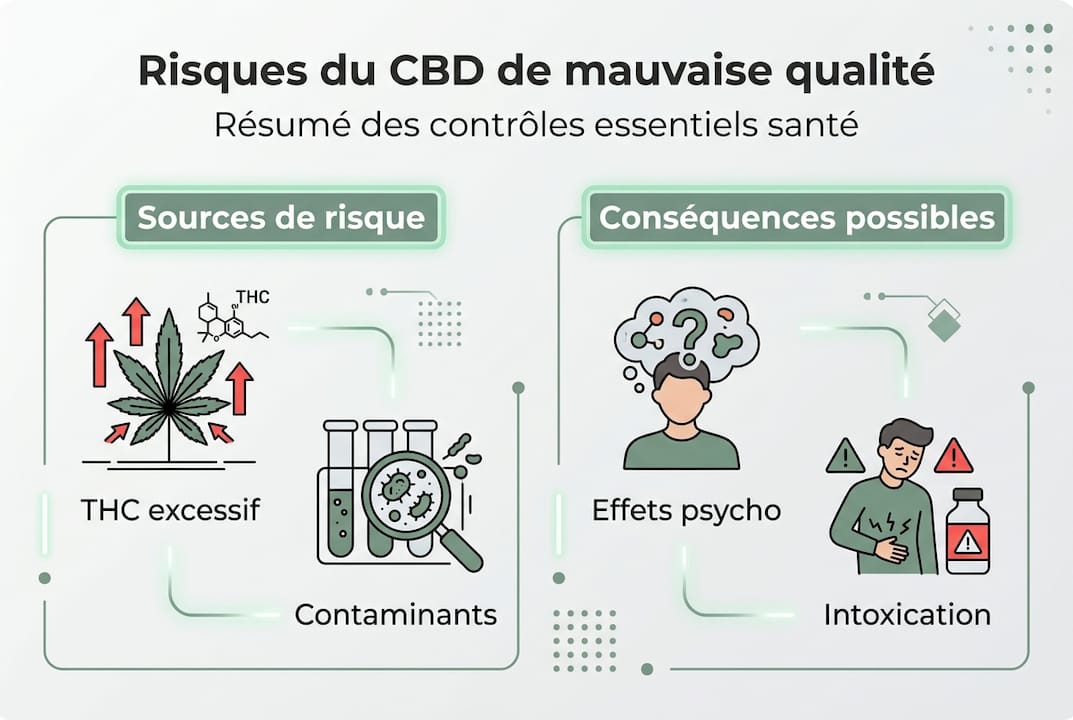
Not all CBD products are created equal, and this reality has direct consequences for your health. Europe's legal framework for CBD imposes strict THC thresholds, set at 0.2% or 0.3% depending on the country. Exceeding these thresholds not only exposes you to legal risks, but above all to unwanted psychoactive effects and health complications.
Some inexpensive products are contaminated with heavy metals, pesticides, or synthetic cannabinoids. These substances are not listed on the label, but they act in your body. European regulations govern placing products on the market, but inspections are not systematic, allowing non-compliant products to circulate.
The EFSA sets the provisional safe dose of CBD at 0.0275 mg per kg of body weight per day for healthy adults. This figure illustrates how important dosage precision is. A product with an inaccurate dose or contamination makes any dose calculation pointless.
“The purity of a CBD product is not a luxury; it is the basic condition for it to be useful and safe.”
| Risk | Source | Possible consequence |
|---|---|---|
| THC > legal threshold | Poor quality control | Psychoactive effects, legal issues |
| Synthetic cannabinoids | Fraud or negligence | Serious poisoning |
| Heavy metals | Contaminated soil or extraction | Chronic toxicity |
| Pesticides | Uncontrolled cultivation | Endocrine disruption |
| Inaccurate dosage | Misleading labeling | Underdosing or overdosing |
Understanding these natural wellness criteria helps you ask the right questions before buying.
The essential criteria for identifying quality CBD
Once you understand the issues involved, it becomes easier to know what to look for. Here are the specific indicators to check before making any purchase.
Essential criteria to check:
- Independent certificate of analysis (COA): conducted by an accredited third-party laboratory, it confirms the product's actual composition
- Clearly indicated CBD and THC levels: with precise values, not vague ranges
- Absence of contaminants: heavy metals, pesticides, residual solvents
- Complete traceability: geographical origin of the hemp, cultivation method, extraction process
- Clearly stated spectrum: full spectrum, broad spectrum or isolate, with each type having different effects depending on your needs
- Labels and certifications: EU-certified organic farming, ISO certification or equivalent
Mastering the CBD vocabulary enables you to read this information without getting lost. Understanding the difference between types of CBD is also essential for choosing what suits your situation.
THC compliance tests below 0.3% and contaminant analyses are a minimum standard in Europe. A product that cannot provide this data does not deserve your trust.
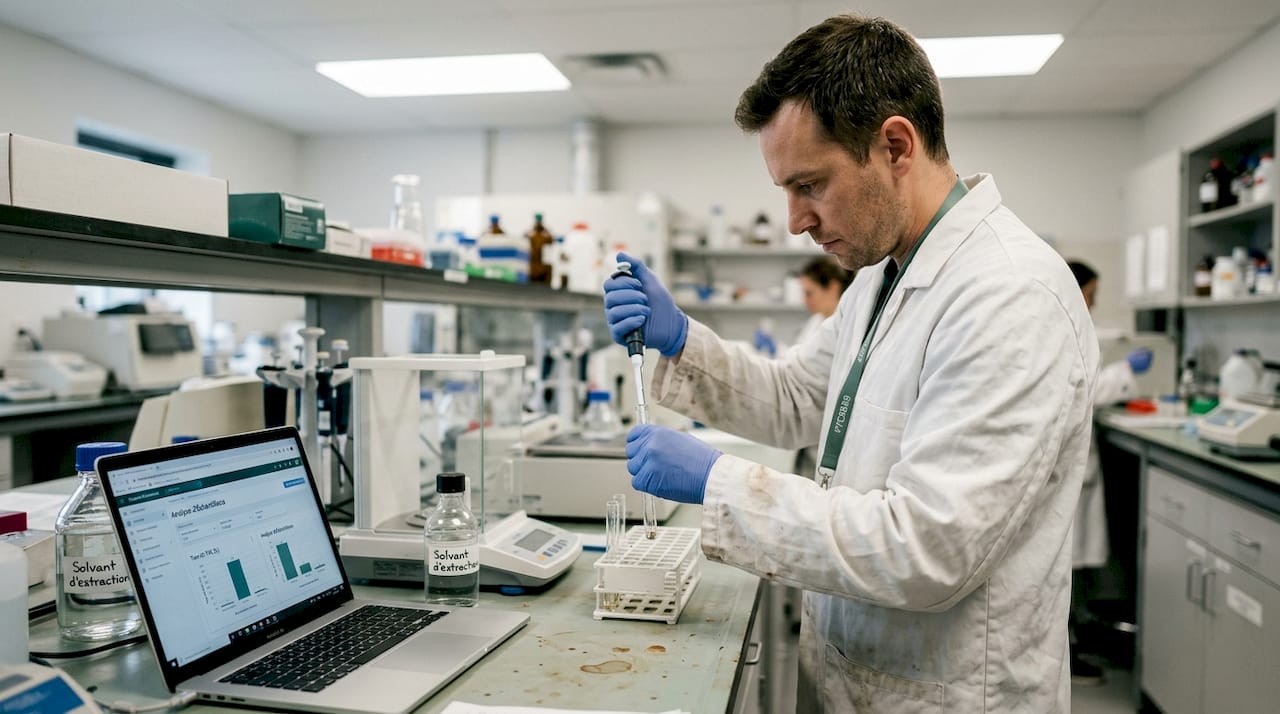
Pro tip: Always request the third-party certificate of analysis before buying. Check the test date: a certificate that is more than a year old is no longer reliable. If the seller cannot provide it, move on.
| Criterion | Certified CBD | Dubious CBD |
|---|---|---|
| Certificate of analysis | Available, recent, accredited laboratory | Absent, illegible, or undated |
| THC level | Precise, below 0.3% | Vague or not mentioned |
| Hemp origin | Traceable, preferably from the EU | Unknown or unspecified |
| Spectrum | Clearly indicated | Absent or ambiguous |
| Contaminants | Tested and compliant | Untested |
How to read a CBD label or certificate of analysis
Having the right criteria in mind is not enough if you do not know where to find them on a product. Here is how to proceed step by step.
- Check the hemp’s origin: look for the country where it was grown. Hemp cultivated in Europe is subject to stricter agricultural standards.
- Read the CBD and THC levels: they must be expressed as a percentage or in mg per ml. Beware of phrases like “high in CBD” without a precise figure.
- Identify the spectrum: full spectrum means that all natural cannabinoids are present, broad spectrum excludes THC, and an isolate contains only pure CBD.
- Check the certificate date: a test conducted more than a year ago no longer reflects the current composition of the batch.
- Look for the contaminants section: the certificate must list results for heavy metals, pesticides, and residual solvents, with values below regulatory thresholds.
The discrepancy between labeling and actual composition is a major documented cause of poisoning. A product that claims to be one thing but contains another is dangerous, not merely disappointing.
Understanding the importance of certificates of analysis gives you a real advantage when shopping. And once you have chosen your product, knowing how to use CBD effectively maximizes your results.
Pro tip: Reject any product whose certificate is missing, illegible, or more than a year old. A reputable seller makes these documents readily available, often via a QR code on the packaging.
At-risk populations and safety recommendations
Even the highest-quality CBD is not suitable for everyone. Certain people require special attention before consuming it.
EFSA advises against pure CBD for people under 25, pregnant or breastfeeding women, and anyone taking medication. These recommendations are based on serious toxicological data, not simple generic precautions.
Safety tips for daily use:
- Always start with the lowest possible dose and increase gradually
- Consult a doctor if you are taking medication, especially blood thinners or antidepressants
- Avoid combining multiple CBD products without knowing the cumulative doses
- Store your products away from light and heat to preserve their composition
- Note how you feel after each dose to fine-tune your dosage
"Provisional safe dose: 0.0275 mg per kg per day for healthy adults, according to EFSA."
If you suffer from a chronic condition, consult our guide on CBD safety for people with chronic conditions before getting started. To get the most out of your product, understanding bioavailability and optimizing absorption makes a real difference. And if you want a broader overview, our article on the benefits and safety of CBD is a good place to start.
If you experience unusual symptoms after taking CBD, such as nausea, dizziness, or an increased heart rate, stop immediately and consult a healthcare professional.
Find quality CBD at European CBD Shop
Choosing reliable CBD should not be an obstacle course. At European CBD Shop, every product is selected according to strict criteria: independent certificates of analysis, THC levels compliant with European regulations, and complete traceability from the plant to the bottle.
Whether you are in France, Belgium, Switzerland, or the United Kingdom, we deliver throughout the European Union, the United Kingdom, and Switzerland. Our catalog covers full-spectrum, broad-spectrum, and isolate oils, with transparent product pages and certificates available directly online. You do not have to guess: all the information is there, clear and verifiable. Explore our selection at cbd-certified.com and choose with confidence.
Frequently asked questions
What are the signs of poor-quality CBD?
An imprecise label, the absence of a certificate of analysis, or a non-compliant THC level are the first warning signs. A seller who refuses to share their certificate of analysis should be avoided.
How can I verify compliance with the THC level?
Check the product’s independent certificate of analysis: it must show a THC level below 0.3%, in accordance with the current European standard.
Are CBD supplements safe for everyone?
No. EFSA recommends avoiding pure CBD for people under 25, pregnant women, and people taking medication because of documented risks.
What should you do if CBD causes side effects?
Stop consuming it immediately and consult a healthcare professional. Do not resume using the product without medical advice, especially if symptoms persist.
Is an organic product necessarily high quality?
An organic label is a positive indicator, but it alone does not guarantee compliance with legal limits or the absence of contaminants. The certificate of analysis remains essential, regardless of the label displayed.