
Topical versus oral CBD: which is better for pain?
In brief:
- CBD is used to relieve pain through topical application or ingestion, with different mechanisms and onset times. Topical CBD acts locally within 10–30 minutes, while oral CBD produces a systemic effect within 15–90 minutes. Combining them optimizes the treatment of localized and chronic pain.
CBD is a natural substance used to relieve pain either through topical application or ingestion, with distinct effects and applications depending on the method chosen. The distinction between topical versus oral CBD for pain is fundamental: topical CBD acts directly on the painful area via cutaneous CB1 and CB2 receptors, while oral CBD passes through the digestive system or the sublingual mucosa to produce a systemic effect. Common topical forms include creams, balms and patches, while oral forms include sublingual oils, capsules and gummies. Understanding this difference helps you choose the right product according to the type of pain being treated.
Topical versus oral CBD: mechanisms and onset times
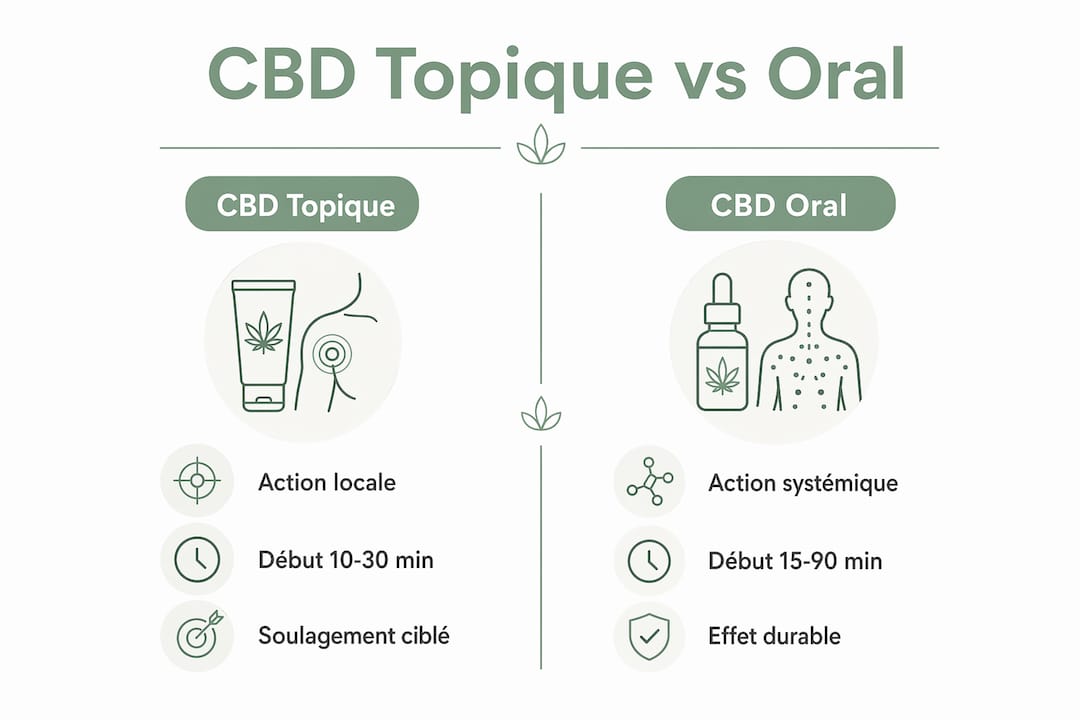
Topical CBD and oral CBD do not follow the same pathways in the body. This difference in mechanism explains why each form is suited to specific situations.
How does topical CBD work?
Topical CBD acts locally on the skin and underlying tissues. It stimulates CB1 and CB2 receptors found in the skin, reduces local inflammation and decreases nerve sensitivity at the application site, without significant passage into the bloodstream. This is precisely what makes it a targeted tool for localized pain. To learn more about this mechanism, the endocannabinoid system plays a central role in this modulation.
How does oral CBD work?
Oral CBD, whether in the form of a sublingual oil or a capsule, enters the bloodstream to act throughout the body. Sublingual bioavailability reaches 20–35%, making it the most effective oral route. Capsules, on the other hand, pass through digestion and provide a longer duration of action but a longer onset time.

The following table summarizes the key differences between the two forms:
| Criterion | Topical CBD | Oral CBD |
|---|---|---|
| Onset of action | 10–30 minutes | 15–90 minutes |
| Duration of effects | 2–6 hours | 4–12 hours |
| Area of action | Local (application site) | Systemic (whole body) |
| Passage into the bloodstream | Minimal | Yes |
| Common form | Cream, balm, patch | Oil, capsule, gummy |
Pro tip: If your pain is precise and localized (knee, shoulder, lower back), start with a topical product. If it is widespread or accompanied by fatigue and general inflammation, opt for the oral route.
What types of pain respond better to topical or oral CBD?
The choice between CBD for local or systemic pain depends primarily on the pain profile. CBD modulates pain perception through the endocannabinoid system without a direct anesthetic effect. This distinction is important: CBD does not eliminate pain instantly; it gradually reduces its intensity.
Pain better relieved by topical CBD:
- Knee or hip osteoarthritis (localized joint pain)
- Tendinitis and muscle contractures
- Post-exercise pain in a specific area
- Localized back pain
- Neck pain or tense trapezius muscles
Pain better relieved by oral CBD:
- Widespread chronic pain (fibromyalgia, polyarthritis)
- Neuropathic pain (sciatica, neuralgia)
- Systemic inflammation
- Pain related to stress or anxiety
- Migraines and recurrent headaches
The 2026 Cochrane review of 2,187 patients confirms that CBD has a moderate and variable effect on pain. 42% of regular users were able to reduce or stop taking nonsteroidal anti-inflammatory drugs (NSAIDs) after three months of use. This figure illustrates the real potential of oral CBD in managing chronic pain, provided it is used regularly and gradually. For a detailed overview of the types of pain relieved by CBD, the 2026 data provide useful insights.
Advantages and limitations of each route of administration
Each method of administration offers practical advantages and real limitations. Knowing both sides helps you make an informed choice.
The benefits of topical CBD
- Precise targeting: the action is concentrated on the application area, without affecting the rest of the body.
- Few systemic side effects: no drowsiness or digestive problems.
- Rapid onset: effects begin within 10–30 minutes, which is useful for pain flare-ups.
- Ease of use: direct application, with no complex dosage calculations.
The limitations of topical CBD
- Shorter duration of action (2–6 hours maximum).
- Limited effectiveness for superficial pain or pain close to the skin’s surface.
- Insufficient penetration for deep pain (deep-joint and visceral pain).
Advantages of oral CBD
- Prolonged action lasting 4–12 hours, suitable for chronic pain.
- Precise dosage that can be adjusted gradually.
- Effective for diffuse pain and systemic inflammation.
Limitations of oral CBD
- Possible side effects: drowsiness and gastrointestinal problems, especially at high doses.
- Longer onset of action, making it less suitable for immediate acute pain.
- Possible drug interactions, particularly with anticoagulants.
Pro tip: Choose full-spectrum products to benefit from the entourage effect, which enhances CBD’s action on pain. Always check the product’s certificate of analysis (COA) before purchasing.
How to combine topical and oral CBD for optimal relief?
A multimodal approach is the most effective strategy for managing pain with CBD. Practitioners recommend combining both forms: oral CBD for overall inflammation, and topical CBD for local pain flare-ups. Here is a practical five-step protocol:
- Start with a low dose of oral CBD. Begin with 5–10 mg per day, preferably in the evening to limit initial drowsiness. Maintain this dose for 3–7 days before increasing it.
- Add topical CBD in case of a pain flare-up. Apply a cream or balm directly to the affected area as soon as the pain intensifies locally. The effect begins within 10–30 minutes.
- Increase the oral dose gradually. Increase by 5–10 mg every 3–7 days until reaching 20–50 mg per day, depending on how you feel. Do not exceed this range without medical advice.
- Keep a tracking journal. Record your pain intensity, dose taken, and effects experienced each day. This tracking is essential for identifying your personalized optimal dose.
- Consult a doctor if the pain persists. CBD is a supplement, not a long-term treatment. In cases of severe or chronic pain, medical consultation remains essential.
Dosages and precautions for topical and oral CBD
Dosages vary depending on the route of administration and pain intensity. The table below summarizes practical guidelines for 2026:
| Parameter | Oral CBD | Topical CBD |
|---|---|---|
| Starting dose | 5–10 mg/day | Concentration 50–250 mg/ml |
| Target dose | 20–50 mg/day | Depending on the area and intensity |
| Time before lasting effects | 2–4 weeks | Immediate in the short term |
| Common side effects | Drowsiness, digestive problems | Rare; skin reaction possible |
| Drug interactions | Yes (blood thinners, etc.) | Very low |
| Recommended verification | COA, THC level < 0.3% | COA, active ingredients |
CBD acts cumulatively over 2–4 weeks when taken orally. This means lasting effects do not appear from the first day. Patience is a condition for success, not an option. For people subject to professional drug tests, full-spectrum CBD contains trace amounts of THC below 0.3% that may, in rare cases, produce a positive result. A broad-spectrum product or isolate is therefore preferable. The CBD safety guide for people with chronic illnesses explains these precautions in depth.
Key points
Topical CBD is suitable for localized, immediate pain, while oral CBD is preferable for chronic, diffuse, or systemic inflammatory pain, and combining them offers the best results.
| Point | Details |
|---|---|
| Topical vs. oral action | The topical form acts locally within 10–30 min; the oral form acts throughout the body within 15–90 min. |
| Duration of effects | The topical form lasts 2–6 hours; the oral form provides prolonged action for 4–12 hours. |
| Targeted types of pain | Topical for osteoarthritis and tendinitis; oral for chronic and neuropathic pain. |
| Gradual oral dosage | Start at 5–10 mg/day and increase gradually in increments up to 20–50 mg, depending on how you feel. |
| Combined approach | Combining both forms maximizes effectiveness, according to specialized practitioners. |
What experience has taught me about CBD and pain
After years of observing CBD users in Europe, one conclusion stands out: most disappointments stem from poorly calibrated expectations. People expect an immediate and total effect, as with a conventional painkiller. CBD does not work that way. It modulates, regulates, and supports. This is not a weakness; it is its nature.
What surprised me most was the real effectiveness of the combined approach for people suffering from chronic pain. A balm applied in the morning to an arthritic knee, combined with a sublingual oil taken in the evening, produces results that neither would have achieved alone. The key is consistency and patience.
The most frequent mistake I observe is using CBD as the sole answer to complex pain. CBD works best as part of a comprehensive approach that includes physical therapy, good sleep hygiene, and stress management. On its own, it remains limited. Combined with other practices, it can make a real difference.
Finally, product quality is non-negotiable. Poorly dosed CBD or CBD without a certificate of analysis will not produce any meaningful results. Choose verified products with a clear COA and a THC level compliant with European regulations.
— Rod
Discover Cbd-certified's CBD selection for pain relief
Cbd-certified is a European shop specializing in quality CBD products, with delivery available throughout the European Union, the United Kingdom, and Switzerland. The range covers all needs: sublingual oils, capsules, topical creams and balms, all sourced from certified producers with certificates of analysis available.
Whether you are looking for oral CBD to manage chronic pain on a daily basis or a topical product to target a specific area, Cbd-certified offers a selection suited to every profile. Discover all the available products at the CBD shop in Europe and get clear advice to make the right choice for your situation.
Frequently asked questions
What is the difference between topical and oral CBD?
Topical CBD acts locally on the application area via skin receptors, without entering the bloodstream. Oral CBD acts throughout the body after digestive or sublingual absorption.
Which CBD should you choose for joint pain?
For localized joint pain, such as knee osteoarthritis, topical CBD (cream or balm) is preferred. It acts directly on the affected area within 10–30 minutes.
How long does it take to feel the effects of oral CBD?
The effects of oral CBD begin within 15–90 minutes, depending on the form (sublingual oil or capsule). Lasting effects on chronic pain appear after 2–4 weeks of regular use.
Can topical and oral CBD be used at the same time?
Yes. Practitioners recommend combining both forms: oral CBD manages systemic inflammation, while topical CBD targets local pain spikes for more complete relief.
What are the side effects of oral CBD?
The most common side effects of oral CBD are drowsiness and gastrointestinal problems, especially at high doses. Drug interactions are possible, particularly with anticoagulants.