
CBD and Mental Health: Soothing Anxiety and Sleep
Finding a natural solution to soothe anxiety or sleep better is never simple given the confusion around CBD and THC. Many people in France hesitate to try CBD flower or resin for fear of psychoactive effects or dependence. Yet, according to the World Health Organization, CBD does not present potential for abuse or dependence and remains distinct from THC. This article clarifies misconceptions and helps you choose with confidence for your well-being.
Table of Contents
- Definition of CBD and misconceptions
- Types of CBD products and modes of action
- Effects of CBD on anxiety and sleep
- Risks, side effects, and interactions
- Legality of CBD in France and Europe
Key Points
| Dot | Details |
|---|---|
| Key definitions | CBD is a non-psychoactive cannabinoid from hemp, unlike THC which causes a “high.” |
| Health effects | CBD can help reduce anxiety and improve sleep quality without side effects related to intoxication. |
| Safe use | Consult a healthcare professional before using CBD, especially if you are taking medications, to avoid interactions. |
| Legality in Europe | CBD is legal in France and Europe as long as it contains less than 0.3% THC, but always check the certificates of analysis. |
Definition of CBD and misconceptions
CBD (cannabidiol) is a natural organic compound extracted from the hemp plant. Discovered in 1940, this cannabinoid represents up to 5% of certain hemp varieties. Unlike THC, CBD produces no psychoactive effect and would not “get you high.”
CBD acts differently from THC on your nervous system. While THC strongly binds to cannabinoid receptors, CBD acts weakly on these receptors, which explains why it does not create euphoria. Your neurotransmitters respond to its presence without altering your consciousness.
Here is an overview of the main differences between CBD and THC in the human body:
| Property | CBD | THC |
|---|---|---|
| Psychoactive effect | None, no euphoria | Present, causes a “high” |
| Risk of dependence | Very low, non-addictive | Real risk of dependence |
| Targeted receptors | Indirect action on the endocannabinoid system | Direct binding to CB1 receptors |
| Legality in France | Legal if < 0.3% THC | Illegal except for medical use |
Why misconceptions persist
Many confuse CBD and THC because both come from cannabis. It's like confusing sugar and salt: only one molecule changes, but the effect is completely different. The World Health Organization confirms that CBD does not present potential for abuse or dependence.
Here are the most common misconceptions:
-
“CBD will get me high”: False. No intoxicating effect, no mental alteration. You will remain yourself.
-
“CBD creates dependence”: False. Scientific studies show no mechanism of addiction.
-
“It’s hidden cannabis”: Partially true. CBD comes from hemp but without psychoactive effects.
-
“It has no scientific basis”: Partially false. Evidence exists for certain uses, notably severe childhood epilepsies.
What science really knows
CBD is the second most abundant active ingredient in cannabis, mainly extracted from industrial hemp. Researchers have shown that CBD works on several biological systems.
CBD is not addictive and is not associated with any public health problems according to the WHO.
But here’s the honesty: scientific evidence remains limited for many indications. Research on anxiety and sleep is progressing but still requires more studies to establish precise dosages and optimal protocols.
Pro tip: Before starting CBD, consult a healthcare professional. This allows you to check for possible interactions with other treatments and to define your ideal dosage.
Types of CBD products and modes of action
CBD comes in many different forms. Each format offers distinct advantages depending on your lifestyle and preferences. CBD products include oils, capsules, flowers, crystals, creams, and e-liquids for vaping.
Each format acts differently in your body. Absorption speed varies greatly depending on the path CBD takes to your bloodstream. This explains why some products work better for you than others.
The main types of products
Here are the most popular formats:
-
Oils and tinctures: Quickly absorbed sublingually, act within 15-45 minutes.
-
Capsules and gelcaps: Slowly digested, more gradual and lasting effect.
-
CBD flowers: Vaped or infused, offer optimal dosage control.
-
Crystals: 99% pure form, ultra-concentrated, very flexible in use.
-
Creams and balms: Local application for specific areas, minimally absorbed into the bloodstream.
-
E-liquids: Rapid inhalation, almost immediate effect like vaporization.
Each method corresponds to a different need. CBD extraction methods also influence the quality and purity of the final product.
This table compares the speed of action and duration of effect according to the main types of CBD products:
| Product type | Onset of effect | Duration of action |
|---|---|---|
| Sublingual oil | 15 to 45 minutes | 2 to 4 hours |
| Capsule/pill | 1 to 2 hours | 6 to 8 hours |
| Vaped flowers | 5 to 10 minutes | 1 to 2 hours |
| Cream/ointment | 30 to 60 minutes | 2 to 6 hours |
How CBD acts on your body
CBD works differently from THC. It does not bind directly to cannabinoid receptors in the usual way. Instead, CBD modulates the endocannabinoid system and influences several neurotransmitters.
Your body has a natural endocannabinoid system. CBD optimizes this system by preventing the breakdown of anandamide, a molecule that naturally enhances your well-being. It also acts on serotonin receptors responsible for your mood and sleep.
CBD influences serotonin, pain, and inflammation without intoxicating effects.
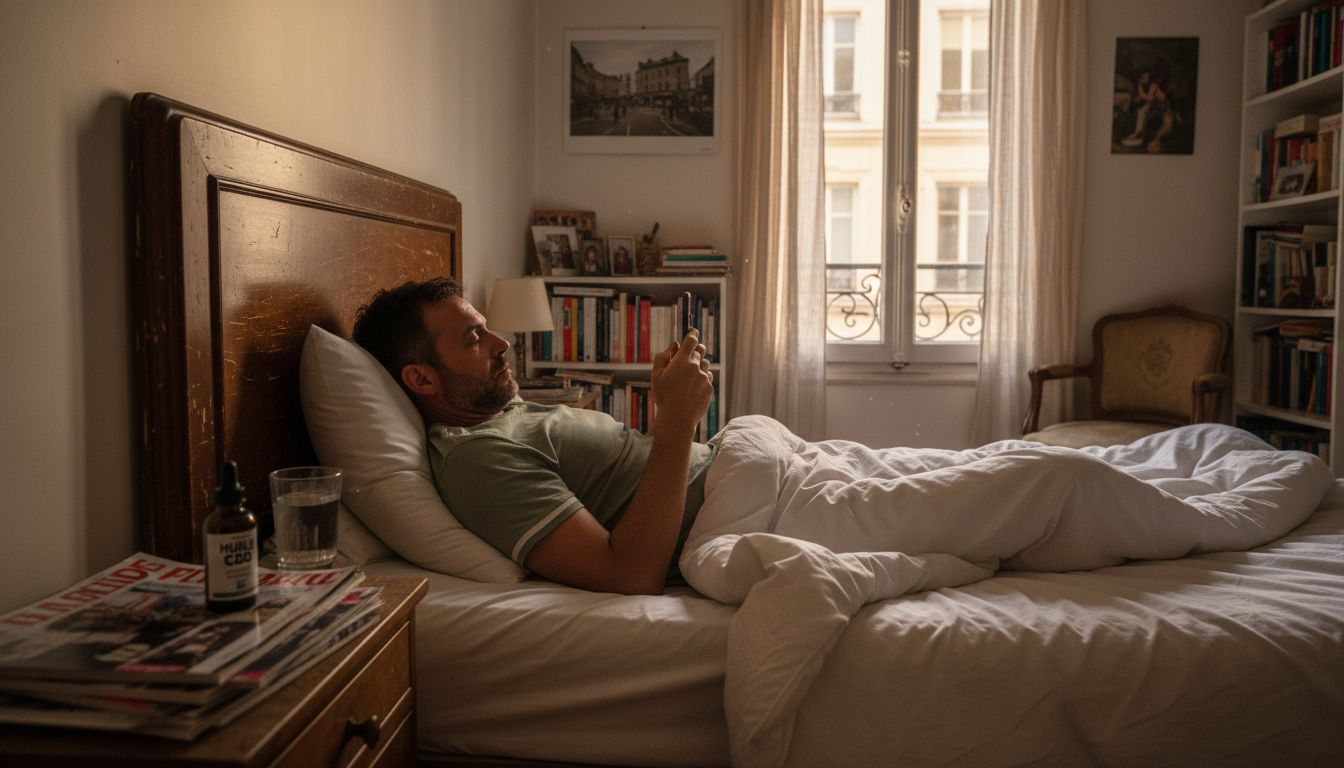
This is why CBD helps so much with both anxiety and sleep. Anxiety decreases through its action on serotonin. Sleep improves due to the overall relaxing effect on the central nervous system.
The analgesic and anti-inflammatory effects of CBD also explain why some people use it for chronic pain.
Pro tip: Start with a fast-absorbing format like sublingual oil if you want to test the effectiveness of CBD. You will feel the effects in 15-45 minutes, which makes dosage adjustment easier.
Effects of CBD on anxiety and sleep
Anxiety and insomnia are often linked. When you are anxious, your body stays alert, which prevents restorative sleep. CBD acts on both problems simultaneously by calming your nervous system.
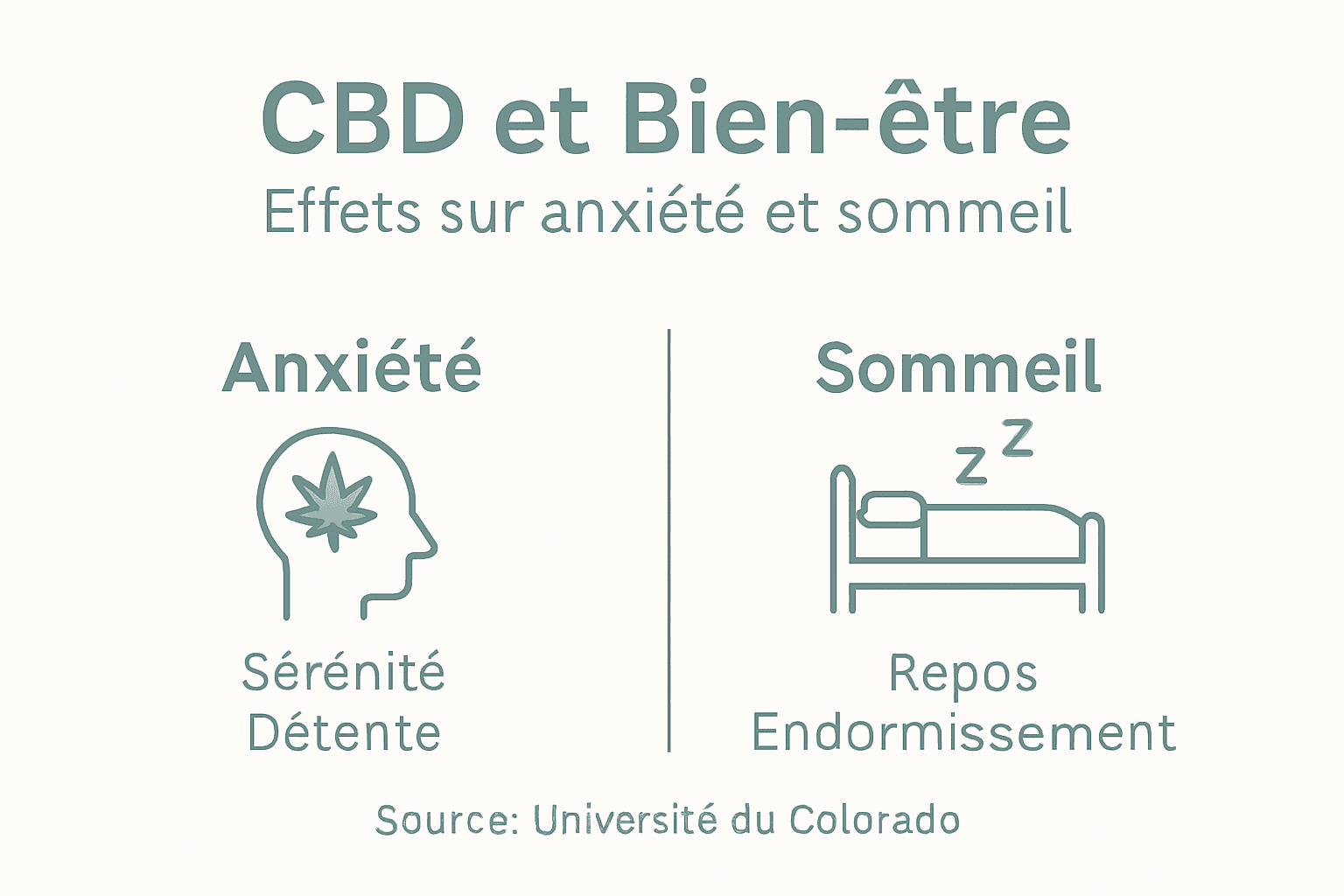
A study conducted by the University of Colorado confirmed that CBD-rich products reduce anxiety without producing the side effects of THC. Among 300 anxious participants, the use of CBD improved symptoms with a limited risk of adverse effects.
How CBD soothes anxiety
Anxiety arises when your brain perceives a threat. Your amygdala (the part of the brain responsible for fear) becomes overactive. CBD calms this excessive reaction by increasing serotonin.
Here is what happens concretely:
-
Your brain produces less cortisol (the stress hormone).
-
Soothing neurotransmitters become more active.
-
Your parasympathetic nervous system takes control (this is your “relaxation” mode).
-
Anxiety naturally decreases without sedation.
This gentle action explains why CBD does not make you drowsy during the day, unlike some pharmaceutical anxiolytics.
Sleep improvement
Quality sleep depends on two factors: anxiety and pain. CBD to improve sleep quality works by reducing these two obstacles. Without stress or pain, you fall asleep more easily.
CBD also acts on your natural circadian rhythm. It helps your body distinguish day from night by optimizing melatonin production. You go to bed tired and wake up more rested.
CBD reduces anxiety and pain, creating ideal conditions for deep sleep.
Results vary from person to person. Some sleep better from the first week. Others require two to three weeks of regular use. The quality of the product and your personal dosage play a crucial role.
Why not traditional medications
Synthetic anxiolytics often create dependence and side effects. CBD offers a natural approach without these risks. Your body does not develop tolerance: CBD works just as well after three months as at the start.
Pro tip: If you suffer from anxiety, start by taking CBD in the morning and afternoon. For sleep, a higher dose in the evening gives better results.
Risks, side effects, and interactions
CBD is generally well tolerated by most people. However, some side effects may occur, especially at high doses. Understanding these risks helps you use CBD safely.
Side effects remain mild and temporary. They often disappear after a few days of use. The good news: no risk of fatal overdose with CBD.
Common side effects
CBD can cause several minor side effects:
-
Dry mouth: The most common symptom. Drink more water to resolve it.
-
Diarrhea: Usually occurs at high doses. Reducing the dosage fixes the problem.
-
Decreased appetite: Some eat less during the first days.
-
Drowsiness: Especially during first use or with high doses.
-
Fatigue: Your body adapts to CBD within one to two weeks.
These effects are not dangerous. They simply indicate that your body is reacting to CBD. CBD side effects usually disappear quickly with dosage adjustment.
Serious drug interactions
CBD can interact with certain medications. These interactions alter the metabolism of your treatments, creating real risks. Your liver processes CBD exactly like some medications, creating metabolic competition.
Medications at risk include:
-
Anticoagulants (warfarin, direct oral anticoagulants).
-
Antiepileptics (phenytoin, levetiracetam).
-
Immunosuppressants (ciclosporin, tacrolimus).
-
Certain statins for cholesterol.
-
Antiarrhythmics and other heart treatments.
Consult your doctor before using CBD if you are taking prescription medications.
This consultation is not optional. It can prevent serious complications. Your pharmacist can also check for potential interactions with your current medications.
Quality and purity of products
A real risk exists: poorly dosed or contaminated CBD products. Some products contain less CBD than advertised, others contain problematic amounts of THC. Buying from reputable sources like a European CBD Shop reduces this risk.
Always check the supplier’s certificates of analysis. These tests verify purity and actual dosage.
Pro tip: Start with a low dose (5 to 10 mg per day) and gradually increase. Wait one week between each increase to observe how your body responds. This minimizes the risk of side effects.
Legality of CBD in France and Europe
The legality of CBD in France and Europe mainly depends on the THC content. The good news: pure CBD is legal in most European countries, including France. However, rules vary depending on the products and countries.
The confusion often comes from the distinction between CBD and THC. CBD alone is not a narcotic. Only THC is. This fundamental distinction explains why you can legally buy and consume CBD in France.
The situation in France
In France, CBD is legal as long as it meets certain strict conditions. The main rule: the final product must contain less than 0.3% THC. This limit exists throughout the European market.
Here is what is allowed in France:
-
CBD oils legally extracted with less than 0.3% THC.
-
CBD flowers from authorized hemp varieties.
-
Pure CBD crystals and isolates (0% THC).
-
Creams and cosmetics containing CBD.
-
Capsules and supplements.
What remains illegal: products containing more than 0.3% THC, even if they contain CBD. Always check the analysis certificates of your products.
European regulation
The legal frameworks of the European Union vary by member country, but all respect the minimum 0.3% THC limit. This harmonization facilitates cross-border trade within the EU. You can legally order CBD from another European country and receive it in France.
However, each country applies its own additional rules. Some countries require mandatory analysis certificates. Others strictly regulate health claims. Switzerland and the United Kingdom have also legalized CBD with similar rules.
CBD is legal in France and Europe if it contains less than 0.3% THC.
This legality offers protection to responsible consumers. You can buy with confidence from authorized sellers who comply with these regulations. The regulations for selling CBD also impose quality and transparency standards on sellers.
Buying CBD legally
To stay legal, follow these simple rules:
-
Buy from established sellers who provide analysis certificates.
-
Check that the product contains less than 0.3% THC on the certificate.
-
Keep your receipts and purchase documentation.
-
Never buy from dubious sources or without certification.
Reputable European CBD Shops all meet these criteria. You can order without legal risk in France and throughout Europe.
Pro tip: Before buying, ask the seller for the independent laboratory analysis certificate. This document proves the CBD content and compliance with legal THC limits.
Find a natural solution to soothe your anxiety and improve your sleep
Persistent anxiety and sleep disorders deeply affect your daily well-being. As explained in the article, CBD works by gently modulating the endocannabinoid system and balancing serotonin. This unique mechanism helps reduce stress while promoting restorative sleep without psychoactive effects or dependency. If you are looking to regain calm and serenity, it’s time to take action.
Discover now the products from European CBD Shop that comply with strict European standards to guarantee quality, purity, and effectiveness. Our sublingual oils, capsules, and other formats are specially designed to help you manage anxiety and insomnia quickly and safely. Enjoy reliable delivery within the European Union, the United Kingdom, and Switzerland.
Don’t wait for stress to become long-lasting. Choose a natural and recommended approach. To learn more about the benefits and uses of CBD, visit our page discover CBD and start your journey towards better sleep and mental health today at https://cbd-certified.com.
Frequently Asked Questions
What is the difference between CBD and THC?
CBD does not produce a psychoactive effect, unlike THC. CBD acts on the endocannabinoid system without altering consciousness, while THC is known for its euphoric effects.
How Does CBD Help Reduce Anxiety?
CBD increases serotonin in the brain, which calms the amygdala, the part responsible for fear. This helps reduce cortisol levels, the stress hormone, and decreases anxiety without causing drowsiness.
Which types of CBD products are most effective for sleep?
Sublingual oils and CBD flowers are often the most effective for sleep due to their rapid absorption. Capsules, although slower to act, offer a lasting effect, ideal for maintaining good sleep.
What are the potential side effects of CBD?
Common side effects include dry mouth, diarrhea, decreased appetite, drowsiness, and fatigue. These effects are generally mild and temporary and disappear with dosage adjustment.