
CBD flower laboratory analysis: 2026 guide
TL;DR:
- Laboratory analysis of CBD flowers makes it possible to verify their composition, legal compliance, and safety. A reliable COA indicates in particular the THC level, cannabinoid profile, and presence of contaminants, thereby guaranteeing product quality. Failing to analyze the flowers exposes consumers to legal and health risks, as well as false positives during roadside checks.
Laboratory analysis of CBD flowers is the reference method for verifying their exact composition, legal compliance, and safety. Without this CBD quality control, no consumer can know with certainty what they are consuming. Scientific techniques such as chromatography coupled with mass spectrometry make it possible to measure CBD, THC, and dozens of other compounds precisely. This guide explains how these analyses work, how to read a certificate of analysis, and why buying untested flowers poses a real risk.
How do laboratories analyze CBD flowers?
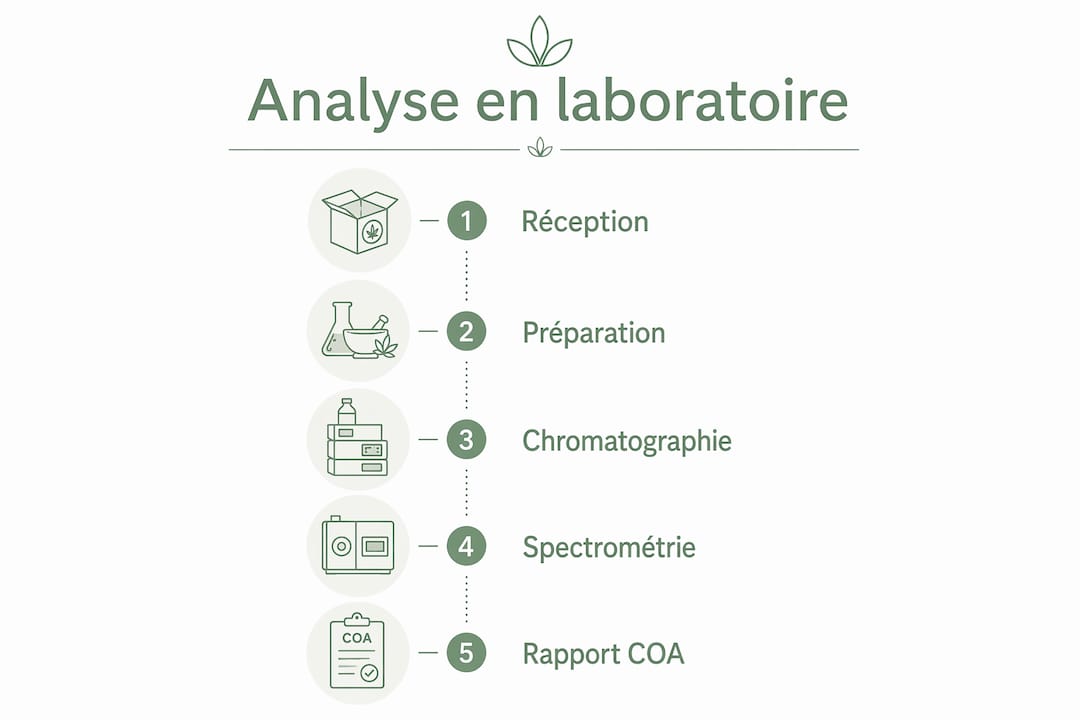
Laboratory analysis of CBD flowers relies on a structured protocol that goes well beyond simply measuring cannabidiol levels. Specialized laboratories, such as LABEXAN in France, carry out several distinct steps to obtain a complete product profile.
Here are the main methods used when testing CBD flowers:
- High-performance liquid chromatography (HPLC): the reference technique for measuring CBD, THC, and other cannabinoids present in the sample. It separates molecules according to their chemical affinity and enables precise measurement of concentrations.
- Gas chromatography (GC): used in particular to analyze terpenes and certain solvent residues. It is suitable for volatile compounds that HPLC does not detect as effectively.
- Mass spectrometry (MS): combined with chromatography, it identifies each molecule by its molecular mass. The typical analysis protocol measures both neutral and acidic CBD through solvent extraction followed by chromatography coupled with mass spectrometry for high precision.
- Microbiological tests: detect the presence of bacteria, molds, or yeasts that may develop on improperly stored or dried flowers.
- Testing for chemical contaminants: pesticides, heavy metals such as lead or cadmium, and solvent residues are systematically screened for in thorough analyses.
The analyses also include acidic cannabinoids such as THCA and CBDA, in addition to the neutral forms CBD and THC. This measurement is useful because THCA converts into THC when exposed to heat, changing the product’s actual profile during consumption.
Regarding turnaround times, laboratories such as LABEXAN provide results for flowers in an average of 7 days for microbiological and cannabinoid testing. This timeframe may be longer depending on the complexity of the requested analyses.
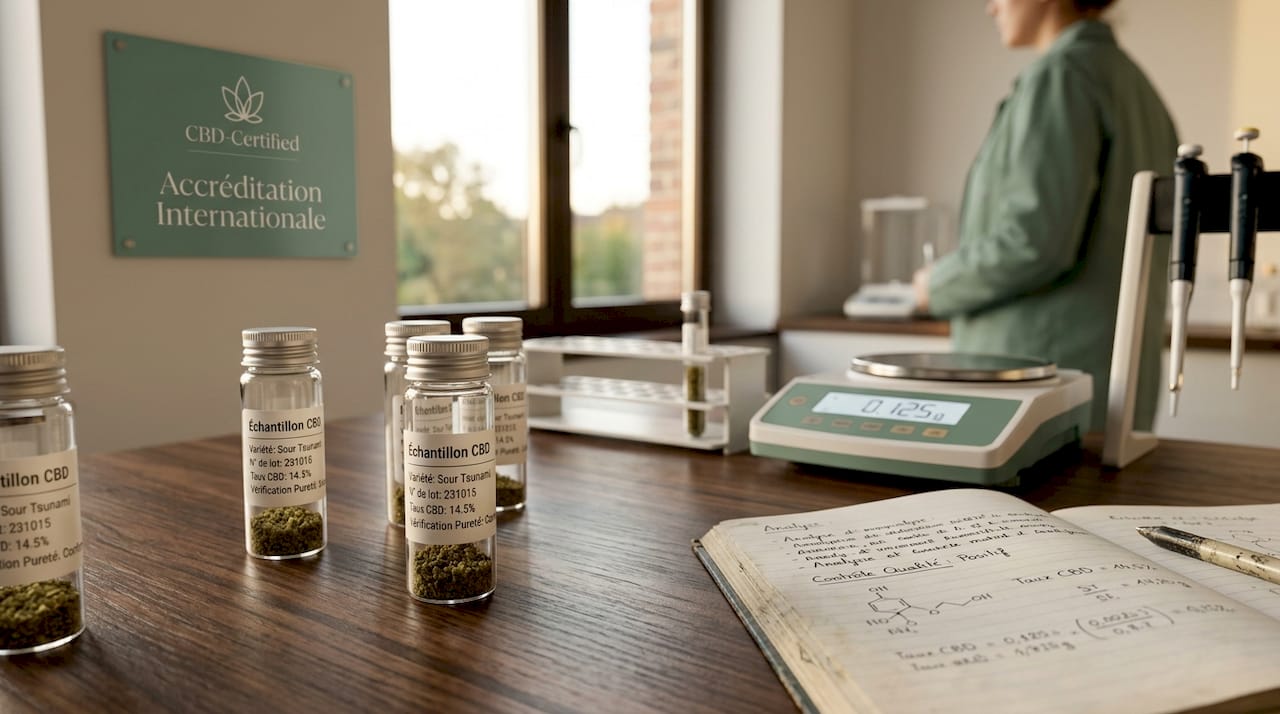
Pro tip: Always ask whether the laboratory that conducted the analysis is ISO 17025 accredited. This accreditation guarantees the reliability and reproducibility of the results.
How to interpret a certificate of analysis (COA)?
The certificate of analysis, called a COA (Certificate of Analysis), is the central document for any responsible purchase of CBD flowers. It summarizes all the results obtained during laboratory testing and allows consumers to verify the product’s compliance.
A reliable COA contains the following elements:
- Total CBD dosage: expressed as a percentage, it includes neutral CBD and converted CBDA.
- THC content: must remain below the legal threshold of 0.3% in Europe. Any exceedance makes the product illegal.
- Terpene profile: myrcene, limonene, linalool, and other aromatic compounds that influence the effects experienced.
- Microbiological results: confirmed absence of pathogens.
- Absence of contaminants: pesticides, heavy metals, and solvent residues below regulatory thresholds.
The distinction between neutral and acidic cannabinoids is often misunderstood. Neutral CBD is the active form directly available, while CBDA is its acidic precursor. A quality COA indicates both values separately. The transparency of independent analysis reports is key to building consumer trust in a market that remains opaque.
| COA element | What it indicates |
|---|---|
| Total CBD content | Actual cannabidiol concentration, including neutral and acidic forms |
| THC content | Legal compliance (European threshold: 0.3%) |
| Terpene profile | The product’s potential aromas and effects |
| Microbiological results | Absence of mold, bacteria, and yeast |
| Chemical contaminants | Absence of pesticides, heavy metals, and residual solvents |
To choose a reliable product, check that the COA is dated within the past 12 months, comes from a laboratory independent of the seller, and that the results correspond to the batch of the product you are buying. Knowing how to recognize quality CBD begins above all with carefully reading this document.
What are the risks if CBD flowers have not been analyzed?
Buying CBD flowers without a certificate of analysis entails real, not merely theoretical, risks. These risks concern both the consumer’s health and legal situation.
- Exceeding the legal THC limit: a poorly controlled product may contain more than 0.3% THC. Saliva tests detect THC, not CBD, with a detection threshold generally around 10 ng/mL. Even traces of THC in a CBD product can produce a positive result.
- Presence of synthetic cannabinoids: some unregulated products contain illegally added synthetic cannabinoids. The presence of more than 0.3% THC or synthetic cannabinoids often causes serious adverse effects.
- Undetected contamination: mold, pesticides, or heavy metals may be present without the consumer knowing, with short- or long-term health consequences.
- Legal consequences: a positive THC saliva test can lead to prosecution, even if the consumer thought they were buying a legal product.
False positives on saliva tests are mainly caused by accumulated traces of THC and test sensitivity, even with a certified COA. Some consumers carry their certificate of analysis with them to justify their situation in the event of a check.
It is advisable to wait at least 24 hours after consuming CBD before driving, to limit the risk of a positive THC result. To learn more about this topic, see the information on CBD and driving.
Pro tip: Always keep a digital copy of the product’s COA. In the event of a roadside check, this document can demonstrate that you purchased a compliant product.
Full spectrum, broad spectrum, or isolate: what are the differences in analysis?
The spectrum type of a CBD product directly determines what laboratory analysis will detect. This distinction is fundamental to understanding the risks associated with each profile.
Full-spectrum products contain THC up to the legal limit, broad-spectrum products are formulated without THC, and isolates contain only purified CBD. These profiles directly affect the composition detected during analyses and the risks associated with consumption.
| Spectrum type | THC detected in the analysis | Terpenes present | Risk of a false positive |
|---|---|---|---|
| Full spectrum | Up to 0.3% | Yes, complete profile | Moderate |
| Broad spectrum | Traces or absent | Yes, partial | Low |
| Isolate | Absent | No | Very low |
Full-spectrum products offer what researchers call the “entourage effect”: all the cannabinoids and terpenes work synergistically. However, this richness of composition means that THC is present, even in small amounts. For people subject to anti-doping tests or those who drive regularly, broad-spectrum products or isolates are more cautious options.
Laboratory analysis of an isolate is simpler: it essentially verifies the purity of the CBD and the absence of contaminants. For a full-spectrum product, the complete profile is more complex to interpret, as it is necessary to verify that each cannabinoid remains within legal limits. The benefits of CBD flowers also vary depending on the spectrum chosen, which further highlights the value of a detailed analysis to guide your choice.
Key points
Laboratory testing of CBD flowers is the only reliable way to verify their composition, legal compliance, and safety for consumers.
| Point | Details |
|---|---|
| Testing methods | HPLC chromatography and mass spectrometry are the reference techniques for measuring cannabinoids and contaminants. |
| Results turnaround time | Laboratories such as LABEXAN provide comprehensive results in an average of 7 days. |
| Reading the COA | Check the THC level (below 0.3%), CBD dosage, terpene profile, and absence of contaminants. |
| Risks without testing | Untested products may contain illegal THC, synthetic cannabinoids, or chemical contaminants. |
| Spectrum selection | Broad-spectrum and isolate products pose a lower risk of a false positive on a saliva test than full-spectrum products. |
What I learned after years of following the European CBD market
After observing the evolution of the CBD market in Europe since its beginnings, one reality stands out: most of the problems consumers encounter stem from a lack of information about testing, not from any bad faith on the buyers’ part.
I have seen regular consumers find themselves in delicate situations during roadside checks, not because they had bought a bad product, but because they did not know that even a compliant COA does not guarantee a negative saliva test. Sellers systematically undercommunicate this point.
What also strikes me is the variability of untested products. Two batches of the same variety from the same producer can have very different cannabinoid profiles depending on growing and drying conditions. Without batch-by-batch testing, this variability is invisible. The European CBD market is still marked by blind spots, and independent testing is the most effective way to restore trust.
My recommendation is simple: never buy CBD flowers without an accessible, dated COA issued by an independent laboratory. This document is not an administrative formality. It is your only real guarantee of what you are consuming.
— Rod
Where can you find certified and tested CBD flowers in Europe?
Cbd-certified selects CBD flowers whose every batch is accompanied by an accessible certificate of analysis issued by accredited independent laboratories. Products available on the platform comply with European legal THC limits and are tested for microbiological and chemical contaminants.
For European consumers who want to buy with confidence, Cbd-certified offers a selection of certified CBD shops with verifiable quality and traceability guarantees. Deliveries are available throughout the European Union, the United Kingdom, and Switzerland. Choosing a seller that makes its COAs public is not a luxury. It is the minimum standard for consuming safely.
FAQ
What Is a Certificate of Analysis (COA) for CBD Flowers?
A COA is a document issued by an independent laboratory that details the composition of a batch of CBD flowers: CBD and THC levels, terpene profile, and contaminant test results. It serves as proof of the product’s legal compliance and quality.
Can Full-Spectrum CBD Flowers Cause a False Positive on a Saliva Test?
Yes. Saliva tests detect THC at a threshold generally around 10 ng/mL, and traces of THC present in a full-spectrum product can trigger a positive result. It is advisable to wait at least 24 hours after consumption before driving.
How Long Does a Complete Laboratory Analysis of CBD Flowers Take?
Specialized laboratories such as LABEXAN provide results within 7 days on average for cannabinoid and microbiological testing. More complex analyses, including heavy metals and pesticides, may take longer.
What Is the Difference Between Neutral CBD and CBDA in an Analysis Report?
Neutral CBD is the directly available active form, while CBDA is its acidic precursor, which converts into CBD when exposed to heat. A complete COA lists both values separately to reflect the product’s actual composition.
Why Are Unanalyzed CBD Flowers Risky?
Without CBD laboratory analysis, it is impossible to verify the THC level, the presence of synthetic cannabinoids, or chemical contaminants. These factors can have serious legal and health consequences for consumers.