
Difference Between CBD Oil and CBD Flowers: 2026 Guide
TL;DR:
- CBD flowers are the dried flowering tops of the hemp plant, containing natural CBD and cannabinoids, with considerable variability in composition. CBD oil, derived from a concentrated extraction, offers precise dosing and greater stability, making it suitable for discreet, controlled use. The choice depends on personal preferences, intended use, and the legal framework, while remaining vigilant about quality and current legislation.
CBD is everywhere, yet confusion persists: many people think that CBD oil and flowers are interchangeable, or that one is necessarily better than the other. The reality is more nuanced. The difference between CBD oil and CBD flowers concerns their composition, method of use, perceived effects, and even the regulatory framework. This guide gives you the keys to understanding these two forms of CBD, choosing the one that suits your lifestyle, and using each safely.
Table of contents
- Key points
- Difference between CBD oil and CBD flowers: definitions
- Uses and effects compared
- Legal framework and safety in Europe
- How to choose between CBD oil and flowers
- Risks, precautions, and common misconceptions
- My opinion after years of observing how CBD is used
- Discover tested and certified Cbd-certified products
- FAQ
Key points
| Point | Details |
|---|---|
| Distinct composition | Flowers are the dried flowering tops of hemp; oil is a concentrated extract obtained through extraction. |
| Different method of administration | Inhalation (flowers) produces a rapid, short-lived effect; the sublingual route (oil) offers a gradual, long-lasting effect. |
| More reliable dosing with oil | The dose absorbed through flowers is difficult to reproduce, unlike oil dosed by drops. |
| Strict legal framework | CBD products must contain no more than 0.3% THC in Europe to be legal. |
| Choosing according to your profile | Beginners benefit more from the controlled dosage of oil; flowers are better suited to experienced users. |
Difference between CBD oil and CBD flowers: definitions
The distinction begins well before the store. These two products are not variations of the same thing. They come from the same source plant, but everything else differs.
CBD flowers
CBD flowers are the dried flowering tops of the female hemp plant (Cannabis sativa L.). They naturally contain CBD, along with other cannabinoids, terpenes, and flavonoids. This is known as the entourage effect: the compounds work together synergistically.
Their composition varies according to the cultivated variety, growing conditions, and harvest batch. CBD flowers therefore exhibit significant natural variability between batches, making reproducible use difficult without precise analyses. The CBD content may range from 5% to 25% depending on the strain.
CBD oil
The oil is a processed product. It is obtained by extracting CBD and other cannabinoids from the plant’s trichomes, then diluting them in a carrier oil (hemp oil, MCT oil, olive oil). The extraction methods directly affect the purity of the final product: supercritical CO₂ extraction remains the benchmark.
Here are the main characteristics that distinguish the two forms:
- CBD flowers: raw product, natural and variable composition, aromatic terpenes, used by inhalation or infusion
- CBD oil: processed product, precise CBD concentration, targeted formulations possible (broad spectrum, isolate, THC-free)
- Cannabinoid spectrum: the flowers retain the entire natural profile; some oils are formulated without THC, with a broad spectrum including CBG or CBN for potentially broader effects
- Stability: the oil is easier to store and provides a consistent concentration from one bottle to the next
Uses and effects compared
Knowing what each product is is not enough. What really matters is what you do with it and what you feel.

Comparison table: CBD oil vs. CBD flowers
| Criterion | CBD oil | CBD flowers |
|---|---|---|
| Route of administration | Sublingual, oral, topical | Inhalation (vaporization, combustion), infusion |
| Onset time | 15 to 45 minutes | 5 to 15 minutes |
| Duration of effect | 4 to 6 hours | 1 to 3 hours |
| Dosage precision | High (measurable drops) | Low (varies depending on quantity and method) |
| Discretion | Very discreet, odorless | Strong, not very discreet smell |
| Outdoor use | Easy | Socially difficult |
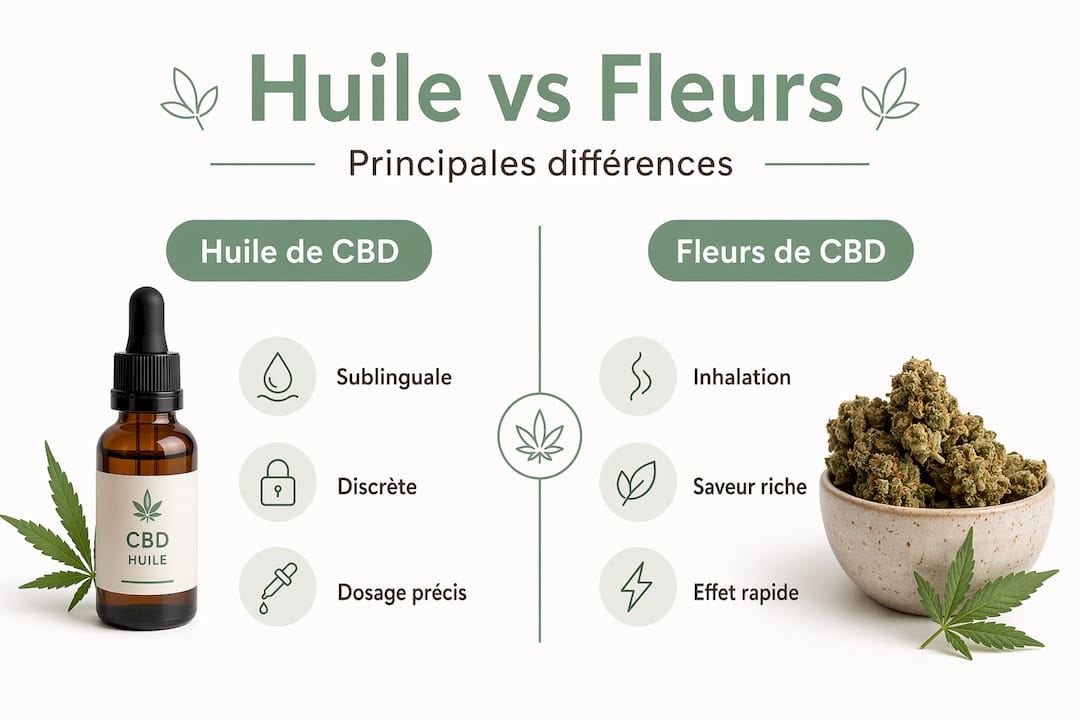
The route of administration determines how quickly the effect is felt and its nature: inhaling the flowers produces an almost immediate but brief effect, while sublingual oil takes longer to take effect but lasts longer.
For medicinal use or daily well-being, this difference in duration makes all the difference. Someone looking to manage anxiety during the day may prefer oil dosed in the morning. Someone seeking a quick aromatic break in the evening may turn to flowers.
Pro tip: Start with oil if you are a beginner. The ability to count your drops and adjust gradually fundamentally changes the experience.
Sublingual oil is odorless, discreet, and allows precise dosing, making it the obvious choice in a professional or public setting. Flowers, on the other hand, give off a recognizable odor and require equipment (a vaporizer or rolling paper), making them more suitable for home use or tolerant settings.
Legal framework and safety in Europe
CBD is not an illegal product, but it remains regulated. And the rules are not the same for flowers and oil.
-
THC limit: the legal limit for CBD products in Europe is a Δ9-THC content of ≤ 0.3%. Any product exceeding this threshold falls into the category of narcotics. This rule applies to both flowers and oils.
-
Mandatory traceability: verifying the THC content and maintaining complete traceability (certificates of analysis, purchase invoices, and batch laboratory analyses) are essential to guarantee the product’s legality and safety, particularly for flowers.
-
At-risk groups: the EFSA recommends a provisional safe level for food CBD of approximately 2 mg per day for a 70 kg adult. Safety has not been established for people under 25, pregnant or breastfeeding women, or people undergoing medical treatment.
-
Regulatory developments: food CBD will be subject to regulatory oversight from May 2026, directly affecting CBD oils and edible products. Buyers should ensure that their products comply with this new framework.
-
Combustion vs vaporization: burning CBD flowers produces the same toxic substances as smoked tobacco. Vaporization remains a less harmful alternative, but it does not eliminate all respiratory risks.
“The form (oil or flowers) does not eliminate safety concerns. EFSA emphasizes caution with dosage, regardless of the format used.”
To learn more about the specific French legal framework, Cbd-certified’s complete CBD France 2026 guide explains the current nuances.
How to choose between CBD oil and flowers
The question “CBD: oil or flowers?” has no universal answer. It depends on you: your objective, your lifestyle, your tolerance for the smell, and your experience with CBD.
Choose oil if you:
- Are new to CBD and want to control your dosage precisely
- Are looking for discreet use at work or while traveling
- Need a lasting effect over several hours
- Want to avoid inhalation for respiratory reasons
- Prefer to incorporate CBD into a structured daily routine
Choose flowers if you:
- Are already familiar with CBD and want a more natural experience
- Appreciate the sensory ritual associated with use (smell, texture, preparation)
- Look for a rapid effect to manage a moment of occasional stress
- Use a vaporizer and seek to optimize the inhalation experience
- Primarily consume it at home in a private environment
The choice between oil and flowers largely depends on your preferred way of using them and the social context, with discretion potentially being a decisive factor. A professional who uses CBD to manage daily anxiety does not face the same constraints as a recreational user who consumes it at home in the evening.
Pro tip: If you are still unsure, start with a broad-spectrum oil or one enriched with CBN or CBG. You get the plant’s entourage effect without the constraints of inhalation.
Mixed formats also exist. Some users combine oil in the morning for its duration of action with vaporized flowers in the evening for faster effects. This gradual approach allows you to refine your use without committing to a single format.
Risks, precautions, and common misconceptions
The fact that CBD is non-psychoactive does not mean that it has no side effects or legal restrictions. A few points deserve particular attention.
- Myth of “100% risk-free”: even without THC or with legal THC, CBD can interact with certain medications (particularly blood thinners and antiepileptic drugs). Consult a doctor if you are taking medication.
- Saliva tests and driving: traces of THC in flowers can lead to penalties during roadside checks despite a legal level. Do not drive after consuming CBD flowers.
- Vulnerable populations: the safety of CBD has not been established for people under 25, pregnant or breastfeeding women, or people taking medication. These groups should avoid any use without medical advice.
- Product quality: buy only products whose batch laboratory analyses are accessible and verifiable. A product without a certificate of analysis guarantees neither the stated CBD level nor the absence of contaminants.
- Combustion: smoking CBD flowers with tobacco or even on their own remains the most harmful method for the respiratory tract. Low-temperature vaporization is preferable if you want to inhale.
My opinion after years of observing how CBD is used
I have seen it dozens of times: people arrive with a fixed idea, convinced that flowers are more “authentic” or that oil is more “serious.” The reality I have observed is quite different.
Oil is unbeatable for beginners. Reproducible dosing, discretion, and no smell… these are concrete advantages that make a difference when you are trying to incorporate CBD into a routine. I have seen too many beginners misdose their flowers and conclude that CBD “doesn’t work” for them, when it was simply a matter of dose variability.
That said, flowers have a value that oil does not. The ritual, the smell, the preparation process: for some experienced users, it is an integral part of the experience. This is not nostalgia; it is a sensory reality that matters.
My advice: don’t pit the two formats against each other. Understand what each one offers you, and choose based on your stage of life, not on a trend or generic recommendation. Also beware of simplistic claims about therapeutic effects. CBD has potential, but it does not replace medical follow-up, and the form you choose does not fundamentally change that reality.
— Rod
Discover tested and certified Cbd-certified products
Cbd-certified offers a carefully selected range of CBD oils and flowers, with laboratory analyses available for every batch. Looking for a broad-spectrum oil without THC? The Nobilis CBN + CBG + CBD THC-free formulation is a practical option for exploring the benefits of a broader cannabinoid spectrum without compromising legality. Prefer a CBN-rich format for relaxation? The CBN + CBD broad-spectrum oil is also available. All deliveries are insured within the EU, the United Kingdom, and Switzerland. Browse the store and compare each product’s profiles before buying.
FAQ
What is the main difference between CBD oil and flowers?
CBD flowers are the raw product of the hemp plant, consumed by inhalation or infusion. Oil is a concentrated extract used sublingually, offering more precise dosing and greater discretion.
Can you legally smoke CBD flowers in France?
Yes, provided the THC content remains below 0.3%, in accordance with European regulations. However, combustion poses health risks, and traces of THC may trigger a positive result in a roadside drug test.
Is CBD oil more effective than flowers?
Not necessarily. Oil offers more reliable dosing and a longer-lasting effect, but flowers act more quickly. Effectiveness depends on your goal and consumption profile.
Which form is best for beginners?
CBD oil is generally recommended for beginners because it allows you to adjust the dose gradually and precisely, reducing the risk of overconsumption.
Are all CBD oils identical?
No. Formulations vary: full-spectrum, broad-spectrum, isolate, with or without THC, enriched with CBG or CBN. Always check the batch certificate of analysis before buying.