
CBD Popularity Europe 2026: 72% of patients relieved
The European CBD market has exploded with a 300% increase in searches and sales in three years. Millions of people are turning to this natural molecule to manage chronic pain, anxiety, and insomnia. In the face of this massive enthusiasm, legitimate questions arise about the real effectiveness of CBD, its limitations, and its legal framework. This article deciphers the scientific mechanisms, analyzes recent clinical evidence, and clarifies European regulations to help you understand this phenomenon and adopt an informed use.
Table of contents
- Key points to remember
- Introduction to the CBD phenomenon in Europe
- Mechanisms of CBD action to relieve pain, anxiety, and insomnia
- Critical review of recent scientific evidence on CBD
- Myths, limitations, and controversies surrounding CBD
- European regulations and their impact on the CBD market
- Specific use cases and testimonials
- Practical advice for choosing and consuming CBD effectively
- Conclusion: toward a better understanding and use of CBD
- Discover our certified and compliant CBD products in Europe
- Frequently asked questions about CBD's popularity
Key points to remember
| Point | Details |
|---|---|
| Mechanism of action | CBD acts through the endocannabinoid system to modulate pain, anxiety, and sleep. |
| Clinical effectiveness | 72% of fibromyalgia patients have replaced opioids with CBD, demonstrating its therapeutic potential. |
| Favorable legal framework | European regulations set a THC threshold at 0.2%, ensuring product legality and safety. |
| Recognized limitations | CBD is not effective for all chronic pains; quality and dosage determine the results. |
| Safety of use | Side effects affect less than 5% of users according to recent clinical trials. |
Introduction to the CBD phenomenon in Europe
The European cannabidiol market is experiencing spectacular growth. Interest in CBD has increased by more than 300% in three years, reflecting a profound shift in attitudes toward natural health solutions. This rise is explained by several converging factors.
Consumers are looking for natural alternatives to traditional pharmaceutical treatments. Three uses dominate the market:
- Management of chronic pain (osteoarthritis, fibromyalgia, migraines)
- Reduction of daily anxiety and stress
- Improvement of sleep quality and treatment of insomnia
The European regulatory framework has played a decisive role in this expansion. By setting a legal THC threshold at 0.2%, the European Union has created a favorable environment for the legal marketing of CBD. This legal clarity reassures consumers and encourages companies to develop compliant products.
Confidence is also growing thanks to the benefits of CBD documented by scientific research. Clinical studies are increasing, providing tangible evidence of cannabidiol’s effectiveness for certain conditions. This solid scientific foundation is transforming the perception of CBD, shifting it from a niche product to a credible therapeutic solution.
CBD’s mechanisms of action to relieve pain, anxiety, and insomnia
CBD exerts its effects via the endocannabinoid system, a complex network of receptors present throughout the body. This system regulates many vital functions such as pain, mood, sleep, and inflammation.
Cannabidiol mainly interacts with two types of receptors. CB1 receptors, concentrated in the brain and nervous system, influence pain perception and emotions. CB2 receptors, found in the immune system and peripheral tissues, modulate inflammation and immune responses.
A key action of CBD is to increase levels of anandamide, a natural neurotransmitter nicknamed the “bliss molecule.” Anandamide plays a crucial role in regulating mood, managing stress, and perceiving pain. By blocking the enzyme that breaks down anandamide, CBD prolongs its beneficial effects.
CBD also activates TRPV1 receptors, involved in the perception of pain and temperature. This interaction contributes to cannabidiol’s anti-inflammatory and analgesic properties. Recent studies confirm this significant reduction in anxiety thanks to these multiple mechanisms.
Cannabidiol also modulates several key neurotransmitters:
- Serotonin: improves mood and reduces anxiety
- GABA: promotes relaxation and sleep
- Glutamate: regulates neuronal excitation and pain
Pro tip: Choose the form of administration based on your goal. Sublingual oil acts quickly for acute anxiety, capsules offer gradual release for sleep, and topicals target localized pain. This targeted approach optimizes the therapeutic use of CBD according to your specific needs.
Critical review of recent scientific evidence on CBD
Clinical research on CBD is intensifying, providing evidence of its effectiveness. A meta-analysis combining five independent studies confirms a moderate but significant reduction in neuropathic pain in patients treated with CBD. These results validate cannabidiol’s therapeutic value for specific pains.
The most striking statistic concerns patients with fibromyalgia. 72% of them successfully replaced their opioids with CBD, thus reducing the risks of dependence and serious side effects. This impressive substitution rate highlights CBD’s potential as an alternative to traditional painkillers.
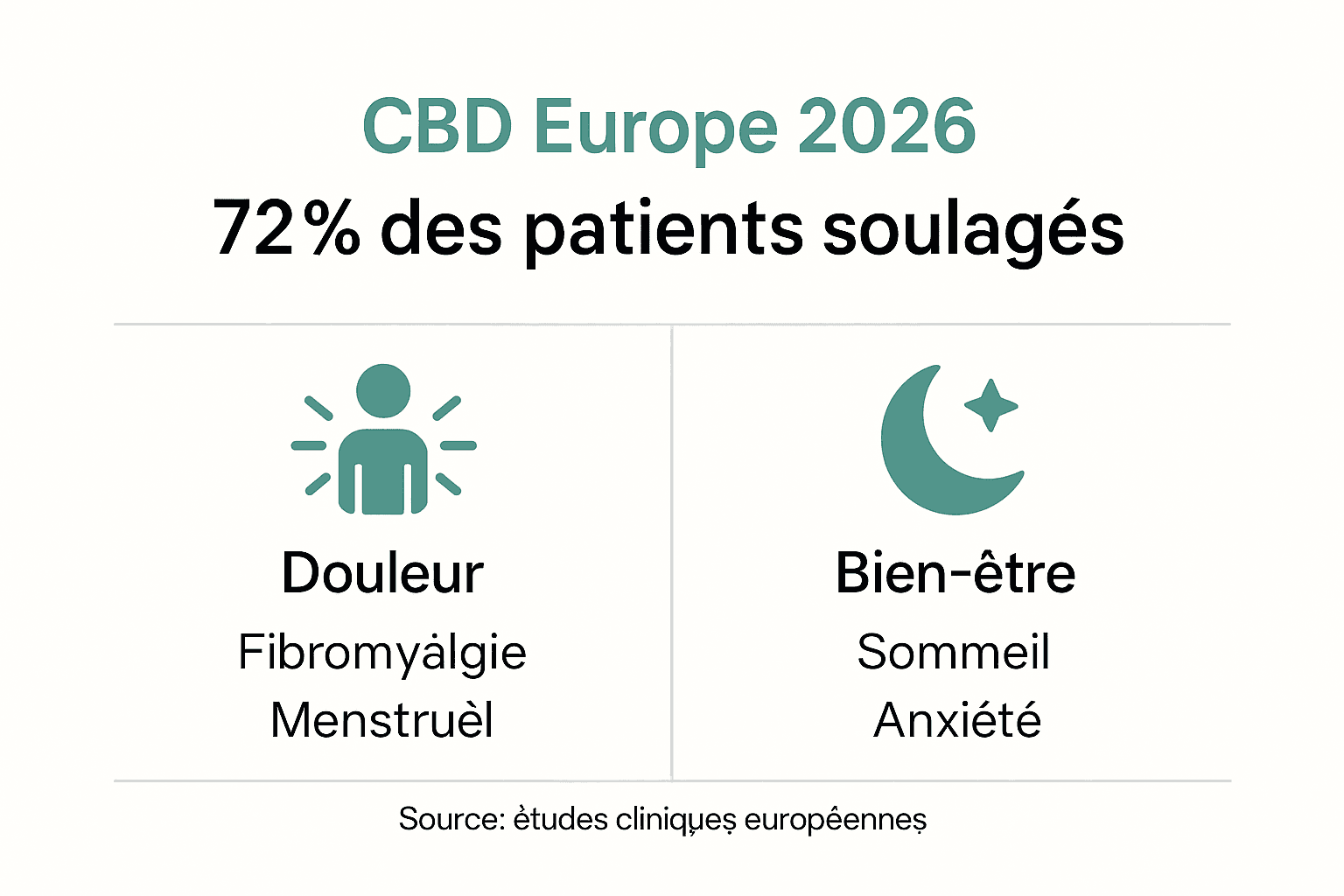
For sleep disorders, the data is also encouraging. Pilot studies report a 20 to 40% improvement in sleep quality among participants regularly using CBD. These modest but consistent gains help many people regain restorative rest without relying on traditional sleeping pills.
Research on anxiety shows promising results. Academic work demonstrates a significant reduction in social anxiety symptoms after CBD administration. Participants report less nervousness, better ability to face stressful situations, and overall improvement in emotional well-being.
| Condition | Improvement rate | Study source |
|---|---|---|
| Neuropathic pain | Moderate reduction | Meta-analysis of 5 studies |
| Fibromyalgia | 72% opioid substitution | Observational study |
| Insomnia | 20 to 40% improvement | Pilot studies |
| Social anxiety | Significant reduction | University of Cambridge |
A particular use case deserves attention. CBD tampons significantly reduce menstrual pain in women suffering from dysmenorrhea. This targeted application demonstrates cannabidiol’s versatility for different types of pain.

Pro tip: Always examine the methodology of cited studies. Check the sample size, follow-up duration, and presence of a control group. These criteria determine the reliability of the conclusions. Recent high-quality clinical studies provide the best evidence to assess CBD’s effectiveness on pain. Explore our solutions for anxiety and insomnia based on this evidence.
Myths, Limits, and Controversies Around CBD
Despite the enthusiasm, CBD is not a universal cure-all. Some chronic pains resist cannabidiol treatment, notably acute inflammatory pain or certain complex neuropathies. Effectiveness varies considerably depending on the type of pain and individual patient characteristics.
Product quality is a critical factor often overlooked. Poorly formulated products containing impurities or inaccurate CBD concentrations will not produce the expected effects. Inappropriate dosing is also a common cause of therapeutic failure. Too low, CBD provides no benefit; too high, it can cause adverse effects.
Side effects, although rare, do exist. Clinical trials report less than 5% adverse effects, mainly mild fatigue, digestive issues, or dry mouth. These symptoms are generally mild and disappear with dosage adjustment. However, be cautious of drug interactions, especially with anticoagulants or certain antiepileptics.
A persistent myth confuses CBD and THC. Unlike tetrahydrocannabinol, CBD causes no psychoactive effects or cognitive impairment. You will not experience euphoria, altered perception, or mental deficiency. This fundamental distinction explains why CBD enjoys a favorable legal status. Discover the CBD and THC differences to understand their respective properties.
Regulatory compliance protects consumers. Non-compliant products, illegally imported or containing THC levels above the authorized limits, unfortunately circulate on the market. These products expose users to legal and health risks. Always prioritize certified sources that comply with European standards.
List of essential points of caution:
- Individual variability in response to CBD
- Need for an adaptation period of 2 to 4 weeks
- Importance of the administration method according to the therapeutic goal
- Risk of interactions with prescribed medications
- Variable quality of products available on the market
Understanding these effectiveness limits of CBD helps set realistic expectations and optimize its use.
European regulation and its impact on the CBD market
The European legal framework structures the CBD market and guarantees consumer safety. The European Union imposes a maximum threshold of 0.2% THC in all legally marketed cannabidiol products. This strict limit ensures the absence of psychoactive effects while preserving the therapeutic properties of CBD.
The United Kingdom maintains similar rules since Brexit, with some administrative specifics. CBD products there are classified as dietary supplements and must obtain prior authorization. Switzerland adopts a slightly different approach, allowing a THC threshold up to 1%, reflecting a more permissive policy.
| Jurisdiction | Legal THC threshold | Product status | Authorization required |
|---|---|---|---|
| European Union | 0,2% | Dietary supplement | Depends on member country |
| United Kingdom | 0,2% | Dietary supplement | Yes (Novel Food) |
| Switzerland | 1,0% | Therapeutic use | Varies by canton |
This clear regulatory framework stimulates the growth of the legal market. Consumers gain confidence knowing that compliant products meet strict quality and safety standards. Serious companies invest in traceability, independent laboratory testing, and full transparency about composition.
The CBD sales regulations are constantly evolving. Some EU member countries add additional requirements regarding labeling, advertising, or therapeutic claims. This gradual harmonization aims to protect consumers while promoting responsible innovation.
Strict compliance with these standards distinguishes reliable players from opportunistic sellers. Always verify that your supplier can prove product compliance with recent certificates of analysis. This diligence legally protects you and guarantees the effectiveness of your purchase.
Specific use cases and testimonials
The practical applications of CBD demonstrate its real therapeutic potential. A notable clinical study tested CBD-infused tampons on 63 women suffering from dysmenorrhea. The results show a significant reduction in menstrual pain, with 78% of participants reporting notable relief from the first cycle of use.
Testimonials from patients with endometriosis reveal remarkable improvements. They describe a decrease in chronic pelvic pain, a reduction in digestive cramps, and an overall better quality of life. These qualitative reports complement clinical data by illustrating the daily impact of CBD.
Managing professional stress is a growing use in Europe. Thousands of people incorporate CBD into their routine to better handle work pressures, reduce anticipatory anxiety, and maintain stable emotional balance. The absence of a sedative effect allows full functionality while benefiting from anxiolytic properties.
Sleep disorders are a major indication. Users report:
- Faster falling asleep (reduced sleep latency)
- Deeper and more restorative sleep
- Less frequent nighttime awakenings
- Improved feeling of rest upon waking
Popular and compliant products include full-spectrum sublingual oils, extended-release capsules for sleep, and topical balms for localized joint pain. These varied formats allow therapeutic use of CBD to be tailored to individual needs.
User testimonials emphasize the importance of a personalized approach. What works for one person may require adjustments for another. Patience and guided experimentation are essential to find the optimal dosage and formulation.
Practical advice for choosing and using CBD effectively
Choosing a quality CBD product starts with verifying its traceability. Request certificates of analysis issued by independent laboratories. These documents confirm the exact CBD concentration, absence of contaminants (pesticides, heavy metals, solvents), and compliance with the legal THC limit.
The optimal dosage varies according to the therapeutic goal:
- Mild anxiety: 10 to 15 mg per day
- Sleep disorders: 15 to 25 mg one hour before bedtime
- Moderate chronic pain: 20 to 40 mg divided into two doses
- Acute inflammation: 25 to 50 mg depending on intensity
Always start with the minimum recommended dose. Increase gradually in 5 mg increments every three days until the desired effect is achieved. This titration approach minimizes side effects and identifies your personal therapeutic dose. Consult our guide on CBD dosing for detailed recommendations.
The method of administration affects effectiveness and speed of action. Sublingual oil offers rapid absorption (15 to 30 minutes), ideal for acute anxiety. Capsules provide a gradual release over 6 to 8 hours, perfect for sleep or chronic pain. Topicals act locally without systemic absorption, targeting specific painful areas.
Caution regarding drug interactions. CBD inhibits certain liver enzymes that metabolize many medications. It is essential to consult a healthcare professional if you are taking anticoagulants, antiepileptics, or immunosuppressants. This precaution helps avoid potentially serious complications.
Pro tip: Store your CBD products away from direct light, heat, and humidity. Cannabinoid degradation reduces their effectiveness. An opened bottle of oil can be kept for 6 months in the refrigerator. Follow our workflow to choose CBD products suited to your profile and goals.
Conclusion: towards a better understanding and use of CBD
CBD has scientifically validated benefits for certain neuropathic pains, anxiety disorders, and insomnia. Clinical evidence is accumulating, confirming its therapeutic potential and safety when used in a controlled setting. The impressive rate of 72% of fibromyalgia patients substituting their opioids illustrates this real potential.
However, effectiveness depends on critical factors. Product quality, accurate dosing, and compliance with European legal frameworks determine the results. A poor-quality product or inappropriate dosage will not produce the expected effects, unnecessarily fueling skepticism.
Side effects remain rare and generally mild. Fewer than 5% of users report unwanted symptoms, mostly light and temporary. This favorable safety profile positions CBD as a credible alternative to conventional treatments for specific indications.
The European CBD market continues to grow thanks to clear regulations and solid clinical evidence. This positive momentum encourages innovation, improves product quality, and strengthens consumer trust. The future looks promising for this natural molecule with multiple therapeutic properties.
Adopt an informed, responsible, and legally compliant use. Consult reliable sources, prioritize certified products, and don’t hesitate to seek advice from healthcare professionals. This enlightened approach maximizes benefits while minimizing risks.
Discover our certified and compliant CBD products in Europe
Are you looking for reliable and legal CBD products to relieve your pain, improve your sleep, or manage your stress? European CBD Shop offers you a carefully selected range of cannabidiol compliant with the strictest European regulations. Each product undergoes independent laboratory testing to guarantee purity, concentration, and absence of contaminants.
Our team supports you in choosing the product suited to your specific needs. Consult our comprehensive guide to buy CBD online safely. Enjoy fast delivery across the EU, the UK, and Switzerland, with dedicated customer service to answer your questions. Discover why we are recognized as the best CBD shop in Europe by thousands of satisfied customers. Optimize your CBD product choice with our expertise.
Frequently asked questions about CBD popularity
What are the most common side effects of CBD?
CBD side effects remain rare and mild. Less than 5% of users report side effects such as temporary fatigue, minor digestive issues, or dry mouth. These symptoms usually disappear with dosage adjustment. Always follow dosage recommendations to minimize any risk.
How to choose a CBD product compliant with European regulations?
Always check that the product contains less than 0.2% THC to comply with European legislation. Request recent certificates of analysis issued by independent laboratories. Favor transparent brands offering full traceability from hemp cultivation to the finished product.
Can CBD interact with my medications?
Yes, CBD can interact with certain medications, especially blood thinners, antiepileptics, and immunosuppressants. It inhibits liver enzymes responsible for metabolizing many drugs. Always consult your doctor or pharmacist before combining CBD with medications. This precaution prevents potentially serious complications.
Is CBD effective for all types of chronic pain?
No, CBD is not effective for all types of chronic pain. It mainly works on specific neuropathic pain and certain inflammations. Its effectiveness varies significantly depending on the cause, intensity, and location of the pain. A trial period of 2 to 4 weeks allows you to assess its effect on your particular condition.
Which form of CBD is recommended for insomnia?
CBD oil taken 30 to 60 minutes before bedtime is the most popular option for insomnia. It provides a gradual effect that promotes natural falling asleep. Capsules or pills offer a convenient alternative with extended release throughout the night. Start with 15 to 25 mg and adjust according to your individual response.