
CBD and THC: What Changes for Your Well-Being
Finding serenity or restorative sleep drives many Europeans toward CBD, but confusion often reigns between CBD and THC. This distinction is essential because, unlike THC, CBD does not cause psychoactive effects or euphoria, according to data from the United States Centers for Disease Control and Prevention. You will discover how these two molecules act differently and why it matters to choose a solution that fits your wellness needs.
Table of Contents
- CBD and THC: definitions and misconceptions
- Distinct effects: anxiety, sleep, well-being
- Why THC is psychoactive, CBD is not
- Legality: European, UK, and Swiss framework in 2026
- Risks, precautions, and choosing a CBD product
Key Points
| Dot | Details |
|---|---|
| Differences between CBD and THC | THC is psychoactive and causes a "high," while CBD is non-psychoactive and does not affect mental state. |
| Therapeutic use of CBD | CBD can reduce anxiety and improve sleep without psychoactive side effects. |
| Legality of CBD in Europe | CBD is legal in the European Union as long as the THC content is below 0.2%. |
| Choosing a quality CBD product | Check the origin, certification, THC content, and extraction method to ensure safety and effectiveness. |
CBD and THC: definitions and misconceptions
Cannabis is a complex plant composed of many compounds, but two molecules particularly draw attention: CBD (cannabidiol) and THC (tetrahydrocannabinol). These two cannabinoids share similar origins but have radically different effects on our body.
Understanding these differences is essential to demystify certain misconceptions. Contrary to popular belief, CBD and THC do not produce the same physiological reactions. Can you really get "high" with CBD? Let’s explore the main characteristics of these two fascinating molecules.
Here are the main differences between CBD and THC:
- THC : Psychoactive molecule that causes a "high"
- CBD : Non-psychoactive molecule that does not alter mental state
- Legal effects : THC remains strictly regulated, unlike CBD
- Interaction : Each molecule interacts differently with brain receptors
Their interaction with our endocannabinoid system is particularly interesting. The entourage effect suggests that these compounds can work synergistically, potentially offering broader therapeutic benefits when combined.
Pro tip: Always consult a healthcare professional before incorporating cannabinoid-based products into your wellness routine.
Distinct effects: anxiety, sleep, well-being
CBD and THC influence our body in radically different ways, especially regarding stress management, sleep, and mental well-being. Each cannabinoid interacts only with our brain receptors, producing distinct physiological and psychological effects.

For people suffering from anxiety, CBD represents a particularly promising natural alternative. The anti-stress effects of CBD can significantly reduce anxiety symptoms without the psychoactive effects associated with THC. The mechanisms of action involve a complex interaction with the endocannabinoid system, regulating cortisol levels and promoting a state of relaxation.
Regarding sleep, the results are equally encouraging:
- Reduction in time to fall asleep
- Improvement in deep sleep quality
- Reduction of nighttime awakenings
- Natural regulation of sleep cycles
Strategies to improve sleep suggest that CBD can help restore a balanced circadian rhythm without the side effects of traditional medications.
Overall well-being involves a holistic approach. CBD acts as a subtle modulator, supporting emotional and physiological balance without altering consciousness. Its ability to reduce inflammation, decrease stress, and promote relaxation makes it a valuable ally for mental health.
Pro tip: Start with minimal doses and gradually increase to observe your individual response to CBD.
Here is a comparative overview of the impact of CBD and THC on different aspects of well-being:
| Appearance | CBD | THC |
|---|---|---|
| Anxiety | Natural stress reduction | Can cause anxiety in some |
| Sleep | Promotes deep relaxation | Can disrupt sleep cycles |
| Mental well-being | Supports emotional balance | Can alter mental perception |
| Therapeutic use | Commonly used for anxiety disorders | Mainly recreational use and pain |
Why THC is psychoactive, CBD is not
The difference between THC and CBD mainly lies in their unique interaction with our nervous system. These two molecules, although from the same plant, produce radically different effects on our body.
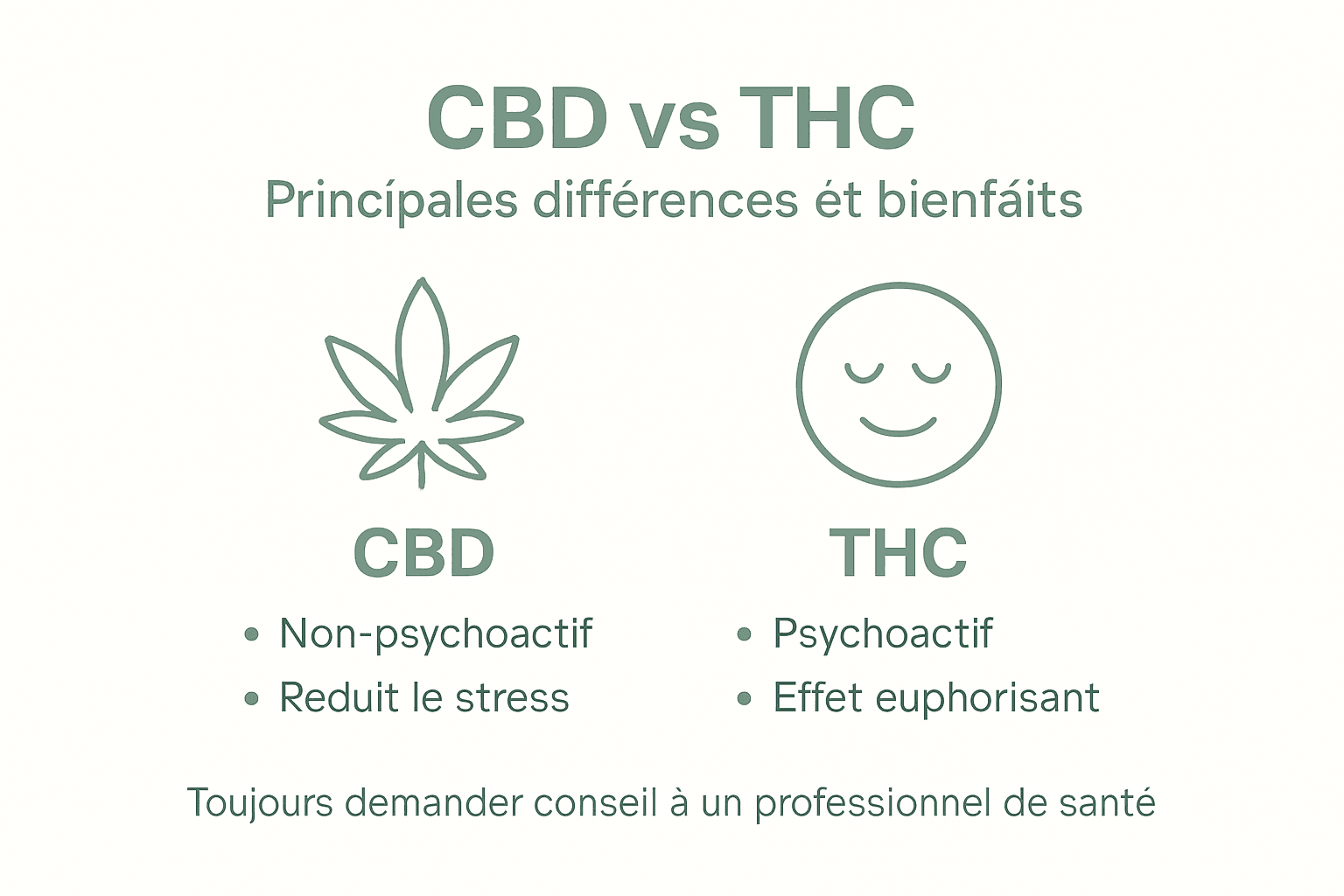
The distinct properties of CBD are based on a specific molecular structure that prevents any direct interaction with brain receptors responsible for psychoactive effects. Chemically, THC has a unique ability to bind directly to CB1 receptors, mainly located in the brain and central nervous system.
The mechanisms of action differ fundamentally:
- THC: Directly activates CB1 receptors
- CBD: Indirectly modifies signal transmission
- THC: Causes a euphoric state
- CBD: Maintains mental clarity
This structural difference allows THC to trigger significant changes in consciousness, while CBD acts as a subtle regulator. CBD can even mitigate some psychoactive effects of THC, playing a role as a complex neuronal modulator.
CBD does not produce altered consciousness, unlike THC which can profoundly change perception.
Pro tip: Always choose products whose composition is clearly analyzed and certified to precisely understand the proportion of cannabinoids.
Legality: European framework, UK and Switzerland in 2026
The legal landscape of CBD in Europe is rapidly evolving and complex, with regulations varying significantly between countries. The legal situation is becoming increasingly nuanced, requiring a precise understanding of national specifics.
CBD sales regulations differ significantly between various European territories. In the European Union, the general trend is towards progressive liberalization, but with strict conditions regarding the allowed THC level.
Here is an overview of the main regulations:
- European Union: CBD legal if THC level is below 0.2%
- United Kingdom: 0.2% THC limit, post-Brexit regulation
- Switzerland: Authorized THC level up to 1%, more flexible legislation
- France: Stricter restrictions, enhanced administrative controls
Marketing conditions remain strictly regulated. Sellers must provide certificates of analysis, guaranteeing product compliance with current regulatory standards.
The legality of CBD is constantly evolving: stay informed of the latest regulations before any purchase.
Pro tip: Always check the certifications and analyses of your CBD products, ensuring their legal compliance.
Risks, precautions, and choosing a CBD product
Choosing a quality CBD product requires a methodical and informed approach. The variety of products on the market demands constant vigilance to ensure safety and effectiveness.
The potential side effects of CBD must be carefully evaluated before any consumption. Some drug interactions may occur, especially with treatments metabolized by the liver.
Essential criteria for selecting a CBD product:
- Origin: European or Swiss source
- Certification: Full analysis available
- THC level: Below 0.2%
- Extraction method: Preferably supercritical CO2
- Culture: Organic and pesticide-free
Special attention must be given to vulnerable populations. Pregnant women, people under medical treatment, and minors should consult a healthcare professional before any use.
The quality of a CBD product is measured by its transparency and traceability.
Pro tip: Always request the full certificate of analysis before any CBD product purchase.
To choose a reliable CBD product, compare the following essential criteria:
| Criteria | Why it is important | Consequence if neglected |
|---|---|---|
| Product origin | Quality and traceability guarantee | Risk of unwanted substances |
| Laboratory certification | Legal compliance assurance | Lack of credible analysis |
| Extraction method | Purity and safety of CBD | Possible residues or contaminants |
| Organic cultivation | Absence of pesticides | Adverse health effects |
Discover how CBD can transform your well-being starting today
Navigating between the effects of CBD and THC can seem complex, especially when it comes to reducing stress, improving sleep, or supporting your emotional balance. Facing these challenges, it is essential to choose safe, legal products perfectly suited to your needs. On our site CBD Certified you will find a rigorous selection of products meeting European and Swiss standards, guaranteeing total quality and transparency.
Don’t let anxiety or sleep disorders affect your daily life anymore—explore now the anti-stress effects of CBD and discover our tips to improve your sleep with CBD. Act today for natural well-being without psychoactive effects. Visit CBD Certified to choose the solution that fits your needs and enjoy our fast deliveries in Europe, the UK, and Switzerland.
Frequently Asked Questions
What are the main differences between CBD and THC?
CBD (cannabidiol) is non-psychoactive and does not alter mental state, while THC (tetrahydrocannabinol) is psychoactive and causes a "high."
How can CBD help manage anxiety?
CBD can reduce anxiety symptoms without the psychoactive effects associated with THC by interacting with the endocannabinoid system to regulate cortisol levels and promote relaxation.
What precautions should be taken when using CBD products?
It is recommended to consult a healthcare professional before using CBD products, especially if you are pregnant, undergoing medical treatment, or a minor. Always start with minimal doses.
What is the impact of CBD on sleep?
CBD can promote better sleep by reducing the time it takes to fall asleep, improving the quality of deep sleep, and decreasing nighttime awakenings.