
Role of CBD in Europe: regulations and benefits 2026
TL;DR:
- CBD in Europe is primarily regulated by the Novel Food regulation, which prohibits the sale of food products containing CBD without approval. Ingestible oils, herbal teas, and edible products have been prohibited in France since 2026, while flowers and e-liquids remain permitted in some countries. Scientific research confirms limited benefits, particularly for epilepsy, but emphasizes the need for caution because of gaps in safety data.
Cannabidiol (CBD) is defined as a non-psychoactive compound extracted from cannabis, and CBD’s role in Europe today is shaped by two inseparable fronts: regulation and health. Since 2026, the rules governing its commercialization have become considerably stricter, particularly with the strict enforcement of the European Union’s Novel Food regulation. Understanding this framework is essential whether you are a consumer, producer, or simply curious to know what you can legally buy in your country.
What are the key regulatory frameworks defining the role of CBD in Europe?
In Europe, CBD is subject to several distinct regulations depending on the product’s form and intended use. EU Regulation 2015/2283 on novel foods (Novel Food) is the central legislation for any CBD product intended for ingestion. Under this framework, foodstuffs containing CBD are not authorized for sale because their safety has not yet been demonstrated satisfactorily. In practical terms, this means that ingestible oils, herbal teas, and CBD candies are subject to an active ban.
The European Food Safety Authority (EFSA) published its initial conclusions on CBD in 2022 and confirmed them in February 2026: significant gaps remain in the available safety data. EFSA nevertheless set a provisional safe level of 0.0275 mg/kg/day, but only for supplements containing CBD with a minimum purity of 98%, no nanoparticles, and no established genotoxic risk. This extremely restrictive threshold illustrates how much regulatory compliance depends on the product’s exact formulation, not just the CBD molecule itself.
Since May 15, 2026, France’s Directorate General for Food (DGAL) has been strictly enforcing this Novel Food framework. Food products containing CBD are being removed from store shelves, while e-liquids and smokable flowers remain permitted because they do not fall under food regulations. This distinction is fundamental to understanding what is legally available today.
Here are the main categories of CBD products and their current regulatory status in Europe:
- Sublingual oils and capsules for ingestion: subject to Novel Food and not authorized without an approval dossier validated by EFSA.
- CBD herbal teas, candies, and infused foods: withdrawn from the market in countries that strictly apply Novel Food.
- CBD cosmetics: regulated by the European Cosmetics Regulation and generally tolerated because they are not ingested.
- CBD e-liquids: governed by the directive on tobacco products and related products, and authorized in most countries.
- Flowers and resins for smoking: status varies by country, but they are not covered by Novel Food.
Pro tip: Before buying a CBD product online, always check whether it is classified as a food product or not. An e-liquid or a flower for smoking falls under a different legal framework than an oil intended for ingestion, and this distinction makes all the difference to its legality in your country.
| Product category | Novel Food status | Example of a country where it is authorized |
|---|---|---|
| CBD oil for oral consumption | Subject to regulation, not authorized without approval | No EU country to date |
| CBD cosmetics | Not subject to regulation | France, Germany, the Netherlands |
| CBD e-liquid | Not subject to regulation | France, Belgium, Spain |
| CBD flowers for smoking | Not subject to regulation (varies) | Switzerland, Austria, Italy |
| CBD food supplements | Subject to regulation, highly restrictive | No EU country to date |
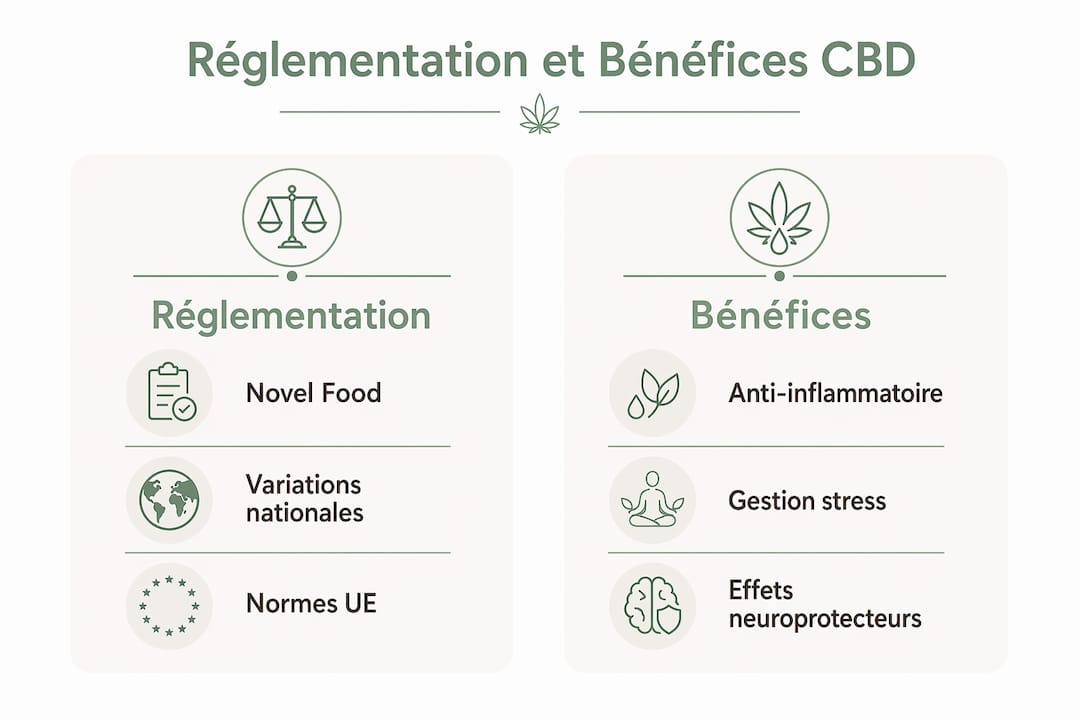
How does CBD regulation vary between European countries?
The regulations vary considerably from one European country to another, even within the European Union. Although the Novel Food Regulation theoretically applies to all Member States, its practical enforcement varies depending on the national authorities. This disparity creates a confusing situation for consumers who travel or order online.
A few concrete examples illustrate these differences:
- Switzerland: as a non-EU country, Switzerland permits CBD flowers with a THC content below 1%, which is more permissive than the European threshold of 0.2%.
- Germany: since the partial legalization of recreational cannabis in 2024, CBD has benefited from a more open framework, particularly for flowers and e-liquids.
- France: strict enforcement since May 2026, with CBD food products withdrawn while flowers and e-liquids remain available.
- The Netherlands: historical tolerance for certain products, but gradual alignment with the Novel Food framework.
- Italy: CBD flowers occupy an ambiguous legal area, alternating between tolerance and bans depending on the period.
These disparities have direct consequences for the market. Sudden bans lead to the mass withdrawal of products and threaten several thousand jobs in the European CBD industry. Local producers, particularly in France and Italy, are forced to reformulate or reposition their entire product ranges to remain legal.
| Country | CBD flowers | CBD oil for oral consumption | E-liquids | Cosmetics |
|---|---|---|---|---|
| France | Authorized | Banned (Novel Food) | Authorized | Authorized |
| Germany | Authorized | Uncertain status | Authorized | Authorized |
| Switzerland | Authorized (THC ≤ 1%) | Tolerated | Authorized | Authorized |
| Italy | Ambiguous | Banned | Authorized | Authorized |
| Netherlands | Tolerated | Banned | Authorized | Authorized |
To navigate this fragmented landscape, it is useful to consult an up-to-date European guide on the history and development of CBD regulations, which places these differences in their historical context.
What are the health benefits attributed to CBD, and what does science say?
CBD for well-being is often presented as a natural solution for relaxation, stress management, and certain types of pain. Scientific research confirms several potential effects, but with important nuances. According to Inserm, CBD has recognized relaxing and anti-inflammatory properties, and its use in certain conditions such as epilepsy is documented. The medicine Epidyolex, based on pure CBD, is also authorized in Europe to treat certain severe forms of epilepsy.
The most studied benefits include:
- Anxiety reduction: several studies show that CBD has anxiolytic effects, particularly in situations involving temporary stress.
- Anti-inflammatory properties: CBD interacts with the endocannabinoid system to modulate inflammatory responses.
- Sleep aid: users report improved sleep quality, although clinical evidence remains limited.
- Chronic pain management: used as an adjunct in certain neuropathic pain protocols.
- Refractory epilepsy: this is the best-documented indication and the only one to have received medical authorization in Europe.
“CBD offers real therapeutic possibilities, but research remains insufficient to validate widespread uses beyond severe epilepsy.” Source: Inserm, 2024.
The EFSA emphasizes that the potential toxicity of CBD to the liver, endocrine, nervous, and reproductive systems warrants increased caution. Groups for whom safe consumption has not been established include pregnant women, people under 25, and those undergoing medical treatment. This caution does not mean that CBD is dangerous for everyone, but that its use should be adapted to each person’s individual profile.
Pro tip: If you take medication, consult a healthcare professional before using CBD, even in the form of flowers or e-liquids. CBD may interact with certain treatments, particularly anticoagulants.

To learn more about CBD products for well-being and their practical uses in 2026, detailed resources tailored to the current European context are available.
What are the different forms of CBD on the European market?
The distinction between ingestible and non-ingestible CBD is the most important dividing line in today’s European market. A CBD product intended to be swallowed falls under the Novel Food regulation and faces severe restrictions. A product intended to be inhaled, applied to the skin, or used in another way does not follow the same rules. This regulatory distinction explains why some products disappear from stores while others remain available.
Specifically, here is what this changes for you as a consumer:
- Sublingual CBD oil: if it is designed to be swallowed, it is subject to the Novel Food regulation and is therefore not authorized. If it is presented solely for external or aromatic use, the regulatory framework is different.
- CBD flowers: they are not foodstuffs and remain available in many European countries, including France.
- CBD e-liquids: governed by regulations on vaping products, they are legal in the majority of EU countries.
- Cosmetics: CBD creams, balms, and serums are generally permitted because they are not ingested.
The difference between CBD oil and CBD flowers deserves particular attention, as many consumers confuse these two forms and their respective legal status. Buying with full awareness protects both your health and your compliance with local law.
Pro tip: Prioritize retailers that clearly indicate the regulatory classification of their products. A reputable seller specifies whether its CBD oil is intended for external or edible use and provides independent laboratory analyses.
Key points
CBD’s role in Europe is primarily defined by the Novel Food regulation, which prohibits food products containing CBD without prior EFSA authorization, while leaving flowers, e-liquids, and cosmetics within a more accessible legal framework.
| Point | Details |
|---|---|
| Novel Food and edible CBD | CBD oils and food products are banned in the EU without EFSA approval, and have been withdrawn in France since May 2026. |
| EFSA safety threshold | 0.0275 mg/kg/day only for CBD with 98% purity, which excludes nearly all commonly available products. |
| Differences between countries | Switzerland, Germany, and France apply different rules, particularly to flowers and e-liquids. |
| Documented health benefits | Severe epilepsy, anxiety, and inflammation are the effects best supported by scientific evidence to date. |
| At-risk groups | Pregnant women, people under 25, and those taking medication should avoid CBD without medical advice. |
What I am observing on the ground in 2026
After years of following the development of the European CBD market, I am struck by the gap between public perceptions of CBD and its regulatory reality. Many consumers still think that “legal CBD” means “CBD freely available in all forms.” That has not been true since 2026, and it was not entirely accurate before then either.
What concerns me more is the impact on small producers. The strict application of the Novel Food regulation since May 2026 illustrates how well-intentioned European rules can weaken entire agricultural sectors. French and Italian producers who had built their businesses around CBD oils and herbal teas now have to rethink everything within a few months.
Regarding health benefits, I remain convinced that CBD has a real role to play, particularly in managing stress and mild pain. But self-medication without reliable information is a risk that many people underestimate. EFSA’s caution is not bureaucratic conservatism: it reflects a scientific reality, namely that we still lack solid data on long-term effects. Using CBD responsibly, by choosing compliant products and following dosage recommendations, remains the best approach.
— Rod
Buy CBD compliant with European standards from Cbd-certified
Cbd-certified offers a selection of CBD products that strictly comply with the European regulations in force in 2026. Every product available on the platform comes with independent laboratory analyses, guaranteeing purity and traceability.
Whether you are looking for CBD flowers, e-liquids, or cosmetics, Cbd-certified gives you simple and secure access to legal products, with delivery available throughout the EU, the United Kingdom, and Switzerland. Discover the full selection on the best CBD shops in Europe page to find products suited to your needs and country.
FAQ
Is CBD legal throughout Europe?
CBD is not uniformly legal in all its forms across Europe. Flowers and e-liquids are generally permitted, but CBD food products are prohibited in countries that strictly apply the EU Novel Food regulation.
What is medical CBD and how does it work?
Medical CBD refers to the therapeutic use of cannabidiol, notably through the medicine Epidyolex, authorized in Europe for certain severe epilepsies. CBD acts on the endocannabinoid system to modulate pain, inflammation, and anxiety.
What are the natural sources of CBD?
CBD is extracted mainly from the Cannabis sativa L. plant, particularly industrial hemp varieties with low THC content. Hemp flowers, leaves, and stems are the parts richest in cannabidiol.
Why have CBD oils disappeared from shops in France?
Since May 15, 2026, the DGAL has been strictly enforcing the Novel Food regulation, which prohibits CBD food products without prior EFSA authorization. CBD oils intended for ingestion, herbal teas, and CBD candies have therefore been removed from the French market.
Is CBD safe for everyone?
No. The EFSA explicitly excludes pregnant women, people under 25, and those taking medication from an established safe-consumption recommendation. These groups should consult a doctor before using CBD.