
History of CBD in Europe: Origins and Regulation
TL;DR:
- CBD has a long history in Europe, having been cultivated since the Bronze Age for its fibers and medicinal uses. Fragmented and strict regulations, particularly the ban on food products in France in 2026, complicate its market. Scientific research and European harmonization remain essential to ensuring quality, safety, and market access.
CBD occupies a paradoxical place in European society today. A legal product in most countries, it remains subject to rules that change rapidly and vary from one Member State to another. Understanding the history of CBD in Europe means grasping why this market is so complex today. From the first hemp cultivation in the Bronze Age to the EFSA’s recent decisions in 2026, this article traces the major stages of this evolution, current legal issues, and what every consumer or curious reader needs to know to find their way.
Table of Contents
- Key Points
- The Historical Origins of Hemp in Europe
- Scientific discoveries about CBD
- Evolution of CBD legislation in Europe
- The regulatory situation in 2026
- Current market issues and outlook
- My view on this development
- Find compliant CBD products at Cbd-certified
- FAQ
Key Points
| Point | Details |
|---|---|
| Hemp Cultivated Since Antiquity | Hemp was used in Europe long before CBD was scientifically recognized, for its fibers and medicinal uses. |
| Mechoulam, Founder of Modern Research | The exact structure of CBD was determined in the 1960s, clearly distinguishing CBD from THC. |
| Fragmented Regulation in Europe | Each Member State applies its own rules, creating a legal patchwork that is difficult to navigate. |
| Food Ban in France in 2026 | Since May 15, 2026, food products containing CBD have been banned in France under the Novel Food Regulation. |
| Market Awaiting Harmonization | The EFSA has set provisional thresholds, but broad authorization remains conditional on solid scientific evidence. |
The Historical Origins of Hemp in Europe
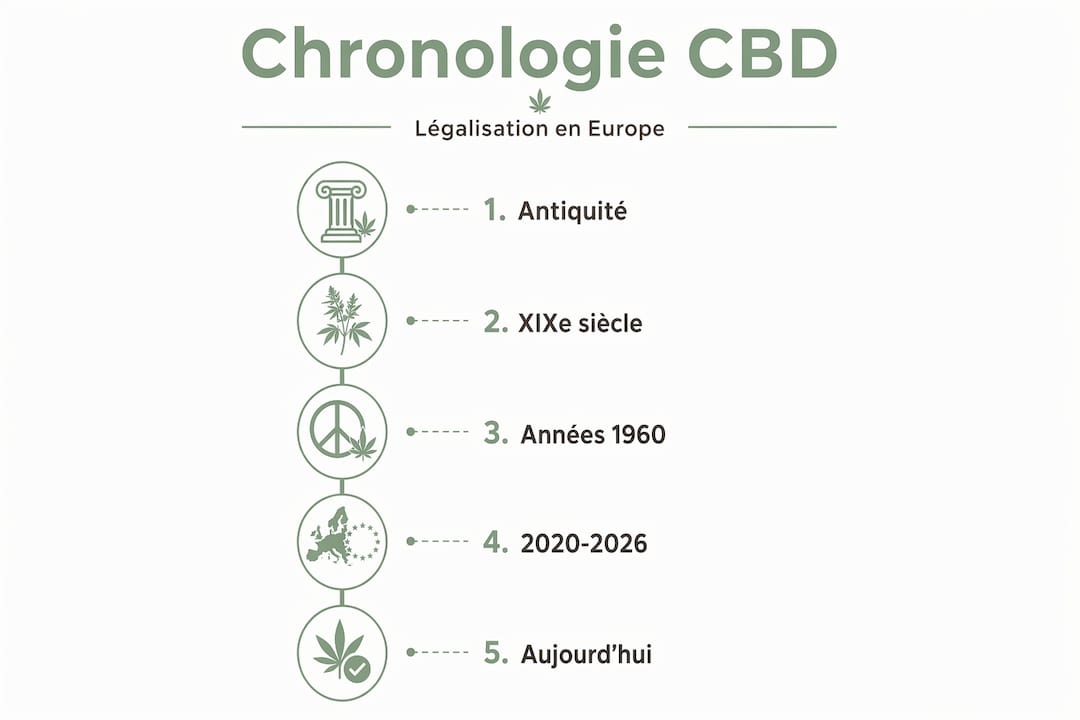
The history of CBD in Europe does not begin in a laboratory. It begins in a field. Hemp was cultivated in Europe as early as the Bronze Age, long before anyone knew what cannabidiol was. Its fibers were used to make ropes, clothing, and sails. Its seeds provided a rich food source. And its medicinal properties were already recognized empirically.
In medieval Europe, hemp was an ordinary cultivated plant, much like flax or nettle. Herbalists used it to soothe pain and promote sleep. Monasteries grew it for both practical and therapeutic purposes. At the time, there was no distinction between industrial hemp and psychoactive cannabis. This conceptual separation is much more recent.
Here are the main functions of hemp in ancient Europe:
- Textiles and industry: production of ship sails, ropes, and coarse fabric, used extensively until the 18th century
- Folk medicine: topical applications for joint pain, oral preparations for sleep disorders
- Food: pressed seeds provided an oil consumed in several regions of Northern Europe
- Agriculture: a soil-enriching plant, often grown in rotation with other crops
Pro tip: If you want to understand why CBD is now associated with wellness uses, look to European medicinal traditions. They show that this association is not a recent marketing invention.
Perceptions of cannabis shifted in the 19th century under the influence of colonial policies and the first international conventions on narcotics. Hemp, once commonplace, gradually became suspect. The history of cannabis in Europe shows that this transformation was not scientific in nature. It was primarily political and cultural.
Scientific discoveries about CBD
Modern research on cannabidiol truly began in the 1940s, when chemists succeeded in isolating several compounds from cannabis. But a true understanding of CBD came later.
- 1940: first isolation Roger Adams, an American chemist, isolated CBD for the first time, without yet fully understanding its structure.
- 1963: identification of the structure Raphael Mechoulam determined the exact structure of CBD at the Hebrew University of Jerusalem. This was a foundational step for all subsequent research.
- 1964: distinction from THC Mechoulam also identified tetrahydrocannabinol (THC) and showed that it—not CBD—produces psychoactive effects. This distinction was crucial to the legal future of CBD.
- 1980s–1990s: discovery of the endocannabinoid system Researchers identified CB1 and CB2 receptors in the human body, paving the way for an understanding of how CBD acts in the body.
- 2000s: first serious clinical trials The rise of studies on epilepsy, chronic pain, and anxiety disorders brought CBD into the spotlight of Western medicine.
This scientific journey explains why the definition and uses of CBD are still partly debated today. The molecule is well known, but its full therapeutic effects still require years of controlled clinical research.
Evolution of CBD legislation in Europe
CBD legislation in Europe is one of the most complex to follow in the world. Not because the rules are strict, but because they are fragmented. Regulations vary according to the product category: what is authorized as a cosmetic may be prohibited as a food product in the same country.

| Product category | General status in Europe | Example of a specific restriction |
|---|---|---|
| Smokable CBD (flowers) | Varies by country | Banned in Slovakia, tolerated in France under certain conditions |
| CBD e-liquids | Generally authorized | Subject to controls on residual THC levels |
| Food supplements | Subject to Novel Food regulations in the EU | Prior authorization required since 2019 |
| CBD cosmetics | Widely authorized | Subject to standard cosmetic regulations |
| CBD food products | Banned in France since May 2026 | Novel Food authorization not obtained |
This fragmentation directly harms producers. Legislative disparities limit market access for small businesses that cannot afford to navigate several national legal frameworks. Large companies, on the other hand, have dedicated legal departments.
To find out exactly why CBD is legal in Europe despite its link to cannabis, the key lies in the THC threshold set at 0.2% (currently evolving toward 0.3%). This threshold legally separates industrial hemp from narcotic cannabis under European regulations.
Pro tip: Before buying a CBD product, always check the regulatory category it falls into. A product legally sold as a cosmetic or e-liquid follows very different rules from a food supplement.
The regulatory situation in 2026
The year 2026 marks a concrete turning point for food-grade CBD in France. Since May 15, 2026, food products containing CBD have been prohibited under the strict application of the European Novel Food Regulation. DGAL is enforcing this ban rigorously, affecting approximately 40% of the revenue of specialized stores.
What makes this situation difficult for the general public to understand is the distinction between forms of CBD. Food-grade CBD is prohibited, but CBD for smoking and e-liquids remain authorized under the usual conditions. This is not a contradiction: two distinct regulatory frameworks apply depending on the mode of consumption.
| Form of CBD | Status in France (2026) | Regulatory basis |
|---|---|---|
| CBD candies, chocolates, and infusions | Prohibited for sale | Novel Food Regulation, DGAL decision |
| Flowers and resins for smoking | Tolerated under certain conditions | 2021 order confirmed |
| CBD e-liquids | Authorized | Vaping regulations |
| CBD oils (non-food use) | Subject to conditions | Cosmetic regulation or external use |
Health risks played a role in this decision. Poisoning linked to CBD food products has been reported by poison control centers, with symptoms such as drowsiness, headaches, or confusion, particularly among vulnerable people.
EFSA, for its part, has set a provisional safe daily intake level of 0.0275 mg of CBD per kilogram of body weight per day. For a 70 kg adult, this represents approximately 2 mg per day, with explicit reservations for pregnant women and people under 25. This threshold is provisional and does not constitute marketing authorization. It simply guides case-by-case decisions based on the quality of the data submitted by manufacturers.
Current market issues and outlook
The European CBD market is at a crossroads. On the one hand, consumer demand is not weakening. On the other, the market is subject to rapidly evolving public policy, with strengthened controls to protect public health. Here are the main issues shaping the sector’s future:
- Regulatory harmonization: European institutions are working toward a more coherent approach, but national differences remain significant in 2026.
- Quality and traceability: European agencies require solid scientific evidence on toxicology and metabolism before any approval, which slows down authorizations.
- Access for small producers: compliance costs weigh most heavily on independent players, who struggle to finance Novel Food application dossiers.
- Growing social acceptance: the impact of CBD on European culture is real. Consumers are increasingly informed and demanding when it comes to product quality.
- Pharmaceutical research: Epidyolex, a CBD-based medicine approved for certain forms of epilepsy, paves the way for medically recognized uses on a large scale.
The quality of CBD products will be the central selection criterion in the coming years. Consumers who rely on certified and transparent brands will be better protected against regulatory uncertainties.
My view on this development
I am convinced that the greatest confusion in this sector does not come from consumers. It comes from decision-makers themselves. When CBD candies are banned because of health risks but inhaled CBD is authorized, it reveals a regulatory logic that follows administrative categories more than a coherent vision of public health.
What I have observed for years is that serious producers and informed consumers are often better aligned than national administrations are with one another. A Swiss manufacturer that complies with EFSA standards and a French consumer seeking a quality product share the same objective. It is the rules that separate them, not their intentions.
The history of CBD in Europe also shows us something valuable: plants used for centuries do not fit modern classifications very well. Hemp has not changed. It is our legal perspective that has turned it into a problem, then a solution, then a problem again over the decades. The next step must be harmonization based on real science, not administrative caution.
What concerns me most today is the exclusion of small players from the market. The Novel Food compliance requirements are legitimate. But their cost overwhelms independent producers in favor of multinationals that did not wait for legalization to position their brands. A healthy market is one where quality and transparency come first, not the size of the legal budget.
— Rod
Find compliant CBD products at Cbd-certified
Faced with such a rapidly changing regulatory framework, choosing where to buy your CBD is a decision that deserves careful consideration. Cbd-certified offers a selection of products that strictly comply with current European regulations, with clear traceability and purity analyses available. Whether you are in France, the EU, the United Kingdom, or Switzerland, the CBD-Certified store guarantees products suited to your country’s legal framework.
For delivery details and return conditions, please consult the delivery and returns page directly. Buying with confidence in a complex market is possible. You simply need to rely on the right players.
FAQ
What is the origin of CBD in Europe?
Hemp has been cultivated in Europe since the Bronze Age for its fibers and medicinal uses. The CBD molecule was chemically isolated in 1940, and its structure was clarified by Raphael Mechoulam in 1963.
Is CBD legal everywhere in Europe?
No. Regulations vary by country and product type. CBD cosmetics are widely accepted, while food products are subject to a strict Novel Food framework, now enforced in France since May 2026.
Why are CBD food products banned in France in 2026?
They did not obtain the Novel Food authorization required under European regulations. Poisonings reported by poison control centers also accelerated the DGAL’s decision to enforce this ban.
What CBD dosage is considered safe according to the EFSA?
The EFSA has set a provisional threshold of 0.0275 mg per kg of body weight per day, or approximately 2 mg for a 70 kg adult. This threshold is particularly restrictive for pregnant women and people under 25.
When will the European regulatory framework for CBD be harmonized?
No specific date has been set. European institutions are moving toward a more coherent approach, but national differences remain significant in 2026. Harmonization depends largely on the scientific data submitted by the industry.