
Sublingual CBD: why is it effective against pain
In short:
- Sublingual CBD offers rapid and effective absorption for relieving chronic pain thanks to its high bioavailability. It acts within 15 to 45 minutes by modulating several receptors in the endocannabinoid system and reducing inflammation. Proper technique, consistency, and integration into a comprehensive approach improve its results.
Sublingual CBD is the most effective method for rapid and long-lasting pain relief. Administered under the tongue, cannabidiol (CBD) passes directly into the bloodstream through the sublingual mucosa, without passing through the liver. This mechanism, called the sublingual route in pharmacology, explains why the sublingual format is preferred for managing chronic pain. Sublingual bioavailability reaches 13–19%, compared with just 6% for conventional ingestion. This difference directly affects the speed and intensity of the relief experienced.
Why is sublingual CBD effective against pain?
Sublingual CBD acts quickly because it bypasses hepatic metabolism. When a capsule is swallowed, CBD passes through the stomach and intestines, then the liver before reaching the bloodstream. This “first-pass hepatic effect” breaks down a large portion of the molecule, reducing its effect. Under the tongue, CBD passes directly through the mucous membrane and enters the bloodstream within a few minutes.

The CB1, CB2, and TRPV1 receptors are the main biological targets of CBD in pain management. CB1 and CB2 are part of the endocannabinoid system, a signaling network found in the brain, spinal cord, and peripheral tissues. TRPV1 is a thermal receptor involved in the perception of heat and acute pain. CBD modulates all three receptors simultaneously, which explains its action on several types of pain.
CBD also has a neuroinflammatory effect. By reducing the release of pro-inflammatory cytokines, it alleviates inflammation at the source of many chronic pain conditions. This action is particularly useful for neuropathic pain, in which the nervous system itself is sensitized. To explore this mechanism in greater depth, Cbd-certified's guide on the endocannabinoid system and pain details each stage of this biological cascade.
The effects of sublingual CBD oil appear within 15 to 45 minutes and last 4 to 6 hours. This window of action makes it a suitable format for chronic pain requiring prolonged coverage throughout the day.
Pro tip: Hold the oil under your tongue for 60 to 90 seconds before swallowing. This time is essential to maximize direct absorption and prevent the CBD from being degraded by saliva or stomach acid.
Sublingual CBD vs. other formats: which is the best choice for pain?
Not all CBD formats are equally effective for pain. The choice depends on the type of pain, the desired speed of action, and the expected duration of effect. The following table summarizes the key differences.
| Format | Onset of action | Duration of effect | Suitable pain type |
|---|---|---|---|
| Sublingual oil | 15–30 min | 4–6 h | Diffuse, chronic, and neuropathic pain |
| Softgels / capsules | 1–2 h | 6–8 h | Background pain, nighttime use |
| Topicals (creams, balms) | 10–30 min | 2–4 h | Localized, joint, and muscle pain |
| Direct ingestion | 1–2 h | 6–8 h | General use, less recommended for acute pain |
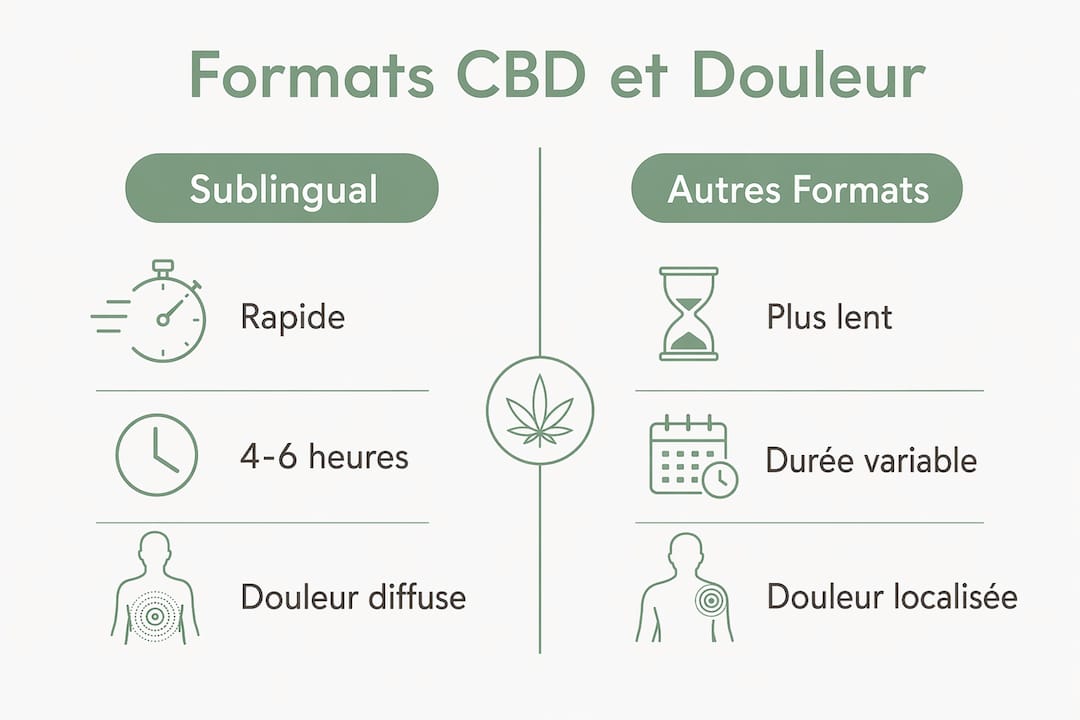
Sublingual oils act within 15–30 minutes, compared with 1 to 2 hours for capsules. This difference is decisive when pain is severe and requires a rapid response. Capsules are better suited to providing background coverage overnight, thanks to their longer-lasting effect.
Topicals are useful for localized pain such as an inflamed joint or muscle strain. Their action remains local and produces no systemic effect. For diffuse or neuropathic pain, a sublingual or oral format remains essential. A detailed comparison between the formats is available in Cbd-certified's guide Topical versus oral CBD.
Combining formats is possible. A topical product can relieve a specific area while a sublingual oil acts on underlying pain. This approach is particularly relevant for people suffering from fibromyalgia or rheumatoid arthritis.
Pro tip: For widespread chronic pain, choose a sublingual oil in the morning and early evening. Add a topical product to specific painful areas if necessary.
How to use sublingual CBD effectively for pain
Good technique makes all the difference. Here are the steps to follow to get the most out of a sublingual oil.
- Choose the right concentration. Start with a low-concentration oil (5% or 10%) to assess your sensitivity. Severe pain may require higher concentrations.
- Increase the dose gradually. Starting with a titration of 10–15 mg per day, with increases in 5 mg increments, makes it possible to find the effective dose without adverse effects. This method is called titration and is recommended by healthcare professionals.
- Hold it under the tongue. Place the drops under your tongue and wait 60 to 90 seconds before swallowing. This contact time with the mucous membrane is key to optimal absorption.
- Take it regularly. Daily use for 2 to 4 weeks is necessary to achieve an underlying effect on chronic pain. CBD accumulates in the tissues, and its effects intensify with regular use.
- Keep a journal of the effects. Record the dose taken, the time, and the intensity of the pain before and after each day. This tracking makes it possible to adjust the dose quickly and identify the optimal dose.
- Consult a doctor if you are taking other medications. CBD can interact with certain medications, particularly blood thinners and antiepileptic drugs. A prior medical consultation is essential.
Consistency is the most often underestimated factor. Many people give up after a few days without results. However, CBD's underlying effect on chronic pain takes several weeks to fully develop.
Pro tip: Take your sublingual oil at a fixed time, preferably in the morning on an empty stomach or 30 minutes before a meal. Absorption is slightly better when the stomach is empty.
Which types of pain benefit most from sublingual CBD?
CBD is not a universal analgesic. Its effectiveness is best documented for certain specific types of pain.
Neuropathic, menstrual, and inflammatory pain are the best covered by the available clinical studies. Neuropathic pain, caused by an injury to or dysfunction of the nervous system, responds particularly well to CBD thanks to its action on TRPV1 and CB2 receptors. Menstrual pain, linked to local inflammation, benefits from CBD’s anti-inflammatory effect. To learn more about the types of pain targeted, the Cbd-certified guide on pain relieved by CBD is a useful resource.
The following table summarizes the available evidence by type of pain.
| Type of pain | Level of evidence | Main mechanism involved |
|---|---|---|
| Neuropathic | High | CB2, TRPV1 receptors |
| Inflammatory | High | Cytokine reduction, CB2 |
| Menstrual | Moderate | Anti-inflammatory action |
| Fibromyalgia | Moderate | Global endocannabinoid system |
| Diffuse chronic pain | Moderate | Neuroinflammatory modulation |
Individual variability is real. Two people suffering from the same condition may respond differently to CBD depending on their genetics, microbiome, and individual endocannabinoid system. This variability justifies gradual titration and regular monitoring.
CBD remains a complementary approach. It does not replace prescribed medical treatment, but it may reduce the dose of medication needed or improve quality of life between doses. Regular use combined with non-pharmacological approaches such as physical therapy, meditation, or gentle physical activity maximizes overall results.
Key points
Sublingual CBD is the most effective format for pain thanks to its high bioavailability, rapid onset of action, and direct interaction with pain receptors.
| Point | Details |
|---|---|
| Higher bioavailability | The sublingual route achieves 13–19% bioavailability, compared with 6% for conventional ingestion. |
| Fast action | Effects appear within 15–45 minutes and last 4 to 6 hours. |
| Proper technique | Keeping the oil under the tongue for 60–90 seconds is essential for optimal absorption. |
| Consistency required | Daily use for 2 to 4 weeks is required for an underlying effect on chronic pain. |
| Complementary approach | Sublingual CBD is more effective when combined with non-drug approaches and medical monitoring. |
What I learned from testing different CBD formats for pain
I have tried virtually every format available on the European market: capsules, topicals, infusions, sprays, and sublingual oils. The conclusion is clear. Sublingual oil is the only format that offers both sufficient speed and duration of effect to manage chronic pain on a daily basis.
What surprised me most was the importance of technique. Many people place the drops under their tongue and swallow immediately. As a result, they get little more benefit than they would from a capsule. Holding them for 60 to 90 seconds is not an insignificant recommendation. It makes a measurable difference to the speed and intensity of relief.
Another common mistake is giving up too soon. CBD does not work like paracetamol. Its underlying effect on chronic pain develops gradually. I have seen people conclude that it was ineffective after five days, even though the real benefits often appear after two to three weeks of regular use.
I also recommend not overlooking drug interactions. CBD is metabolized by cytochrome P450, the same enzymatic pathway used by many common medications. Anyone undergoing treatment should talk to their doctor before starting. This is not a superficial precaution. It is a concrete pharmacological reality.
Finally, sublingual CBD is not a miracle cure. It is a serious, well-documented tool that works best when integrated into a comprehensive approach. Combined with physiotherapy, appropriate physical activity, and medical monitoring, it can significantly improve the quality of life of people suffering from chronic pain.
— Rod
Cbd-certified sublingual oils for pain management
Cbd-certified offers a selection of broad-spectrum and full-spectrum sublingual oils formulated to meet the specific needs of people suffering from chronic or inflammatory pain.
The Nobilis THC-free CBN + CBG + CBD oil combines three complementary cannabinoids for enhanced action against pain and inflammation. For a high concentration, the 4000 mg full-spectrum CBD oil is suitable for severe pain requiring precise dosing. All Cbd-certified oils are certified, independently laboratory-tested, and delivered throughout the European Union, the United Kingdom, and Switzerland. The store also offers personalized advice to help you choose the concentration suited to your pain profile.
Frequently asked questions
How long should CBD be kept under the tongue?
Keep the oil under your tongue for 60 to 90 seconds before swallowing. This contact time with the sublingual mucosa is essential to maximize direct absorption into the bloodstream.
Is sublingual CBD effective for chronic pain?
Yes, provided you take it regularly. Daily use for 2 to 4 weeks is necessary to achieve a baseline effect on chronic pain, according to current recommendations.
What is the bioavailability of sublingual CBD compared with capsules?
The sublingual route offers a bioavailability of 13–19%, compared with approximately 6% for conventional ingestion. This means the body absorbs two to three times more CBD sublingually.
Can sublingual CBD interact with my medications?
Yes. CBD is metabolized by cytochrome P450, a liver enzyme involved in breaking down many medications. Medical advice is recommended before use in case of concomitant treatment.
What types of pain respond best to sublingual CBD?
Neuropathic, inflammatory, and menstrual pain are the best documented. Pain associated with fibromyalgia and widespread chronic pain also shows positive results in the available clinical studies.