
CBD and pain: why it does not cause addiction
In brief:
- CBD relieves pain without causing dependence because it does not activate the brain’s reward pathways. It acts on receptors involved in pain and anxiety, enhancing its effects without psychoactive effects. Clinical evidence confirms the absence of a dependence risk, unlike THC or opioids.
Cannabidiol (CBD) is a natural molecule extracted from hemp that relieves pain without causing dependence. Unlike THC or opioids, CBD does not activate the brain’s reward pathways. The World Health Organization confirms its lack of abuse potential. This unique property explains why CBD is attracting more and more people suffering from chronic pain, inflammation, or anxiety who are seeking an alternative without addiction risks. Understanding why CBD does not cause dependence in pain means understanding its fundamental pharmacology.
Why CBD does not cause dependence in pain
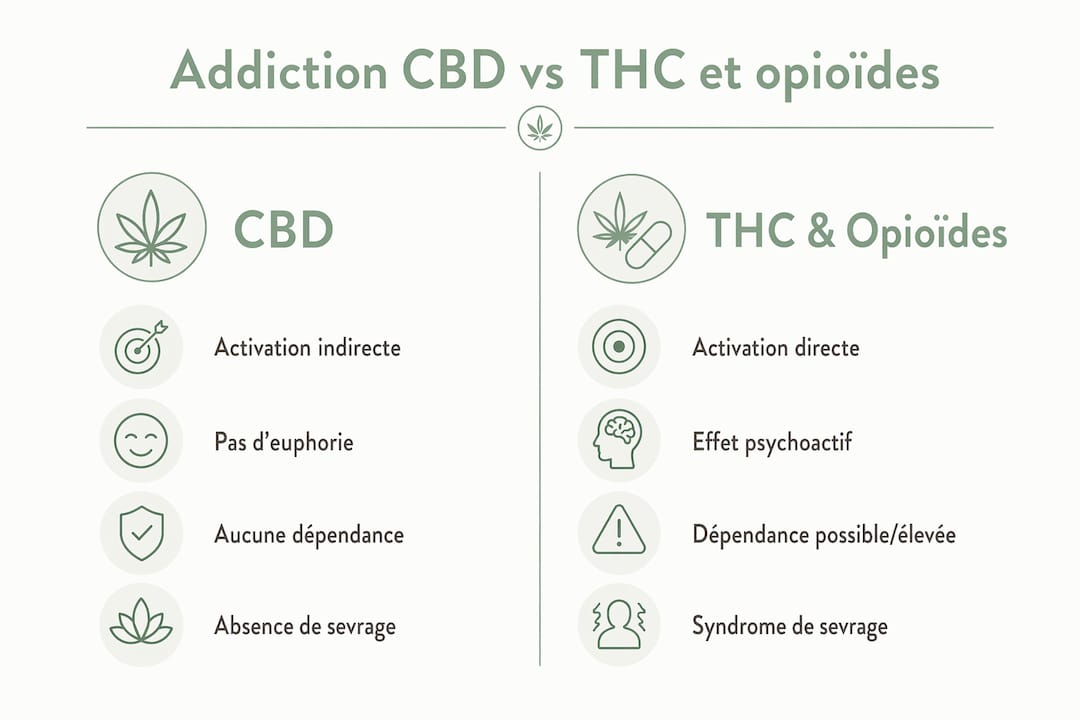
CBD acts indirectly on the endocannabinoid system. It does not bind directly to CB1 receptors in the brain, unlike THC. This difference is decisive: the absence of CB1 activation prevents the creation of an addictive reward pathway. Without this pathway, the brain develops neither compulsion nor craving.

CBD also modulates other receptors involved in pain and anxiety. TRPV1 receptors regulate the perception of heat and pain. 5-HT1A receptors, linked to serotonin, play a role in managing stress and mood. By acting on these two targets, CBD reduces pain without causing euphoria or the characteristic “high” associated with addictive substances.
CBD also inhibits the FAAH enzyme, which is responsible for breaking down anandamide. Anandamide is a natural painkiller produced by the body. By increasing its levels, CBD enhances the natural analgesic response without introducing a foreign molecule into the reward pathway. This mechanism is fundamentally different from that of opioids.
Here are the key mechanisms that explain the absence of CBD addiction:
- No direct activation of CB1 receptors: THC binds directly to them and triggers euphoria; CBD does not.
- No dopaminergic effect: CBD does not cause a massive release of dopamine, the central neurotransmitter involved in addiction.
- TRPV1 and 5-HT1A modulation: action on pain and anxiety without psychoactive effects.
- FAAH inhibition: increased anandamide, an endogenous painkiller.
- Absence of psychoactive effects: no “high” or “comedown,” and therefore no compulsive substance-seeking behavior.
Pro tip: Choose a full-spectrum CBD extract rather than an isolate. The terpenes and minor cannabinoids present in the full spectrum enhance the analgesic effect through the entourage effect, without altering the safety profile.
What clinical evidence confirms the absence of dependence on CBD?
Recent clinical data are clear. A 2026 Cochrane review involving 2,187 patients confirms that CBD has a better tolerability profile than formulations containing THC, with no abuse potential or physical dependence. This figure represents one of the strongest databases available to date on the subject.
A study comparing CBD with dronabinol (synthetic THC) in elderly patients suffering from chronic pain produced a particularly telling result. The treatment discontinuation rate due to adverse effects reached 5.6% with CBD, compared with 19.2% with standard treatments. Such a low dropout rate indicates good tolerability and the absence of avoidance behaviors related to intolerable side effects.
“The main clinical criterion distinguishing an addictive substance is compulsion and craving. These two phenomena are absent with CBD, even after prolonged discontinuation.”
Data on reducing nonsteroidal anti-inflammatory drugs (NSAIDs) also confirm the value of CBD. 42% of regular users of CBD reduced or stopped their NSAID use without rebound withdrawal effects after 3 months. This result shows that CBD can replace compounds with a high risk of gastric complications without creating a new dependency.
| Criterion | CBD | THC | Opioids |
|---|---|---|---|
| Physical dependence | Absent | Possible | High |
| Withdrawal syndrome | Absent | Moderate | Severe |
| Craving upon discontinuation | Absent | Present | Very pronounced |
| Treatment discontinuation rate | 5,6 % | 19,2 % | Variable |
| NSAID reduction possible | Yes (42%) | Not documented | Not applicable |
CBD, THC, and opioids: what are the differences regarding addiction?
THC is the psychoactive molecule in cannabis. It binds directly to CB1 receptors in the brain and causes dopamine release in the nucleus accumbens, a central area of the reward circuit. This repeated activation creates tolerance, followed by dependence. Stopping THC may cause irritability, sleep disturbances, and anxiety.
Opioids such as morphine, oxycodone, or tramadol act on mu-opioid receptors. Their analgesic efficacy is real, but their addictive potential is among the highest in the pharmacopoeia. Tolerance develops quickly, forcing dose increases. Withdrawal is physically painful and can last several weeks.
CBD does not share any of these mechanisms. It causes neither euphoria, progressive tolerance, nor a clinical withdrawal syndrome. People who stop taking CBD may see their painful symptoms return, but this return of symptoms is not an addiction. This is a fundamental distinction that healthcare professionals regularly emphasize.
| Substance | CB1 activation | Dopaminergic effect | Dependence | Withdrawal |
|---|---|---|---|---|
| CBD | Indirect | Absent | No | No |
| THC | Direct | Present | Possible | Moderate |
| Morphine | Not applicable | Present | High | Severe |
| NSAIDs | Not applicable | Absent | No | No |
Pro tip: For people taking opioid treatment who are seeking to reduce their dose, CBD may serve as an adjunct. This approach should always be supervised by a doctor, as drug interactions via CYP450 may alter the plasma concentrations of other treatments.
What are the real effects and limitations of CBD for pain?
CBD acts on several types of pain. Neuropathic, inflammatory, and chronic pain respond best to regular use. The types of pain relieved include pain related to multiple sclerosis, diabetic neuropathies, and post-exercise muscle pain. Anxiety associated with chronic pain also decreases with continued use.
CBD is not a painkiller with an immediate effect. It is a gradual modulator that requires 2 to 4 weeks of regular use to produce a measurable baseline effect. This timeframe sometimes disappoints people who expect rapid relief comparable to that of a conventional anti-inflammatory.
Here are the essential points for safe use:
- Possible side effects: mild drowsiness, digestive problems (nausea, mild diarrhea), dry mouth. These effects are generally dose-dependent and temporary.
- Gradual titration: start with a low dose (5–10 mg per day) and increase in 5 mg increments every 1 to 2 weeks according to individual tolerance.
- Drug interactions: CBD inhibits the liver enzymes CYP3A4 and CYP2C19, which may alter the blood concentrations of anticoagulants, antidepressants, or antiepileptic drugs. Medical advice is essential in these cases.
- Product quality: poorly labeled products may contain THC levels above legal thresholds or contaminants. Choosing products with independent certificates of analysis reduces this risk.
- Individual responses: some people respond well to CBD, while others respond little. Metabolism, body weight, and the nature of the pain affect its effectiveness.
The safety of CBD for people with chronic illnesses depends above all on choosing certified products and appropriate medical monitoring, especially in cases of polypharmacy.
Key points
CBD does not cause dependence when treating pain because it does not activate CB1 receptors or the dopaminergic reward circuits, unlike THC and opioids.
| Point | Details |
|---|---|
| Confirmed absence of addiction | The 2026 Cochrane review of 2,187 patients confirms the absence of physical dependence on CBD. |
| Non-addictive mechanism | CBD does not activate CB1 receptors or dopamine release, thereby avoiding any reward circuit. |
| Greater tolerability than alternatives | Only 5.6% discontinued treatment with CBD compared with 19.2% with standard treatments. |
| Gradual effects, not immediate ones | A measurable baseline effect requires 2 to 4 weeks of regular use and gradual titration. |
| Possible drug interactions | CBD inhibits CYP3A4 and CYP2C19; medical advice is necessary when taking anticoagulants or antidepressants. |
What I learned about CBD and pain after years of observing its uses
Many people arrive with the same expectation: they want CBD to make their pain disappear within a few days, like paracetamol. This expectation is understandable, but it often leads to unfair disappointment with a molecule that works differently.
What strikes me most in recent clinical data is the distinction between the return of symptoms and dependence. When someone stops taking CBD and their pain returns, this is not a sign of addiction. It is simply the underlying pain reasserting itself. This nuance changes everything about how to approach treatment.
CBD works best as part of a holistic approach. Combined with good sleep hygiene, appropriate physical activity, and medical monitoring, its effects are significantly more pronounced than when used alone. The people who benefit most from it are those who incorporate it into a routine, not those who use it occasionally during a crisis.
I also remain cautious about one point: product quality varies enormously across the European market. A poorly labeled product may contain more THC than declared, which completely distorts the safety profile. Choosing products with third-party certificates of analysis is not a luxury; it is a basic condition for reliable use.
— Rod
Certified CBD products for relieving pain with confidence
Choosing quality-controlled CBD makes all the difference between a noticeable effect and disappointment. Oils, capsules, and topical balms are not all equal, and the traceability of the extracts directly affects their safety and effectiveness.
Cbd-certified offers a selection of products tested by independent laboratories, available for delivery throughout the European Union, the United Kingdom, and Switzerland. Each product displays its certificate of analysis, CBD content, and origin. For people seeking to manage chronic pain without addiction risk, Cbd-certified's CBD shop in Europe offers a reliable starting point, with advice tailored to each profile.
Frequently asked questions
Does CBD cause physical dependence?
No. CBD causes neither compulsive use nor craving, nor a clinical withdrawal syndrome upon discontinuation. The 2026 Cochrane review of 2,187 patients confirms the absence of physical dependence.
Why do symptoms return after stopping CBD?
The return of symptoms after stopping CBD is not a sign of dependence. It is the underlying pain that returns, not withdrawal related to the molecule itself.
Is CBD safer than opioids for chronic pain?
Yes, in terms of addiction risk. CBD does not activate mu-opioid receptors or the dopaminergic reward pathway, unlike morphine or oxycodone.
How long does it take to feel the effects of CBD on pain?
CBD is a gradual modulator. A measurable baseline effect generally requires 2 to 4 weeks of regular use, with appropriate dose titration.
Can CBD interact with other medications?
Yes. CBD inhibits the liver enzymes CYP3A4 and CYP2C19, which can alter the concentration of anticoagulants, antidepressants, or antiepileptic drugs. Medical advice is essential before combining them.