
How does CBD affect the nervous system?
TL;DR:
- CBD does not cause euphoria or altered consciousness, despite having a real neurological effect.
- It modulates the endocannabinoid system by indirectly modulating CB1 and CB2 receptors, promoting the regulation of mood, pain, and stress.
CBD does not get you high. Yet many people think that if a product acts on the brain, it must necessarily alter consciousness. This is a common misunderstanding. Understanding how CBD acts on the nervous system means recognizing precisely why the two can coexist: a real neurological effect without any intoxicating effect. This guide explores the molecular mechanisms, the receptors involved, the validated benefits, and the fundamental distinctions from THC, to give you a clear and honest understanding of the subject.
Table of contents
- Key points
- The nervous system and the endocannabinoid system
- Mechanisms of action of CBD on the brain
- Clinical applications in neurology
- CBD versus THC: what really changes
- My opinion after years of observing CBD
- Find Trusted CBD at Cbd-certified
- FAQ
Key points
| Point | Details |
|---|---|
| No high, but a real effect | CBD acts on the brain through indirect pathways, without causing euphoria or intoxication. |
| Modulator of the endocannabinoid system | CBD influences CB1 and CB2 receptors allosterically, regulating mood, pain, and stress. |
| Documented clinical applications | In treatment-resistant epilepsy, pharmaceutical CBD significantly and measurably reduces seizures. |
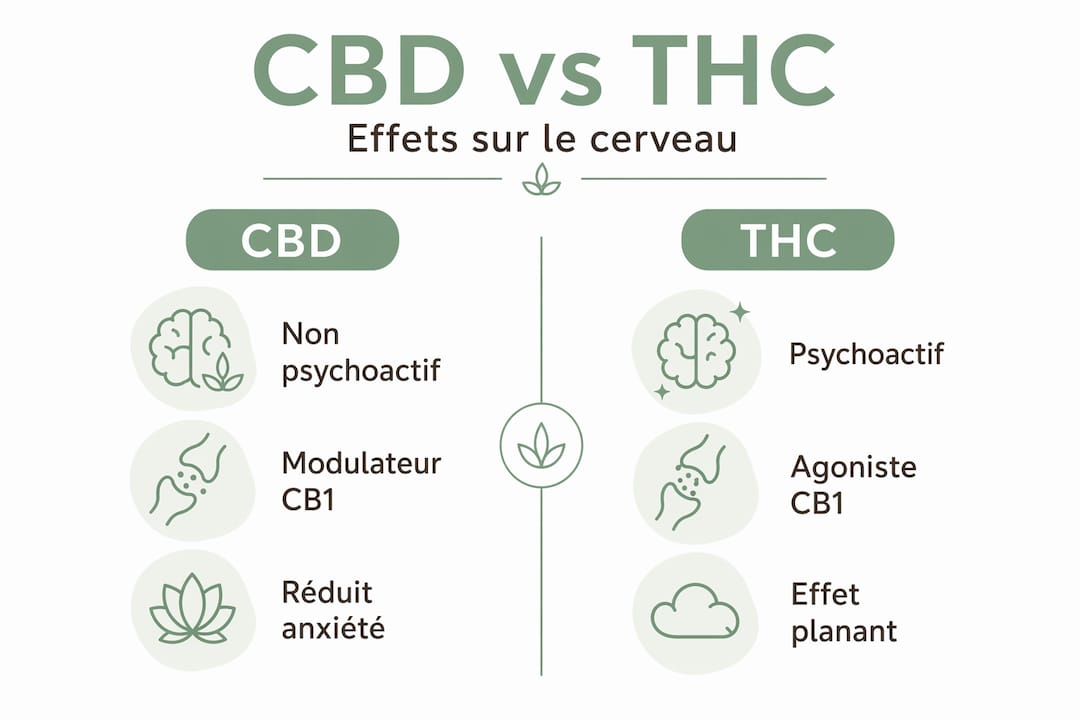
| CBD and THC: distinct profiles | THC directly activates CB1 receptors; CBD modulates them indirectly without a strong psychoactive effect. |
| Product quality = safety | Non-compliant products have caused severe poisonings; choosing certified CBD is essential. |
The nervous system and the endocannabinoid system
To understand how CBD influences the nervous system, you first need to know the environment in which it operates.
The nervous system is divided into two main branches. The central nervous system (CNS) comprises the brain and spinal cord. The peripheral nervous system connects the CNS to the rest of the body, transmitting sensory and motor signals. These two parts work together continuously to regulate every bodily function, from breathing to emotions.
Within this network lies another, lesser-known system: the endocannabinoid system. This system is present in all mammals and plays a fundamental role in maintaining the body’s internal balance.
Its three main components are:
- CB1 receptors, concentrated in the brain and spinal cord, are involved in memory, coordination, pain, and mood.
- CB2 receptors, predominantly found in the immune system and peripheral tissues, are linked to inflammation and immune responses.
- Endocannabinoids, molecules naturally produced by the body such as anandamide, which bind to these receptors to adjust nerve signaling.
The endocannabinoid system regulates the body’s homeostasis, including mood, pain, and stress. It works like a biological thermostat: when a signal is too strong, it tempers it; when a reaction is lacking, it encourages it. CBD integrates into this system not as a key, but as a fine regulator of its parameters.
Pro tip: If you are new to CBD, understanding that your body already has natural receptors for cannabinoids will help you better interpret its effects. You are not consuming something foreign to your biology.
Mechanisms of action of CBD on the brain
This is where things become really interesting. CBD’s effects on the brain do not result from direct activation of cannabinoid receptors, unlike THC.
CBD acts as a partial negative allosteric modulator of CB1 receptors. In simple terms: it binds to a different site on the receptor and changes its sensitivity without directly activating it. The result: it reduces neuronal overactivation without triggering a strong psychoactive effect. This mechanism specifically explains its neuroprotective properties.
CBD also acts on other important molecular targets:
| Molecular target | Observed effect |
|---|---|
| 5-HT1A receptors (serotonin) | Calming effect, reduction in anxiety |
| TRPV1 ion channels | Modulation of pain and inflammation |
| CB1 receptors (allosteric) | Neuroprotection, reduction in seizures |
| Anandamide reuptake | Prolongs the effect of natural endocannabinoids |
CBD influences serotonin receptors 5-HT1A and ion channels, contributing to a relaxing effect without intoxication. This action on serotonin notably explains why the neurological benefits of CBD include managing anxiety and mild sleep disorders.
Another often-overlooked mechanism: CBD inhibits the reuptake of anandamide, a natural endocannabinoid sometimes nicknamed the “bliss molecule.” By slowing its breakdown, CBD indirectly prolongs its calming effects. CBD modulates the stress–cortisol axis via the endocannabinoid system, helping reduce anxiety and chronic pain.
Pro tip: The effects of CBD on the brain are not instantaneous for everyone. With a sublingual oil, the first effects generally appear within 15 to 45 minutes. Be patient before adjusting your dose.
Clinical applications in neurology
The field with the strongest evidence remains neurology, particularly in the treatment of certain forms of epilepsy.

Purified pharmaceutical CBD (Epidiolex) is used for Dravet syndrome and Lennox-Gastaut syndrome, two severe pediatric epilepsies resistant to conventional medications. Phase 3 trials show seizure reductions of approximately 44% in some treated patients, compared with 22% in placebo groups. These figures leave no room for doubt about the clinical effectiveness of CBD in this context.
However, clinical use involves important nuances:
- Drug interactions: CBD increases active levels of clobazam, a commonly co-administered antiepileptic, which may cause initial drowsiness. Dosage adjustments are based on careful monitoring of interactions with clobazam and valproate, along with regular liver monitoring.
- Effects on anxiety and sleep: outside the strict medical framework, many users report that CBD has a calming effect. The anti-anxiety effect of CBD is linked to its action on serotonin receptors and support of the endocannabinoid system, corresponding to the mechanisms described above.
- Product quality and compliance: this is where the risks become tangible. Poisonings linked to food products that do not comply with CBD regulations have caused drowsiness, hallucinations, and seizures, leading to regulatory recalls in 2026. CBD itself is not dangerous; it is poor quality or contaminants present in certain products that pose the risk.
For users wishing to explore the benefits for anxiety and sleep, choosing traceable products with independent laboratory testing remains the non-negotiable foundation of responsible use.
CBD versus THC: what really changes
Confusion between CBD and THC remains one of the most common barriers to informed CBD use. Here are the fundamental differences.
| Criterion | CBD | THC |
|---|---|---|
| Mode of action on CB1 | Indirect allosteric modulator | Direct agonist (strong activation) |
| Psychoactive effect | Absent (mild psychotropic effects possible) | Yes, euphoria and cognitive impairment |
| Risk of intoxication | Very low if the product complies | High at high doses |
| Legal use in Europe | Yes, if THC level complies (<0.3%) | Regulated or prohibited depending on the country |
| Documented benefit | Epilepsy, anxiety, pain | Pain, nausea (controlled medical use) |
THC acts directly on CB1 like a key in a lock, triggering euphoria, perceptual distortion, and short-term memory effects. CBD alters the sensitivity of this same receptor without ever triggering these effects. The distinction is precise: CBD may have mild psychotropic effects (a feeling of calm, slight drowsiness at high doses), but no true intoxicating effect.
Early use of cannabis containing THC during brain development increases the risk of mental disorders, as the brain continues developing until age 25. CBD alone does not share this risk profile, but a poorly dosed product or one containing THC residues can obscure the expected effects.
To explore this topic further, the THC and CBD comparison details the practical nuances to help guide your consumption choices.
My opinion after years of observing CBD
What strikes me most in discussions about CBD is the gap between users’ expectations and what science actually validates.
I have seen people give up on CBD after two weeks because they had not “felt a strong effect.” And others who, conversely, attributed almost miraculous properties to it for which no serious studies yet exist. Both approaches miss the point.
What I have learned is that individual variability in effects is enormous. Two people taking the same dose can have radically different experiences depending on their genetics, metabolism, and current medications. This is not a flaw of CBD. It is the reality of any substance that interacts with a complex biological system.
My conviction: CBD deserves a patient and methodical approach. Start with low doses, note how you feel, and adjust gradually. Above all, choose products with accessible laboratory analyses. Not to be a purist, but because a poorly made product can completely distort your experience and deprive you of real benefits. Clinical research is advancing, and the evidence is accumulating. But it will never replace informed, personalized use.
— Rod
Find Trusted CBD at Cbd-certified
At Cbd-certified, every product offered is selected according to strict criteria: independent laboratory testing, complete traceability from plant to finished product, and legal compliance throughout the European Union, the United Kingdom, and Switzerland.
Whether you are looking for a sublingual oil for stress management, capsules for daily use, or CBD flowers for targeted relaxation, the Cbd-certified selection meets the most common neurological needs. Browse the best CBD shops in Europe to find a product suited to your profile, with all the quality guarantees you deserve.
FAQ
Is CBD psychoactive?
CBD has mild psychotropic effects (calmness and slight drowsiness at high doses) but does not cause a high or cognitive impairment. It does not directly activate CB1 receptors like THC.
How does CBD work for anxiety?
CBD acts on 5-HT1A serotonin receptors and supports the endocannabinoid system to reduce the stress response. This dual action explains its documented calming effect without intoxication.
Is CBD effective against epilepsy?
Yes, in certain severe forms that are resistant to conventional medications. Pharmaceutical CBD (Epidiolex) reduced seizures by approximately 44% in phase 3 clinical trials, compared with 22% for the placebo.
Can CBD be taken with other medications?
Interactions do exist, particularly with clobazam and valproate used in neurology. CBD increases the active levels of certain medications, requiring medical monitoring and dosage adjustments.
How long does it take to feel the effects of CBD?
With a sublingual oil, effects generally appear within 15 to 45 minutes. The response varies depending on metabolism, dosage, and the quality of the product used.