
Understanding Cannabinoids: Effects and Mechanisms of CBD
TL;DR:
- CBD is not psychoactive, unlike THC, which causes a “high” effect.
- Cannabinoids act through the endocannabinoid system by modulating pain, mood, and sleep.
- The form, dosage, and legislation influence the effectiveness and safety of CBD in Europe.
Many people think that all cannabinoids cause a high. This is a persistent misconception. In reality, cannabis contains more than 100 distinct compounds, some of which have no psychoactive effects. CBD (cannabidiol) and THC (tetrahydrocannabinol) are the best known, but they act very differently in the body. Understanding this difference changes everything, especially if you are exploring these compounds to better manage chronic pain, anxiety, or insomnia. This guide gives you clear basics and practical information to help you understand things better.
Table of contents
- What are cannabinoids? A simple explanation and the basics
- How the endocannabinoid system works and how CBD acts
- Effects of CBD and THC: comparison for pain, insomnia, and anxiety
- Important factors: dosage, form, and safety of use in Europe
- Why cannabinoid science should still be approached with caution
- Where can you get quality CBD in Europe?
- Frequently asked questions about cannabinoids
Key Points
| Point | Details |
|---|---|
| CBD and THC differ | CBD is not psychoactive, unlike THC, and targets different mechanisms. |
| Variable effects on pain | CBD provides modest pain relief and is more effective when combined with THC, according to studies. |
| Importance of individualized dosing | The response depends on the dosage, the form, and each person’s characteristics. |
| Necessary safety precautions | Although generally well tolerated, CBD should be used with caution and personalized guidance. |
What are cannabinoids? A simple explanation and the basics
Cannabinoids are, by definition, molecules capable of interacting with a biological network present in the human body called the endocannabinoid system. This system regulates essential functions such as pain, mood, sleep, and the immune response. There are two main families: phytocannabinoids, naturally present in the cannabis plant, and endocannabinoids, produced by the body itself.
Of the more than 100 cannabinoids identified to date, CBD and THC account for the majority of scientific research. If you would like to explore the definition of CBD in greater depth, the nuances between these compounds quickly become more accessible. Each cannabinoid has a slightly different molecular structure, which explains why their effects vary so much.
The system relies on two main types of receptors:
- CB1 receptors: concentrated in the brain and central nervous system. They influence memory, coordination, pain perception, and mood.
- CB2 receptors: found mainly in the immune system and peripheral tissues. They play a role in inflammation and the immune response.
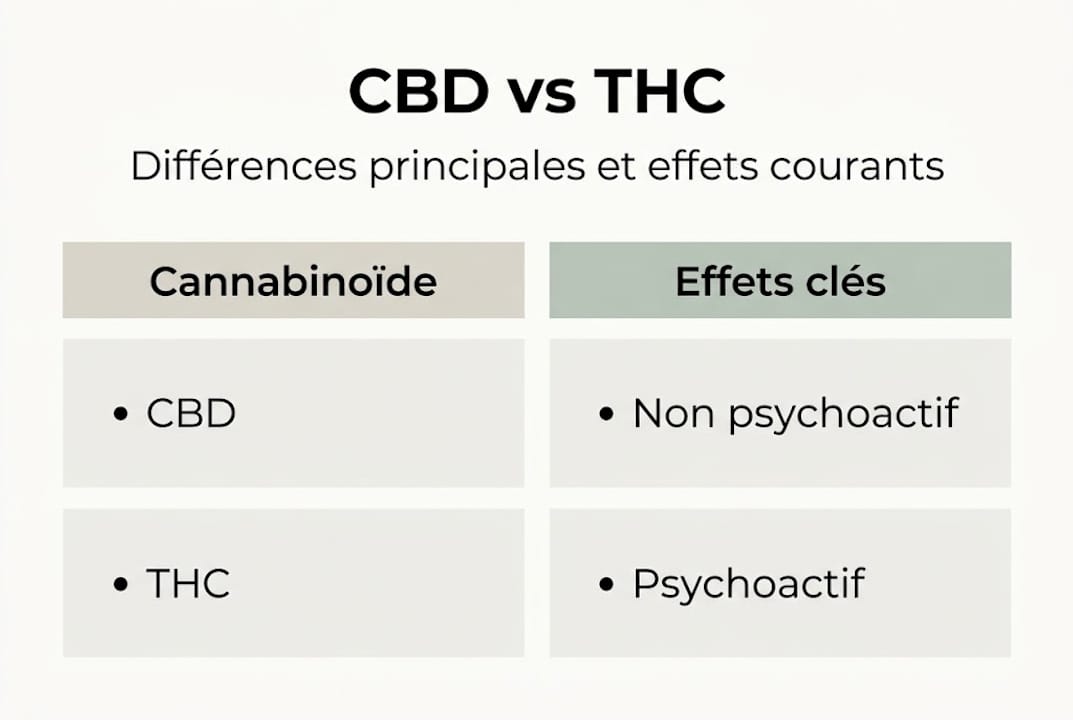
The most important difference to remember between CBD and THC is simple: THC binds directly to CB1 receptors, producing the characteristic psychoactive effect (the feeling of being “high”). CBD, on the other hand, does not act in this direct way and does not cause any alteration of consciousness.
| Property | CBD | THC |
|---|---|---|
| Psychoactive | No | Yes |
| Legal in Europe | Yes (< 0.3% THC) | Restricted |
| Targeted receptors | Indirect (CB1, CB2, others) | Direct CB1 |
| Main effects | Calming, anti-inflammatory | Euphoria, analgesic |
This fundamental distinction explains why CBD has become so popular in Europe for wellness-related uses, without the undesirable effects associated with THC.
Having clarified what these molecules are, let us examine how they function in the human body.
How the endocannabinoid system works and how CBD acts
The endocannabinoid system functions as an internal regulator. It produces its own molecules, notably anandamide (often nicknamed the “bliss molecule”) and 2-AG (2-arachidonoylglycerol), which bind to CB1 and CB2 receptors according to the body’s needs. CBD influences this system indirectly, notably by slowing the breakdown of anandamide.

THC, by contrast, directly mimics endocannabinoids and binds to CB1 receptors with high affinity. It is this direct action that creates the psychoactive effect. CBD, on the other hand, acts through various mechanisms: it modulates several receptors at once (including serotonin and vanilloid receptors), which explains the range of effects observed from person to person.
Practical tips for choosing the right CBD form according to your goal:
| Form | Speed of action | Duration of effects | Ideal for |
|---|---|---|---|
| Sublingual oil | 15 to 45 min | 4 to 6 h | Anxiety, general pain |
| Capsules | 1 to 2 h | 6 to 8 h | Regular use, sleep |
| Flowers (inhalation) | 5 to 15 min | 2 to 3 h | Acute episode, occasional stress |
| Topicals | Localized | Variable | Muscle pain, inflammation |
The variability in responses is also explained by individual factors: your weight, metabolism, the state of your endocannabinoid system, and frequency of use all play a role. To understand in depth how CBD and the endocannabinoid system interact, current research points to gradual modulation rather than an immediate and uniform effect.
Pro tip: Choose the form of CBD based on your primary goal. Sublingual oil offers the easiest dosing flexibility for beginners, while capsules are better suited to a stable daily routine.
Once this principle is understood, it becomes easier to distinguish the real effects of CBD and THC on different health concerns.
Effects of CBD and THC: comparison for pain, insomnia, and anxiety
Now, let’s take a closer look at what science says about CBD’s potential for each common symptom among European consumers.
For chronic pain, the data are encouraging but nuanced. According to the available clinical evidence, a 50% reduction in neuropathic pain concerns approximately 21% of medical cannabis users, compared with 17% taking a placebo. This figure remains modest but is significant for those who have suffered for a long time without a satisfactory solution. CBD alone offers benefits for neuropathy, mainly for pain of nerve origin.
For anxiety, CBD shows more consistent results. It acts on serotonin receptors and reduces overactivation of the nervous system without producing a pronounced sedative effect. THC can, by contrast, worsen anxiety in some users, especially at high doses.
For insomnia, CBD appears to promote easier sleep onset and more stable sleep, especially when the issues are related to pain or underlying anxiety. To learn more about CBD uses for pain and anxiety, recent studies suggest that regular doses produce better results than occasional use.
| Symptom | CBD alone | THC alone | CBD+THC combination |
|---|---|---|---|
| Chronic pain | Moderate | Effective | More effective |
| Anxiety | Effective | Risky (high doses) | Possible with low THC |
| Insomnia | Moderate to good | Effective in the short term | May be useful |
A few key points to remember:
- CBD is preferable as a first-line option for anxiety and mild to moderate insomnia.
- THC may be more effective for severe pain but involves more side effects (potential dependence, cognitive effects).
- The combination of CBD+THC, with a low THC content, may offer a good compromise for some users.
- The placebo effect plays a documented role in pain studies and should not be ignored.
Understanding the importance of the usage framework makes it possible to use CBD optimally and safely.
Important factors: dosage, form, and safety of use in Europe
CBD’s effectiveness does not depend solely on the product itself. Results vary significantly depending on the dosage, the form consumed, and the duration of use. Here are the main forms available in Europe and their characteristics:
- CBD oil: rapid absorption through sublingual administration, easy to dose, ideal for beginners.
- CBD capsules: precise and convenient dosing, prolonged effects, perfect for daily use.
- CBD flowers: inhalation or infusion, almost immediate effects but shorter duration.
- Topicals (creams, balms): local application to a painful area, without entering the bloodstream.
- Herbal teas and infusions: slow absorption, gentle effects, suitable for sensitive users.
Safety is a central concern. For those with chronic conditions, the complete guide to safety regarding CBD emphasizes the importance of consulting a healthcare professional before starting, especially when taking medication.
Regarding dosage, there is no universal dose. For anxiety, a CBD dosage guide generally recommends starting between 10 and 25 mg per day, then adjusting according to the effects experienced. For insomnia, protocols and CBD dosage for insomnia often suggest taking it in the evening, between 25 and 75 mg depending on individual needs.
Important precautions:
- Avoid mixing CBD with blood-thinning medications without medical advice.
- Choose products with third-party certificates of analysis (COAs) available.
- Check that the THC content complies with the regulations in your country.
Pro tip: Always start with the lowest effective dose and increase it gradually over two to three weeks. This approach reduces the risk of adverse effects and helps identify your personal optimal dose.
Why cannabinoid science should still be approached with caution
The enthusiasm surrounding CBD is understandable, but caution is still warranted. Clinical trial results vary considerably depending on dosage, form, and duration of use, making comparisons between studies difficult.
It is also important to recognize the influence of individual expectations. The placebo effect is documented in studies on pain and anxiety, and it can amplify or reduce the perceived effects of CBD. Self-medication without a clear framework carries real risks, particularly the risk of neglecting appropriate medical treatment.
Our experience with European consumers shows that those who achieve the best results are the ones who adjust their use over time while keeping a journal of their sensations. To optimize CBD absorption, simple strategies such as taking the oil with a fatty meal can make a real difference.
No effect is universal. What works for one person may be ineffective for another. Consulting reliable sources and, if possible, a healthcare professional remains the best approach to get the most out of these fascinating molecules.
Where can you get quality CBD in Europe?
Finding a reliable product is often the first obstacle for new users. Quality CBD can be identified by several criteria: supercritical CO2 extraction, an independent certificate of analysis, plant traceability, and THC content compliant with the regulations of your country.
To make your search easier, we have selected the best CBD shops in Europe, all verified according to these strict criteria. If you are looking for a targeted product for muscle or joint pain, the Swiss FX CBD balm containing 450 mg is a popular topical option, deliverable in the EU, the United Kingdom, and Switzerland. Choosing the right product also means choosing the right starting point for your experience with cannabinoids.
Frequently asked questions about cannabinoids
Is CBD legal everywhere in Europe?
CBD is legal in most European countries as long as its THC content is very low (generally below 0.2 or 0.3%), but legislation may vary from one country to another and is regularly updated.
What is the difference between natural and synthetic cannabinoids?
Natural cannabinoids come from plants such as cannabis, whereas synthetic ones are created in a laboratory; among the 100 cannabinoids identified, synthetic versions may have different or significantly stronger effects, making them potentially riskier.
Does CBD have side effects?
CBD is well tolerated in most cases, but effects depending on the dose and form may include mild fatigue or digestive issues; starting with a low dose helps assess your personal tolerance.
Is CBD effective for chronic pain?
Studies show a moderate reduction in chronic pain, especially neuropathic pain, with an NNT of approximately 11 according to the available data, meaning that effects vary depending on the person and method of use.