
Non-psychoactive CBD: effects, mechanisms, and benefits
TL;DR:
- CBD does not alter consciousness or cause psychoactive effects.
- It acts as an allosteric modulator of CB1 receptors, unlike THC.
- Its legality is based on its low capacity to induce a “high.”
Many consumers still associate CBD with recreational cannabis and wonder about its effects on the brain. This confusion is understandable: both substances come from the same plant, but their effects are radically different. CBD, or cannabidiol, causes no alteration of consciousness, no euphoria, and no “high.” This article explains why, drawing on the biology of the endocannabinoid system, clinical data, and recent studies. Understanding this mechanism also helps you choose your products more wisely and enjoy the benefits of CBD for everyday well-being with peace of mind.
Table of contents
- The basics: what are the differences between CBD and THC?
- Why CBD does not act like a narcotic: the mechanism explained
- What do clinical studies in humans show?
- Are there any exceptions? Edge cases and common misconceptions
- The expert’s view: what consumers often overlook
- Where can you find quality, non-psychoactive CBD?
- Frequently asked questions about CBD’s non-psychoactivity
Key Points
| Point | Details |
|---|---|
| No psychoactive effects | CBD induces neither euphoria nor cognitive impairment, regardless of the dose used. |
| Unique mechanism | CBD does not stimulate the brain receptors targeted by THC and acts indirectly without causing a “high.” |
| Proven safety | Clinical studies confirm the absence of intoxicating effects, even with prolonged use. |
| Rare edge cases | Minor effects may occur at very high doses, but they are never comparable to those of THC. |
| Wellness value | CBD promotes relaxation and stress management without altering perception. |
The basics: what are the differences between CBD and THC?
CBD (cannabidiol) and THC (tetrahydrocannabinol) share the same molecular formula, C₂₁H₃₀O₂, but their three-dimensional structures differ. This detail changes everything. This difference in configuration explains why one causes an altered state of consciousness while the other does not.
THC binds directly and strongly to CB1 receptors, which are abundant in the brain. This binding triggers a cascade of signals that produce euphoria, altered perception, and the characteristic psychoactive effects. CBD, on the other hand, does not directly activate CB1 receptors, unlike THC, which binds orthosterically and generates these effects. This is the fundamental reason why CBD does not make you “stoned.”
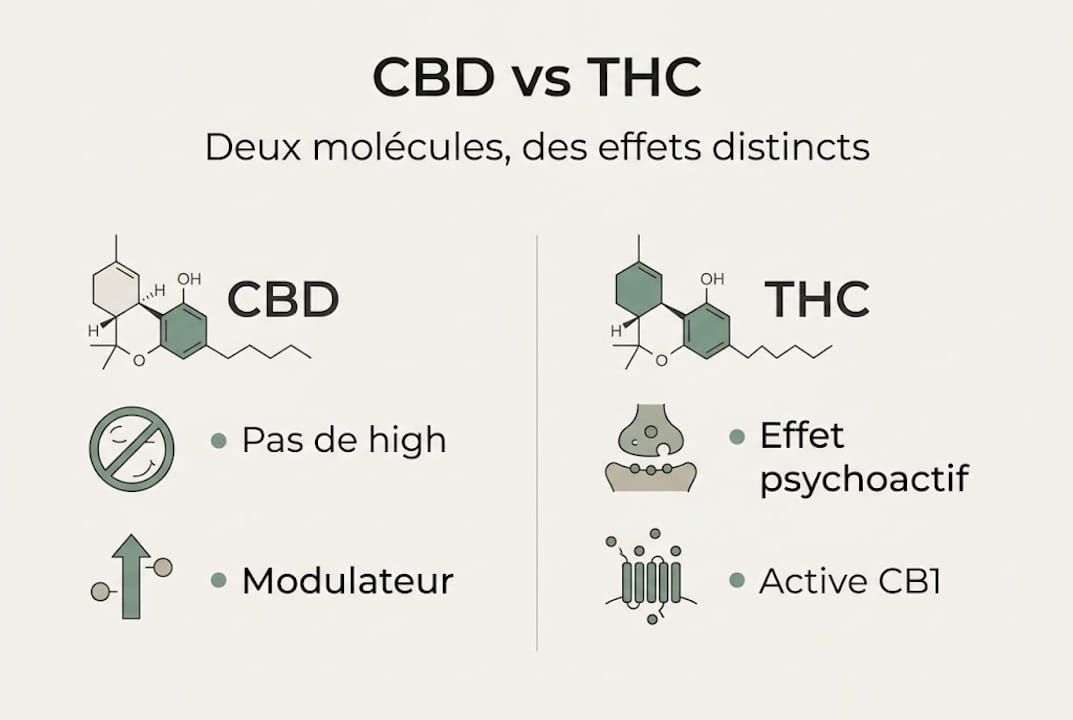
This distinction also has direct legal consequences. In Europe, THC regulation in Europe sets a maximum threshold of 0.2% THC in CBD products authorized for sale. Below this threshold, products are considered to have no narcotic effect and may circulate freely in most member countries of the European Union.
To better visualize these contrasts, here is a comparison table:
| Characteristic | CBD | THC |
|---|---|---|
| Psychoactive effect | No | Yes |
| Binding to CB1 receptors | Weak / indirect | Strong / direct |
| Legal status in Europe | Legal (<0.2% THC) | Controlled / illegal |
| Risk of dependence | Low | Moderate to high |
| Primary use | Well-being, relaxation | Recreational, medical (highlighted) |
The main points to remember about the differences between CBD and THC:
- CBD does not impair cognition or perception
- THC strongly activates CB1; CBD does not
- CBD can be consumed without the risk of an altered state
- A scientific review on CBD notes that research is progressing, but not all claims have yet been verified
Key takeaway: the chemical similarity between CBD and THC does not imply similar effects. The 3D structure is decisive.
Having clarified the fundamental difference from THC, it is time to take a closer look at how CBD works in the brain.
Why CBD does not act like a narcotic: the mechanism explained
The endocannabinoid system (ECS) is a network of receptors and molecules found throughout the human body. It regulates essential functions such as mood, pain, sleep, and inflammation. The two main receptors are CB1 (mainly in the brain) and CB2 (mainly in the immune system).

CBD interacts with this system, but not in the same way as THC. It acts as a negative allosteric modulator of CB1 receptors: it binds to a different site on the receptor and reduces the effectiveness of molecules that activate it, such as THC or natural endocannabinoids. It does not itself trigger a psychoactive signal.
Specifically, imagine CB1 as a lock. THC is a key that directly opens this lock. CBD, on the other hand, fits into a secondary slot and slightly changes the shape of the lock, making the key less effective. It never opens the door itself.
The scientific mechanisms confirm this interpretation: CBD has a very low affinity for CB1 (Ki approximately 1.5 μM), does not induce agonist signaling, and produces subtle effects through indirect pathways such as inhibition of FAAH, the enzyme that breaks down anandamide (a natural endocannabinoid associated with well-being).
Here is how CBD interacts with the ECS through the main pathways:
| Mode of action | Observed effect | Psychoactive nature |
|---|---|---|
| CB1 allosteric modulation | Reduction of the THC high | No |
| FAAH inhibition | Increased anandamide | No |
| 5-HT1A receptor activation | Anxiolytic effect | No |
| TRPV1 interaction | Pain modulation | No |
To fully understand the role of the ECS and CBD, it is important to remember these key points:
- CBD does not bind directly to CB1 as an agonist
- It modulates existing signals without creating new psychoactive ones
- Its effects involve several simultaneous pathways, which explains their subtlety
- The mechanisms of action of CBD are becoming increasingly well documented in 2026
Now that the biological mechanism has been clarified, let’s look at what studies say about the actual effects of CBD in humans.
What do clinical studies in humans show?
The biological mechanisms are compelling, but the real question remains: what do we actually observe in humans? Clinical trials on CBD provide clear answers.
Comparative studies administered CBD at high oral doses (600 mg) and THC at much lower doses (10 mg). The results are unequivocal: no significant euphoria or cognitive impairment was observed with CBD, even at these substantial doses. Conversely, 10 mg of THC was enough to induce a notable altered state in participants.
The Frontiers in Pharmacology review also confirms that CBD does not cause significant accumulation in the brain or psychotic-like effects, even during prolonged use at therapeutic doses. This finding is essential for consumers who want to incorporate CBD into their routine without fearing adverse effects on their ability to work, drive, or interact socially.
What clinical studies consistently show:
- No euphoria: no participant reports a pleasant altered state resembling a “high”
- No induced anxiety: on the contrary, some studies show a reduction in anxiety
- No psychosis: no psychotic episode linked to CBD alone has been documented at standard doses
- Generally well tolerated: high doses are well tolerated by most subjects
- Variable bioavailability: CBD bioavailability depends on the method of consumption and influences the intensity of the effects experienced
Pro tip: To ensure that you consume CBD without psychoactive residues, choose products whose label explicitly states a THC level below 0.2% and that provide an analysis by an independent laboratory (COA certificate). This document guarantees the product’s exact composition.
After reviewing the clinical evidence, it is essential to address the gray areas and edge cases reported by recent research.
Are there any exceptions? Edge cases and common misconceptions
CBD is generally safe and non-psychoactive. However, the science is nuanced, and it is important to be honest about individual cases. This helps people make informed choices and use CBD responsibly.
Here are the documented points to watch:
- Very high doses and the liver: At very high chronic doses, liver effects are possible, but the CBD remains strictly non-psychoactive. This risk mainly concerns people taking CBD at medical doses far higher than those sold in stores.
- Minor effects on serotonin: Some sources, including Ameli.fr, note minor psychoactive effects via serotonin, but the scientific consensus remains clear: CBD is not a narcotic.
- THC modulation: CBD can lessen the effects of a product containing THC. This entourage effect of CBD is even considered an advantage in certain therapeutic contexts.
- Poorly labeled products: The real risk for consumers often comes from non-standardized products containing more THC than declared. Always check the certificate of analysis.
Professional advice: Be wary of CBD products sold without an accessible COA certificate. A good manufacturer systematically publishes these analyses on its website or includes them with the product. Transparency is the first indicator of quality.
For people interested in CBD’s attenuation of THC, it is useful to know that this modulatory effect is documented, but that it does not turn CBD itself into a psychoactive substance. The truth about CBD should always be carefully distinguished from false claims, especially in a sometimes-sensationalist media environment.
The expert’s view: what consumers often overlook
CBD’s true strength does not lie in a spectacular effect. It lies precisely in its lack of a disruptive effect on consciousness. For millions of European consumers, obtaining benefits without cognitive impairment is exactly what they are looking for: discreet support for sleep, stress management, or physical recovery, without compromising their clarity of mind.
What many people don’t realize is that this subtle action is a quality, not a weakness. CBD does not seek to replace a recreational experience. It supports the body’s natural functions without bypassing them. Studies on CBD and anxiety reduction are among the strongest to date.
Our advice: read the studies carefully, but beware of exaggerated claims. CBD’s effectiveness is real for some uses and limited for others. Choosing a quality, standardized, and transparent product remains the foundation of a positive experience.
Where can you find quality, non-psychoactive CBD?
Finding a reliable CBD product primarily means ensuring that it contains well under 0.2% THC and comes with an independent laboratory analysis. This guarantee distinguishes serious products from questionable offerings.
For European consumers, the best CBD shops in Europe offer tested products, accurately labeled and deliverable to France, Belgium, Switzerland, and the United Kingdom. If you are looking for an option with no trace of THC whatsoever, Nobilis’s THC-free CBD oil is an appealing choice: a broad-spectrum formula enriched with CBN and CBG, zero THC detected, and a COA certificate available. A practical way to enjoy the benefits of cannabidiol with complete peace of mind.
Frequently asked questions about CBD’s non-psychoactivity
Can CBD make you feel “stoned” or cause a high?
No, clinical research shows that CBD does not induce euphoria or altered consciousness, even at high oral doses such as 600 mg. The effects remain subtle and non-disruptive.
Why is CBD legal while cannabis (THC) is not?
CBD does not activate the CB1 receptors responsible for the high, unlike THC. European law allows products containing less than 0.2% THC precisely because they produce no intoxicating effect.
Is there a risk with very high doses of CBD?
At very high continuous doses, liver monitoring is recommended based on documented hepatic effects, but there is no risk of psychoactive effects. Pay particular attention to the quality and composition of the product chosen.
Can CBD lessen the psychoactive effects of THC?
Yes, because CBD acts as a negative allosteric modulator of CB1 receptors and can reduce the intensity of the high induced by THC, without ever causing it itself.