
Why Choose European CBD: 2026 Guide
TL;DR:
- European CBD comes from hemp varieties cultivated according to strict standards, guaranteeing quality and safety. European regulations, including the 0.3% THC threshold, ensure the legality and traceability of certified products. Choosing certified European CBD offers better protection, enhanced effectiveness, and a reduced environmental impact.
European CBD is defined as cannabidiol extracted from industrial hemp varieties grown and processed according to strict European Union standards, guaranteeing traceability, purity, and legal compliance. For any consumer wishing to understand why to choose European CBD, the answer comes down to three criteria: regulations that are among the strictest in the world, controlled cultivation methods, and transparency regarding the composition of the finished product. Cbd-certified, a certified European CBD shop delivering across the EU, the United Kingdom, and Switzerland, observes every day that the best-informed consumers systematically choose European origin.
Why Choose European CBD: Quality Criteria
European CBD stands out above all for its requirements regarding organic farming and extraction methods. Certified organic CBD made from hemp grown without synthetic pesticides offers a level of purity that few productions outside the EU can match. This agricultural rigor directly translates into the quality of the product you consume.
The main criteria defining quality European CBD are as follows:
- Organic Farming: European hemp is cultivated according to strict specifications, limiting or prohibiting pesticides, herbicides, and chemical fertilizers. France, the Netherlands, and Austria are among the EU’s most rigorous producing countries.
- Supercritical CO2 Extraction: this method preserves all cannabinoids and terpenes without chemical solvent residue. It is considered the benchmark for obtaining a pure and stable extract.
- Independent Certificates of Analysis: each certified batch must be accompanied by an analysis carried out by a third-party laboratory, confirming the CBD content, THC content, and absence of contaminants. This is the only way to objectively verify what your product contains.
- Complete traceability: from the field to the bottle, every stage of production is documented. This transparency is a requirement of the European market, not a marketing argument.
Professional tip: Before making any purchase, always request the certificate of analysis for the batch corresponding to your product. A reputable seller will provide it without hesitation, often via a QR code on the packaging.
Supercritical CO2 extraction deserves particular attention. Unlike extraction with ethanol or petroleum-based solvents, it leaves no toxic residue and makes it possible to precisely control the compounds extracted. The result is a natural CBD extract faithful to the plant’s phytochemical profile, which enhances its perceived effectiveness among regular consumers.
How does European regulation govern CBD?
The European legal framework for CBD is based on several fundamental texts that directly determine what you can legally buy and consume. Understanding this framework means understanding why European origin is a guarantee in itself.
Here are the four regulatory pillars to know in 2026:
- The Novel Food Regulation: according to the French Ministry of Agriculture, food products containing CBD are not authorized for sale in Europe due to insufficient proof of safety. Controls have been generalized since 2023, and market withdrawals take effect from May 15, 2026. This means that food oils, herbal teas, and CBD candies sold without Novel Food authorization are illegal.
- Inhalable forms: CBD flowers and resins intended for inhalation remain tolerated in most European countries, provided the THC threshold is respected. This is both the most accessible and the most regulated segment.
- The THC threshold in the finished product: compliance is measured on the finished product, not solely on the plant. European regulations require certified analyses for each marketed batch, with a THC content generally below 0.3% in the final product.
- The 2020 CJEU case law: this judgment by the Court of Justice of the European Union is a major turning point. It protects the free movement of compliant CBD products between Member States, even when national laws differ. This decision strengthens the position of European producers and distributors that comply with the standards.
“The key point is not solely the European origin, but above all regulatory compliance and quality under Novel Food rules, which determine the legality and safety of CBD.” Source: French Ministry of Agriculture.
The DGAL (Directorate General for Food) has strictly enforced these rules since 2026. Inhaled forms remain tolerated, but food supplements and foods containing CBD are being withdrawn from the market. This regulatory clarification, although restrictive for some stakeholders, strengthens consumer confidence in the products that legally remain available.
European CBD vs. other CBD: what are the main differences?
The comparison between European CBD and CBD from other origins reveals significant differences across four dimensions: agricultural quality, compliance with the THC threshold, traceability, and environmental impact.
| Criterion | European CBD | CBD outside the EU |
|---|---|---|
| Pesticide controls | Strict agricultural regulations, often certified organic | Varies by country, sometimes absent |
| THC level (finished product) | Below 0.3%, verified through certified analyses | Not guaranteed, with different or unchecked thresholds |
| Traceability | Documented from cultivation to sale | Often partial or nonexistent |
| Certificate of analysis | Mandatory for serious operators | Optional or absent in many markets |
| Carbon footprint | Reduced thanks to short supply chains | High due to intercontinental transport |
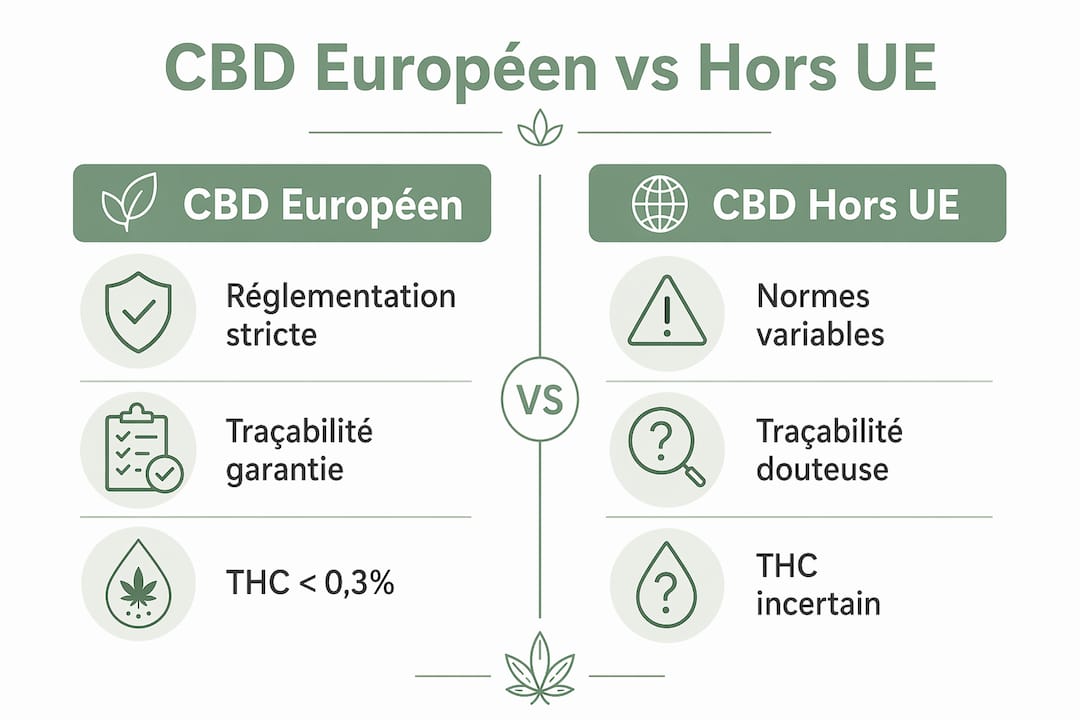
European CBD stands out from others through its strict requirements for THC levels and traceability, often involving fewer pesticides and regular inspections. This transparency about product origins provides concrete protection for consumers, not merely a marketing promise.
A point that is often misunderstood concerns the distinction between the THC level permitted in the plant and that measured in the finished product. Compliance is based on the finished product with certified analyses, which requires regular checks throughout the production chain. An imported product without this level of verification exposes consumers to real risks, particularly non-compliant THC content.
Professional tip: Beware of CBD products sold at very low prices without a visible certificate of analysis. The cost of laboratory testing is included in the price of a reputable European product. An unusually low price often indicates that these checks are absent.
The risks associated with imported products without traceability are not theoretical. The increase in reported poisonings since 2024 mainly concerns non-compliant food products, often of uncertain origin. Choosing CBD of certified European origin directly reduces this risk.
What are the concrete benefits for consumers who choose European CBD?
Choosing CBD of European origin has tangible effects on your safety, consumption experience, and environmental impact. These benefits of European CBD are not abstract: they can be measured with every purchase.
- Enhanced health safety: certified European products undergo independent laboratory analyses that verify the absence of heavy metals, residual solvents, and pesticides. This systematic testing reduces the risk of exposure to contaminants.
- Effectiveness and taste quality: CBD extracted using supercritical CO2 from organic hemp retains its natural terpene profile. Terpenes contribute to the entourage effect, the mechanism by which hemp compounds act synergistically to enhance the effects of CBD.
- Support for local agriculture: local production in Europe reduces the carbon footprint and supports sustainable family farms. Buying European is also an economic choice that benefits producers in your region.
- Short supply chains and freshness: a product that travels a shorter distance between cultivation and your order is fresher, better preserved, and has a chain of responsibility that is easier to verify.
- Guaranteed legal compliance: a legal CBD product in Europe that complies with the requirements of the CJEU and national authorities protects you as a consumer. You do not have to question its legality during an inspection or when purchasing online.
To take your purchasing process further, the legal CBD purchasing process details the concrete steps for securing your choice and identifying reliable sellers.
Key points
Certified European CBD represents the safest, most traceable, and most compliant choice for any consumer wishing to incorporate cannabidiol into their daily life in 2026.
| Point | Details |
|---|---|
| Superior agricultural quality | Choose European organic hemp grown without pesticides, with supercritical CO2 extraction. |
| 2026 regulatory compliance | Only inhalable products remain legal; CBD foods have been withdrawn from the market since May 2026. |
| Certificate of analysis required | Require a laboratory certificate for each batch to verify the THC level and the absence of contaminants. |
| Traceability as a guarantee | A reputable European CBD product documents every step of production, from field to bottle. |
| Reduced environmental impact | Short European supply chains reduce the carbon footprint and support sustainable local agriculture. |
My perspective after years of following this market
After closely following the evolution of the European CBD market, I see that confusion between origin and compliance remains the main pitfall for consumers. Many people think that a product labeled “European” is automatically safe. That is not enough. What really matters is the combination of certified provenance, a documented extraction method, and a recent certificate of analysis.
I’ve seen products sold as “French CBD” or “Swiss CBD” without any accessible certificate of analysis. Geographical origin is a good starting point, but it does not replace batch verification. The role of CBD in Europe is evolving quickly, and consumers who learn about the 2026 regulations consistently make better purchasing decisions.
What I’ve learned is that the European market rewards transparency. Companies that publish their certificates, explain their methods, and comply with the Novel Food framework earn trust over the long term. Those that rely on low prices without documentation disappear or face recalls. My practical advice: treat the certificate of analysis as a non-negotiable requirement, just like the expiration date on food.
— Rod
Where to find certified and reliable European CBD?
Cbd-certified selects and offers CBD products that comply with the latest European requirements, with delivery to the EU, the United Kingdom, and Switzerland. Each listed product meets the traceability, purity, and regulatory compliance criteria described in this article.
Whether you are looking for CBD flowers, oils, or resins, Cbd-certified directs you to products whose origin and composition have been verified. Discover the full selection on the page of the best CBD shops in Europe to find a certified retailer near you or order directly online with confidence.
FAQ
What makes European CBD legally safe?
European CBD is legally safe when it complies with the THC threshold of less than 0.3% in the finished product, confirmed by an independent certificate of analysis. The 2020 CJEU case law protects the free movement of these compliant products between Member States.
Are CBD oils for food use still legal in Europe in 2026?
No. According to the French Ministry of Agriculture, food products containing CBD are being removed from the market from May 15, 2026, due to the lack of Novel Food authorization. Only inhalable forms remain tolerated in most European countries.
How can you check the quality of European CBD before buying?
Request the batch certificate of analysis, verify that the extraction is performed using supercritical CO2, and confirm that the hemp comes from a certified organic crop. A reliable seller provides this information promptly, often via a QR code on the packaging.
What is the difference between natural CBD and synthetic CBD?
Natural CBD is extracted directly from the hemp plant and retains its full terpene profile, which promotes the entourage effect. Synthetic CBD is produced in a laboratory and does not contain these additional compounds, which may reduce its perceived effectiveness.
Why is European CBD more expensive than other CBD?
The higher price reflects the actual costs of laboratory testing, organic certification, CO2 extraction, and documented traceability. These checks are included in the price and are precisely the guarantees you pay for to ensure your safety.