
CBD Quality in Europe: A Guide to Effective Use
TL;DR:
- CBD quality depends on its traceability, cannabinoid profile, and the presence of terpenes.
- It is essential to check ISO 17025-certified laboratory analyses before purchasing.
- The positive effects of full-spectrum CBD include reducing pain, improving sleep, and reducing anxiety.
Many European consumers think CBD is interchangeable from one country to another, or even from one brand to another. This is a misconception that can be costly, both in terms of effectiveness and safety. The reality is far more nuanced: differences in regulations, extraction methods, and quality control create a two-tier market. This article explains the official criteria that define reliable CBD, how controls work in Europe, and, above all, how to make the right choices to relieve chronic pain, improve sleep, or reduce anxiety.
Table of contents
- Understanding CBD regulations in Europe
- The essential criteria for assessing CBD quality
- CBD quality and effectiveness for pain, sleep, and anxiety
- The nuances and pitfalls to avoid when choosing CBD in Europe
- Why the concept of quality remains evolving and misunderstood
- Where to find reliable, certified CBD in Europe
- Frequently asked questions about CBD quality
Key points
| Point | Details |
|---|---|
| Strict legal framework | CBD quality in Europe depends on compliance with THC thresholds and testing by independent laboratories. |
| Reliability criteria | A quality product offers accessible analysis, a traceable origin, and a demonstrated full-spectrum effect. |
| Proven effectiveness | Full-spectrum CBD oils provide proven superior relief for pain, anxiety, and sleep. |
| Avoiding pitfalls | Always check local legality and favor transparent brands. |
Understanding CBD regulations in Europe
To better understand what defines quality CBD, we must first clarify the regulatory framework governing its production. In Europe, CBD-based products come from industrial hemp (Cannabis sativa), a variety selected for its low THC content, the psychoactive molecule. Regulations impose strict thresholds: the THC level must remain below 0.3% during cultivation and below 0.2% in finished products. These controls rely on analyses conducted by ISO 17025-certified laboratories, the international reference standard for test reliability.
Traceability is at the heart of this system. A compliant product must be traceable from the agricultural plot to the bottle or sachet you hold in your hands. This includes the batch number, the hemp variety used, the cultivation site, and the analysis results. Without this information, no serious guarantee is possible.
There is also an important legal distinction between the different forms of CBD:
- Flowers and resins: often tolerated as “industrial hemp” in several countries, but their status varies greatly depending on national legislation.
- Extracts and oils: subject to the novel food process in several European Union member states, requiring prior authorization before marketing.
- CBD isolates: 99% pure CBD, with no other cannabinoids, often used in cosmetics and supplements.
| CBD form | Regulatory status | ISO 17025 test required |
|---|---|---|
| Dried flowers | Industrial hemp (variable) | Yes |
| Resins / extracts | Novel food in the EU | Yes |
| Full-spectrum oils | Novel food under review | Yes |
| CBD isolate | Cosmetic / supplement | Recommended |
Pro tip: Before buying, request the certificate of analysis for the batch you are purchasing, issued by an independent laboratory certified to ISO 17025. A simple QR code on the packaging should give you access to it within seconds.
To deepen your understanding and recognize quality CBD at first glance, take the time to learn how to read these certificates. And if you want to ensure quality and benefits during your next purchase, several practical steps can help guide you.
The essential criteria for assessing CBD quality
After detailing the regulations, let’s move on to the practical criteria for distinguishing reliable CBD from a questionable product. Whether you are looking for flowers, resin, or oil, the quality indicators remain consistent and can be learned.
For CBD flowers, here is what to look for:
- The color: a fresh flower displays shades ranging from deep green to purple. A yellow or brown hue indicates advanced aging or poor storage.
- The texture: neither too dry nor too damp. A properly dried flower holds together without crumbling into dust at the slightest touch.
- The smell: rich, complex, and distinctive. This indicates a preserved terpene profile, ensuring a better entourage effect.
- The presence of trichomes: these small, shiny resins visible to the naked eye indicate that the flower was harvested at the right time.
For resins and extracts, the comparison table below summarizes the essentials:
| Criterion | Full spectrum | CBD isolate |
|---|---|---|
| Cannabinoids present | CBD, CBG, CBN, trace THC | CBD only |
| Terpenes | Yes | No |
| Entourage effect | Maximum | Absent |
| Recommended use | Pain, anxiety, sleep | Cosmetic use |
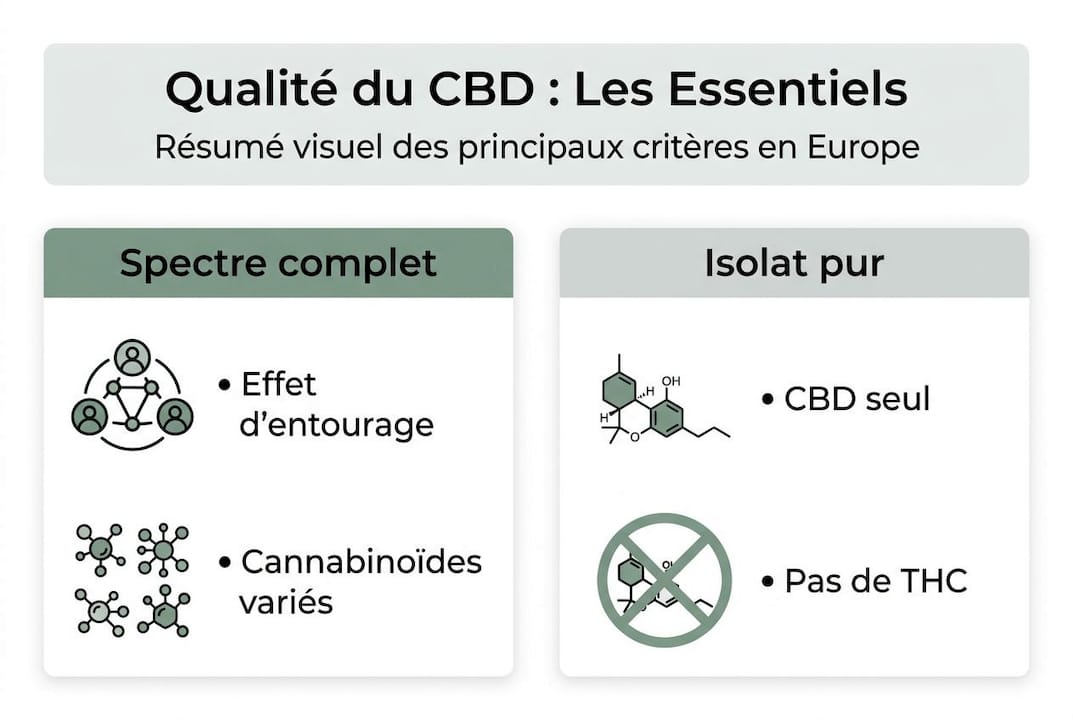
High-potency full-spectrum oils are recommended for pain management and sleep disorders, while untested products from uncontrolled imports are strongly discouraged by experts.
Also systematically check the labeling: it must state the CBD concentration (in mg), the origin of the hemp (ideally Europe), and accessible analysis results. To choose a CBD product suited to your specific needs, a step-by-step guide can effectively guide you according to your profile and expectations regarding natural well-being with CBD.
Pro tip: Avoid any product without a QR code or a link to a publicly accessible laboratory analysis. A lack of transparency is the most reliable warning sign of a risky product.
CBD quality and effectiveness for pain, sleep, and anxiety
Now that the quality criteria are clear, let’s see how these choices affect your health and concrete well-being. Product quality is not a marketing detail. It directly determines the effects you will experience.
The latest clinical evidence is clear. Phase 3 clinical trials published in 2025 in Nature Medicine show that full-spectrum extracts reduce pain intensity by 1.9 to 2.5 points on a standardized scale and significantly improve sleep quality compared with placebo and certain opioids. These results are achieved with high-quality products that are tested and precisely dosed.
Here are the documented effects of quality full-spectrum CBD:
- Chronic pain: measurable reduction in intensity, with better digestive tolerance than anti-inflammatory drugs or conventional opioids.
- Sleep: improved duration and quality of deep sleep, with no reported dependence at therapeutic doses.
- Anxiety: the proven benefits of CBD for anxiety are largely mediated by the interaction of terpenes and minor cannabinoids, a mechanism absent in isolates.
The role of terpenes deserves particular attention. These aromatic molecules naturally present in hemp enhance the action of CBD by interacting with the endocannabinoid system. Linalool, for example, strengthens the calming effect. Myrcene intensifies muscle relaxation. Without terpenes, a product loses a significant part of its therapeutic potential.
If you are interested in the impact of CBD and mental health, studies support its role in modulating cortisol, the stress hormone. And for those who wish to use CBD daily, regular, gradual use generally produces better results than occasional, irregular use.
The nuances and pitfalls to avoid when choosing CBD in Europe
After detailing the benefits, it is still necessary to highlight the precautions and pitfalls specific to the European market. The CBD market is still young, and gray areas persist, creating fertile ground for unpleasant surprises.
The first reality to understand is that laws vary widely from one member state to another. In France, for example, raw CBD flowers were prohibited for sale until 2022, and regulations remain subject to varying interpretations. In other countries such as Germany, Switzerland, or Belgium, the rules differ again. Resins are often classified as novel foods, with prior authorization requirements.
Here are the most common pitfalls to avoid:
- Imported products without analysis: many extracts come from Asia or North America, without a certificate of analysis compliant with European standards. The risk of contamination by pesticides or heavy metals is real.
- Misleading labeling: a product labeled “10% CBD” may actually contain much less if the extraction is poor or the dosage has not been verified by an independent third party.
- Unusually low price: extraction quality, organic certification, and laboratory testing all come at a cost. A price far below the market average should raise your concerns.
- Lack of information about the origin: hemp grown using organic farming methods in Europe offers far greater guarantees than hemp of unknown origin.
To better understand the therapeutic uses of CBD authorized in your country, always consult the local legislation currently in force before buying. And if you are looking for a specific guide on pain management with CBD, practical resources are available to guide you.
Pro tip: Before making any purchase, check that the brand publishes its laboratory analyses online, clearly states the origin of its hemp, and offers reachable customer service. These are the three fundamental indicators of reliability in this market.
Why the concept of quality remains evolving and misunderstood
After exploring the pitfalls and advice, it is time to step back and reflect on the very concept of quality. At European CBD Shop, we regularly find that many consumers reduce quality to a single figure: CBD concentration. Yet this approach is too narrow to be truly useful.
A poorly extracted or stored 20% CBD product with no terpenes may prove less effective than an 8% flower grown with care and harvested at the optimal time. Quality encompasses the product’s entire profile: its traceability, the diversity of its cannabinoids, its terpenes, and the producer’s transparency.
Standards are evolving rapidly. In the years ahead, “premium” products will probably include standardized microbiological controls, bioavailability measurements, and perhaps specific terpene levels on the label. Consumers who already rely on scientific evidence on anxiety and other clinical data will be much better equipped to navigate this rapidly changing market. Stay curious. Cross-check your sources. Quality is never permanently guaranteed.
Where to find reliable, certified CBD in Europe
To conclude, here is where to turn to buy compliant, tested CBD. Finding quality CBD in Europe is not a matter of luck. It is a matter of method and trust in the source.
European CBD Shop offers a catalog of flowers, resins, and broad-spectrum CBD oils, with laboratory analyses available for each product. Deliveries are available throughout the EU, the United Kingdom, and Switzerland. Whether you are in Paris, Geneva, or London, you can consult the best CBD shops in London or place an order directly on our website for a secure purchase of certified CBD. Each product complies with European regulatory requirements, and our teams remain available to guide you toward the right choice for your needs.
Frequently asked questions about CBD quality
How can you verify that the CBD purchased in Europe complies with regulations?
Check for ISO 17025 analyses confirming the THC content and the absence of pesticides, heavy metals, and microbiological contaminants in the exact batch you are buying.
What effects can you expect from a quality full-spectrum CBD product?
A quality full-spectrum product offers a measurable reduction in chronic pain, improved sleep, and reduced anxiety, with effects amplified by the combined presence of cannabinoids and terpenes.
Is CBD legal everywhere in Europe?
No. Each country applies its own rules: flowers are legal as industrial hemp in some countries, prohibited in others, and extracts are often subject to the novel food regime, with specific authorizations.
How to avoid scams or risky purchases?
Choose only brands that publish their laboratory analyses and clearly state the origin of the hemp, as untested imports pose documented risks of contamination and incorrect dosage.