
CBD Relaxing Sleep Workflow: Practical Guide 2026
In brief:
- The CBD nighttime workflow is based on a structured routine designed to promote restorative sleep and reduce stress. Each step, from reducing screen time to keeping a journal, reinforces the calming effect of CBD, which acts on anxiety and the endocannabinoid system. Consistency, dosage, and the choice of CBD form determine the success of this approach.
A CBD restful-night workflow is a set of structured nighttime practices centered around taking cannabidiol to support restorative sleep and reduce stress. This CBD wellness ritual is based on a simple principle: CBD acts on the endocannabinoid system to calm mental activity, creating the conditions for natural sleep onset. The effects of CBD on sleep are now documented by several clinical studies, particularly regarding increased deep slow-wave sleep at moderate doses. Building this type of routine requires method, patience, and some key knowledge about dosage and the available formats.
How should you dose and choose the form of CBD for nighttime use?
CBD has a dose-dependent biphasic effect that many people initially overlook. At a low dose, it may have a mildly stimulating effect. At a higher dose, it promotes relaxation and deep slow-wave sleep. This nuance makes all the difference when creating a nighttime ritual.
The clinically tested doses for reducing anxiety range from 25 mg to 400 mg depending on the context and individual profile. For nighttime use focused on relaxation, a range of 25 mg to 150 mg represents a reasonable starting point. The recommended strategy is to start with a low dose (10 mg), then gradually increase it every three days until the desired effect is achieved.
Available formats and their effectiveness
Each form of CBD offers a different experience depending on the speed of absorption and duration of action:
- Sublingual oil: fast absorption, with effects felt within 15–30 minutes. Ideal for use just before bedtime. The sublingual route is the most effective, provided you hold the oil under your tongue for 60–90 seconds before swallowing.
- Hemp herbal tea: gentler and more gradual effects. It naturally fits into a soothing ritual and enhances the relaxing effect through its warmth and aromas.
- CBD gummies: convenient, precisely dosed, but slower absorption (45–90 minutes). Take them about an hour before bedtime for an effect synchronized with falling asleep.
- CBD e-liquid: rapid pulmonary absorption, but less suitable for daily nighttime use for comfort reasons.
Pro tip: Pair your CBD night oil with a glass of lukewarm water immediately after taking it sublingually. This makes swallowing easier and enhances the feeling of a soothing ritual.
What are the steps of a soothing nighttime workflow with CBD?
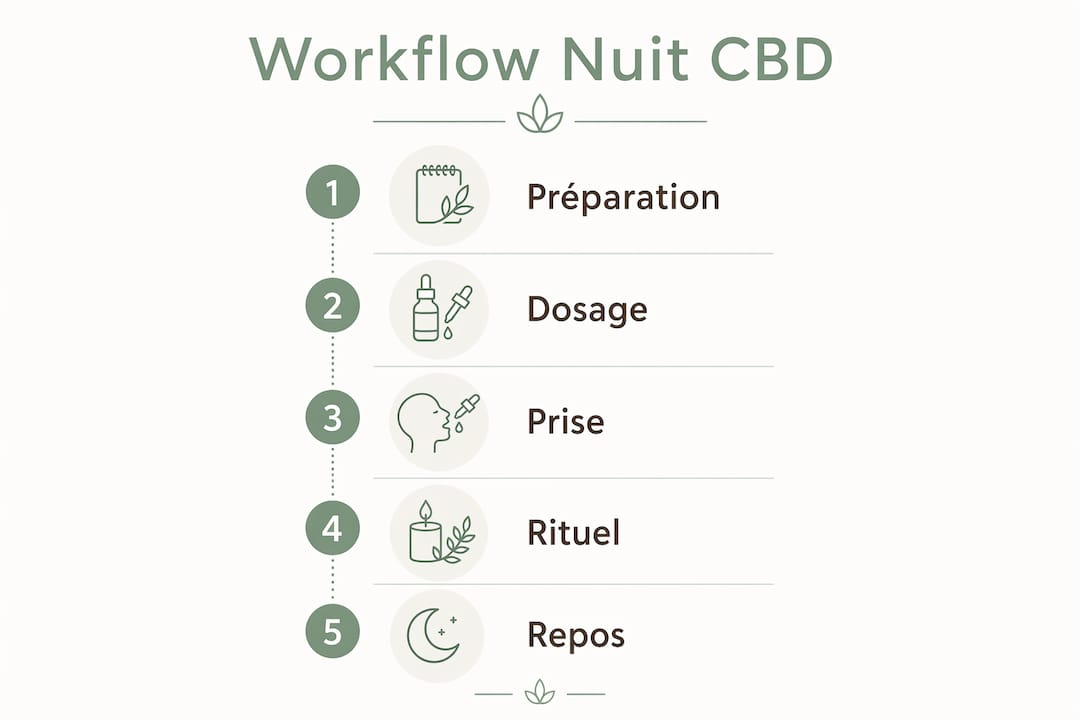
An effective nighttime ritual relies on repeating actions in a fixed order. The brain associates these actions with relaxation, which strengthens their effect over time. Here are the key steps of a structured nighttime workflow:
-
8:00 p.m.: gradually reducing screen time. Blue light from screens inhibits the natural production of melatonin. Reducing exposure from the evening onward preserves this essential biological signal for falling asleep.
-
9:00 p.m.: hemp herbal tea or a hot drink. THC-free hemp tea prepares the body for relaxation. It creates a thermal and olfactory signal that the brain gradually associates with rest.
-
9:30 p.m.: taking sublingual CBD. Take your CBD oil 30–60 minutes before bedtime so that its effects coincide with the time you fall asleep. Hold the oil under your tongue for 60–90 seconds to maximize absorption.
-
9:45 p.m.: hot bath or gentle stretching. Heat lowers body temperature after a bath, a physiological mechanism that naturally promotes sleep. Stretching releases muscle tension accumulated during the day.
-
10:00 p.m.: reading or breathing exercises. Coherent breathing (a breathing technique of 6 cycles per minute) measurably reduces cortisol. Reading on paper is a beneficial alternative to screens without disrupting melatonin production.
-
10:15 p.m.: go to bed in a cool, dark room. A room temperature of 18–19°C is recognized as beneficial for the quality of deep sleep.
Pro tip: Associate taking CBD with an already established reflex action, such as brushing your teeth. This behavioral link reinforces the regularity of the ritual without requiring additional mental effort.
How should you adapt your CBD ritual according to your stress profile?
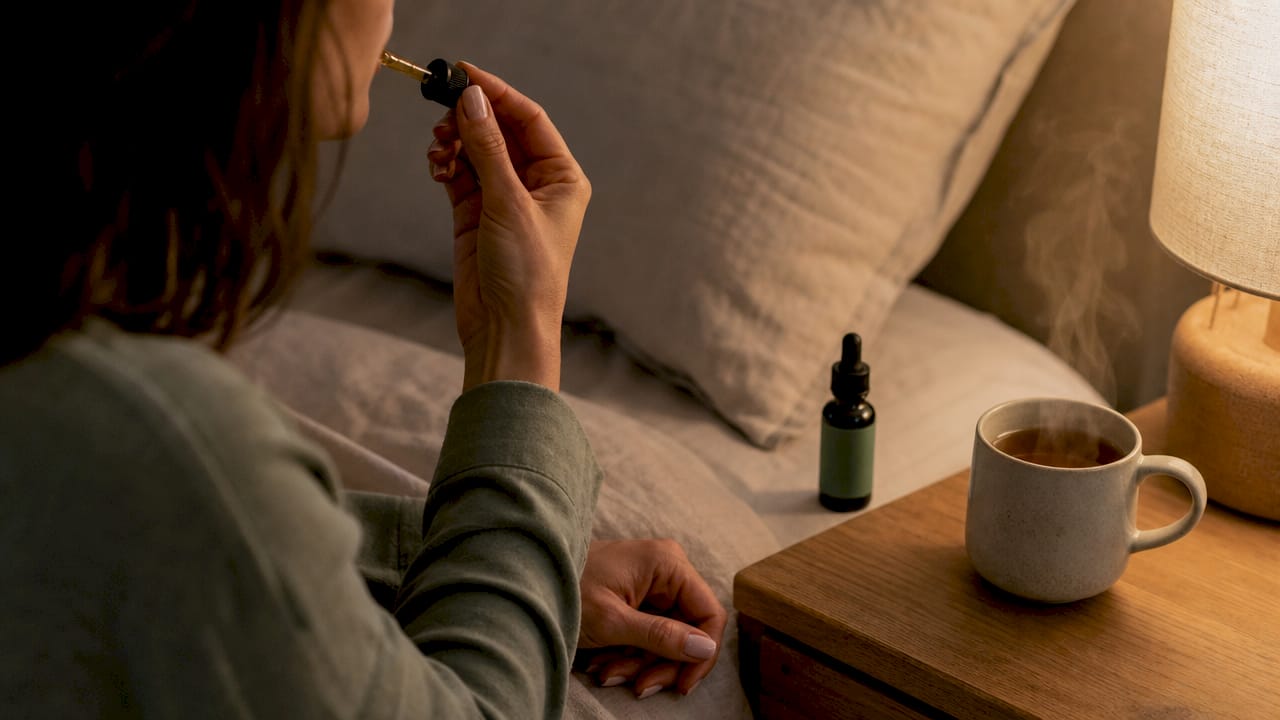
CBD is not a traditional sleeping pill. It acts primarily by reducing anxiety and stress, which indirectly improves sleep. This distinction is essential for calibrating expectations and dosage.
Two profiles clearly stand out:
- Stress- and anxiety-related disorders: CBD acts directly on the cause. A dose of 25–50 mg taken regularly in the evening produces noticeable effects on sleep quality after two to four weeks. The CBD routine for anxiety must be maintained without interruption to observe stable results.
- Pure physiological insomnia: CBD alone is not enough. Factors such as sleep apnea, chronic pain, or hormonal disorders require additional medical care. CBD may nevertheless support sleep quality by reducing muscle tension and promoting a general state of calm.
The effects of CBD vary according to the individual profile. Genetics, body weight, metabolism, and consistency of use all influence the outcome. A sleep journal (sleep quality, mood upon waking, dose taken) makes it possible to adjust the dosage precisely over two to three weeks.
What mistakes reduce CBD's effectiveness at night?
Certain habits cancel out the benefits of CBD before it even has time to work. Here are the most common mistakes to correct:
- Taking it too late. Swallowing CBD oil just before going to bed delays the effect by 15–30 minutes after the desired time of falling asleep. Take it 30–60 minutes before bedtime.
- Insufficient sublingual retention. Swallowing the oil immediately greatly reduces its absorption. Keeping it under the tongue for 60–90 seconds is not optional.
- Screen exposure after taking it. Blue light blocks melatonin and directly counteracts CBD's calming effect. These two actions cancel each other out.
- Dose too low or too high without adjustment. A dose that is too low produces little effect. A dose that is too high may cause slight daytime drowsiness. Gradual adjustment remains the only reliable method.
- Lack of consistency. CBD produces its best effects after several days of continuous use. Occasional use produces unpredictable results.
- Separating CBD from the rest of the routine. Taking CBD without changing other habits (evening caffeine, late meals, unmanaged stress) greatly limits its effectiveness.
CBD is not a miracle solution. It is a tool that works within a consistent routine. Without this framework, even the best product remains underused.
Key points
A CBD workflow for a restful night works only when dosage, timing, and associated habits form a coherent routine repeated every evening.
| Point | Details |
|---|---|
| Biphasic effect of CBD | A low dose provides mild stimulation; a higher dose promotes relaxation and deep sleep. |
| Timing of use | Take CBD 30–60 minutes before bedtime to synchronize its effect with falling asleep. |
| Sublingual administration | Holding the oil under the tongue for 60–90 seconds maximizes absorption and effectiveness. |
| Reducing screen time | Blue light blocks melatonin and cancels out CBD's benefits for sleep. |
| Consistency above all | Lasting effects appear after two to four weeks of regular daily use. |
What I learned from incorporating CBD into my sleep routine
The first thing I understood was that CBD does not replace good sleep hygiene. It amplifies it. When I started incorporating it without changing my other habits, the results were disappointing. It was only when I built a complete routine around taking it that the effects became real and consistent.
What surprised me most was the diversity of individual responses. Some people feel a clear effect as early as the first week at 25 mg. Others need six weeks and 75 mg to notice a perceptible change. This variability is not a flaw of CBD. It is simply the biological reality of each individual.
My most practical advice: keep a journal for a month. Record the dose, time of use, sleep quality, and how you feel upon waking. This personal data is worth more than any generic dosage found online. It allows you to make precise adjustments rather than feeling your way in the dark.
Finally, be patient with yourself. Building an effective nighttime routine takes time. CBD is a reliable ally in this process, provided you give it time to work within a stable framework.
— Rod
Cbd-certified products for a successful nighttime ritual
Cbd-certified offers a selection of certified CBD products designed to support a soothing nighttime ritual. From broad-spectrum oils to relaxing gummies, each product is selected for its quality and compliance with European regulations.
For people looking for a targeted nighttime formula, Nobilis CBN + CBD oil combines two cannabinoids known for their soothing effects. Sensavea’s Super Relax CBD & CBG oil is also highly appreciated for evening muscle relaxation. Cbd-certified delivers throughout the European Union, the United Kingdom, and Switzerland. Explore the full range at the certified CBD shop in Europe.
Frequently asked questions
When should you take CBD to sleep better?
CBD is ideally taken 30–60 minutes before bedtime. This interval allows the effects to coincide with the time you fall asleep.
What dose of CBD provides a relaxing effect at night?
A dose of 25–50 mg is a suitable starting point for nighttime relaxation. Gradual adjustment every three days makes it possible to find the effective dose for each individual.
Is CBD a sleeping pill?
CBD is not a sleeping pill. It works by reducing anxiety and stress, which improves sleep indirectly rather than directly inducing sleep.
How long does it take to see effects on sleep?
CBD’s lasting effects on sleep generally appear after two to four weeks of regular use. Consistency in the ritual is the determining factor.
Is sublingual oil the best form for nighttime use?
Sublingual oil is the fastest and most effective form for nighttime use. It takes effect within 15–30 minutes when held under the tongue for 60–90 seconds.