
Optimize your CBD routine to better manage anxiety and sleep
TL;DR:
- To optimize your CBD routine, first define clear goals such as anxiety relief or better sleep, using precise tracking with suitable tools. Take the time to titrate your dose gradually, noting how you feel each time, while maintaining a regular schedule to enhance the product’s effectiveness. Selecting a high-quality product and adapting it to your individual needs remain essential for achieving lasting, satisfying results.
You’ve been taking CBD for a few weeks, but the results remain unclear. Sometimes you sleep a little better, sometimes you don’t. Your anxiety eases on some days, then returns without warning. This lack of consistency is one of the most common frustrations among European CBD consumers, and it rarely comes from the product itself. It comes from a poorly structured routine, approximate dosing, and a lack of tracking. This guide offers you a practical, step-by-step method for building a truly effective CBD routine around your specific goals: anxiety, stress, or sleep disorders.
Table of contents
- Defining your goals: anxiety, stress, or sleep disorders
- Equipment and prerequisites needed to optimize the routine
- Key steps for structuring and tracking your CBD routine
- Optimizing the link between a CBD routine and restorative sleep
- Precautions, safety, and individual adaptation
- What research does not tell you: the key to a successful CBD routine
- Find the best CBD shops and suitable products
- Frequently asked questions about optimizing a CBD routine
Key Points
| Point | Details |
|---|---|
| Clarify your goals | Identify whether your priority is anxiety, stress, or sleep so you can create an appropriate routine. |
| Prepare your tracking | A journal or tracking app is essential for adjusting your CBD intake. |
| Adopt cautious titration | Start with a low dose of CBD and gradually increase it according to how you feel. |
| Make your routine safe | Consult a professional if you are undergoing medical treatment or have specific health conditions. |
| Test, adjust, document | The optimal CBD routine is the one you carefully adapt to your profile and symptoms. |
Defining your goals: anxiety, stress, or sleep disorders
After outlining the general issue, it is essential to focus on your personal goals. Because optimizing a CBD routine without a clear goal is a bit like going hiking without a map. You’re moving forward, but toward where?
Chronic anxiety, situational stress, and sleep disorders are three distinct problems, even though they often overlap. Here’s why the distinction matters:
- Chronic anxiety: characterized by persistent tension, intrusive thoughts, and sometimes panic attacks. It often calls for regular CBD use spread throughout the day.
- Situational stress: linked to specific events (an exam, an important meeting, a conflict). A single dose or a dose taken in advance may be sufficient.
- Sleep disorders: difficulty falling asleep, nighttime awakenings, or unrefreshing sleep. Here, the timing of intake is crucial, generally 30 to 60 minutes before bedtime.
These nuances directly influence the form, dose, and timing. CBD and mental health remains an evolving field: CBD’s anxiolytic potential is recognized, but optimal dosing regimens remain uncertain. A 2026 literature review confirms positive effects on anxiety while highlighting uncertainty about dosage and insufficient data concerning depression.
So take five minutes to honestly note: what is your main symptom? This answer will guide every practical decision that follows.
Equipment and prerequisites needed to optimize the routine
Once the goal has been determined, you need to prepare practically. Too many consumers try CBD blindly, without tracking tools or a solid foundation. As a result, they do not know whether the product works, at what dose, or under what conditions.
Here are the essential items to gather before getting started:
- A quality CBD product, with certificates of analysis (COAs) available, stating the cannabidiol content and absence of contaminants
- A tracking journal (paper or digital) for recording doses, times, and how you feel
- A sleep-tracking app if your goal is insomnia (Sleep Cycle, Oura Ring, or even your smartphone data)
- Self-assessment forms to measure your level of anxiety or stress on a scale of 1 to 10 before and after taking it
- A sufficient supply of product for at least 3 to 4 weeks without interruption
| Tool | Main use | Recommended format |
|---|---|---|
| Tracking journal | Document doses and effects | Paper or notes app |
| Sleep app | Measure sleep quality | Smartphone or wearable |
| Self-assessment form | Quantify anxiety and stress | Scale of 1 to 10 |
| CBD product with COA | Ensure quality and traceability | Oil, capsule, or gummy |
| Timer or alarm | Stick to the dosing schedule | Phone |
Cautious titration is recommended by the most recent clinical reviews, precisely because there is no universal dose. Without individual monitoring, it is impossible to know whether your dose is too low, appropriate, or too high. Also consult the CBD dosage guide for a quantified starting point based on your goal and weight.
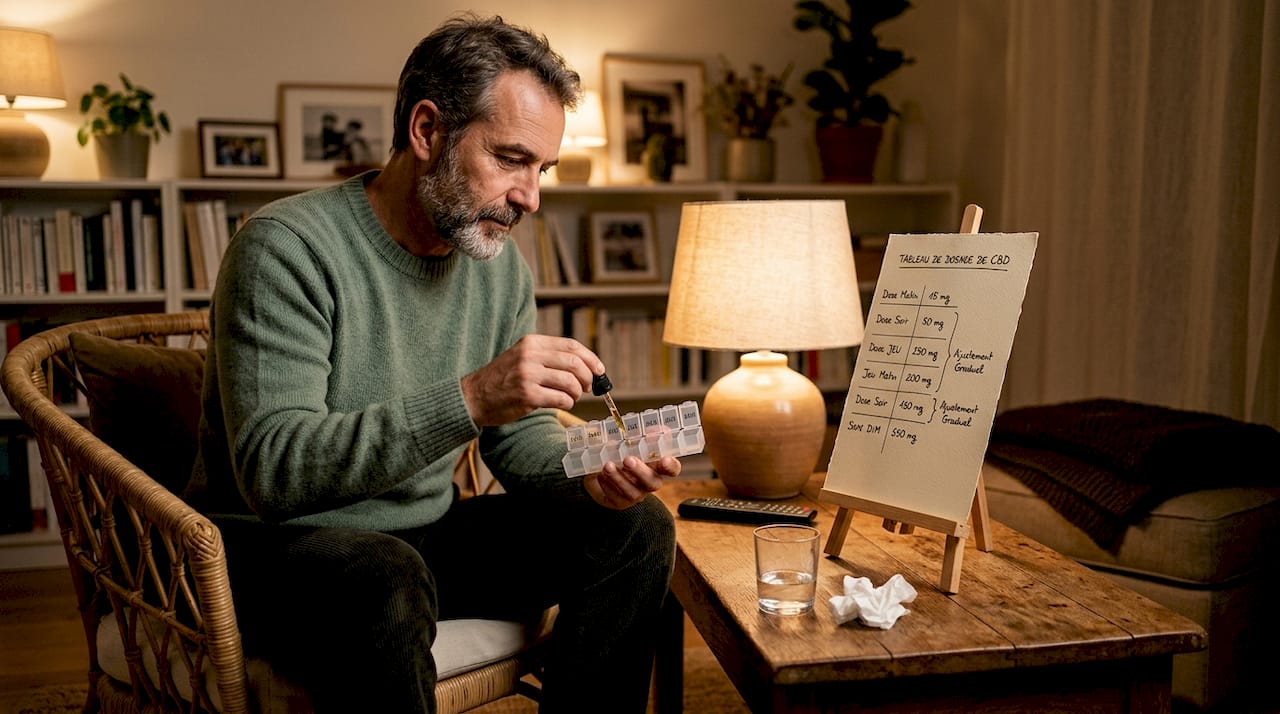
Above all, avoid the trap of a fixed single product: buying an oil, taking 5 drops every evening without ever adjusting, and concluding that “it doesn’t work” after ten days. Optimization requires an active, not passive, approach.
Key steps for structuring and tracking your CBD routine
With the tools in hand, it is time to take a methodical approach. Here are the concrete steps for a structured routine.
-
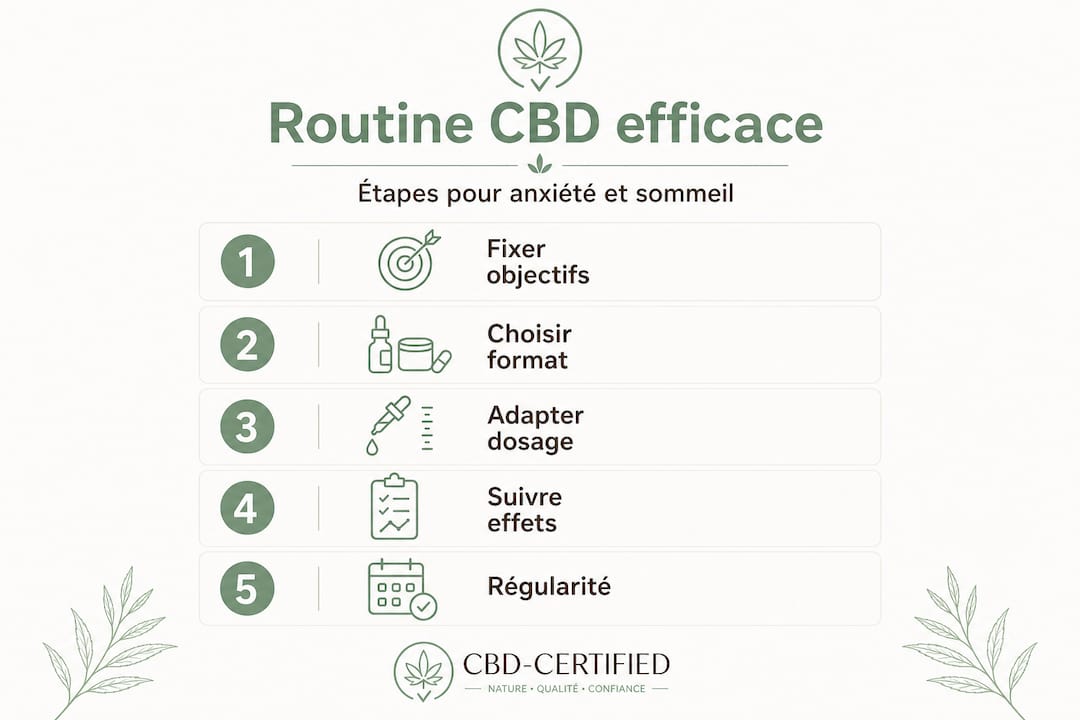
Start with a low dose and increase gradually. Start with 5 to 10 mg of CBD per dose. Maintain this dose for 5 to 7 days while recording how you feel each day. If the effects are insufficient and you experience no adverse effects, increase by 5 mg per step.
-
Keep a rigorous tracking journal. For each dose, note the time, dosage, format (sublingual oil, capsule, gummy), your anxiety or stress level before taking it (on a scale of 10), and how you feel 1 to 2 hours afterward. For sleep, also record your estimated time of falling asleep and the quality of your awakening.
-
Analyze your data every two weeks. Review your notes and look for patterns: Do certain days work better? Does a specific dose seem more effective? Is evening better than morning for you? These observations guide adjustments.
-
Adjust the format according to your needs and profile. Sublingual oil takes effect within 15 to 45 minutes, making it ideal for rapid relief in cases of acute stress. Capsules have a slower effect (1 to 2 hours) but are more consistent over time, making them suitable for chronic anxiety. Gummies are convenient and pre-dosed, making them well suited for evening use to support sleep.
| Format | Onset time | Duration of effect | Dosage precision | Ideal profile |
|---|---|---|---|---|
| Sublingual oil | 15 to 45 minutes | 4 to 6 hours | High | Acute stress, titration |
| Capsules | 1 to 2 hours | 6 to 8 hours | Medium | Chronic anxiety |
| Gummies | 30 to 90 minutes | 4 to 6 hours | Fixed | Sleep, convenience |
| Flowers/pre-rolls | 5 to 15 minutes | 2 to 3 hours | Low | Occasional use |
Results vary significantly from one person to another, which justifies this stepwise approach rather than relying on a generic dose found online.
For further guidance on building a daily routine, the CBD wellness guide and advice on CBD in everyday life offer highly practical complementary approaches.
Pro tip: Set the same intake time every day, at least during the first two weeks. Consistency allows your body to adapt and gives you reliable comparison data. A schedule that constantly changes makes any analysis impossible.
Optimizing the link between a CBD routine and restorative sleep
The evening routine deserves specific optimization for sleep quality. Contrary to what many people think, swallowing CBD just before turning off the light is not necessarily optimal.
Here is how to structure a sleep-focused CBD routine:
- Take your CBD 30 to 60 minutes before your desired bedtime, especially in oil or gummy form, so that the effects coincide with your attempt to fall asleep.
- Combine your intake with relaxation rituals: deep breathing, dimmed lighting, and no screens for the following 30 minutes. CBD supports relaxation but does not replace good sleep hygiene.
- Record your sleep quality every morning using a simple scale: ease of falling asleep, number of awakenings, and how refreshed you feel upon waking.
- Test different dosages in the evening without changing your morning intake if you have one, to isolate the effect on sleep.
- Avoid taking it too late if you choose capsules: their prolonged effect could cause a slight residual effect the next morning.
To understand how CBD interacts with sleep cycles, see the articles on the CBD sleep comparison and on CBD and sleep cycles.
The effects of CBD on sleep have been reported positively in several studies, but the evidence remains insufficient to establish an optimal dosage. Effects vary from person to person, and no standardized protocol currently exists specifically for sleep disorders.
Professional advice: Do not use CBD as a direct substitute for a prescribed sleeping medication without speaking to your doctor. CBD may complement your sleep routine, but abruptly stopping a prescribed treatment carries real risks. A complementary approach, rather than abruptly replacing treatment, is always the safest option.
Precautions, safety, and individual adaptation
Optimizing also means ensuring safety and adapting use to your personal situation. CBD is generally well tolerated, but certain situations call for caution.
Points to consider based on your profile:
- Current medical treatments: CBD may interact with certain medications, particularly blood thinners, antidepressants, and some antiepileptic drugs. Consult your doctor before starting.
- Older adults: metabolism slows with age, which can alter the duration and intensity of the effects. Start with a lower dose and increase it even more slowly.
- Pregnant or breastfeeding women: CBD use is not recommended as a precaution, due to insufficient data on these specific populations.
- Liver problems: CBD is metabolized by the liver. In the event of liver disease, medical monitoring is essential.
- Sensitivity to cannabinoids: some people react strongly even to low doses. Mild nausea, drowsiness, or dry mouth are signs to take into account.
For people with chronic conditions, the guide to CBD safety is essential reading before optimizing any routine.
Particular caution is recommended in the case of concomitant treatments. In the absence of validated official protocols, consulting a healthcare professional remains the best guarantee of personalized and safe use.
It is important to remember that CBD does not cure anxiety or insomnia. It may support an overall wellness approach, but it is not a substitute for therapeutic support in severe cases. This distinction is essential to avoid disappointment and risks.
What research does not tell you: the key to a successful CBD routine
After detailing the precautions, it is time to adopt a broad and critical view. Research on CBD is advancing, but it will never tell you exactly what will work for you. And this is where many consumers get lost.
Most articles about CBD offer you a general dosage, a list of benefits, and a product. What is less often mentioned is that the optimal CBD routine is deeply individual, influenced by your genetics, your endocannabinoid system, your lifestyle habits, your medications, your diet, and even your baseline stress level. Two people who take 20 mg of CBD oil every evening may have radically different experiences.
The real lesson drawn from observing thousands of European consumers is that those who succeed are not the ones who have found the “best product.” They are the ones who have documented, tested, and adjusted over the long term. A tracking journal kept for six weeks is worth more than any generic recommendation.
There is also a common error in perspective: focusing exclusively on the dose at the expense of context. CBD taken after three cups of coffee, just before a stressful meeting, while mentally agitated, will not produce the same effect as the same CBD taken after a walk, in a calm environment, in the evening. The product does not change, but the result does.
Finally, we must have the intellectual honesty to acknowledge that some people respond only minimally to CBD, and that this is not a personal failure. Studies clearly show it: variability in outcomes is substantial. To better understand the role of CBD in managing anxiety, we must accept this uncertainty and remain pragmatic, curious, and patient.
Find the best CBD shops and suitable products
To take action or fine-tune your routine, you first need reliable, traceable products suited to your goals. This is the basic condition on which everything else depends.
European CBD Shop offers a carefully selected range, with tested products, available certificates of analysis, and formats suited to every profile, whether you are looking for an oil for precise titration or gummies for a simple evening routine. Consult the list of best CBD shops in Europe to find reliable sources in your country. If you also want to explore the practical and aromatherapeutic side of CBD flowers, the CBD pre-roll assortment offers an accessible introduction, ideal for occasional moments of stress or relaxation at the end of the day.
Frequently asked questions about optimizing a CBD routine
What CBD dosage should you choose for anxiety?
There is no universal dosage: studies confirm that the optimal dosage remains unknown and recommend cautious titration, starting with a low dose and gradually increasing it based on your documented responses.
How long does it take to notice the effects of CBD?
The first effects may appear within a few days, but effects vary considerably from person to person, and 2 to 3 weeks of regular monitoring are often necessary to observe stable, interpretable results.
Can CBD be used to improve sleep?
Yes, positive effects on sleep have been reported, but the evidence remains limited and the optimal dosage has not yet been scientifically established, making individual adjustment and personal monitoring essential.
Are there any risks or contraindications to a CBD routine?
Yes, particularly in cases of concomitant treatments such as anticoagulants or certain antidepressants. Consulting a doctor before starting a routine remains the most prudent recommendation.
Which format (oil, capsule, etc.) should you choose for an effective routine?
The choice depends on your primary goal and practical preferences. Sublingual oil remains the most versatile format because it allows more precise titration thanks to its rapid, adjustable action, drop by drop.