
Improve falling asleep with CBD: 2026 guide
TL;DR:
- CBD helps relax the central nervous system and promotes falling asleep without acting like a conventional sleeping pill. The dosage form, gradual dosage, and product quality are essential for optimizing its effects. When properly selected and used according to best practices, CBD is an effective natural option for certain sleep disorders.
CBD (cannabidiol) is defined as a modulator of the central nervous system that facilitates relaxation and reduces pre-sleep mental tension, without acting like a conventional sleeping pill. To optimize falling asleep with CBD, three factors are decisive: choosing the right dosage form, adopting a gradual dosage, and selecting rigorously tested products. This practical guide, designed for European consumers, takes you step by step through getting the most out of CBD for sleep disorders, while taking into account the latest regulatory precautions of 2026.
How can you optimize falling asleep with CBD depending on the chosen dosage form?
The choice of dosage form directly determines the speed and duration of CBD’s effects on falling asleep. Sublingual oil takes effect within 15 to 45 minutes and produces effects for 4 to 6 hours, making it the most suitable format for reducing sleep-onset latency. Capsules, on the other hand, release CBD more slowly and are better suited to people who wake up in the middle of the night. Vaporization offers the fastest response (less than 10 minutes), but its effects last for a shorter time, and its use requires some caution.
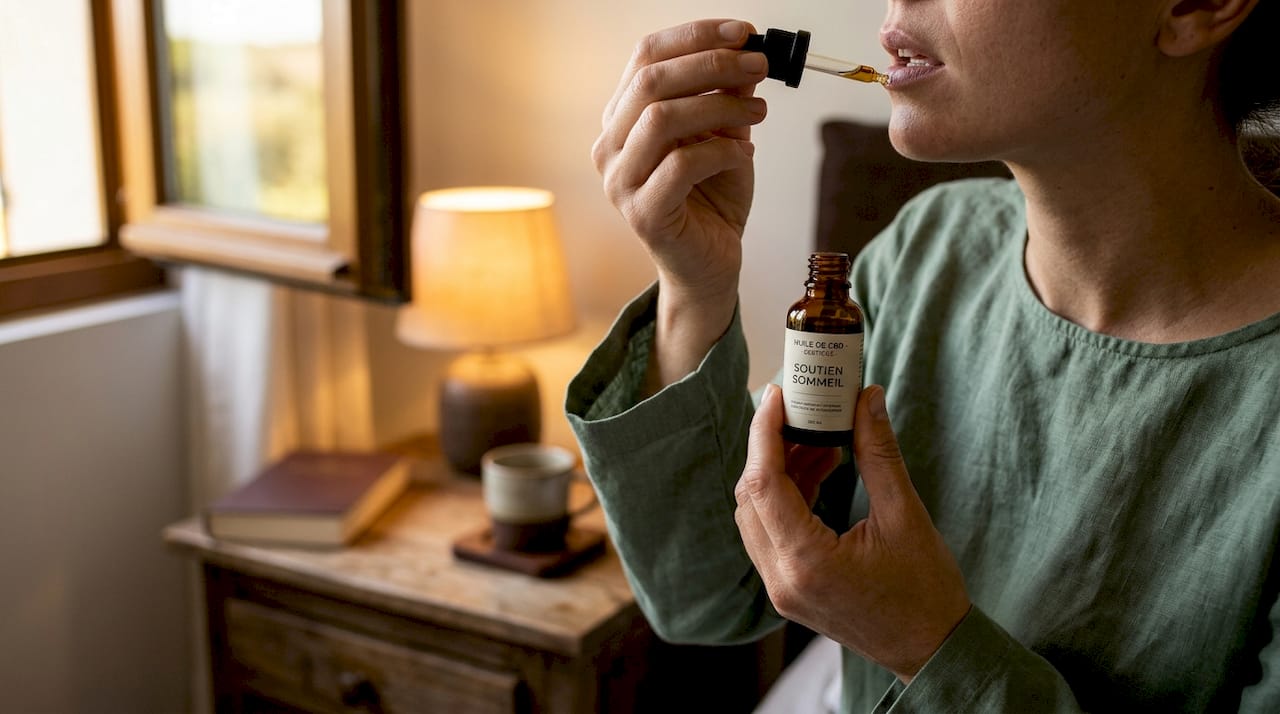
To choose the dosage form suited to your condition, you need to distinguish between two profiles: those who struggle to fall asleep and those who wake up too early. The former will benefit from a sublingual oil taken 30 minutes before bedtime. The latter can combine sublingual oil in the evening with a capsule to prolong the effects throughout the night.
| Format | Onset time | Effect duration | Recommended use |
|---|---|---|---|
| Sublingual oil | 15 to 45 min | 4 to 6 hours | Difficulty falling asleep |
| Capsules | 45 to 90 min | 6 to 8 hours | Nighttime awakenings |
| Vaporization | 5 to 10 min | 2 to 3 hours | Emergency help falling asleep |
| Herbal teas | 20 to 40 min | 3 to 5 hours | Relaxation ritual |
| Gummies | 30 to 60 min | 4 to 6 hours | Convenient occasional use |
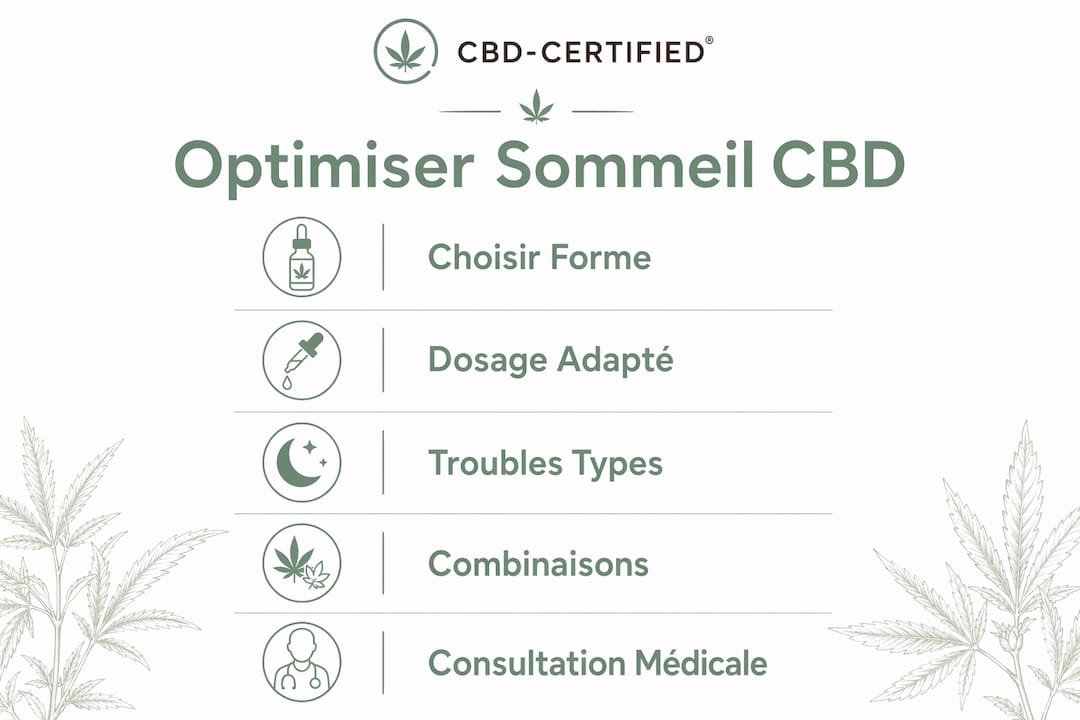
Professional tip: For sublingual use, hold the oil under your tongue for 60 to 90 seconds before swallowing. This technique maximizes absorption through the mucous membranes and significantly improves CBD bioavailability compared with direct ingestion.
What CBD dosage should you use to improve falling asleep?
The optimal CBD dosage varies according to each person’s profile, weight, metabolism, and the nature of their sleep problems. The universally recommended method is gradual dosing: start low, observe, then adjust. Here are the steps for reducing insomnia with CBD in a methodical and safe way.
- Week 1: start with 10 mg per evening. Take your dose 30 to 45 minutes before bedtime. Record how long it takes you to fall asleep and the quality of your sleep in a dedicated journal.
- Week 2: increase to 20 mg if necessary. If the effects are insufficient after 5 to 7 days, increase in increments of 5 to 10 mg. A gradual dosage increase in 3-day increments is the recommended method for finding the effective dose without adverse effects.
- Week 3: stabilize the effective dose. Once you notice a significant improvement, maintain this dose for at least two weeks before considering a further adjustment.
- Monitor side effects. CBD side effects are generally mild: dry mouth, mild daytime drowsiness, or digestive discomfort. They often indicate that the dose is too high.
- Do not expect an immediate effect. CBD is not a sleeping pill. Its effects on sleep regulation develop over several days of regular use.
Individual differences play a major role. A person weighing 60 kg with mild anxiety will respond differently from a person weighing 90 kg with chronic pain. There is no universal dose, which makes keeping a journal essential for refining your personal protocol.
Professional tip: If you take other medications, particularly anticoagulants or antidepressants, consult a doctor before starting CBD. Cannabidiol can interact with certain liver enzymes responsible for metabolizing medications.
What practices should you adopt to maximize CBD’s effects at bedtime?
Using CBD in isolation without changing your sleep habits considerably limits its effectiveness. A consistent bedtime ritual, combined with avoiding screens, forms the foundation on which CBD can fully exert its effects. Here are the practices to adopt to improve your sleep with CBD:
- Set a fixed bedtime. The human body functions according to a precise circadian cycle. Going to bed at the same time every evening enhances CBD’s effectiveness by synchronizing its intake with the natural melatonin peak.
- Turn off screens 60 minutes before bedtime. The blue light from smartphones and computers suppresses melatonin secretion and directly counteracts CBD’s relaxing effects.
- Create an environment conducive to sleep. A cool (between 16 and 19°C), dark, and quiet bedroom enhances CBD’s effects on muscular and mental relaxation.
- Combine CBD with other natural methods. Heart coherence, mindfulness meditation, or valerian tea can enhance CBD’s effects on pre-sleep relaxation.
- Check the quality of the product used. Supercritical CO2 extraction guarantees the purity of the CBD and the absence of chemical residues. Choose products accompanied by independent laboratory analyses.
- Comply with the European regulatory framework. Food products containing CBD are not all authorized for sale in Europe. In 2026, health inspections have been strengthened: check that the products you purchase comply with the legislation in force in your country.
Why does CBD not always work, and how can you adjust?
CBD does not produce the same effects for all types of insomnia, and understanding why it may be ineffective is just as useful as knowing how to use it. CBD is most beneficial for insomnia related to stress, anxiety, or moderate pain. It is less effective for hormonal disorders, sleep apnea, or serious psychiatric conditions.
Here are the most common causes of ineffectiveness and possible adjustments:
- Poor product quality. Low-purity CBD without third-party testing may contain residues or an inaccurate cannabinoid content. Change suppliers and choose certified products.
- Unsuitable dose. A dose that is too low produces no noticeable effect. A dose that is too high can paradoxically disrupt sleep. Return to the gradual method described above.
- Untreated underlying condition. If your insomnia is related to a thyroid disorder, sleep apnea, or depression, CBD alone will not be enough. A medical consultation is essential.
- Expecting results too soon. Some people give up after 3 days. The effects of CBD on sleep generally become more established after 2 to 4 weeks of regular use.
- Poor timing of intake. Taking CBD too early (more than 2 hours before bedtime) or too late (right at bedtime) reduces its effectiveness. The ideal window is between 30 and 60 minutes before sleep.
For complex cases, combining CBD with melatonin may be appropriate. Melatonin regulates the sleep-onset signal, while CBD reduces the mental tension that delays this signal. This combination is particularly useful for people experiencing jet lag or working irregular hours. Consult a healthcare professional to determine whether this approach is suitable for your personal situation.
Key points
CBD promotes sleep onset by reducing pre-sleep mental tension, provided you choose the right form, adopt a gradual dosing approach, and select certified products.
| Point | Details |
|---|---|
| Suitable dosage form | Sublingual oil remains the most effective option for rapid sleep onset, thanks to its effect within 15 to 45 minutes. |
| Gradual dosing | Start at 10 mg and increase in 5 to 10 mg increments every 3 to 7 days based on your observations. |
| Product quality | Choose CBD products extracted using supercritical CO2, with independent laboratory analyses available. |
| Sleep hygiene | Combine CBD with a consistent, screen-free ritual to maximize its relaxing effects. |
| Insomnia profile | CBD is more effective for stress- and anxiety-related insomnia than for organic sleep disorders. |
What I have observed after years of following the use of CBD for sleep
After helping hundreds of European consumers with their use of CBD, one observation comes up consistently: the people who achieve the best results are not those who take the highest dose. They are the ones who keep a journal, adjust patiently, and treat CBD as one tool among others rather than as a miracle solution.
What also strikes me is the reluctance to accept that product quality changes everything. Two 10% CBD oils can produce radically different effects depending on the extraction method, the traceability of the plant, and whether or not secondary cannabinoids are present. Buying the cheapest option is often the main reason people conclude that “CBD doesn’t work.”
The combination of CBD and melatonin also deserves more attention. Many consumers are unaware of this, but these two substances act on complementary mechanisms. Melatonin and CBD do not replace one another. They enhance each other when properly dosed and taken at the right time.
Finally, I remain cautious about overly enthusiastic claims. CBD is not suitable for every type of insomnia. For severe or persistent sleep disorders, it does not replace a medical consultation. But for mild to moderate insomnia linked to daily stress, when used correctly, it represents a serious, well-tolerated natural option.
— Rod
Where can you find reliable CBD products for better sleep in Europe?
Cbd-certified selects rigorously tested CBD products, extracted using supercritical CO2 and accompanied by independent laboratory analyses, available with delivery in Europe, the United Kingdom, and Switzerland.
Whether you are looking for sublingual oil for quickly falling asleep or capsules for nighttime awakenings, the Cbd-certified catalog offers formats suited to every profile. Each product complies with the legal THC limits in force in the European Union and provides complete traceability from the plant to the bottle. For a secure first purchase, this is the recommended starting point.
FAQ
Does CBD really help with falling asleep?
CBD acts as a modulator that reduces mental tension and pre-sleep anxiety without being a sleeping pill. Its effectiveness depends on the cause of insomnia and consistency of use.
What form of CBD is fastest for falling asleep?
Sublingual oil is the fastest form, with noticeable effects within 15 to 45 minutes and a duration of action of 4 to 6 hours. Vaporization acts even faster, but its effects are shorter.
Can CBD and melatonin be combined for sleep?
Yes, the combination is relevant because the two substances act on different mechanisms. Melatonin triggers the sleep-onset signal, while CBD reduces the mental tension that delays it.
What CBD dose should you take to sleep for the first time?
Start with 10 mg, taken 30 to 45 minutes before bedtime. Gradually increase by increments of 5 to 10 mg every 3 to 7 days if the effects are insufficient.
Is CBD legal for sleep in Europe?
CBD in oil or flower form is legal in most European countries, provided that the THC content is below 0.3%. Food products containing CBD are subject to enhanced controls in 2026: check product compliance before purchasing.