
CBD nighttime relaxation method: practical guide 2026
In brief:
- CBD used during nighttime relaxation promotes falling asleep and reduces anxiety. Product quality, gradual dosing, and adaptation to the individual profile are essential. Sublingual oil is the most effective form for acting quickly and lastingly.
The CBD nighttime relaxation method involves using controlled doses of cannabidiol to promote falling asleep, reduce anxiety, and improve sleep quality. CBD, or cannabidiol, is a natural hemp compound with no psychoactive effects. Its action on the endocannabinoid system makes it a serious ally for difficult nights. A 2019 study involving 72 adults suffering from anxiety and sleep disorders showed that 66.7% of participants experienced improved sleep after one month of daily CBD use at 25–75 mg per day. This result positions CBD as a credible natural method, provided it is used correctly.
Which CBD nighttime relaxation method should you choose based on your profile?
Before getting started, three criteria determine the effectiveness of CBD at night: product quality, the initial dosage, and suitability for your individual profile.
Product quality is the number-one criterion. Certified CBD tested by an independent laboratory guarantees the absence of dangerous synthetic cannabinoids such as THCX or HHCPO. These substances are found in some unregulated products and can cause serious effects. Choosing a product with available test results is not a luxury; it is a basic precaution.
The initial dosage should remain cautious. The standard recommendation is to start at 10 mg per day, then increase in 5 mg increments based on how you feel, over a period of 21 days. This gradual titration phase helps identify the minimum effective dose without overloading the body.
Adapting to the individual profile is essential. Someone primarily suffering from nighttime anxiety does not have the same needs as someone with chronic pain or simply difficulty falling asleep. The available forms vary accordingly:
- Sublingual oils: rapid absorption, easy-to-adjust dosage
- CBD herbal teas: gentle effect, ideal for an evening ritual
- Gummies and capsules: convenient, but with a longer-lasting effect
- Inhalation (vaporization): almost immediate action, reserved for occasional use
Pro tip: If you take blood thinners, antidepressants, or antiepileptic drugs, consult a doctor before incorporating CBD into your routine. CBD may interact with certain compounds metabolized by the liver.
Which forms of CBD are most effective for sleep?
The method of administering CBD radically changes the speed and duration of its effects. Here is a comparison of the main forms suitable for evening relaxation.
| Form | Time to take effect | Duration of effects | Recommended dosage |
|---|---|---|---|
| Sublingual oil | 15–45 minutes | 4–6 hours | 10–30 mg |
| CBD herbal tea | 30–60 minutes | 3–5 hours | 1–2 sachets |
| Gummies / capsules | 60–120 minutes | 6–8 hours | 10–25 mg |
| Vaporization | 5–15 minutes | 2–3 hours | Low dose |
Sublingual absorption offers the best balance between speed and duration of action for nighttime use. A few drops of oil placed under the tongue for 60 seconds allow direct diffusion into the bloodstream without passing through the digestive system. This is the most recommended form for sleeping better with CBD.
CBD herbal teas are perfect for people who enjoy a structured evening ritual. The effect is more gradual, which is well suited to preparing for bed over 30 to 60 minutes. Gummies and capsules act more slowly but maintain a longer-lasting effect, which is useful for people who wake up in the middle of the night.
Vaporization produces an immediate effect, but it is not suitable for long-term daily use. It remains an occasional option for episodes of intense nighttime stress.
How do you establish an effective nighttime routine with CBD?
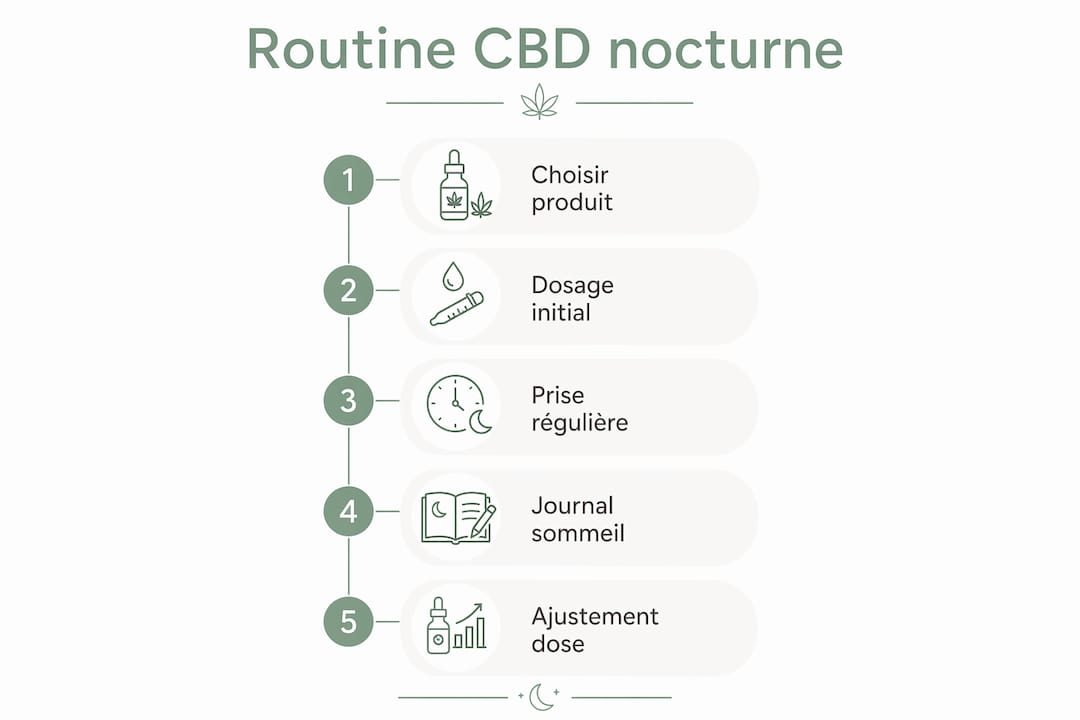
An effective CBD nighttime routine is based on four clear steps. Here’s how to build it gradually.
-
Start with 10 mg for 3 consecutive days. This starting dose allows you to observe your body’s response without the risk of overloading it. Record your sleep quality every morning in a notebook or app.
-
Increase in 5 mg increments every 3 to 5 days. Titration over 21 days is the most reliable method for finding your optimal dose. Stop increasing as soon as you feel a satisfactory effect.
-
Take CBD 30 to 60 minutes before bedtime. This optimal timing corresponds to the peak effect of sublingual oil. Taking CBD too early or too late reduces its effectiveness when falling asleep.
-
Create a calming environment around taking it. CBD works best in a setting conducive to relaxation. Combine taking it with dim lighting, a cool bedroom temperature (around 18–19 °C), and no screens for the following 30 minutes.
To optimize your CBD routine over the long term, adjust the dose if the effects wear off after a few weeks. A 2- to 3-day break may be enough to restore sensitivity to CBD.
Pro tip: Keep a sleep journal during the first 21 days. Note the time you take it, the dose, how easily you fall asleep, and any nighttime awakenings. This data will allow you to make precise adjustments.
What risks should be avoided when using CBD at night?
Natural CBD has a favorable safety profile. The real danger comes from poorly controlled products.
Important warning: Synthetic cannabinoids such as THCX and HHCPO are found in some CBD products sold without certification. Psychiatrist Philippe Batel has warned of cases of severe intoxication, including panic attacks, hallucinations, and temporary paralysis of the limbs. These substances are not CBD. They are illegal and dangerous.
Choosing products with independent laboratory analyses is the only safeguard against this risk. A certificate of analysis (COA) must indicate the exact CBD concentration, the absence of THC above the legal threshold, and the absence of contaminants.
Dosing errors are the other common risk. Starting directly at 50 mg or more often causes excessive drowsiness, mild nausea, or a heavy-headed feeling the next day. These minor side effects disappear when the dose is reduced, but they unnecessarily discourage beginners.
CBD is not a sleeping pill. It does not cause physical dependence or a documented withdrawal syndrome at usual doses. However, it does not replace medical treatment for severe insomnia or diagnosed anxiety disorders.
What are the scientifically proven benefits of CBD for sleep?
Scientific evidence on CBD and sleep has been accumulating since 2019. Here are the strongest results to date.
The reference study of 72 adults showed that after one month of CBD, 66.7% of participants had improved sleep. This improvement mainly involved falling asleep more quickly and fewer nighttime awakenings. The dose used varied between 25 and 75 mg per day depending on individual profiles.
| Study | Population | Main outcome |
|---|---|---|
| 2019 anxiety/sleep study | 72 adults | 66.7% improved their sleep within 1 month |
| Fibromyalgia trial (Australia) | 24 patients | 70% reduce pain by 30% in 16 weeks |
The Australian trial involving patients with fibromyalgia showed that 70% of them reduced their pain by at least 30% after 16 weeks of sublingual THC+CBD oil, with a parallel improvement in sleep. This result confirms that reducing nighttime pain directly contributes to rest quality.
The mechanism of action is well established. CBD activates CB1 and CB2 receptors in the endocannabinoid system, promoting the mental and muscular relaxation conducive to falling asleep. This system also regulates circadian cycles and may influence the production of melatonin, the sleep hormone. To explore this point further, the impact of CBD on melatonin is the subject of a comprehensive analysis on the Cbd-certified blog.
Limitations exist. Effects vary from person to person, studies remain small in scale, and CBD does not work in the same way for all types of insomnia. That is precisely why personalized titration is essential.
Key points
The nighttime CBD relaxation method is based on three pillars: a certified product, progressive titration over 21 days, and taking it 30 to 60 minutes before bedtime.
| Point | Details |
|---|---|
| Product quality | Choose CBD with independent laboratory testing to avoid synthetic cannabinoids. |
| Progressive titration | Start at 10 mg and increase in 5 mg increments over 21 days to find your optimal dose. |
| Timing | Take CBD 30 to 60 minutes before bedtime for maximum effect when falling asleep. |
| Suitable form | Sublingual oil takes effect within 15–45 minutes, making it the most suitable form for nighttime use. |
| Scientific evidence | 66.7% of participants in a 2019 study improved their sleep with 25–75 mg of CBD per day. |
My opinion after years of following CBD use in Europe
CBD for sleep is often presented either as a miracle solution or, conversely, as an unfounded fad. The reality is more nuanced and more interesting.
What strikes me most is the gap between people who achieve remarkable results and those who give up after a week. In the vast majority of cases, the difference does not lie in the CBD itself. It lies in the method. Successful people all have one thing in common: they followed the titration phase and chose a certified product.
The danger of synthetic cannabinoids is, in my view, underestimated by the general public. Reports of serious intoxication circulate little in the mainstream media, but they are real. Buying cheap CBD without a certificate of analysis means taking a risk that nothing justifies when reliable alternatives exist.
I remain convinced that CBD is a serious natural supplement for nighttime relaxation. But it does not replace solid sleep hygiene, daytime stress management, or medical care for severe disorders. It is one tool among others, particularly effective when used properly.
— Rod
Discover Cbd-certified’s certified CBD products
Cbd-certified offers a selection of products specially suited to nighttime relaxation, all accompanied by their laboratory analysis certificates.
Among the most popular options for nighttime use, Nobilis THC-free CBN + CBG + CBD oil combines three complementary cannabinoids for deep relaxation. Sensavea’s Super Relax CBD & CBG oil is specifically designed for evening relaxation. All orders are delivered in Europe, the United Kingdom, and Switzerland. Visit the Cbd-certified store to explore the full range and find the product that matches your nighttime profile.
Frequently asked questions
What dose of CBD should you take to sleep?
The recommended starting dose is 10 mg per day, to be increased gradually in 5 mg increments over 21 days. Most studies use doses between 25 and 75 mg per day depending on individual profiles.
When should you take CBD before going to bed?
CBD is ideally taken 30 to 60 minutes before bedtime. This interval corresponds to the peak effect of sublingual oil, which acts within 15–45 minutes.
Is CBD addictive?
CBD does not cause documented physical dependence at usual doses. Reported side effects remain minor: mild drowsiness and temporary nausea.
How can you recognize quality CBD?
Quality CBD comes with a certificate of analysis from an independent laboratory. This document confirms the CBD concentration, the absence of THC above the legal threshold, and the absence of synthetic cannabinoids.
Does CBD replace sleeping pills?
CBD is not a sleeping pill and does not replace prescribed medical treatment. It acts as a natural supplement to reduce nighttime anxiety and make it easier to fall asleep, with a favorable safety profile for regular use.