
CBD entourage effect: synergy, limitations, and uses
TL;DR:
- The entourage effect results from the synergy between CBD, THC, terpenes, and flavonoids.
- Full-spectrum products offer greater effectiveness for pain, anxiety, and insomnia.
- You need to watch out for traces of THC and choose certified products for safe use.
CBD alone may not be as powerful as you think. Recent observations show that full-spectrum products, which combine CBD, THC, and terpenes, produce effects significantly different from pure isolates. Yet the term “entourage effect” remains poorly understood, often overused in marketing, and sometimes ignored by consumers. If you are looking to better manage chronic pain, insomnia, or anxiety with CBD, understanding this mechanism truly changes how you choose your products. This guide explains the concept, the science behind it, and how to apply it to your specific situation.
Table of Contents
- Definition and Origin of the CBD Entourage Effect
- How the synergy between components works: CBD, THC, and terpenes
- Entourage effect and relief from chronic pain, anxiety, and insomnia
- Limitations, controversies, and precautions surrounding the entourage effect
- Our analysis: what most articles leave out about the CBD entourage effect
- Where to find CBD products suited to the entourage effect in Europe
- Frequently asked questions about the CBD entourage effect
Key Points
| Point | Details |
|---|---|
| Entourage Effect Defined | The entourage effect results from the synergy between CBD, THC, terpenes, and flavonoids, which modulates the effects of cannabis. |
| Benefits for Conditions | Full- and broad-spectrum products are often more effective for chronic pain, insomnia, and anxiety than CBD alone. |
| Limitations and Precautions | Scientific evidence for the entourage effect is still limited, and you should consult a professional before making any changes to your treatment. |
| Product Selection | Choose broad-spectrum to avoid THC and full-spectrum to maximize synergy, depending on your personal requirements. |
Definition and Origin of the CBD Entourage Effect
The entourage effect refers to the synergy that occurs when CBD acts together with other molecules naturally present in the cannabis plant: THC, terpenes, flavonoids, and other minor cannabinoids. Together, these components produce a more nuanced and often more effective effect than each molecule taken separately.
The term was popularized in the 1990s by Israeli researcher Raphael Mechoulam, considered the father of cannabinoid research. Later, Dr. Ethan Russo explored this concept further by showing how terpenes modulate the effects of cannabinoids. The central idea is simple: whole cannabis is not the sum of its parts; it is greater than that.
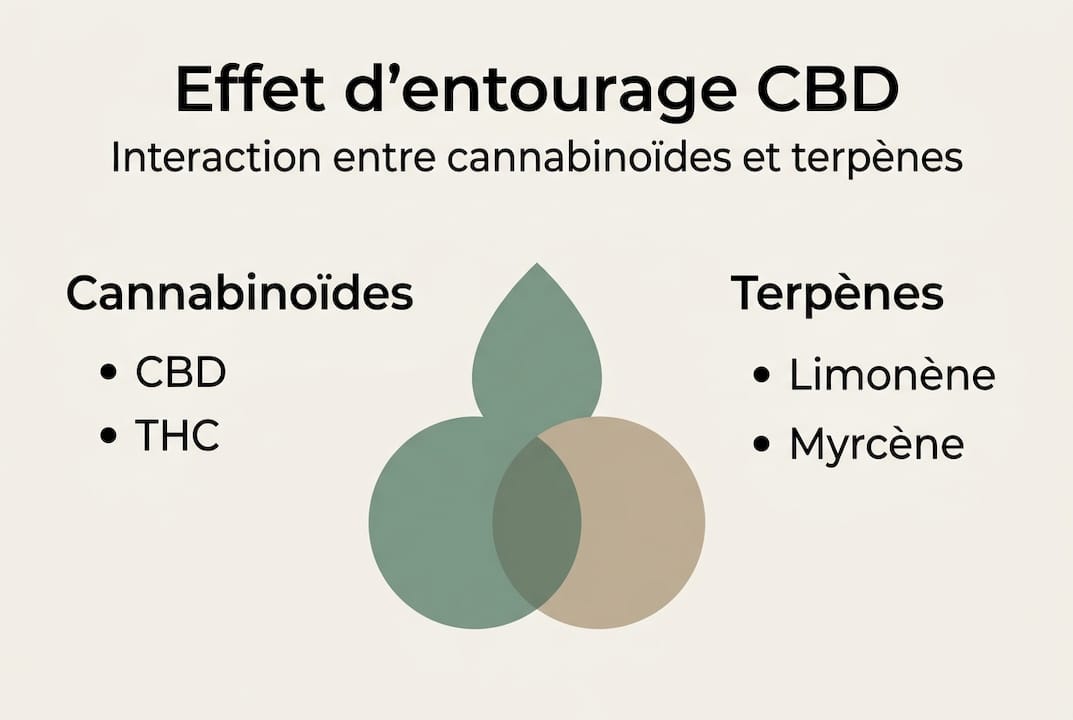
The interactions between CBD, THC, and terpenes within the endocannabinoid system (ECS) explain this phenomenon. The ECS is a network of receptors, including CB1 and CB2, found in the brain, immune system, and organs. CBD and THC bind to these receptors differently, while terpenes modulate this interaction. To better understand this mechanism, you can read our article on how the endocannabinoid system works.
Here are the main molecules involved in the entourage effect:
- CBD (cannabidiol): the main non-psychoactive cannabinoid, it modulates receptors without directly activating them.
- THC (tetrahydrocannabinol): psychoactive at high doses, it enhances certain effects of CBD in small amounts.
- Myrcene: a terpene with sedative properties, often associated with a relaxing effect.
- Limonene: a terpene with potential anxiolytic properties, found in citrus fruits.
- Flavonoids: antioxidants that enhance the overall anti-inflammatory action.
“The entourage effect is not an abstract theory: it is the observation that the whole plant acts differently from its isolated components.” Ethan Russo, neurology researcher.
This observation has transformed the way scientists and consumers view cannabis-based products. Choosing a full-spectrum product rather than an isolate means choosing to benefit from this natural synergy.
How the synergy between components works: CBD, THC, and terpenes
Understanding synergy means understanding how each molecule plays a precise role in the overall effect. CBD and THC do more than simply add up: they modulate each other. CBD mitigates the psychoactive effects of THC, making it possible to use full-spectrum products with fewer unwanted effects.
Terpenes directly influence the endocannabinoid system and the central nervous system. Limonene, for example, is associated with reduced anxiety by modulating serotonin receptors. Myrcene, meanwhile, promotes muscle relaxation and sleep by acting on GABA receptors. These effects are not merely anecdotal: they directly guide product selection according to your needs.
Bioavailability, meaning the amount of CBD actually absorbed by the body, is also improved in a full-spectrum context. The molecules help one another cross biological barriers more efficiently.
Here is a comparison table of the three types of CBD products:
| Type | Cannabinoids | Terpenes | THC | Entourage effect |
|---|---|---|---|---|
| Full-spectrum | All | Yes | Traces (<0.3%) | Maximum |
| Broad-spectrum | Several | Yes | No | Partial |
| Isolate | CBD alone | No | No | Absent |
To learn more about the types of CBD available and their differences, our dedicated guide will help you make the right choice.
According to some analyses, avoiding full-spectrum products is recommended for people subject to drug testing or particularly sensitive to THC, even in trace amounts.
Pro tip: If you are subject to workplace drug testing or are sensitive to THC, opt for a broad-spectrum product. You benefit from partial synergy without the risk associated with THC.
Entourage effect and relief from chronic pain, anxiety, and insomnia
For European consumers dealing with persistent symptoms, the entourage effect represents a serious avenue to explore. Here is what current data indicates for each situation.
-
Chronic pain: Full-spectrum products show better results than isolates. According to observational data, a pain reduction of up to 70% has been reported by some full-spectrum users. Evidence remains limited, but the trend is consistent. To learn more about pain relieved by CBD, our article details the types of pain concerned.
-
Anxiety: CBD combined with limonene shows notable anxiolytic potential, particularly by reducing hyperactivity in the amygdala, the area of the brain linked to fear and stress. Broad-spectrum products rich in limonene are particularly suitable for this use.
-
Insomnia: Myrcene, found in full-spectrum products and some broad-spectrum products, enhances CBD’s sedative effect. The CBD-myrcene combination promotes faster sleep onset and more stable sleep.
“The synergy between cannabinoids and terpenes is not a placebo effect: it is based on documented biological mechanisms, even though clinical studies remain to be completed.”
Here is a summary table to help guide your choice according to the symptom:
| Symptom | Recommended type | Key terpene | Level of evidence |
|---|---|---|---|
| Chronic pain | Full-spectrum | Myrcene, beta-caryophyllene | Moderate |
| Anxiety | Broad-spectrum | Limonene | Moderate |
| Insomnia | Full- or broad-spectrum | Myrcene, linalool | Low to moderate |
To explore the impact on pain and anxiety via the endocannabinoid system in greater depth, as well as the best CBD oils for pain, we have dedicated resources on our blog.
Limitations, controversies, and precautions surrounding the entourage effect
Enthusiasm about the entourage effect should be tempered by an honest reading of the available data. Preclinical evidence is strong, particularly in animal models, but clinical studies in humans remain scarce, often small or methodologically limited.
Dr. Russo actively advocates this concept, but some members of the scientific community remain skeptical of what they view as marketing hype. The truth lies somewhere in between: the entourage effect is real for CBD-THC synergy, but the role of terpenes alone remains debated.
Here are the essential points to keep in mind for responsible use in Europe:
- Screening tests: Full-spectrum products contain traces of THC (<0.3%) that may trigger a positive result. Choose broad-spectrum or isolate products in this case.
- Drug interactions: CBD may interact with certain medications, particularly blood thinners. Always consult a doctor before combining CBD with medical treatment.
- Product quality: Not all full-spectrum products are equal. Check the certificates of analysis (COAs) provided by independent laboratories.
- Regulations: The legal THC limit varies across European countries. Check the rules applicable in your country. Our article on legal CBD in Europe provides an overview of the current situation.
For people with chronic illnesses, our guide to CBD safety is essential reading before any use.
Professional advice: Never replace medical treatment with CBD without speaking to your doctor first. The entourage effect is a complementary avenue, not a therapeutic substitute.
Our analysis: what most articles leave out about the CBD entourage effect
Much of the content about the entourage effect falls into two extremes: either overselling the concept as a miracle solution or rejecting it entirely. The reality is more nuanced and deserves an honest assessment.
What we observe is that marketing hype has often preceded science. Some brands have used the term “entourage effect” to justify higher prices for full-spectrum products without always providing solid supporting evidence. Informed consumers must distinguish between what is documented and what is speculative.
Full-spectrum is not automatically the best choice. For some people, particularly those sensitive to THC or subject to professional restrictions, a well-formulated broad-spectrum product offers a better benefit-risk ratio. Isolate, often criticized, remains relevant for highly targeted uses.
Finally, comparing CBD with conventional medications helps set expectations realistically. The entourage effect is a promising avenue, not an established therapeutic certainty.
Where to find CBD products suited to the entourage effect in Europe
If you want to benefit from the entourage effect, choosing the right product and supplier is crucial. In Europe, it is essential to turn to certified shops that provide independent laboratory analyses for each product.
At European CBD Shop, we offer a carefully selected range of full-spectrum and broad-spectrum products, with delivery in Europe, the United Kingdom, and Switzerland. Consult our guide to the best CBD shops in Europe to identify reliable retailers. If you want to benefit from synergy without THC, our THC-free CBD oil is a high-quality broad-spectrum option, ideal for anxiety and sleep.
Frequently asked questions about the CBD entourage effect
What is the difference between an isolate, full-spectrum, and broad-spectrum CBD product?
Full-spectrum contains all cannabinoids, terpenes, and traces of THC; broad-spectrum removes THC while retaining the other components; isolate contains only pure CBD, with no possible synergy.
Is the entourage effect scientifically proven for anxiety and pain?
Observational data show a notable reduction in pain with full-spectrum products, but robust clinical studies remain rare and the quality of the evidence is still low to moderate.
Can you consume full-spectrum CBD if you need to undergo THC screening tests?
It is best to avoid full-spectrum products if you need to undergo screening tests, as traces of THC may result in a positive test, even at legal doses.
Does CBD-terpene synergy enhance the effect on sleep or anxiety?
Certain terpenes, such as limonene and myrcene, may enhance the anxiolytic or sedative effect of CBD, although the clinical evidence remains debated and requires further study.
Should I consult a doctor before changing my treatment to an entourage-effect CBD product?
Yes, it is imperative to consult a healthcare professional before making any treatment changes, because CBD can interact with certain medications and does not replace appropriate medical follow-up.