
CBD and organic farming: practical guide 2026
In short:
- Organic CBD cultivation from hemp follows strict specifications, ensuring a high-quality product. It prioritizes living soil management, crop rotation, and biological pest control for sustainable agriculture. Organic certification ensures traceability, regulatory compliance, and enhanced commercial value in the European market.
Organic CBD refers to cannabidiol extracted from hemp cultivated according to strict organic farming standards, excluding synthetic pesticides, chemical herbicides, and mineral fertilizers. The convergence of CBD and organic farming represents far more than a trend: it is a concrete response to the growing demands for quality, traceability, and sustainability that European farmers face today. EU Regulation 2018/848 has governed this practice since 2018, and labels such as FR-BIO-01 guarantee compliance. Understanding these foundations means laying the groundwork for profitable hemp cultivation that respects ecosystems.
1. CBD and organic farming: defining the essential foundations
Organic CBD is not simply CBD without pesticides. It is a product derived from an entire agricultural system in which every decision, from variety selection to harvesting, complies with precise specifications. EU Regulation 2018/848 formally prohibits synthetic chemical inputs and requires certification by an independent body. This systemic approach distinguishes organic CBD from conventional CBD in terms of quality and environmental impact.
Organic hemp cultivation follows the tradition of European organic farming, but with specific features unique to Cannabis sativa. Hemp is demanding in terms of soil and light, but offers interesting yields when cultivated methodically. For farmers wishing to understand the complete legal framework, Cbd-certified’s guide to legal CBD in France details the regulatory nuances to know in 2026.
2. Best hemp cultivation practices for premium organic CBD
The quality of organic CBD begins in the soil, long before flowering. Here are the practices that make the difference between an ordinary harvest and a premium product.
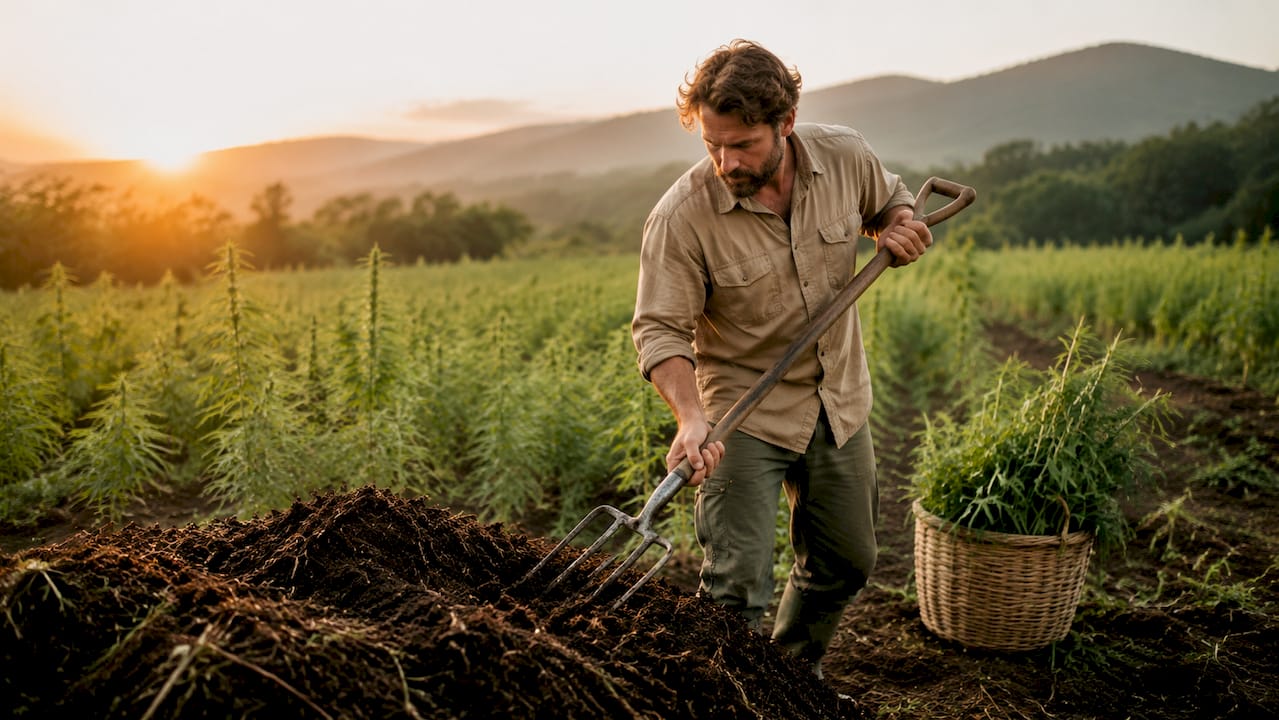
Living soil management and organic fertilization
A living soil rich in microbial biodiversity significantly improves the cannabinoid and terpene profile of CBD flowers. This means that a flower’s aromatic richness and CBD concentration depend directly on soil health. 85% of organic farms use compost to fertilize their hemp crops. Compost provides nutrients gradually and nourishes soil microorganisms without unbalancing its pH.
Crop rotation and agronomic health
Rotating hemp with cereals or legumes regenerates depleted soils and breaks pest cycles. This practice reduces pest pressure without using chemical treatments. It also improves the soil’s physical structure over the long term.
Biological pest control
- Release of beneficial insects such as lacewings or ladybugs to control aphids
- Use of preparations based on Bacillus thuringiensis against caterpillars
- Pheromone traps to monitor pest populations
- Insect-proof nets in greenhouse cultivation to limit infestations
Irrigation and planting density
Around 70% of organic producers use drip irrigation and precise planting densities to control humidity and prevent fungal diseases. Poorly calibrated density encourages botrytis, the main cause of losses in organic CBD cultivation. Humidity management is therefore a non-negotiable technical priority.
Pro tip: Test your soil before each season with an accredited laboratory such as Agro-Analyses or Labocéa. A complete microbiological profile tells you which amendments are needed and helps you avoid over-fertilizing, which degrades terpene quality.
3. environmental and agronomic benefits of organic hemp
Integrating hemp into an organic farming system generates measurable benefits for the environment and soil fertility.
“Hemp plays a structuring role in regenerative agriculture: its roots improve soil structure, capture carbon, and nourish soil microorganisms.” — Sol n’Vie
Rotation with organic hemp reduces the use of synthetic pesticides by approximately 23%. This figure represents direct savings on inputs and a reduction in the chemical load in local groundwater. For a farmer transitioning to organic farming, this is an economic argument as well as an environmental one.
| Benefit | Measured impact | Scope |
|---|---|---|
| Pesticide reduction | Approximately 23% decrease | Rotation with hemp |
| Soil structuring | Improved porosity | Deep taproots |
| Carbon sequestration | Active trapping | Root biomass |
| Local biodiversity | Increase in pollinators | Hemp flowering |
| Water savings | Drip irrigation reduction | Precise irrigation |
Hemp is also a melliferous plant. Its flowering attracts bees and other pollinators, benefiting nearby crops. This contribution to local biodiversity is often underestimated by farmers discovering organic hemp cultivation for the first time.
4. how to obtain organic certification for CBD cultivation
Organic certification for CBD production is based on precise, non-negotiable requirements. Here are the key steps to follow.
-
Comply with the conversion period: the soil must be free of synthetic pesticides for at least 3 years before the first certified organic harvest. This period allows microbial life to naturally recover.
-
Choose an approved certifying body: in France, organizations such as Ecocert, Bureau Veritas Certification, and Certipaq issue the FR-BIO-01 label. Each organization conducts annual on-site inspections.
-
Implement complete traceability: traceability from seed to finished product is a central requirement of EU Regulation 2018/848. Each batch must be documented with the inputs used, treatment dates, and analysis results.
-
Adopt integrated pest management: organic certification requires proactive integrated management with the release of beneficial organisms. Chemical curative treatments are prohibited, even in cases of severe pest pressure.
-
Submit product analyses: CBD flowers and extracts must be analyzed by an independent laboratory to confirm the absence of chemical residues and validate cannabinoid levels.
For an overview of European regulatory requirements, the CBD regulations in Europe guide by Cbd-certified provides a clear, up-to-date summary for 2026.
5. Innovations and trends in organic CBD in 2026
The year 2026 marks an acceleration of agricultural practices surrounding organic hemp, driven by new research and more demanding market requirements.
CBD as an alternative to antibiotics in livestock farming
CBD is being tested as a natural alternative to antibiotics in poultry farming, particularly in Morocco. These trials aim to strengthen animals' immunity without relying on conventional treatments. For organic farmers who raise livestock, this avenue opens up uses for CBD in agriculture well beyond flower production.
Regenerative techniques and agroforestry
- Combining hemp with fruit trees or hedgerows to create favorable microclimates
- Intercropping with nitrogen-fixing legumes to reduce fertilization needs
- Direct seeding under cover to preserve soil structure and limit erosion
- Closed-loop composting using hemp stems and leaves after harvest
The role of living soil in cannabinoid profile expression
The transition to organic farming requires systemic change that promotes living soils and regenerative practices. Depleted soil produces flowers with lower terpene and CBD content. Farmers who invest in soil biology obtain more complex aromatic profiles, which are valued by specialist buyers.
Market outlook and profitability
Organic CBD cultivation represents an economic opportunity for farmers wishing to diversify their business through a sustainable approach. The sale prices of certified organic flowers remain higher than those of conventional hemp, with steadily growing European demand. Greenhouse cultivation enables even ripening and limits phytosanitary treatments, thereby increasing the commercial value of the finished product.
Pro tip: To maximize your cannabinoid profile, harvest at the end of trichome maturation, when the trichomes change from milky white to amber. A pocket microscope with 60x magnification is sufficient for this precise visual inspection.
Key points
Certified organic hemp cultivation under EU Regulation 2018/848, combined with active management of living soil, ensures superior-quality CBD and sustainable profitability for the farmer.
| Point | Details |
|---|---|
| EU Regulation 2018/848 certification | Requires 3 years without synthetic pesticides and annual inspections by an approved body. |
| Living soil and CBD profile | The soil’s microbial biodiversity directly influences the richness of cannabinoids and terpenes. |
| Pesticide reduction | Rotation with organic hemp reduces the use of synthetic pesticides by approximately 23%. |
| Complete traceability | Each batch must be documented from seed to finished product to maintain certification. |
| Organic profitability | Certified organic CBD flowers sell at higher prices in a growing European market. |
What I learned from closely following organic CBD farms
Many farmers approach organic hemp cultivation with the idea that hemp is a hardy plant that can fend for itself. This is partly true. But this natural resilience does not eliminate the need for close attention, especially when the goal is certified high-quality CBD.
What I have observed is that the most successful farms are not those that spend the most on equipment. They are the ones that understand their soil. A farmer who knows the microbial life in their fields makes better decisions at every stage, from fertilization to harvest. Living soil is not an abstract concept: it is the true driver of quality.
The other misconception to dispel is that organic certification is an administrative burden. In reality, it structures the process and creates a lasting competitive advantage. Professional buyers, distributors, and discerning consumers pay a premium for traceability. This premium more than offsets the cost of certification over two or three seasons.
My recommendation for making the transition a success: start with a pilot plot, invest in a comprehensive soil analysis, and choose your certifying body from the first year of conversion. Also, do not underestimate the value of certified CBD quality in the European consumer’s final purchasing decision.
— Rod
Discover Cbd-certified’s certified organic CBD products
Cbd-certified selects CBD products made from hemp grown according to the strictest European organic standards. Every product offered in the shop has complete traceability, from the seed’s origin to independent laboratory analyses.
Whether you are a farmer looking for quality references or an enthusiast wishing to consume CBD produced with respect for the environment, the Cbd-certified shop offers a carefully selected range delivered in France, the European Union, the United Kingdom, and Switzerland. Ordering and return terms are detailed on the shipping and returns page for a transparent, hassle-free shopping experience.
Frequently asked questions
What exactly is organic CBD?
Organic CBD is cannabidiol extracted from hemp grown without synthetic pesticides or chemical herbicides, in accordance with EU Regulation 2018/848. It is certified by an independent organization such as Ecocert or Bureau Veritas Certification.
How long does the conversion to organic farming take?
The conversion period lasts at least 3 years without chemical inputs before the first organic certification can be obtained. This period allows the soil’s microbial life to fully recover.
Is organic CBD more effective than conventional CBD?
Living soil rich in microbial biodiversity improves the cannabinoid and terpene profile of the flowers. Certified organic flowers generally have more complex aromatic profiles and better-preserved CBD levels.
Which labels should you recognize for certified organic CBD in France?
The FR-BIO-01 label is the French reference for certified organic products. It guarantees compliance with EU Regulation 2018/848 and annual inspections by an accredited organization.
Is organic hemp cultivation profitable for a small farmer?
Organic hemp cultivation represents a real economic opportunity, with certified flower selling prices higher than those of conventional hemp. Profitability depends on soil quality, variety selection, and mastery of organic farming practices.