
CBD Legality in the United Kingdom: Complete Guide 2026
TL;DR:
- CBD is legal in the United Kingdom if it comes from industrial hemp containing less than 0.2% THC and less than 1 mg of controlled cannabinoids per container.
- However, certain products such as CBD flowers remain illegal, and regulations require strict checks to ensure compliance.
CBD (cannabidiol) is often perceived as a product that can be freely sold throughout the United Kingdom, but the reality is much more nuanced. Between THC content criteria, FSA requirements (Food Standards Agency, meaning the UK food agency), and distinctions between product types, navigating this legal framework can quickly become complex. This guide clearly explains the exact conditions for legality, permitted and prohibited products, essential health precautions, and how to make your purchases more safely and responsibly.
Table of contents
- The legal framework for CBD in the United Kingdom
- Status and restrictions of CBD products
- Consumption, dosage and health precautions
- How to ensure the purchase of compliant and safe CBD
- Our perspective on the legality and challenges of CBD
- Where to Find Compliant and Reliable CBD Products
- Frequently Asked Questions About the Legality of CBD in the United Kingdom
Key Points
| Point | Details |
|---|---|
| THC and cannabinoid limits | CBD must contain less than 0.2% THC and 1 mg of controlled cannabinoids per product. |
| CBD flowers prohibited | The sale of CBD flowers remains illegal despite reduced prosecution risks since 2023. |
| Mandatory FSA approval | Only products listed by the FSA with an approved application may be legally sold. |
| Safe daily dose | 10 mg/day for a 70 kg adult according to the FSA; to be avoided by certain at-risk groups. |
| Essential verification | Always check the laboratory report and regulatory compliance before purchasing any CBD. |
The legal framework for CBD in the United Kingdom
The first thing to understand is that CBD is not an illegal substance in the United Kingdom, but its legality depends on specific conditions. According to the rules currently in force, a CBD product is legal if it is derived from industrial hemp, contains less than 0.2% THC (tetrahydrocannabinol, the psychoactive compound in cannabis), and does not contain more than 1 mg of controlled cannabinoids such as THC per container.
The legal compliance criteria
These three criteria form the backbone of the regulatory framework. The origin of the CBD is fundamental: only industrial hemp (varieties authorized by law) is accepted as a source. A product extracted from another cannabis variety would immediately be considered illegal, regardless of its THC content. This principle can be compared with the THC rules in Europe, where the 0.2% limit is also the prevailing benchmark.
The distinction between food, cosmetic, and therapeutic CBD products is equally important:
- Food CBD (oils, gummies, capsules): subject to the FSA’s “novel foods” rules
- Cosmetic CBD (creams, balms, lotions): regulated under the cosmetics directive, with different requirements
- Medicinal CBD: strictly regulated by the MHRA (Medicines and Healthcare products Regulatory Agency); rare and available by prescription
“CBD is legal in the UK if it comes from industrial hemp containing less than 0.2% THC and no more than 1mg of controlled cannabinoids per container.” This detail, often overlooked by consumers, radically changes the perception of the market.
| Criterion | Legal threshold |
|---|---|
| THC content | Less than 0.2% |
| THC per container | Less than 1mg |
| Source | Industrial hemp only |
| Medical claims | Prohibited |
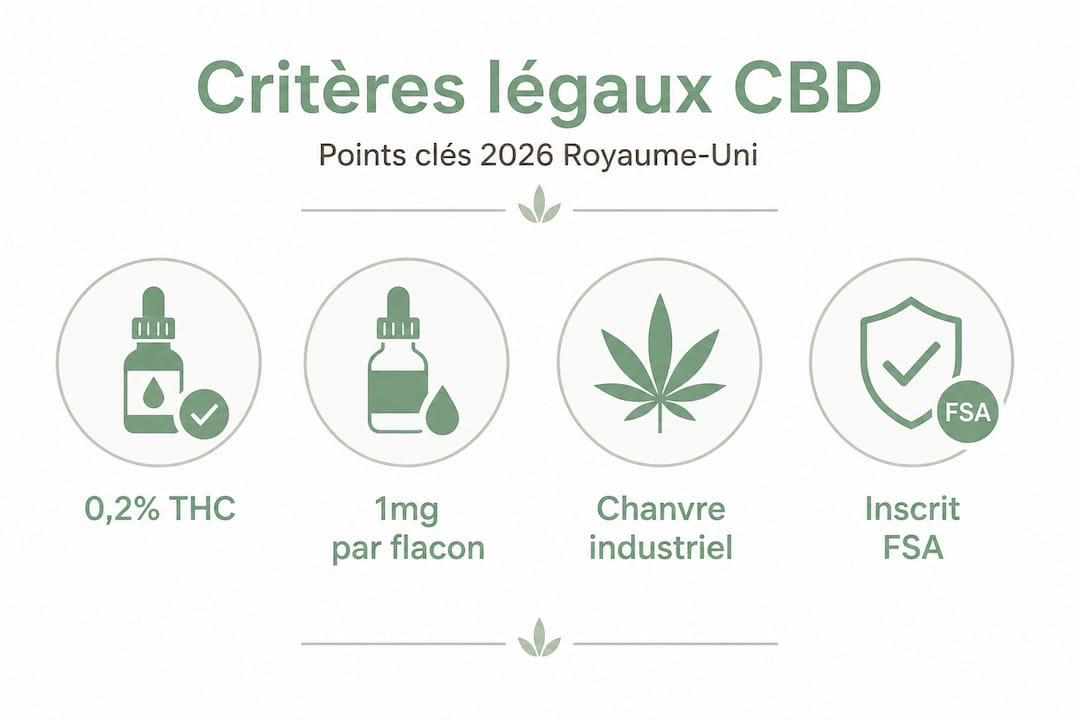
Problematic situations do exist. For example, buying a concentrated CBD oil in a 30ml bottle may seem straightforward, but if the total THC concentration exceeds 1mg for this volume, the product is no longer legally compliant. Legality may also be called into question if the manufacturer makes therapeutic claims on the packaging.
A useful comparison can be drawn with the legality of CBD in France, which follows similar principles but with some notable differences in how the rules are applied. Understanding the nuances of the UK context is therefore essential before making any purchase.
Status and restrictions of CBD products
Now that the legal foundations have been established, we need to examine the variety of products available and the pitfalls associated with them. Not all CBD products have the same legal status, and some clearly remain in a grey area.
CBD flowers: a persistent grey area
CBD flowers (raw hemp buds) represent the most complex case. Despite a 2023 Court of Appeal ruling that reduced the risk of prosecution for flowers with low THC content (less than 0.2%), flowers remain illegal under the Misuse of Drugs Act 1971 because cannabis leaves and flowers are controlled substances. No legislative change has occurred since. It is therefore strongly advised to avoid these products.
Food oils and supplements
CBD extracts in food products are classified as “novel foods” (new foods). This means they require FSA authorization to be legally marketed. In 2026, no full authorization has yet been granted. Only products appearing on the public FSA list, with validated authorization applications, may be sold while those applications are being processed.
| Product type | Legal status | Main requirements |
|---|---|---|
| CBD food oils | Legal under certain conditions | FSA list, less than 1mg THC/container |
| CBD cosmetics | Legal | Cosmetics directive, not novel food |
| CBD flowers | Illegal | Misuse of Drugs Act 1971 |
| Medicinal CBD | Strictly regulated | Medical prescription required |
| CBD gummies/capsules | Legal under certain conditions | FSA list, no medical claims |
CBD cosmetics (creams, balms) are exempt from “novel food” rules and are governed solely by cosmetics regulations. This is one of the most accessible categories for consumers.
Here are the steps for distinguishing a compliant product:
- Verify that the product appears on the public FSA list
- Check that the label makes no medical claims
- Carefully check the THC content (less than 0.2% and less than 1mg/container)
- Make sure the brand provides a recent laboratory report (Certificate of Analysis)
- Confirm the hemp’s origin (Europe preferred)
You can browse a selection of legal CBD products to help you find compliant options. To learn more about the purchasing process, the guide on ensuring quality offers a structured approach.
Pro tip: Before making any purchase, consult the public FSA list available online and always request the product’s laboratory report (CoA). A reputable seller will provide these documents without hesitation.
Consumption, dosage and health precautions
Knowing which products are authorized is not enough. You also need to know the recommended quantities and precautions to follow for responsible consumption. The FSA has established clear guidelines, but many users remain unaware of them.
The daily dose recommended by the FSA
The provisionally safe dose set by the FSA is 10mg of CBD per day for a 70kg adult, equivalent to 0.14mg per kilogram of body weight. This limit applies to food products and supplements. It should not be considered an arbitrary ceiling: it results from a scientific assessment of potential health risks.
Key statistic: The low awareness of the 10mg/day threshold among CBD users is documented by the FSA itself. Many consumers exceed this limit without knowing it, particularly with products containing high concentrations.
The categories of people who should refrain from consuming CBD are:
- Pregnant or breastfeeding women
- Children and adolescents
- People taking medication (risk of interactions)
- Immunocompromised people
- Anyone with untreated liver problems
Potential benefits for well-being
CBD is non-psychoactive, unlike THC. Documented potential benefits include help managing anxiety and improved sleep quality. However, these effects are still being researched, and CBD should never replace prescribed medical treatment.
For those who wish to adapt their consumption to their needs, the guide on the effective CBD dose for anxiety is a useful resource. People suffering from chronic conditions will also find valuable information on CBD safety for people with chronic conditions.
The issue of drug interactions deserves particular attention. CBD is metabolized by the liver via the CYP450 enzyme system, the same system involved in processing many common medications. Prior medical consultation is therefore essential if you take anticoagulants, antidepressants, or epilepsy medication.
Pro tip: Consult the FSA's scientific bulletins available on its official website to validate information about CBD safety. These documents are available to the general public and are updated regularly. Also consult our guide on safe CBD use to understand the mechanisms of tolerance.
How to ensure the purchase of compliant and safe CBD
You now know the legal criteria and health precautions. The next step is to apply them in practice to every purchase. A rigorous method helps avoid non-compliant products, which still represent a significant share of the British market.
The five-point purchasing methodology
Here is the process to follow for any CBD purchase:
- Check the FSA list: consult the public list of products with validated authorization applications before purchasing a food product or CBD supplement.
- Require a laboratory report (CoA): this document confirms that the product contains less than 0.2% THC and is free from contaminants and pesticides. A reliable laboratory report is the number one guarantee of quality.
- Analyze the labeling: CBD products cannot make medical claims. Statements such as “treats anxiety” or “cures pain” are illegal and indicate a non-compliant product.
- Prioritize seller transparency: a reputable supplier clearly indicates the origin of the hemp, the certifications obtained, and makes laboratory reports available without you having to request them.
- Check how the product is presented: CBD oils must be presented as food supplements; creams as cosmetics. Any other presentation is a warning sign.
The main criteria to prioritize are as follows:
- Certified organic or traceable hemp (ideally European)
- Recent CoA report, dated less than 12 months ago
- THC concentration below 0.2% and less than 1 mg per container
- Presence on the FSA list (for food products)
- Complete absence of medical claims on the packaging
To identify a quality product, the guide how to recognize quality CBD details the specific indicators. The safe purchasing procedure guides you step by step.
Pro tip: Always analyze the seller's geographical origin and level of transparency regarding certifications. A seller based in Europe with ISO or GMP (Good Manufacturing Practices) certifications generally offers an additional guarantee of compliance. Explore a selection of compliant CBD products to get started on a solid footing.
Our perspective on the legality and challenges of CBD
At European CBD Shop, we closely monitor developments in the UK market, and our conclusion is clear: many consumers overestimate how open this market is. The idea that “CBD is legal in the UK” is true on the surface, but conceals a complex administrative reality.
The FSA's delays in processing “novel food” authorization applications risk triggering market consolidation: small brands without the resources to maintain complete dossiers will gradually be eliminated. In 2026, no full authorization has yet been granted, and this situation is creating lasting uncertainty for businesses and consumers alike.
The question of CBD flowers clearly illustrates this ambiguity. Although the 2023 ruling reduced the risk of prosecution for flowers with low THC content, no legislative change has taken place. The legal framework remains unchanged, and the risk still exists. Advising our customers to avoid these products is not a commercial stance; it is a recommendation based on the facts.
What we also observe is that transparency is becoming a major differentiating factor. Brands that publish their laboratory reports, trace the origin of their hemp, and strictly comply with restrictions on claims are the ones that will survive the announced consolidation. For consumers, this means one thing: your vigilance is your best protection.
The well-being you seek with CBD is legitimate. But it must never take precedence over legal and health compliance. A non-compliant product is not only a legal risk; it is also a risk to your health.
Where to Find Compliant and Reliable CBD Products
With all this information, you are now equipped to make informed choices. But finding products that meet all these criteria requires time and expertise.
At European CBD Shop, we rigorously select each product according to the legal and health criteria presented in this guide: certified origin, available laboratory reports, FSA compliance, and no medical claims. We deliver throughout Europe, the United Kingdom, and Switzerland, with a range of CBD oils, cosmetics, and food supplements that meet the strictest standards. Whether you are in Edinburgh, London, or elsewhere in the United Kingdom, our catalog offers a safe, transparent, and compliant solution. Discover our selection at cbd-certified.com and shop with confidence.
Frequently Asked Questions About the Legality of CBD in the United Kingdom
What Are the Criteria for a CBD Product to Be Legal in the United Kingdom?
A product must come from industrial hemp, contain less than 0.2% THC, and have less than 1mg of controlled cannabinoids per container to be considered legal.
Can CBD Flowers Be Purchased in the United Kingdom?
No, CBD flowers remain prohibited under the Misuse of Drugs Act 1971, even though a 2023 decision reduced the risk of prosecution for flowers with low THC content.
Which CBD Products Are Authorized for Sale?
Only products with a validated application on the FSA list, without medical claims and complying with the limit of 1mg of THC per dose, may be sold legally.
What CBD Dose Is Considered Safe?
The FSA recommends 10mg per day for a 70kg adult; pregnant women, children, and people taking medication should avoid any consumption.
How to Check Whether a CBD Product Is Compliant?
You should consult the FSA list, analyze the laboratory report (CoA) confirming less than 0.2% THC, and ensure that the packaging contains no medicinal claims.