
CBD or sleeping pills? Comparing the benefits for sleep
TL;DR:
- CBD offers a natural alternative to traditional sleeping pills, with a very low risk of dependence. It acts on the endocannabinoid system to promote more natural sleep, particularly in people suffering from anxiety or chronic pain. However, its effectiveness varies from person to person, and medically supervised use remains essential.
Every night, millions of Europeans struggle to sleep, and many eventually open their medicine cabinet. Yet in recent years, a broader trend has emerged: CBD (cannabidiol, the non-psychoactive molecule in cannabis) is attracting more and more people who want to sleep better without depending on traditional medications. This shift is not insignificant. It reflects genuine questions about the long-term risks of sleeping pills and a search for gentler, more natural solutions. This article objectively compares CBD with traditional sleeping pills, explains the mechanisms involved, and clarifies for whom and in which situations CBD can truly make a difference.
Table of contents
- Why look for natural alternatives to traditional sleeping pills?
- CBD and sleeping pills: comparative table of benefits and limitations
- Who can CBD really be an effective alternative for?
- Points to watch: interactions, side effects, and European recommendations
- Our view: for sensible, personalized CBD use
- Discover and buy quality CBD in Europe
- Frequently Asked Questions About CBD and Sleeping Pills
Key Points
| Point | Details |
|---|---|
| Lower risk of dependence | Unlike traditional sleeping pills, CBD generally does not cause dependence. |
| Gentler action | CBD promotes natural sleep onset without the forced sedative effect typical of hypnotics. |
| User profile is a determining factor | CBD’s effectiveness varies depending on the cause of insomnia and does not always replace an existing medical treatment. |
| Beware of interactions | CBD can interact with various medications: seek advice before replacing or adding any treatment. |
Why look for natural alternatives to traditional sleeping pills?
Sleeping pills, particularly benzodiazepines (a family of medications that act on the central nervous system to induce sedation, such as diazepam or lorazepam), are effective tools in the short term. They shorten the time it takes to fall asleep, reduce nighttime awakenings, and help people get through periods of crisis without staying awake for hours. That is their true clinical value.
But the problem arises when use continues over time. Benzodiazepines are associated with a real risk of dependence and tolerance, which leads official medical recommendations to limit their prescription to short periods, generally a few weeks. The body quickly becomes accustomed to the molecule, and doses must be increased to achieve the same effect.
The consequences of prolonged use are well documented:
- Physical and psychological dependence, making discontinuation difficult and sometimes accompanied by severe withdrawal symptoms
- Tolerance: the effect of the medication gradually decreases, requiring dosage adjustments
- Cognitive impairment: memory and concentration problems, slowed reflexes, particularly pronounced in older people
- Residual daytime drowsiness that affects quality of life, driving, and daily activities
- Risk of falls and accidents among vulnerable people
- Depression and rebound anxiety upon discontinuation
According to public health data, benzodiazepine sleeping pills are among the most prescribed medications in Europe, despite repeated warnings from health authorities about their prolonged use.
In light of this, demand for natural alternatives such as CBD has accelerated considerably. The aim is not to reject conventional medicine, but to find solutions with a more favorable risk profile for regular or long-term use. It is in this context that CBD has begun to occupy a serious place in discussions about sleep health in Europe.
CBD and sleeping pills: comparative table of benefits and limitations
To understand the practical differences, nothing beats a direct comparison. CBD (cannabidiol) acts on the endocannabinoid system (a network of receptors found throughout the body that is involved in regulating mood, pain, and sleep) without producing a “high” or forced sedation. Benzodiazepine sleeping pills, on the other hand, act directly on GABA receptors in the brain to induce a state of calm and drowsiness.
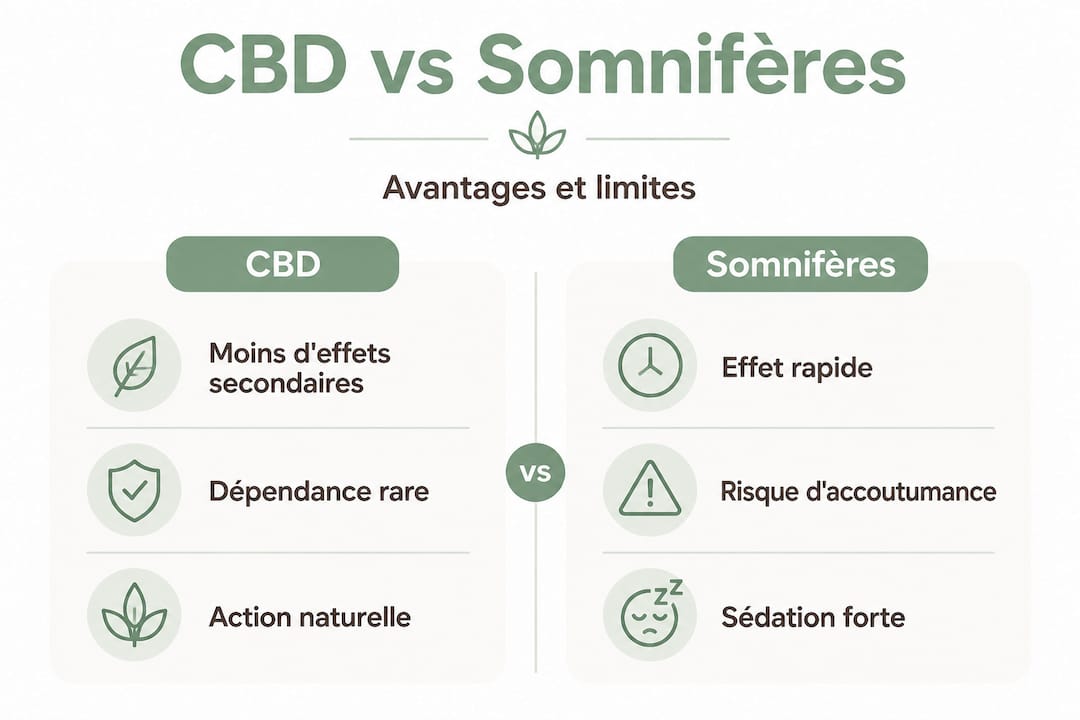
| Criterion | CBD | Sleeping pills (benzodiazepines) |
|---|---|---|
| Mechanism of action | Acts on the endocannabinoid system and reduces anxiety | Enhances GABA activity, with a direct sedative effect |
| Effect on falling asleep | Makes it easier to fall asleep by reducing stress | Quickly induces sedation |
| Sleep quality | May improve deep sleep stages | May disrupt sleep architecture |
| Risk of dependence | Very low | High with prolonged use |
| Effects upon waking | Generally little residual drowsiness | Frequent daytime drowsiness |
| Drug interactions | Possible (to be checked) | Numerous and documented |
| Recommended duration of use | No strict limit established | A few weeks maximum |
| Legal status in Europe | Legal (under certain conditions) | Prescription only |
Compared with benzodiazepines, CBD offers the sought-after advantage of not “forcing” sleep through imposed chemical sedation. It does not act like a switch but rather as a facilitator: it helps the body relax, reduce mental activity and find its way to sleep more naturally.
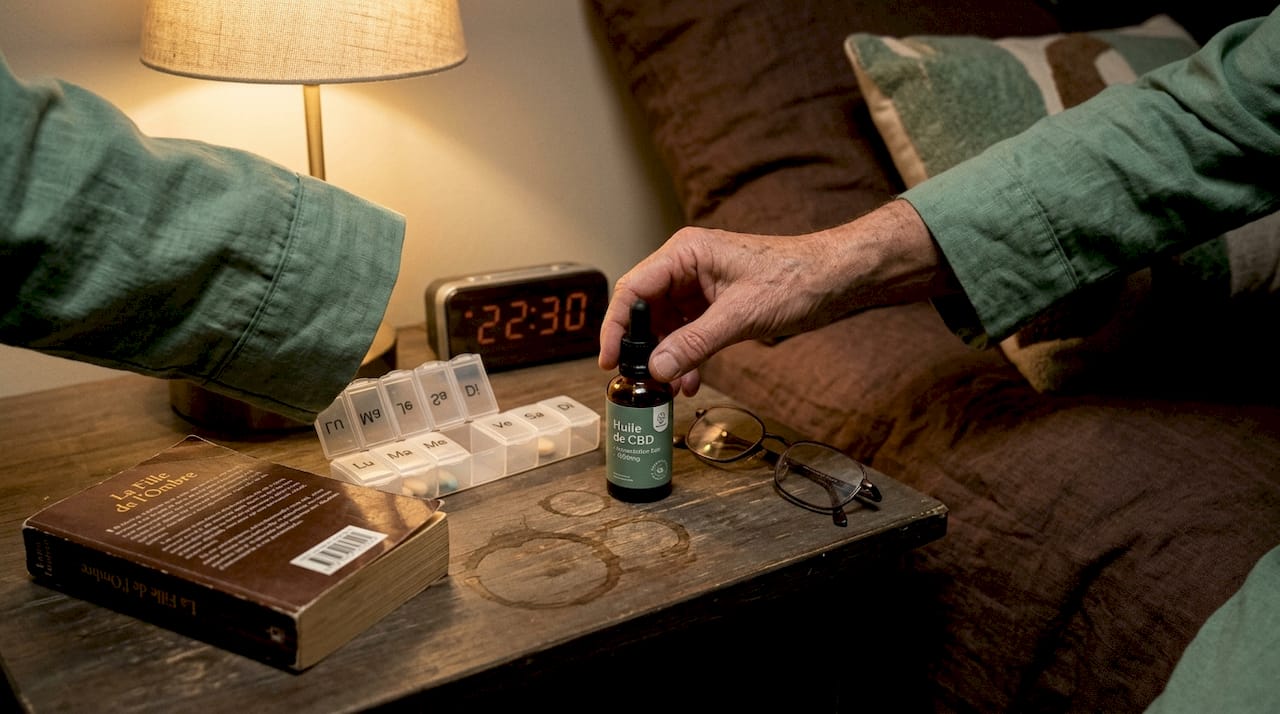
That said, it would be inaccurate to present CBD as a perfect or universal solution. The available evidence remains heterogeneous depending on the profiles and types of sleep disorders, particularly when comparing its effectiveness for anxiety-related insomnia versus primary insomnia with no identified psychological cause. Research on cannabis and sleep highlights that results vary greatly from person to person.
Pro tip: If you are already taking medication (blood thinners, antiepileptic drugs, antidepressants), always talk to your doctor about CBD before starting. Interactions can affect the effectiveness of your current treatments.
Who can CBD really be an effective alternative for?
The question is not “does CBD work for sleep” but rather “for whom, and under what precise conditions.” This distinction changes everything about the approach.
Here are the profiles for which CBD appears most relevant:
-
People suffering from stress- or anxiety-related insomnia: anxiety (a state of persistent mental tension that prevents you from “letting go” in the evening) is one of the most common causes of difficulty falling asleep. CBD seems to act effectively on this mechanism by regulating the stress response.
-
People with chronic pain: pain is a major obstacle to sleep. CBD, recognized for its anti-inflammatory and analgesic properties, may reduce nighttime discomfort and thereby enable more continuous sleep.
-
People transitioning off sleeping pills: in the context of gradual withdrawal that is always medically supervised, CBD may provide support during the discontinuation phase without relapsing into benzodiazepine use.
-
Users wishing to improve their overall sleep quality without a severe condition, alongside good sleep hygiene.
For certain individuals, particularly those suffering from stress- or pain-related insomnia, CBD may be considered a supportive tool rather than a direct replacement for a sleeping pill.
However, CBD is not recommended as a first-line solution for specific conditions such as sleep apnea (a condition in which breathing stops during the night), restless legs syndrome, or REM sleep behavior disorder. These situations require an appropriate medical diagnosis and treatment.
To take your personal approach further, specialized resources on CBD dosage for insomnia and CBD for anxiety and insomnia offer useful practical guides. Uses of CBD in 2026 also documents how practices are evolving according to the latest available data.
One essential point: dosage plays a crucial role. Moderate doses of CBD seem to promote light alertness and reduce anxiety, while higher doses tend to have a more sedative effect. There is not yet a universally validated standardized dosage, which reinforces the importance of personalized guidance.
Points to watch: interactions, side effects, and European recommendations
CBD is not harmless. Although it is legal in most European countries under certain conditions (THC content below 0.2 or 0.3% depending on the country), this does not mean that it is free of adverse effects or risks.
Here are the main known side effects:
- Daytime drowsiness, especially at high doses
- Digestive disorders (nausea, diarrhea) at the beginning of use or at high doses
- Dry mouth
- Changes in appetite
- Mild hypotension (drop in blood pressure) in some people
The Île-de-France CRPV points out that CBD can cause these adverse effects and, above all, that there is a real risk of drug interactions, particularly through inhibition of cytochrome P450 enzymes (a liver system that metabolizes many medications).
| Drug class | Risk of interaction with CBD |
|---|---|
| Anticoagulants (warfarin) | Possible increase in the anticoagulant effect |
| Antiepileptic drugs | Changes in plasma concentrations |
| Antidepressants | Potentiation of sedative effects |
| Benzodiazepines | Risk of excessive sedation |
| Immunosuppressants | Changes in liver metabolism |
These interactions do not mean that CBD is prohibited in combination with these treatments, but they do require medical monitoring. A healthcare professional can adjust the doses or adapt the follow-up accordingly.
Choosing the right formulation is also a key factor. The available CBD forms (sublingual oils, gummies, capsules) do not have the same onset of action or duration of effect. For CBD uses and limitations, it is always useful to consult reliable, specialized sources.
Professional advice: Never replace a prescribed sleeping pill with CBD without speaking to your doctor first. Abruptly stopping benzodiazepines can cause seizures, severe anxiety, and other serious withdrawal symptoms. The transition should always be gradual and supervised.
Our view: for sensible, personalized CBD use
After years of observing how CBD has become part of European consumption habits, our conviction is clear: it is neither a miracle cure nor merely a passing trend. CBD has a real place in the wellness toolbox, but that place is specific and limited.
What strikes us most is the tendency to imitate others. Someone reads a friend’s positive experience on social media, buys the same oil, and expects the same result. The problem is that this friend’s insomnia was related to work-related stress, whereas theirs is caused by undiagnosed sleep apnea. Two radically different situations, with responses that cannot be identical.
Cannabis-based sleep aids are generally not recommended for long-term use, and both the evidence and risks are still debated within the scientific community. This caution is not intended to discourage anyone, but to remind us that CBD is part of a comprehensive approach.
This approach includes: good sleep hygiene (regular schedules, a cool and dark bedroom, turning off screens before bed), active day-to-day stress management, a balanced diet, and regular physical activity. CBD can support all of this, but not replace it.
Another point that is often overlooked: CBD’s duration of action often requires several weeks of regular use to show its most stable effects. Many people give up too soon, thinking that “it doesn’t work.” Others, conversely, increase the doses without reason, believing that more is better. Neither is the right approach.
For those who want to explore the links between CBD and mental health, there are reliable resources that help explain the mechanisms without falling into overly enthusiastic or overly alarmist claims. Guidance from a doctor or pharmacist trained in CBD remains, in our view, the best guarantee of a useful and safe experience.
Discover and buy quality CBD in Europe
Do you want to explore CBD to seriously improve your sleep? The starting point is choosing the product. Not all CBD sold online is equal: quality, actual CBD content, traceability, and legal compliance vary enormously from one shop to another.
To find reliable products that comply with European regulations, it is essential to use certified retailers that are transparent about their laboratory analyses. European CBD Shop offers a carefully selected range of tested products, with deliveries available throughout the EU, the United Kingdom, and Switzerland. Whether you are a beginner or a regular consumer, among the best CBD shops in Europe you will find products suited to your sleep needs, with advice tailored to each profile.
Frequently Asked Questions About CBD and Sleeping Pills
Can CBD completely replace sleeping pills?
No, in most cases CBD is considered a supportive tool rather than a universal substitute, especially if insomnia has a medical cause. Evidence remains mixed depending on the individual, and medical advice is essential before making any treatment changes.
What are the main risks of abruptly stopping sleeping pills to switch to CBD?
Suddenly stopping benzodiazepines can cause severe withdrawal symptoms. Chronic benzodiazepine use increases the risks of tolerance, dependence, and cognitive impairment, and switching to a natural alternative should always be supervised by a professional.
Does CBD have any known side effects?
Yes. CBD can cause drowsiness and digestive issues and interact with certain medications, making medical advice all the more important before starting.
Which form of CBD should you choose to optimize sleep?
The choice of formulation directly influences how quickly it takes effect: gummies act more slowly than sublingual oils, but their effects often last longer. It is advisable to adapt the format to your habits and specific needs, ideally with professional guidance.