
Terpenes and CBD: complete guide to pain, anxiety, and sleep
Terpenes in CBD raise many questions among European consumers seeking relief from chronic pain, insomnia, or anxiety. These aromatic compounds influence cannabidiol’s effects in complex ways that are often poorly understood. This article demystifies the role of terpenes, explains their synergy with CBD, and provides practical advice for optimizing your therapeutic use. You will discover how these molecules can enhance CBD’s effectiveness according to your specific needs.
Table of contents
- Key takeaways
- What are terpenes and their role in CBD?
- How terpenes improve chronic pain management with CBD
- The impact of terpenes and CBD on improving sleep
- Anxiolytic effects of terpenes alongside CBD: between hope and limitations
- Adapting terpene and CBD use: practical advice and precautions
- Discover our selection of CBD products enriched with terpenes
- FAQ about terpenes and CBD
Key Points
| Point | Details |
|---|---|
| CBD–terpene synergy | Terpenes modulate the effects of CBD through the entourage effect and influence its bioavailability as well as the activity of CB1 and CB2 receptors. |
| Potential benefits for pain, sleep, and anxiety | They may enhance relief from chronic pain, improve sleep, and reduce anxiety according to preclinical data. |
| Limited clinical evidence | Clinical evidence in humans remains limited and requires more controlled research. |
| Personalized dosing required | Responses vary considerably between individuals, making personalized dosing and careful observation essential. |
| Cautious and informed use | The synergy between terpenes and CBD offers promising potential, but it must be used with caution and knowledge. |
What are terpenes and their role in CBD?
Terpenes are aromatic hydrocarbons produced by many plants, including cannabis. These volatile organic molecules determine the characteristic scent of each variety, from a lemony aroma to an earthy profile. In botanical chemistry, they serve as natural defense against predators and attract pollinators.
Cannabis contains more than 200 identified terpenes, each contributing to aromas and therapeutic effects. The main ones include myrcene (earthy notes), limonene (citrus), pinene (fresh pine), linalool (lavender), and β-caryophyllene (pepper). These compounds do more than fragrance your flowers; they interact directly with your endocannabinoid system.
The entourage effect refers to the synergy between terpenes, CBD, and other cannabinoids. This interaction enhances therapeutic benefits beyond what isolated CBD would produce. Terpenes modify cannabidiol’s bioavailability, influence CB1 and CB2 receptors, and act on other neurobiological systems such as GABA and serotonin. This molecular collaboration explains why CBD flower types with distinct terpene profiles produce different effects.
The distinguishing characteristics of the main terpenes include:
- Myrcene: sedative effect, muscle relaxation, high concentration in indica varieties
- Limonene: anxiolytic properties, mood enhancement, improved absorption
- Pinene: mental alertness, improved memory, anti-inflammatory effects
- Linalool: calming, stress reduction, promotes restorative sleep
- β-caryophyllene: direct anti-inflammatory action via CB2 receptors, pain relief
Research on terpenes reveals complex mechanisms. Each terpene has its own pharmacology while modulating cannabinoid activity. This dual action creates unique therapeutic possibilities for consumers seeking natural solutions.
Pro tip: Always smell your flowers before buying. An intense aromatic profile indicates a high concentration of terpenes, a sign of superior therapeutic efficacy.
How terpenes improve chronic pain management with CBD
Preclinical studies demonstrate that isolated terpenes produce antinociception comparable to 10 mg/kg of morphine in animal models. This discovery transforms our understanding of cannabis-based pain management. The combination of terpenes and morphine shows synergistic effects, amplifying the pain-relieving effects of CBD and THC without increasing doses.
Research on terpenes and chronic pain reveals multiple mechanisms. Terpenes act on opioid receptors, modulate inflammation via COX-2, and influence ion channels involved in pain transmission. This multimodal action explains their effectiveness for different types of pain.

| Terpene | Pain-relieving efficacy | Primary mechanism | Morphine comparison |
|---|---|---|---|
| α-humulene | High | COX-2 anti-inflammatory | 85% at an equivalent dose |
| β-caryophyllene | Very high | Selective CB2 agonist | 92% at an equivalent dose |
| Myrcene | Moderate to high | Muscle relaxation, opioids | 78% at an equivalent dose |
| Linalool | Moderate | Glutamate modulation | 65% at an equivalent dose |
The synergy with CBD has major implications for reducing opioid dependence. Terpenes make it possible to use lower doses of cannabidiol while achieving equivalent or greater relief. This dose reduction cuts costs and minimizes potential side effects.
To optimize its use against neuropathic pain, prioritize:
- β-caryophyllene-rich varieties for chronic inflammatory pain
- Myrcene and linalool combinations for persistent muscle tension
- Pinene combined with CBD for neuropathic pain with inflammation
- Gradual dosing, starting with 5 mg of CBD and 0.5 mg of total terpenes
Pro tip: Keep a pain journal for three weeks, noting the terpene profile used, the dose, and the intensity of relief. This methodical approach reveals your optimal personal combination.
Current limitations include the lack of large-scale human clinical trials. Most data come from animal models or in vitro studies. Individual responses vary according to genetics, baseline health status, and potential drug interactions. Personalized adjustment remains essential.
Avoid unwanted interactions by consulting a healthcare professional if you take blood thinners, antidepressants, or medications metabolized by cytochrome P450. Some terpenes inhibit these liver enzymes, altering the pharmacokinetics of other substances.
The impact of terpenes and CBD on improving sleep
Randomized clinical trials provide concrete evidence on sleep. A formulation combining 300 mg of CBD and 1 mg of specific terpenes significantly improves deep and REM sleep in people with insomnia. The 1.3% increase in total sleep time may seem modest, but it reflects a substantial improvement in rest quality.
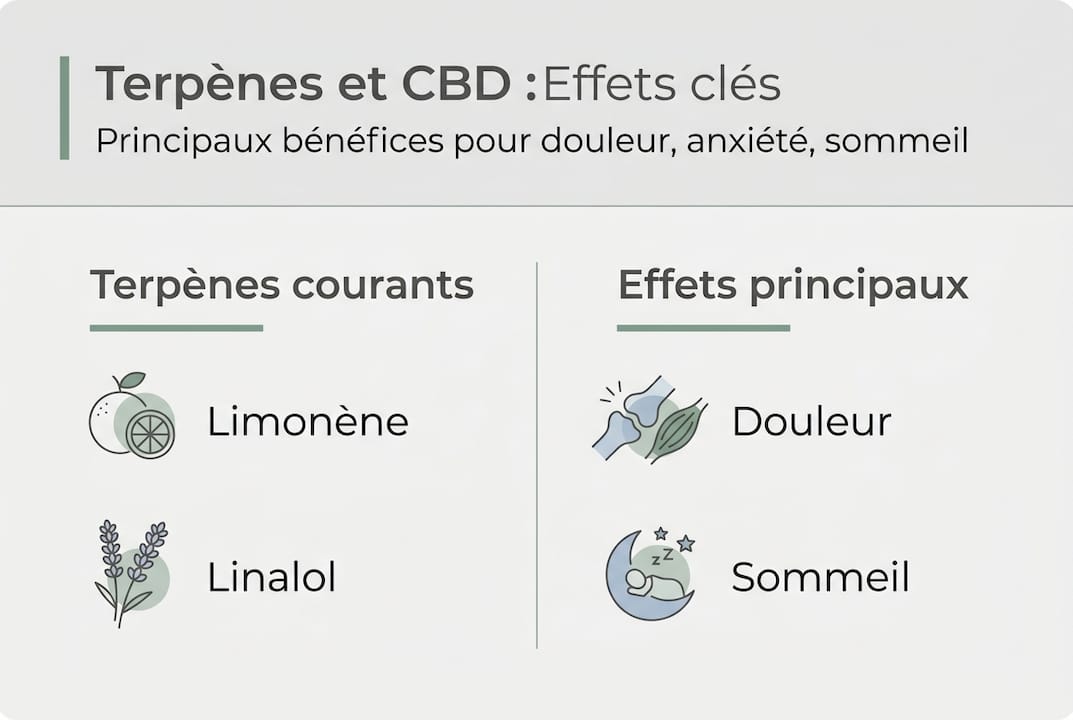
The specific effects on sleep stages reveal distinct mechanisms. Deep slow-wave sleep (SWS) increases with sedative terpenes such as myrcene and linalool, promoting physical recovery. REM sleep benefits from limonene and pinene, improving memory consolidation and emotional balance.
To incorporate terpenes and CBD into your sleep routine:
- Choose a formulation with a minimum CBD-to-terpenes ratio of 300:1 to avoid aromatic oversaturation
- Take your dose 60 to 90 minutes before bedtime to synchronize the peak effect with falling asleep
- Create a conducive environment by combining this with sleep hygiene (a cool temperature, complete darkness)
- Start with 150 mg of CBD with 0.5 mg of terpenes, increasing gradually if necessary
- Maintain consistent use for at least two weeks to assess actual effectiveness
- Adjust the terpene profile according to your reactions: more myrcene if you have difficulty falling asleep, more linalool if you experience nighttime awakenings
Pro tip: Terpenes are volatile and degrade quickly when exposed to heat. Store your products in a cool place and use them within three months of opening to maintain maximum effectiveness.
The data show that low doses of terpenes (0.5 to 2 mg) produce better results than higher concentrations. Above 3 mg, some users report paradoxical stimulation or vivid dreams that disrupt sleep. This inverted U-shaped dose–response curve highlights the importance of moderation.
CBD solutions for insomnia vary according to individual profiles. People with anxiety benefit more from linalool, while those with nighttime pain prefer β-caryophyllene. Experiment with different combinations while following the established principles of CBD dosing for insomnia.
Anxiolytic effects of terpenes alongside CBD: between hope and limitations
The neurobiological mechanisms involved in anxiety include:
- Modulation of the GABAergic system (the brain’s main inhibitory neurotransmitter system)
- Activation of serotonin 5-HT1A receptors (target of conventional anxiolytics)
- Regulation of the hypothalamic–pituitary–adrenal axis (stress response)
- Influence on the amygdala and prefrontal cortex (emotional processing)
Terpenes such as limonene demonstrate anxiolytic properties through GABA and 5-HT1A modulation. Systematic reviews suggest an entourage effect with CBD for anxiety disorders, but human evidence remains limited in 2026. This critical distinction separates scientific enthusiasm from definitive clinical validation.
Comparing anxiolytic effects reveals significant differences. Terpenes alone produce a rapid but temporary effect lasting 30 to 60 minutes. Isolated CBD provides a longer-lasting effect but requires regular use over several weeks. The optimal combination harnesses the speed of terpenes and the stability of cannabidiol.
Studies on the entourage effect show promising results in the laboratory, but controlled clinical trials in humans remain insufficient to establish definitive therapeutic recommendations. Scientific caution is warranted despite the optimism of the preclinical data.
| Criterion | Terpenes alone | CBD isolate | Terpenes + CBD combination |
|---|---|---|---|
| Speed of action | 15–30 minutes | 2–4 weeks | 30–60 minutes |
| Duration of effect | 1–2 hours | 6–8 hours | 4–6 hours |
| Level of evidence | Preclinical | Moderate clinical | Promising preclinical |
| Side effects | Rare, possible irritation | Fatigue, interactions | Varies by profile |
| Relative cost | Low | Medium | Medium to high |
For anxious consumers, prioritize limonene and linalool while avoiding high doses of myrcene, which can amplify sedation. Start with 100mg of CBD combined with 0.3mg of anxiolytic terpenes, twice a day. Monitor your reactions for a week before adjusting.
Vigilance remains essential because some combinations produce paradoxical effects. People sensitive to residual THC should avoid myrcene-rich profiles that amplify psychoactive effects. Mental health approaches require strict individualization.
The entourage data highlight that responses vary according to individual genetics. Some fast metabolizers require higher doses, while slow metabolizers achieve results with minimal amounts. This pharmacogenetic variability explains the reported differences in effectiveness.
Consult the anxiety dosing guide to establish your personalized protocol. A gradual approach remains the safest and most effective in the long term.
Adapting terpene and CBD use: practical advice and precautions
Recommendations for choosing and dosing your terpenes with CBD include:
- Check certificates of analysis (COAs) indicating the exact concentrations of terpenes and cannabinoids
- Prefer full-spectrum extracts that preserve natural terpenes over reconstituted isolates
- Always start with one-third of the recommended dose to assess your personal sensitivity
- Space doses 8 to 12 hours apart to maintain stable levels without excessive accumulation
- Systematically record your observations on effectiveness, duration of action, and any potential adverse effects
Psychological profiles strongly influence responses. Naturally anxious people should avoid stimulating terpenes such as pinene at high doses in the evening. Depressed individuals benefit more from energizing limonene in the morning. This personalization based on temperament optimizes results.
Professional tip: Test a new terpene profile on a day off when you can calmly observe your reactions without professional obligations. This cautious approach prevents unpleasant surprises and allows you to adjust safely.
Safety precautions for consumers with chronic conditions remain essential. If you have liver disorders, limit terpene doses because they place a burden on hepatic metabolism. People with asthma should favor sublingual oils over inhalation of flowers rich in volatile terpenes.
Individual responses vary according to genetics and baseline condition. Possible synergies with morphine do not produce an addictive reward effect, but caution is warranted regarding combinations to avoid. For example, high myrcene levels combined with residual THC may amplify anxiety in sensitive individuals.
Optimization avenues awaiting further studies include:
- Genetic sequencing of CYP450 enzymes to predict individual metabolism
- Extended-release formulations maintaining stable terpene levels for 12 hours
- Personalized combinations based on inflammatory biomarkers and neurotransmitters
- Dose-escalation protocols guided by objective measurements (sleep quality, pain scales)
Consult the CBD safety guide for people with chronic conditions before incorporating terpenes into your routine. Potential drug interactions require professional supervision, particularly with anticoagulants, SSRIs, and benzodiazepines.
Assess your personal reactions for at least three weeks before drawing conclusions about effectiveness. The effects of terpenes stabilize after a period of neurobiological adaptation. Gradually adjust in increments of 0.2 mg of terpenes or 25 mg of CBD to identify your optimal therapeutic range.
Discover our selection of CBD products enriched with terpenes
Are you looking for CBD products with terpene profiles optimized for your specific needs? Specialized European shops offer selections suited to chronic pain, insomnia, and anxiety. These formulations combine scientific knowledge with carefully cultivated varieties.
The best CBD shops in Eindhoven and London offer personalized advice to help you choose the terpene profile suited to your situation. Their trained teams guide you in your selection based on your therapeutic goals and experience with cannabidiol.
To try different profiles without a major commitment, explore the CBD pre-roll assortments. These collections let you compare the effects of various terpene combinations at a reduced cost. This way, you can identify your preferred variety before investing in larger quantities.
FAQ about terpenes and CBD
What is a terpene, and why is it important in CBD?
A terpene is a natural aromatic molecule that determines the smell and taste of cannabis. These compounds modify the effects of CBD through the entourage effect, amplifying the therapeutic benefits beyond isolated cannabidiol. They act on cannabinoid receptors and other neurobiological systems to enhance effectiveness.
How do you choose terpenes for pain and anxiety management?
For pain, favor β-caryophyllene and α-humulene, which target inflammation. For anxiety, limonene and linalool offer the best anxiolytic effects through GABA and serotonin modulation. Start with low doses and adjust according to your personal reactions observed over a minimum of two weeks.
Can terpenes cause side effects?
Side effects remain rare but possible, including skin irritation with topical application or paradoxical stimulation at high doses. Some people report headaches with excessive concentrations of pinene. Follow the recommended dosages and consult a professional if you take other medications to avoid interactions.
What dose of terpenes should be combined with CBD for sleep?
Clinical studies show that a dose of 0.5 to 1 mg of terpenes combined with 150 to 300 mg of CBD produces the best results for insomnia. Take this combination 60 to 90 minutes before bedtime. Rarely exceed 2 mg of total terpenes, as high doses can disrupt REM sleep. Consult the dosage guide to personalize your approach.
Can terpenes replace conventional medications for pain or anxiety?
Terpenes do not replace established medical treatments without professional supervision. They are a promising supplement according to preclinical data, but clinical evidence in humans remains limited in 2026. Always consult your doctor before modifying an existing treatment, particularly for chronic conditions requiring ongoing medical management.