
CBD and therapeutic support: what the science says
CBD is everywhere: in pharmacies, online shops and conversations among friends. Many present it as a natural solution for soothing chronic pain, getting back to sleep or easing anxiety. But between enthusiastic testimonials and marketing promises, what does the science really say? The reality is more nuanced than what we often hear. This article reviews the biological mechanisms of CBD, the available clinical evidence, the legal framework in Europe and best practices for incorporating it responsibly into your daily life.
Table of contents
- How CBD works in the body: the essential mechanisms
- Evidence of CBD’s effectiveness: chronic pain, anxiety, insomnia
- Legality and precautions in Europe: what you need to know before using it
- How to incorporate CBD as a therapeutic supplement into your daily routine
- Discover our selection of certified-quality CBD
- Frequently Asked Questions
Key Points
| Point | Details |
|---|---|
| Biological mechanisms | CBD acts indirectly on receptors in the brain and immune system without euphoric effects. |
| Limited benefits | The scientific evidence is moderate or weak; use remains primarily complementary. |
| Safety and legality | With less than 0.3% THC, CBD is legal, but caution is required regarding quality and interactions. |
| Responsible use | Using CBD means staying informed, consulting a professional and adjusting its use according to your needs. |
How CBD works in the body: the essential mechanisms
Let’s establish the fundamentals of how CBD works before detailing its therapeutic uses.
CBD, or cannabidiol, is a molecule extracted from hemp. Unlike THC, it does not cause any euphoric effects or altered consciousness. Its action is mainly based on the endocannabinoid system, a network of receptors and chemical messengers found throughout the body that regulates essential functions such as pain, mood, sleep and the immune response.
CBD interacts with CB1, CB2, TRPV1, 5-HT1A and PPARγ, modulating inflammation and pain without psychoactive effects. CB1 receptors are found mainly in the brain, while CB2 receptors are more closely associated with the immune system. The other targets of CBD, such as TRPV1 (involved in pain perception) and 5-HT1A (linked to serotonin), explain its potential effects on anxiety and inflammation.
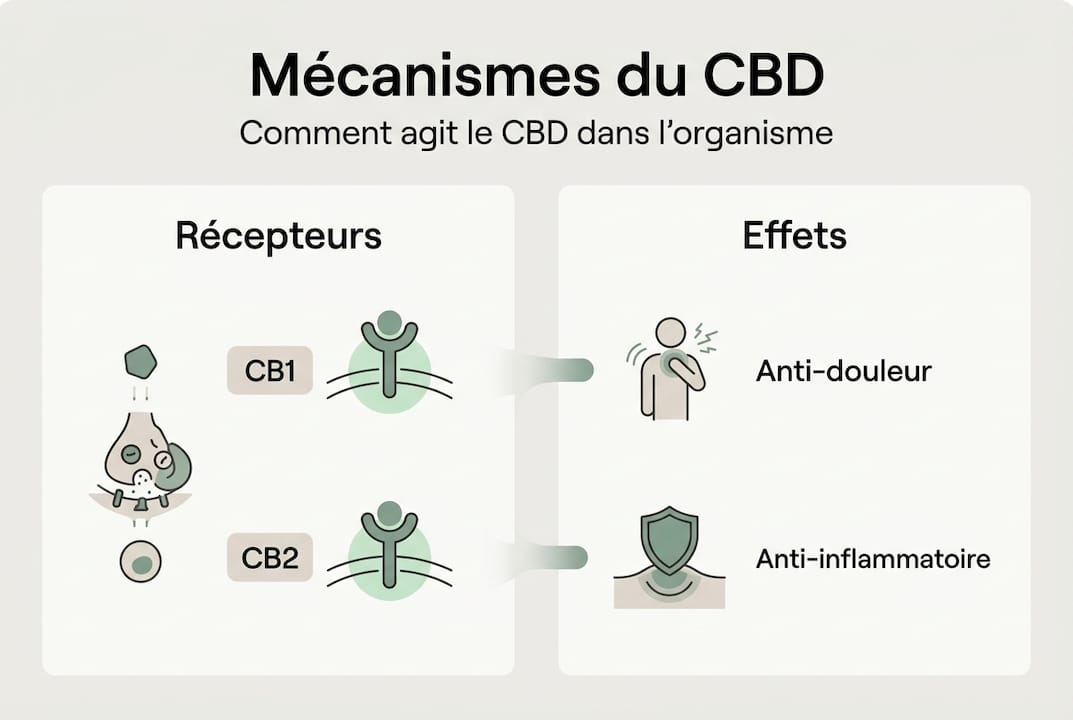
| Receptor | Main location | Potential effect of CBD |
|---|---|---|
| CB1 | Brain, nervous system | Pain and mood modulation |
| CB2 | Immune system | Reduction of inflammation |
| TRPV1 | Peripheral nerves | Analgesia |
| 5-HT1A | Brain | Anxiolytic effect |
| PPARγ | Fat cells, liver | Anti-inflammatory |
Here are the key points to remember about how CBD works:
- It does not cause dependence or a “high”
- It acts on several biological systems simultaneously
- Its effects are modulatory, not blocking
- The response varies from person to person
Professional advice: Understanding these mechanisms helps set realistic expectations. CBD is not a miracle drug, but a biological modulator whose effects depend on your profile and health context.
Evidence of CBD’s effectiveness: chronic pain, anxiety, insomnia
After understanding the mechanisms, let’s examine what the studies say about the purported benefits of CBD.
The scientific data available in 2026 remain heterogeneous. For chronic and neuropathic pain, the results are mixed. Isolated CBD shows little validated clinical efficacy for chronic pain, and placebo effects are frequently observed in studies on anxiety.
Here is a comparative overview of the three main indications:
| Indication | Level of evidence | Observations |
|---|---|---|
| Chronic pain | Low to moderate | Isolated CBD shows little evidence; better results with full-spectrum CBD |
| Anxiety | Moderate | Subtle effects; significant placebo effect in trials |
| Insomnia | Low | Possible improvement in sleep quality |
For anxiety, studies show subtle effects, but the protocols vary widely from one study to another. If you are looking for a suitable dosage for anxiety, it is important to start with low doses and adjust gradually.

Regarding sleep, an average improvement of +1.3% in deep sleep time (SWS/REM) was observed in some studies, which remains modest. To learn more about using CBD for insomnia, the results are promising but not yet definitive.
The clinical evidence for CBD remains insufficient to validate firm therapeutic claims. As several experts point out:
“The reported benefits remain anecdotal and are not solid enough to form an independent therapeutic basis.”
In summary, here are the three indications ranked by current level of evidence:
- Anxiety: the best-documented effects, but heterogeneous studies
- Chronic pain: results vary depending on the type of pain and formulation
- Insomnia: encouraging preliminary data, but insufficient
Legality and precautions in Europe: what you need to know before using it
Before considering therapeutic use, you must ensure that you are complying with the law and acting safely.
In Europe, non-medical CBD is legal provided that the product contains less than 0.3% THC. No medical claims are permitted on the labeling. To better understand why CBD is legal in Europe within this specific framework, it is necessary to distinguish between the status of a food supplement and that of a medicine.
Here are the essential legal requirements to follow:
- THC content below 0.3%
- No therapeutic claims on the packaging
- Product made from authorized hemp varieties
- Traceability and certificates of analysis available
As for side effects, they are generally mild but deserve attention. The most common are drowsiness, dry mouth, and possible interactions with certain medications, particularly blood thinners and antidepressants. Psychoactive substances are increasingly regulated in Europe, and CBD is no exception to this regulatory scrutiny.
For responsible therapeutic use, it is essential to understand the potential interactions with your current treatments.
Professional advice: Always inform your doctor before starting a CBD supplement, especially if you are already taking medication. This simple precaution can help prevent unwanted interactions.
How to incorporate CBD as a therapeutic supplement into your daily routine
Are you ready to put it into practice? Here is how to incorporate CBD safely as a complementary tool.
Medical advice is essential to minimize the risk of drug interactions and adjust your intake according to your health situation. CBD never replaces a prescribed treatment. It is used as a supplement, as additional support within a holistic approach to well-being.
Here is a 4-step approach to incorporating CBD responsibly:
- Medical consultation: talk to your doctor before making any purchase, especially if you are currently undergoing treatment
- Conscious product choice: prioritize oils or capsules with certificates of analysis and verified THC content below 0.3%
- Self-monitoring: record your effects in a journal, starting with low doses (5 to 10 mg/day)
- Gradual adjustment: adjust the dose after 2 to 3 weeks according to how you feel and your doctor's advice
To add CBD to your daily routine in a structured way, here are the quality criteria to check before buying:
- Certificate of analysis (COA) issued by an independent laboratory
- Origin of the hemp clearly indicated (ideally Europe)
- Extraction method stated (supercritical CO2 recommended)
- Confirmed absence of pesticides and heavy metals
If you do not know where to start, a guide to choosing your CBD wisely can help you navigate the many options available on the European market.
Discover our selection of certified-quality CBD
Choosing reliable CBD means, above all, choosing transparency. At European CBD Shop, each product is selected according to strict criteria: THC content below 0.3%, certificates of analysis available, and complete traceability from the plant to the bottle. Whether you are looking for oil for pain, capsules for sleep, or an extract for anxiety, our catalog covers all your complementary therapeutic needs.
We deliver throughout the European Union, the United Kingdom, and Switzerland. Our product pages systematically include laboratory analysis results, so you can make an informed choice with complete confidence. Because a good supplement starts with a verifiable quality product, we put transparency at the heart of every product in our store.
Frequently Asked Questions
Can CBD Replace Conventional Medical Treatment?
No. CBD is a supplement, not a substitute. It never replaces a treatment prescribed by a doctor, and its use should always be discussed with a healthcare professional.
What Are the Main Side Effects of CBD?
Common side effects include drowsiness, dry mouth, and possible interactions with certain medications. Consult your doctor before starting.
Is CBD Legal Everywhere in Europe?
Yes, provided that the product contains less than 0.3% THC and does not claim any therapeutic effect on its label.
Does CBD Work Immediately?
Rarely. The effects of CBD are subtle and often not immediate. Several days, or even a few weeks, may be needed to observe a noticeable change.