
CBG versus CBD: Effect on Anxiety and Sleep
Finding a natural solution to calm anxiety or regain peaceful sleep is a challenge for many consumers of CBD flowers and resins in Europe. Understanding the difference between CBG and CBD becomes essential, as each cannabinoid has a unique mode of action on the nervous system. This article highlights the distinct mechanisms and potential of these non-psychoactive molecules, offering insights to tailor your choice according to your relaxation and wellness needs.
Table of contents
- CBG and CBD: definitions and common misconceptions
- Major differences: origins, actions, profiles
- Effects on anxiety, insomnia, and relaxation
- Legality, safety, and regulation in Europe
- How to choose according to your specific needs
Key takeaways
| Point | Details |
|---|---|
| CBG and CBD are non-psychoactive cannabinoids | They do not affect mental state and interact with the endocannabinoid system for therapeutic benefits. |
| Differences in mechanisms of action | CBG acts as a weak receptor agonist, while CBD has a more complex interaction profile with multiple systems. |
| Varied applications for each cannabinoid | CBD is more studied for anxiety and sleep, while CBG shows potential for neurological disorders. |
| Importance of consulting a healthcare professional | Always seek the advice of a specialist before incorporating CBG or CBD into your wellness routine. |
CBG and CBD: definitions and common misconceptions
Cannabinoids like CBG and CBD have recently gained popularity for their potential therapeutic benefits. Recent research shows that these molecules have fascinating and complementary properties, although they act differently on our endocannabinoid system.
Cannabidiol (CBD) and cannabigerol (CBG) are two non-psychoactive cannabinoids extracted from the cannabis plant, meaning they do not cause a state of euphoria or altered consciousness. Their main characteristics include:
- Complete absence of psychotropic effects
- Complex interactions with the nervous system
- Promising therapeutic potential
- Distinct mechanisms of action
Although chemically similar, these two compounds have notable differences. Scientific studies show that CBD is a major cannabinoid widely studied, while CBG remains a minor cannabinoid still under exploration. CBD has already demonstrated potential effectiveness against anxiety and certain inflammatory diseases, whereas CBG shows growing interest for neurological applications.
There are many misconceptions about these molecules. Contrary to popular belief, these cannabinoids are not doping or intoxicating substances. They naturally interact with our endocannabinoid system, offering potential therapeutic effects without the risks associated with THC.
Pro tip: Always consult a healthcare professional before incorporating CBG or CBD supplements into your wellness routine.
Major differences: origins, actions, profiles
The cannabinoids CBG and CBD share a fascinating common origin but have radically different mechanisms of action and biological profiles. Scientific research reveals that CBG is actually a precursor cannabinoid from which other compounds like THC and CBD are synthesized in the cannabis plant.
Their origins and mechanisms of action differ significantly:
- Origin of CBG: Precursor of other cannabinoids
- Origin of CBD: Secondary derivative of CBGA
- Receptor interaction: CBG as a weak agonist, CBD with multiple interactions
- Pharmacological profile: Distinct mechanisms of action
Comparative studies show that CBG mainly acts as a weak agonist of cannabinoid receptors CB1 and CB2, but has a higher affinity for other receptors such as α2 adrenergic receptors. In contrast, CBD has a much more complex interaction profile, acting on several receptor and enzyme systems.

The transformation process in the plant is also unique: during maturation, the majority of CBGA (cannabigerolic acid) converts into THC and CBD, leaving only a very small amount of CBG. This peculiarity explains why CBG is considered a minor cannabinoid, less abundant and less studied than its cousin CBD.
Here is a structured overview of the main differences between CBG and CBD:
| Distinctive criterion | CBG | CBD |
|---|---|---|
| Abundance in the plant | Very rare, less than 1% | Majority, 10-20% |
| Scientific research | Preliminary studies, little evidence | Advanced studies, numerous publications |
| Preferred target | α2-adrenergic and CB1 receptors | Serotonin and CB2 receptors |
| Medical applications | Neurological disorders, inflammation | Anxiety, sleep, chronic pain |
Pro tip: To understand the nuances between CBG and CBD, always prioritize scientific sources and recent peer-reviewed publications.
Effects on anxiety, insomnia, and relaxation
Recent scientific research demonstrates that CBD and CBG have fascinating properties for managing anxiety and improving sleep quality. These two cannabinoids act in subtle but significant ways on our nervous system, offering promising natural alternatives to conventional treatments.
Their mechanisms of action on anxiety and sleep are distinguished by several characteristics:
- CBD: Modulator of serotonin receptors
- CBG: Interaction with α2-adrenergic receptors
- Neuroprotective properties
- Anti-inflammatory effects
- Potential anxiety reduction
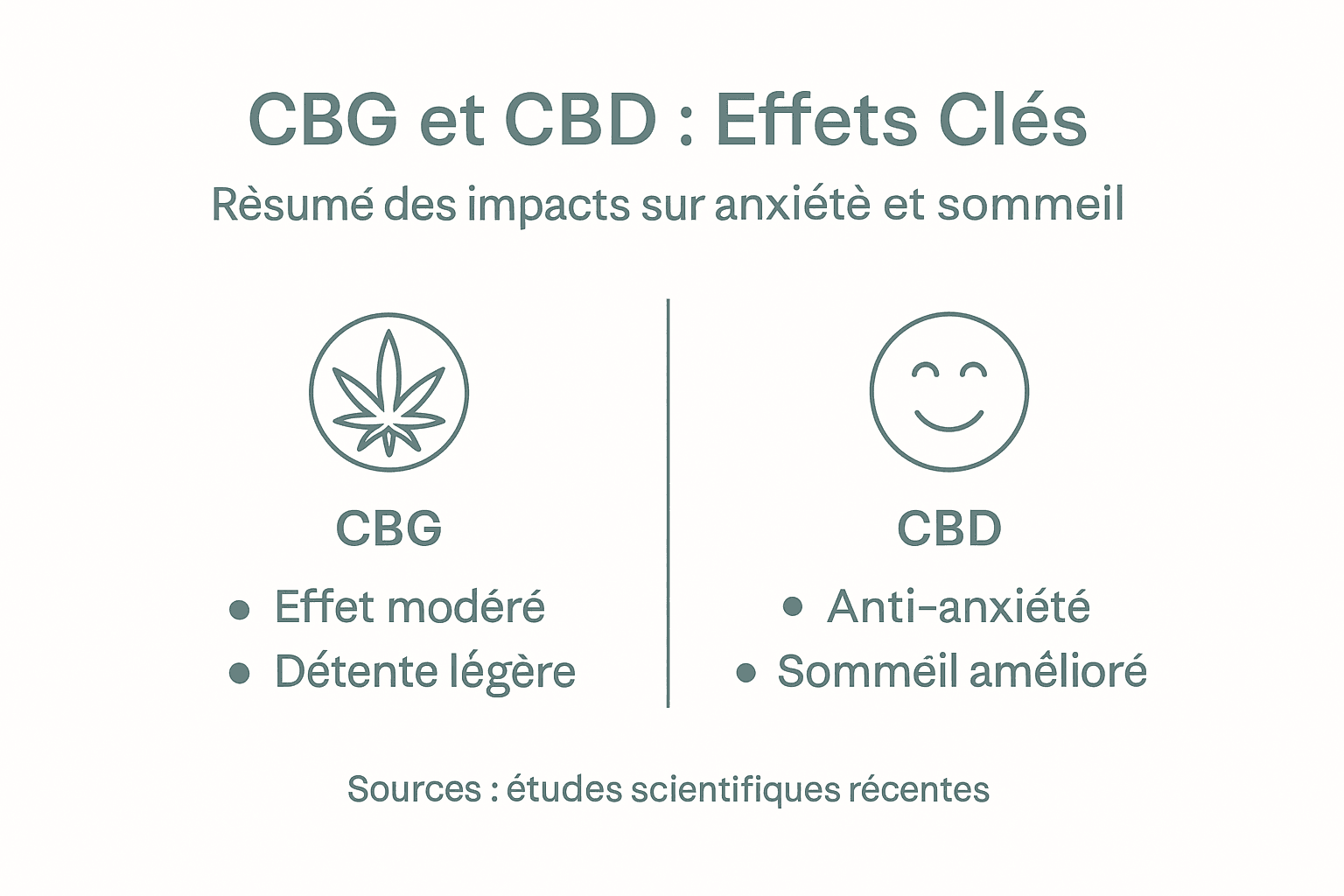
Comparative studies reveal that CBD has more documented anxiolytic properties. It mainly works by modulating 5-HT1A receptors, which helps significantly reduce anxiety symptoms and improve sleep quality. CBG, although less studied, also shows interesting potential for managing stress and anxiety.
In detail, these cannabinoids interact with the endocannabinoid system in a complementary way. CBD is known for its overall calming effects, while CBG seems to target more specifically certain mechanisms of mood regulation and relaxation. Their combined action could offer a more holistic approach to managing stress and sleep disorders.
Pro tip: Always start with low doses and consult a healthcare professional before incorporating these cannabinoids into your wellness routine.
Legality, safety, and regulation in Europe
European regulations concerning CBD and CBG are complex and vary significantly by country. These non-psychoactive cannabinoids benefit from a relatively favorable legal framework but require constant vigilance regarding their composition and use.
The main regulatory characteristics to remember:
- Strict THC limit at 0.2%
- Requirement for origin and traceability
- Mandatory purity controls
- Prohibition of sales to minors
- Variable restrictions according to European countries
European authorities exercise strict oversight on the quality and safety of cannabinoid-based products. The legal framework imposes strict standards regarding THC concentration, extract purity, and production processes, thus ensuring consumer protection.
Each European country maintains specific regulations, which complicates the cross-border marketing of these products. Germany, France, Spain, and the Netherlands have distinct approaches but converge on the fundamental principles of safety and non-psychoactivity.
Pro tip: Always check local regulations before purchasing or using products containing CBD or CBG.
How to choose according to your specific needs
Current medical recommendations emphasize the importance of personalizing the choice between CBG and CBD according to your specific health needs. Each cannabinoid has unique properties that may respond differently to distinct wellness issues.
Here are the essential criteria to make your selection:
- Anxiety: CBD recommended
- Disturbed sleep: CBD more studied
- Inflammation: Interesting potential for both
- Neurological disorders: Promising CBG
- Chronic pain: More documented CBD
Scientific experts remind that individual reactions vary significantly. CBD is generally recommended for anxiety, sleep, and moderate pain issues, while CBG is beginning to show interesting potential for more specific neurological conditions.
To refine your choice, it is crucial to consider several parameters: your specific medical condition, your individual tolerance, the product quality, and its origin. Support from a healthcare professional remains the best approach to ensure optimal and safe use.
This table summarizes the essential criteria for choosing between CBG and CBD according to health needs:
| Health need | Recommended CBG | Recommended CBD |
|---|---|---|
| Stress management | Emerging potential | Recognized calming effect |
| Sleep disorders | Limited studies | Documented and effective |
| Chronic pain | Anti-inflammatory action | Analgesic and anti-inflammatory action |
| Neurological issues | Promising research | Less targeted for now |
Pro tip: Always start with small doses and carefully observe your body's reaction before adjusting the dosage.
Find the Balance between CBG and CBD to Soothe Anxiety and Sleep
The article “CBG versus CBD: Impact on Anxiety and Sleep” reveals how complex natural management of stress and sleep disorders can be. Do you often experience persistent anxiety or restless nights that harm your well-being? Discover how these non-psychoactive cannabinoids specifically target your neurobiological receptors to bring relaxation and serenity. The choice between CBG and CBD depends on your unique needs, and scientific information is evolving rapidly.
Don't let your quality of life crumble in the face of uncertainty. On our European online store, we offer a carefully selected range of CBG and CBD products tailored to your personal goals. Benefit from guaranteed purity, controlled to comply with strict European regulations. Explore now the soothing world of certified CBD and transform your nights. Serenity begins with an informed choice. Visit https://cbd-certified.com and take the first step towards well-being today.
Frequently Asked Questions
What are the effects of CBG on anxiety?
CBG shows interesting potential for anxiety management by interacting with α2-adrenergic receptors, although studies are still preliminary.
Is CBD more effective than CBG for improving sleep quality?
Yes, CBD is generally better documented for its beneficial effects on sleep and is known to modulate serotonin receptors, thereby contributing to improved sleep quality.
Can CBG and CBD be used together?
Yes, the combined use of CBG and CBD could offer a complementary approach to managing anxiety and improving sleep, thanks to their distinct mechanisms of action.
What advice would you give for starting to use CBD or CBG?
Always start with low doses and consult a healthcare professional to tailor the treatment to your specific needs while monitoring your body's response.