
CBD and sleep cycles: understanding its real impact
TL;DR:
- CBD acts primarily by reducing anxiety and cortisol, not through direct sedation.
- In people with insomnia, CBD can improve perceived sleep quality, especially in cases of anxiety.
- Its influence on sleep cycles, particularly REM, is limited and depends on the dose and the individual.
Many Europeans discovering CBD imagine it as a kind of natural sleeping pill, something you take in the evening that makes you fall asleep instantly. The reality is far more nuanced. CBD does not directly sedate the brain: its effect on sleep cycles occurs through indirect mechanisms that vary according to your profile and symptoms. In this article, we will clarify what these cycles are, explain what studies actually show about CBD, distinguish the situations in which it genuinely helps, and give you practical guidance for using it in an informed way.
Table of contents
- What sleep cycles tell us and why they matter
- How does CBD influence sleep cycles?
- CBD, insomnia, and anxiety: what clinical trials reveal
- Choosing and using CBD effectively according to your sleep needs
- What most people forget about CBD and sleep
- Where to find quality CBD products to improve your sleep
- Frequently Asked Questions About CBD and Sleep Cycles
Key points
| Point | Details |
|---|---|
| CBD’s indirect effect | CBD mainly improves sleep in people with anxiety and insomnia through a calming effect, not as a direct sleeping pill. |
| The role of dosage | Effects vary greatly depending on the dose and individual profile, so gradual experimentation is recommended. |
| REM and THC | THC strongly suppresses REM; CBD alone has a neutral or moderate impact, limiting long-term risks. |
| The importance of product quality | A high-quality CBD product, properly dosed and suited to your needs, maximizes the chances of a positive effect on sleep. |
What sleep cycles tell us and why they matter
To understand how CBD affects sleep, you first need to know what sleep cycles are and what they do for your body. A night’s sleep is not one long, uniform state: it consists of several successive cycles, each lasting about 90 minutes.
Each cycle comprises two major phases. The NREM phase (non-REM) is itself divided into three stages: light sleep (N1 and N2), followed by deep sleep (N3). It is during stage N3 that the body physically regenerates, strengthens the immune system, and repairs tissue. The REM phase (Rapid Eye Movement), also called paradoxical sleep, is associated with dreaming, emotional regulation, and memory consolidation.
Here is a summary of the functions of each stage:
| Stage | Common name | Main functions |
|---|---|---|
| N1 | Light sleep | Wakefulness/sleep transition, muscle relaxation |
| N2 | Intermediate sleep | Light consolidation, temperature drop |
| N3 | Deep sleep | Physical recovery, immunity, growth hormones |
| REM | REM sleep | Emotional memory, creativity, stress processing |
When these cycles are disrupted, the consequences are concrete and immediate:
- Lack of deep sleep (N3): chronic fatigue, inadequate physical recovery, and weakened immunity.
- Lack of REM sleep: irritability, difficulty concentrating, increased anxiety, and memory problems.
- Sleep-maintenance insomnia: frequent nighttime awakenings that interrupt cycles before they are complete.
People suffering from anxiety are particularly affected by shortened or fragmented REM sleep. Overactivation of the nervous system maintains a state of alertness that is incompatible with deep sleep. Notably, recent research shows that CBD lengthens the circadian period, improves sleep in a caffeine-induced insomnia model in a dose-dependent manner, and even extends lifespan under food-deprivation conditions, suggesting an interaction with fundamental biological mechanisms.
Understanding these basic mechanisms already gives you an advantage over most CBD users who hope to “sleep better” without knowing exactly what they are affecting.
How does CBD influence sleep cycles?
Now that the structure of sleep is clear, let’s see what CBD actually does to these cycles. The short answer is: not much directly. This is precisely where many people’s expectations go wrong.
Indirect effects, not direct sedation
The main mechanism of action of CBD on sleep is through anxiolysis. In other words, CBD reduces anxiety and cortisol levels (the stress hormone), creating conditions conducive to falling asleep and staying asleep. In particular, it acts on 5-HT1A receptors, the same ones targeted by certain anxiolytic antidepressants. It also increases adenosinergic pressure, meaning the natural “sleep pressure” the body feels when it lacks rest. According to data published in PMC, the main benefit of CBD for people with insomnia and anxiety is indirect, through anxiolysis and cortisol reduction, rather than through direct sedation. It also disrupts sleep cycles less than THC.

CBD vs. THC: a major difference in REM sleep
This point deserves particular attention. THC strongly suppresses REM sleep. This is why some people who use cannabis report fewer dreams, or even no dreams at all. This REM suppression may be useful in the short term for people suffering from post-traumatic nightmares, but it becomes risky in the long term because the brain compensates with “REM rebound” after stopping.
CBD, on the other hand, disrupts REM cycles much less when used alone. This is a fundamental distinction for anyone seeking to improve their overall sleep quality without disrupting its architecture.
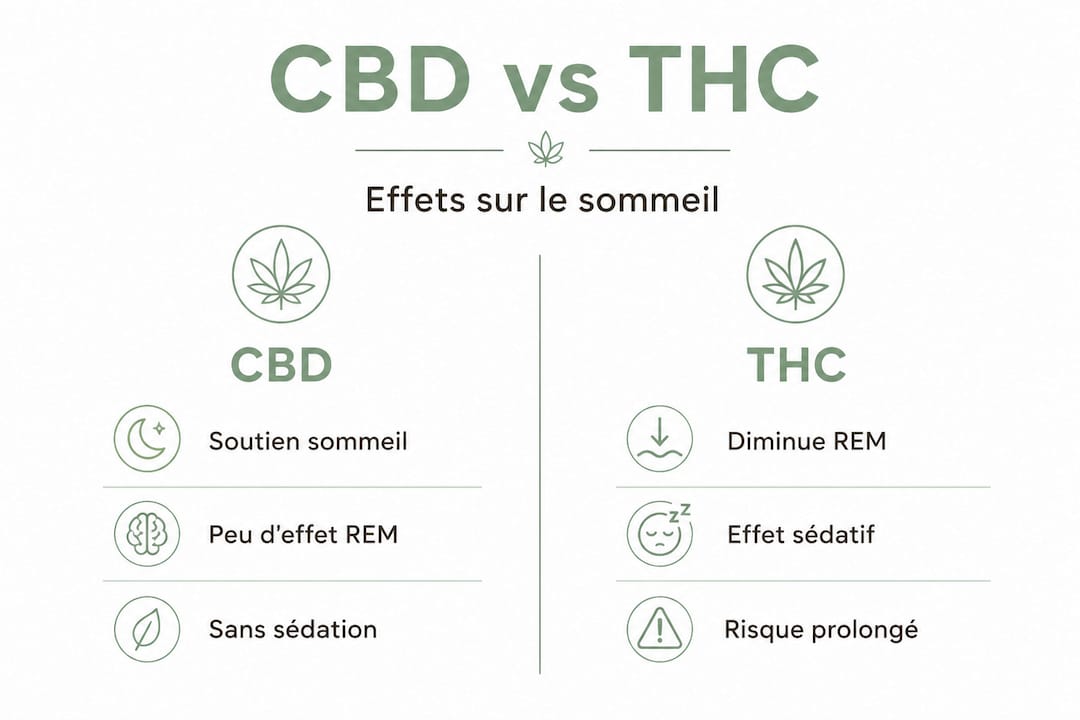
| Molecule | Effect on REM | Direct sedation | Long-term risk |
|---|---|---|---|
| CBD alone | Minor disruption | No | Low |
| THC alone | Strong suppression | Yes (partial) | Moderate to high |
| THC + CBD | Marked suppression | Yes | Things to monitor |
Pro tip: If you are looking to reduce anxiety-related nighttime awakenings, CBD oil under the tongue 30 to 45 minutes before bedtime is often the most suitable form. It provides gradual absorption and avoids the rapid peaks associated with other administration routes.
Form and dose: determining variables
The effects of CBD on sleep vary depending on the dose and form used. Oil absorbed under the tongue takes effect within 20 to 45 minutes. Gummies or capsules can take up to two hours to take effect. Smoked or vaporized flowers act within a few minutes, but their effects last for a shorter time. These differences directly influence how the effects are distributed throughout the night.
When it comes to CBD and mental health, understanding these nuances is crucial to avoiding disappointment. If you want to learn how to incorporate CBD into your daily routine effectively, well-documented gradual protocols are available. CBD solutions for insomnia have also been validated in several European therapeutic contexts.
CBD, insomnia, and anxiety: what clinical trials reveal
Mechanisms are one thing. But what actually happens in clinical studies, with real people measuring real outcomes? The answer significantly qualifies the commercial claims.
For healthy people: little detectable effect
This is one of the most surprising findings: a single dose of 300mg of oral CBD showed no significant effect on sleep architecture in healthy volunteers. In other words, if you already sleep well, CBD probably will not do much that can be measured in your sleep cycles. This finding is important: it means CBD is not a “universal sleep booster” but an active lever mainly where there is an imbalance to correct.
For people with insomnia and anxiety: real but nuanced benefits
Here is what clinical studies show for people with genuine sleep disorders:
- People with chronic anxiety report subjective improvements in sleep quality after several weeks of regular use.
- Objective measures (polysomnography, EEG) show more modest changes than participants report experiencing.
- Perceived sleep quality often improves before objective biological indicators.
Key finding: A study involving people with a strong tendency to worry (n=63) found that 300mg/day of CBD improved self-reported sleep problems more than 50mg/day, although the difference was not statistically significant compared with placebo. This illustrates the complexity of measuring CBD’s true effect in this population.
The THC-CBD combination: beware of shortcuts
A randomized pilot study conducted on 20 patients with insomnia produced striking results. A single dose of 10mg of THC combined with 200mg of CBD reduced total sleep time by 24.5 minutes and REM sleep by 33.9 minutes, while increasing REM latency by 65.6 minutes. EEG changes were also observed, including reduced gamma waves in N2 and delta waves in N3. No cognitive impairment the following day, but mild self-reported drowsiness. In summary: this combination substantially alters sleep architecture, which may pose long-term risks.
For those seeking to understand CBD dosage and insomnia, these data clearly indicate that there is no universal dose. As for CBD’s stress-relieving effect, it is supported by solid clinical evidence, particularly regarding cortisol reduction and improved stress resilience.
Choosing and using CBD effectively according to your sleep needs
After the theory and clinical data, here is how to translate all this into concrete practice according to your profile and specific issues.
Steps for choosing your CBD format
-
Identify your main problem. Difficulty falling asleep? Frequent nighttime awakenings? Evening anxiety? Each issue requires a different approach.
-
Choose the form according to timing. For difficulty falling asleep, a sublingual oil or vaporized CBD flowers and sleep act quickly. For nighttime awakenings, slow-release capsules or gummies can maintain a more stable effect throughout the night.
-
Start with a low dose and increase gradually. Most professionals recommend starting at around 20 to 25mg and adjusting every 5 to 7 days based on how you feel. Never double the dose all at once.
-
Test it for a realistic period. The effects of CBD on sleep often only appear after two to four weeks of regular use. A single test night does not tell you much.
-
Keep a sleep journal. Note the time you take it, the dose, your perceived sleep quality, nighttime awakenings, and how you feel in the morning. This is the most reliable way to identify what works for you.
Pro tip: Avoid increasing the dose every time you have a bad night. CBD works cumulatively, and a single poor night can have dozens of other causes. Consistency in use is more important than quantity.
“CBD is not a switch you simply turn on. It is a gradual regulator that works with your biology, not against it.”
Among the most common pitfalls is believing that more is always better. However, some studies suggest a bell-shaped effect in certain profiles, where very high doses may paradoxically reduce the beneficial effect. In addition, a single oral dose of 300mg does not alter sleep architecture in healthy subjects. Automatically escalating the dose is therefore rarely the right strategy.
To help guide you, the guides on forms of CBD for sleep and on CBD for insomnia offer detailed comparisons suited to different profiles of European consumers.
What most people forget about CBD and sleep
Here is a reality that is rarely stated clearly enough: CBD alone will not repair sleep that has been structurally damaged by years of poor habits, untreated chronic stress, or underlying medical problems. It may be the most useful truth to hear, even if it is less appealing than the usual promises.
CBD can significantly make it easier to fall asleep and reduce awakenings in people whose insomnia is primarily driven by anxiety. This is its strongest area of action. But if you do not also work on your sleep hygiene (regular schedules, brightness, bedroom temperature, screens), you greatly limit CBD’s effect to a few better nights rather than a lasting transformation.
What we also observe is that the future of CBD for sleep lies in personalization. Standardized dosages do not reflect each user’s biological reality. Factors such as weight, liver metabolism, baseline anxiety levels, and even the gut microbiome influence how CBD is absorbed and used. Future studies will need to incorporate these variables to produce truly useful recommendations. In the meantime, understanding the mechanisms of CBD remains the best starting point for making informed decisions.
CBD is one tool among many. A serious tool, with a real scientific basis, but not a standalone solution. Used thoughtfully, within a lifestyle that promotes rest, it can make a real difference, especially if anxiety is at the heart of your difficult nights.
Where to find quality CBD products to improve your sleep
You now have a solid understanding of what CBD can and cannot do for your sleep. The next step: finding reliable, transparent products suited to your situation.
At European CBD Shop, we select CBD products tested by an independent laboratory, with certificates of analysis available for every product. Whether you are looking for an oil to help you fall asleep, gummies for nighttime awakenings, or flowers for rapid evening effects, our range covers all profiles. Our teams support consumers in the EU, the United Kingdom, and Switzerland. You can explore the CBD shops in Europe that are partners in our network or, if you are in Belgium, consult our selection of the best CBD shops in BRUSSELS for local advice.
Frequently Asked Questions About CBD and Sleep Cycles
Does CBD Really Alter Sleep Cycles?
In people suffering from insomnia or anxiety, CBD mainly works by improving perceived sleep quality, but its direct effect on sleep-cycle structure remains moderate and depends on the individual. Research shows that 300mg/day improves reported symptoms more than 50mg/day, with no significant difference from placebo in groups with high anxiety.
Is CBD Effective for Anxiety-Related Insomnia?
Yes, mainly thanks to its anxiolytic effects: reducing stress and improving relaxation often make it easier to fall asleep. CBD acts on 5-HT1A receptors and cortisol, creating conditions conducive to sleep without direct sedation.
What CBD Dose Should You Choose to Sleep Better?
Studies suggest adjusting the dose according to how you feel: doses of 50mg to 300mg/day can be tried, as the response varies greatly from person to person. The study on self-reported sleep disorders shows that a higher dose improves perceived symptoms more, without necessarily reaching statistical significance.
Can CBD Cause Daytime Drowsiness?
At typical doses, CBD alone generally does not cause marked next-day drowsiness. Studies on low-dose cannabinoids in 1:1 or 1:16 THC:CBD ratios have not shown significant effects on daytime drowsiness compared with placebo.
Is CBD Safe for Sleep in the Long Term?
Research on prolonged CBD use remains limited, but it is considered well tolerated in the short term. Available data on low-dose cannabinoids in novice users confirm good immediate tolerability without major adverse effects.