
CBD microdosing: the simple guide to anxiety and sleep
TL;DR:
- CBD microdosing involves very small doses taken regularly for gradual balance.
- It primarily targets stress, sleep, and mild pain through discreet stimulation of the endocannabinoid system.
- Caution is recommended, with medical consultation in case of ongoing treatments and careful selection of certified products.
A dose so small that it is barely noticeable, yet capable of changing how stress, falling asleep, or persistent pain is managed. This is the idea behind CBD microdosing, a practice attracting growing interest in Europe among those seeking a gentle, regular approach to well-being. Contrary to what is often believed, it is not necessary to take large amounts of CBD to benefit from it. This article explains exactly what microdosing is, how to practice it, what results to expect, and what precautions to take.
Table of contents
- What is a CBD microdose?
- What dosage and method should you use to microdose CBD?
- What benefits can CBD microdosing be used for?
- What are the risks, limitations, and nuances of microdosing?
- Practical advice: how can you successfully microdose CBD?
- Why CBD microdosing changes the game (expert opinion)
- Where to find suitable products for microdosing with confidence
- Frequently Asked Questions About CBD Microdosing
Key points
| Point | Details |
|---|---|
| Clear definition | CBD microdosing involves taking very small amounts several times a day for subtle effects. |
| Gradual approach | Start with 1 mg, try it for a week, then adjust according to your needs. |
| Key benefits | Reduces stress, improves sleep, and helps manage mild pain, with cumulative effects. |
| Safety and limitations | Few risks when used reasonably, but consult a doctor if you are undergoing medical treatment. |
| Choosing the right product | Choose certified oils or capsules for precise and safe microdosing. |
What is a CBD microdose?
CBD microdosing is a simple yet precise approach. Rather than taking a large amount of CBD all at once, consumption is divided into very small doses taken several times throughout the day. 1 to 5 mg per dose, two to four times a day, regularly, to subtly stimulate the endocannabinoid system without immediately noticeable effects.
The endocannabinoid system (or ECS) is a network of receptors found throughout the human body. It plays a key role in regulating mood, sleep, pain, and stress. Microdosing acts on this system subtly, like daily maintenance rather than a one-off intervention. To learn more about the impact of CBD on the endocannabinoid system, it is helpful to understand that this discreet stimulation is intended to promote gradual balance.
Here is what characterizes CBD microdosing:
- Very low doses, between 1 and 5 mg per dose
- Frequency of 2 to 4 daily doses
- No immediate or psychoactive effect expected
- Cumulative results observed over several days
- Daily and regular use, like a wellness supplement
| Parameter | CBD microdose | Regular dose |
|---|---|---|
| Dose per intake | 1 to 5 mg | 10 to 50 mg |
| Frequency | 2 to 4 times/day | 1 to 2 times/day |
| Perceived effect | Subtle and cumulative | More immediate |
| Objective | Progressive balance | Targeted relief |
“The idea is not to feel something immediately, but to support the body over time, consistently and gently.”
This focus on consistency is what distinguishes microdosing from any other approach. It requires patience, but also careful attention to how you feel.
What dosage and method should you use to microdose CBD?
Putting it into practice is often where beginners hesitate. The good news is that the recommended method is gradual and accessible. Start with 1 mg, observe the effects for a week, spread the doses throughout the day (morning, noon, evening), then adjust according to your weight and sensitivity.
Here are the steps to follow to get started:
- Start with 1 mg per dose, twice a day, for a full week
- Observe and note: sleep quality, stress level, general sensations
- Increase gradually by 0.5 to 1 mg if no noticeable effect occurs after 7 days
- Spread the doses throughout the day to maintain a stable level in the body
- Adjust according to your profile: an 80 kg person will generally need a higher dose than a 55 kg person
Choosing the right dosage form is crucial for precision. Sublingual oils allow rapid absorption (within 15 to 30 minutes) and highly precise drop-by-drop dosing. Capsules provide a fixed, consistent dose, ideal for people who prefer simplicity. To choose a suitable CBD product for your approach, consider bioavailability and format.

| Dosage form | Onset time | Dosing precision | Main advantage |
|---|---|---|---|
| Sublingual oil | 15 to 30 min | Very high | Rapid absorption |
| Capsules | 45 to 90 min | High | Ease of use |
Professional tip: Choose only certified products with less than 0.3% THC. This legal limit in the European Union ensures the absence of psychoactive effects and full compliance. Refer to the CBD product selection to guide your choice toward reliable, traceable ranges.
What benefits can CBD microdosing be used for?
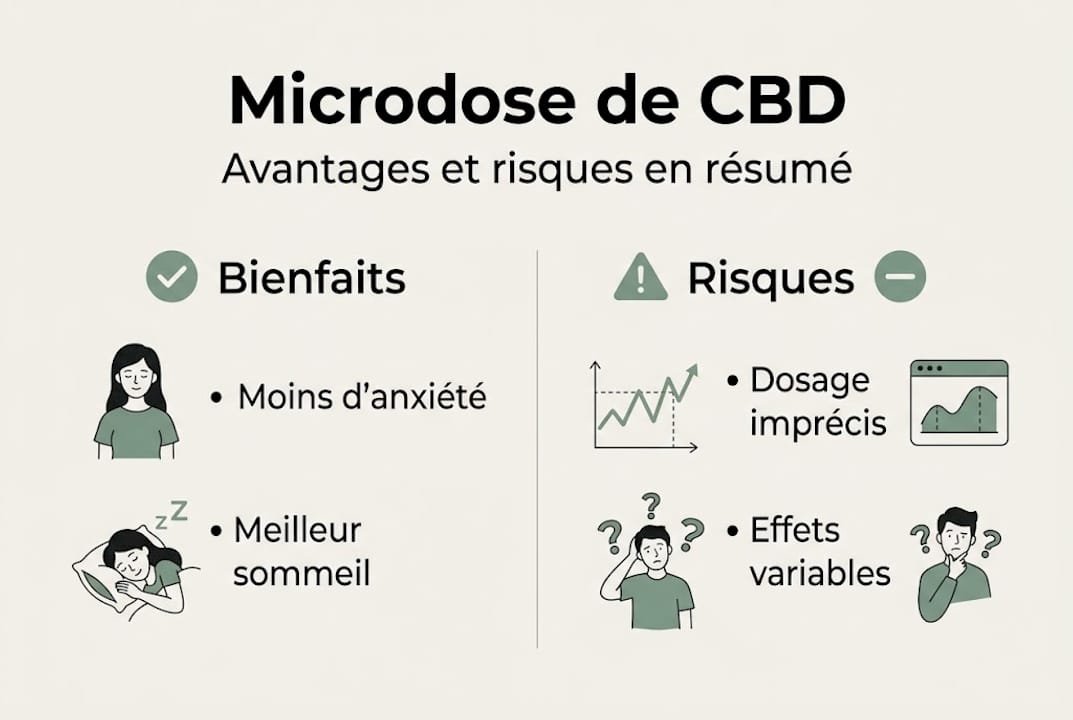
Once the method is well established, the results reported by users fall into three main categories: anxiety, sleep, and pain. The benefits observed for these symptoms include greater resilience to stress, more stable sleep, and reduced mild pain through support for the endocannabinoid system, with cumulative effects over 7 to 10 days.
Here are the most frequently cited benefits:
- Anxiety: a feeling of emotional stability, fewer intrusive thoughts during the day, and better management of stress spikes
- Sleep: easier falling asleep, less fragmented nights, and feeling more rested upon waking
- Mild chronic pain: reduced muscle tension and more manageable joint pain
- General mood: a sense of regularity and diffuse calm, without drowsiness
- Energy: some users report improved mental clarity in the morning with a low dose upon waking
CBD use in 2026 clearly shows that demand is shifting toward gentler approaches integrated into daily life. Microdosing fits this usage profile exactly: no “knockout effect,” but discreet, consistent support.
“After 10 days on minimal doses, some users describe a kind of underlying calm they would not previously have known how to name. It is not a spectacular transformation, but a gradual normalization.”
CBD flowers and their benefits can also be used for microdosing, although dose precision is more challenging with this form.
What are the risks, limitations, and nuances of microdosing?
Let’s be direct: science has not yet formally validated CBD microdosing. Empirical data remains limited, specific microdosing studies are rare, and the inverted U-shaped curve (where doses that are too low or too high prove less effective than an intermediate dose) complicates the conclusions.
What current observations allow us to say:
- The risk of tolerance remains very low according to the available data
- Effects vary greatly from one person to another, making any universal protocol impossible
- Microdosing is not suitable for severe conditions or intense pain requiring medical treatment
- If you are undergoing existing treatment (antidepressants, blood thinners, etc.), a drug interaction is possible
- The lack of scientific consensus calls for vigilance and avoiding overinterpreting personal results
Pro tip: If you take prescription medication, consult a doctor before incorporating even a microdose of CBD into your routine. The benefits of CBD hemp are real for many people, but caution remains a healthy and responsible approach.
The so-called “sweet spot” effect also deserves attention. It refers to the ideal dose for each individual—the one that produces the best results without going too far. Finding it requires observation, patience, and rigor. It is not an exact science, but active listening to your own body.
Practical advice: how can you successfully microdose CBD?
The theory is in place. Here’s how to take structured and safe action. A gentle approach is particularly suited to managing daily anxiety, insomnia, and mild pain, provided you prioritize EU-certified products with less than 0.3% THC and consult a doctor if in doubt.
- Keep an observation journal: record the dose, time of intake, and sensations experienced each day. This helps visualize trends and make objective adjustments.
- Do not increase the dose too quickly: increase in increments of no more than 0.5 mg, and wait at least 5 days before each adjustment.
- Choose certified products: clear labeling, laboratory analyses available, and THC levels verified to be below 0.3%.
- Incorporate it into your routine: with your morning coffee, before lunch, or before bed. Consistency is key.
- Be patient: cumulative effects take time to develop. Do not judge the results before 10 full days have passed.
To learn how to add CBD to your daily routine smoothly, practical resources can help you structure your approach from day one.
Pro tip: Avoid combining several sources of CBD at the same time (oil + infusion + capsule) when starting out. This makes it impossible to identify what really works for you.
Why CBD microdosing changes the game (expert opinion)
What makes CBD microdosing truly interesting is not a spectacular effect. It is precisely the opposite. It puts users back in control of managing their own well-being, without relying on powerful effects or rigid protocols.
In a context where European consumers are seeking gentler alternatives to conventional solutions, microdosing represents a philosophy as much as a method. It teaches consistency, awareness of the body, and the value of small adjustments. It is not a dramatic revolution, but a subtle and lasting evolution.
The lack of solid clinical evidence is real, and it would be dishonest to minimize it. But we must not confuse an absence of evidence with evidence that there is no effect. There are many consistent personal accounts, and they are increasingly well documented. Understanding the role of terpenes and CBD in this context further enriches the approach, showing that the whole plant offers a range of nuances that science is only beginning to explore seriously.
What microdosing teaches above all is that, when it comes to well-being, less can indeed be more.
Where to find suitable products for microdosing with confidence
To microdose with confidence, choosing the product is just as important as the method itself. Poorly dosed CBD without traceability or certification makes any precise approach impossible.
At European CBD Shop, we offer a range of products selected for their analytical quality and transparency. Each product comes with its laboratory analyses, with verified THC levels that comply with European regulations. For microdosing enthusiasts, our THC-free CBD oil is particularly suitable thanks to its precise drop-by-drop dosing. Discover our complete selection of the best CBD in Europe, with delivery available in the EU, the United Kingdom, and Switzerland.
Frequently Asked Questions About CBD Microdosing
What is the difference between CBD microdosing and conventional use?
Microdosing involves very low doses of 1 to 5 mg several times a day, while conventional use involves higher, less frequent doses. The objective is different: gradual balance versus targeted relief.
How long does it take to notice effects from CBD microdosing?
Cumulative effects are generally felt after 7 to 10 days of regular use. Patience is essential for properly evaluating the results.
Should I consult a doctor before trying CBD microdosing?
Yes, especially if you are already undergoing medical treatment. Consulting a doctor can help avoid potential interactions and tailor the approach to your personal situation.
Does CBD microdosing carry a risk of tolerance?
The risk remains very limited according to current observations. The WHO notes that CBD is generally well tolerated, making microdosing a particularly well-tolerated option over time.
Which products should you choose for microdosing?
Sublingual oils and precisely dosed capsules are the most recommended forms for their accuracy and consistency. Always choose products with available laboratory analyses.