
CBD chemotypes explained: practical guide 2026
TL;DR:
- CBD chemotypes refer to the dominant chemical profile of a cannabis variety, determined by its cannabinoid concentrations. Type III, CBD-dominant with THC below 0.3%, is the only legal type and the one recommended for wellness in Europe. Always check the certificate of analysis to ensure a compliant and consistent profile when purchasing.
A CBD chemotype is defined as the dominant chemical profile of a cannabis variety, determined primarily by its concentrations of cannabinoids such as THC and CBD. This straightforward classification goes beyond simple marketing labels and reveals what a product will actually do in your body. Cannabis chemotypes, identified from I to V, range from THC-dominant to CBD-dominant, including profiles without notable cannabinoids. Understanding these CBD types allows you to choose a product suited to your wellness needs rather than at random.
What are CBD chemotypes and how do they differ?
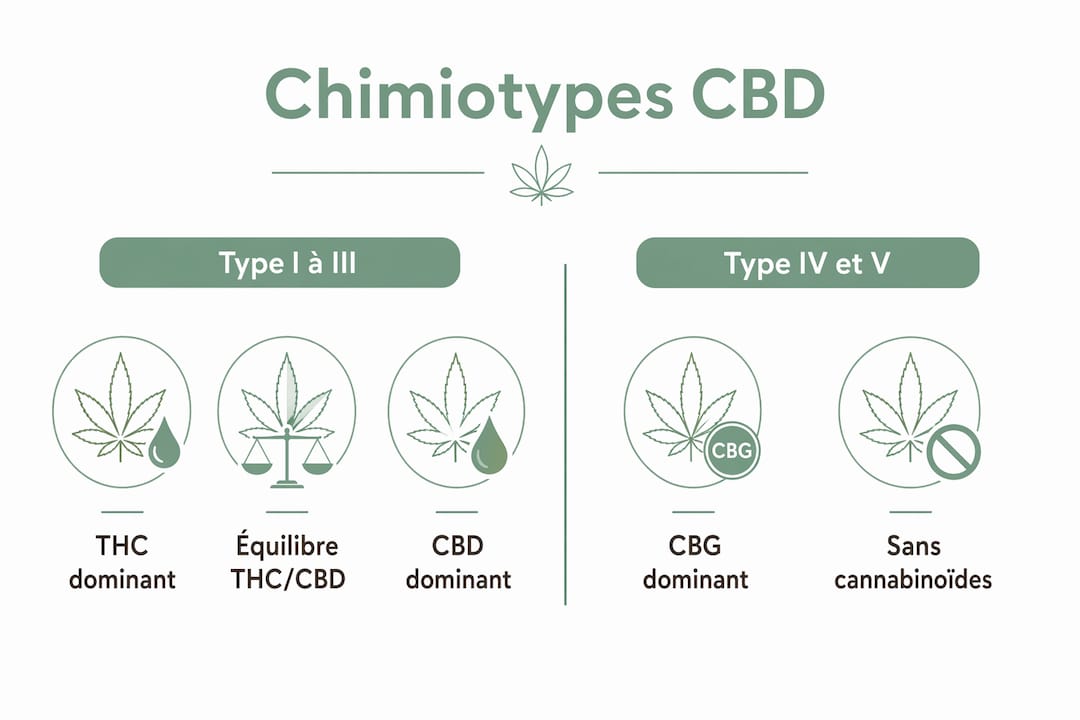
The five main cannabis chemotypes are distinguished by the nature and proportion of the cannabinoids they produce. Each type corresponds to a specific chemical profile, with different overall effects depending on the observed dominance.
Here is a structured overview of the five types:
| Chemotype | Dominant cannabinoid | THC/CBD profile | General effects |
|---|---|---|---|
| Type I | THC | High THC, low CBD | Marked psychoactive effect |
| Type II | THC + CBD | THC/CBD balance | Moderate compromise, mixed effects |
| Type III | CBD | High CBD, low THC | Calming, non-psychoactive |
| Type IV | CBG | CBG dominant | Rare profile, research ongoing |
| Type V | None | Very low in cannabinoids | Primarily terpenes |
Type III is the most relevant for CBD consumers in Europe. With a THC content below 0.3% and a high CBD concentration, it corresponds to the legal products marketed in France and the European Union. This is the profile found in CBD oils, flowers, and resins available in stores.
Type II also deserves attention. It offers a balance between THC and CBD that may be suitable for certain therapeutic contexts, but remains subject to strict legal restrictions depending on the country. In France, this profile generally exceeds the authorized legal threshold.
- Type I: reserved for markets where recreational or medical cannabis is legal
- Type II: used medically in some countries, prohibited in France for the general public
- Type III: the only type legally accessible for wellness purposes in the EU
- Type IV: still poorly represented commercially, with growing scientific interest
- Type V: used primarily for its aromatic terpenes, with no notable cannabinoid effects
This framework transforms the way you approach CBD varieties. Rather than relying on a cultivar name or a packaging claim, you can now ask: what is the chemotype of this product?
How does genetics determine a plant’s chemotype?
The genetics of the cannabis plant directly control which chemotype it will produce through a simple mechanism located on chromosome 7. This mechanism is based on two alleles: BT (oriented toward THCA production) and BD (oriented toward CBDA production).
The model works as follows:
- BT/BT: the plant mainly produces THCA, resulting in chemotype I (THC-dominant)
- BT/BD: the plant produces a mixture of THCA and CBDA, resulting in a balanced chemotype II
- BD/BD: the plant mainly produces CBDA, resulting in chemotype III (CBD-dominant)
This simple Mendelian model explains why two plants from the same germplasm can produce very different chemical profiles. It all depends on the inherited allelic combination.
At the heart of this process is the common precursor CBGA (cannabigerolic acid). Depending on the plant’s genetics, this precursor is converted either by THCA synthase into THC or by CBDA synthase into CBD. These enzymes evolved from ancestral oxidocyclases toward highly precise specialization, which explains the stability of chemical profiles in selected cultivars.

For producers, genetic selection through BT/BT × BD/BD crosses makes it possible to establish precise, reproducible chemotypes from one harvest to the next. For you as a consumer, this means that a product derived from a certified BD/BD cultivar offers far greater chemical consistency than a product without genetic traceability.
Pro tip: When buying a CBD product, ask whether the source cultivar is documented as BD/BD. This information, often available from reputable producers, guarantees a stable and reproducible CBD-dominant profile.
What effects can you expect depending on the CBD chemotype you choose?
The CBD-dominant chemotype (type III) is the reference profile for wellness use without psychoactive effects. It is associated with soothing, anti-inflammatory, and anxiolytic properties, without altering perception or cognition.
Type II, with its THC/CBD balance, can offer an interesting compromise in certain contexts. However, even a low THC level can produce a noticeable psychoactive effect in sensitive individuals. This profile remains legally unavailable to the general public in France.
Here are the general effects associated with the available chemotypes:
- Type III (CBD-dominant): stress reduction, sleep support, joint comfort, without a “high” effect
- Type II (balanced): more pronounced relaxing effect, potentially useful in a supervised medical context
- Type V (terpenes only): aromatic and potentially relaxing effects from terpenes alone
An often-overlooked point: acidic forms such as CBDA found in raw products are not psychoactive, but convert into active CBD through decarboxylation (heat or time). This means that unheated CBD oil contains CBDA, whereas vaporized flower releases active CBD. The method of consumption therefore changes the actual effect, regardless of the starting chemotype.
The bioavailability of CBD also plays a role in the intensity of the effects experienced. A high-quality type III chemotype consumed sublingually will produce more noticeable effects than an equivalent product swallowed without care.
Pro tip: Do not rely solely on the displayed CBD percentage. Check whether the stated value corresponds to active CBD (decarboxylated CBD) or raw CBDA. The difference can reach 20 to 30% in actual effectiveness depending on the product.
How to choose a CBD product according to its chemotype and regulations?
European regulations set a maximum threshold of 0.3% THC in finished products authorized for sale. This threshold applies in France, Belgium, the Netherlands, and most EU countries. Any product exceeding this level is illegal for the general public, regardless of its label.
To choose a reliable product, here are the criteria to check systematically:
- Certificate of Analysis (CoA): this independent laboratory document confirms the batch’s actual cannabinoid profile. A batch-specific CoA is the only way to verify that the product matches what is advertised.
- CBD/THC ratio: a high CBD ratio with THC below 0.3% confirms a compliant chemotype III.
- Cannabinoid form: check whether the CoA indicates CBD or CBDA. The two do not produce the same effects depending on the method of consumption.
- Cultivar traceability: a serious producer states the genetic origin of its plant.
| Personal situation | Recommended chemotype | Key criterion to check |
|---|---|---|
| Daily stress, mild anxiety | Type III (CBD-dominant) | High active CBD, THC below 0.3% |
| Sleep disorders | Type III with sedative terpenes | Terpene profile (myrcene, linalool) |
| Inflammatory pain | Type III or II (depending on local legality) | CBD/THC ratio on the CoA |
| Aromatic curiosity | Type V | Complete terpene profile |
The differences between CBD and THC for well-being are often misunderstood by consumers. A product labeled “full spectrum” may legally contain up to 0.3% THC, which remains within chemotype III. An “isolate” product contains only pure CBD, with no terpene profile or other cannabinoids.
Legal compliance is based on measured THC, not the label. A product sold as “pure CBD” without a CoA guarantees nothing. Requiring this document before any purchase is the only genuinely protective measure.
Key points
CBD chemotypes are the most reliable filter for choosing a product suited to your needs, because they reflect the plant’s actual chemical composition, which can be verified through laboratory analysis.
| Point | Details |
|---|---|
| Five distinct chemotypes | Types I to V range from THC-dominant to a profile with no cannabinoids; only type III is legal in the EU. |
| Simple Mendelian genetics | The BT and BD alleles on chromosome 7 determine whether each plant is THC- or CBD-dominant. |
| CBDA vs active CBD | The acidic form CBDA converts into CBD through decarboxylation; the method of consumption changes the actual effect. |
| CoA required | Only a batch-specific certificate of analysis confirms that the product complies with the legal 0.3% THC threshold. |
| Chemotype III for well-being | The dominant CBD profile is the only one suitable for legal, non-psychoactive daily use in France. |
What I learned by observing the mistakes of CBD consumers
After years of following the evolution of the CBD market in Europe, one conclusion is clear: most disappointments stem from a poor match between the chemotype of the product purchased and the buyer’s actual expectations. Not from the product itself being poor.
Consumers too often rely on the strain name or the percentage displayed prominently on the packaging. A “20% CBD” product without a CoA says nothing about the cannabinoid form (CBDA or active CBD), the actual THC level, or the terpene profile. Yet these are the three elements that determine the actual experience.
What also strikes me is the persistent confusion surrounding “full-spectrum” products. Many people think this term guarantees a superior effect. In reality, it simply means that all natural cannabinoids are present, including up to 0.3% THC. For some sensitive people, this amount is enough to cause a slight unwanted sensation. Knowing the product’s exact chemotype helps avoid this kind of surprise.
My most direct advice: before buying, ask for the CoA. If the seller cannot provide it, look elsewhere. CBD quality in Europe depends on this analytical transparency, not on packaging promises. Reputable brands publish their certificates without hesitation. The others deserve your distrust.
— Rod
Find the right CBD product for your chemotype at Cbd-certified
Choosing a CBD product without knowing its chemotype is like moving forward without a map. Cbd-certified offers a selection of certified CBD products, all accompanied by their certificates of analysis, so you know exactly what you are buying.
Whether you are looking for a CBD-dominant profile for daily stress, a full-spectrum product for a more complete effect, or an oil suitable for regular use, the range available at the best CBD shop in Europe covers all wellness needs. Deliveries are available throughout the EU, the United Kingdom, and Switzerland. Every product complies with the legal 0.3% THC threshold and comes from traceable cultivars.
FAQ
What exactly is a CBD chemotype?
A CBD chemotype is the dominant chemical profile of a cannabis variety, defined by its concentrations of cannabinoids such as CBD and THC. This profile is genetically determined and influences the product’s effects.
What is the difference between chemotypes I, II, and III?
Chemotype I is THC-dominant, type II has a THC/CBD balance, and type III is CBD-dominant with a low THC level. Only type III is legally accessible to the general public in France and the EU.
How can you check a CBD product’s chemotype before buying?
The certificate of analysis (CoA) provided by an independent laboratory is the only document that confirms a batch’s actual cannabinoid profile. Check that the THC is below 0.3% and that the active CBD matches what is advertised.
Do CBDA and CBD have the same effects?
No. CBDA is the non-decarboxylated acidic form of CBD, found in raw plants. It converts into active CBD through heat or time, meaning that the effect also depends on the chosen method of consumption.
Why is chemotype III recommended for daily well-being?
Chemotype III produces a high-CBD profile with THC below the legal threshold of 0.3%, ensuring calming effects without psychoactivity. It is the only profile suitable for regular and legal use in France and the European Union.