
CBD and Depression: Understand, Take Action, and Choose Safely
TL;DR:
- CBD indirectly modulates the endocannabinoid system, potentially supporting emotional stability.
- Human studies do not currently prove CBD’s effectiveness as an antidepressant treatment.
- As a supportive measure, CBD may reduce anxiety, improve sleep, and promote mental comfort.
Is CBD really a natural antidepressant? This question is stirring many Europeans who are often urgently seeking a gentle alternative for depression or mood disorders. Marketing promises abound, online testimonials continue to accumulate, but the scientific reality is far more nuanced. This guide reviews CBD’s actual mechanisms of action in the brain, the honest state of the clinical evidence, the tangible benefits and risks, as well as practical recommendations for acting safely, without ever abandoning appropriate medical care.
Table of contents
- How CBD affects the brain and mood
- What the studies say: between promises and scientific limitations
- Benefits, risks, and side effects of CBD for depression
- How to use CBD as a supplement: practical recommendations
- Our view: CBD, a supplement, not a miracle solution
- Finding Trusted CBD Products and Going Further
- Frequently Asked Questions About CBD and Depression
Key Points
| Point | Details |
|---|---|
| How CBD works | CBD modulates serotonin and brain inflammation, which may support mood. |
| Limited scientific evidence | To date, no robust human study has demonstrated CBD’s effectiveness against depression. |
| Responsible use | CBD should remain a supplement, used under medical supervision, and should never replace an approved treatment. |
| Safety and monitoring | CBD is well tolerated at low doses without causing dependence, but minor side effects are possible. |
How CBD affects the brain and mood
To understand what CBD can or cannot do for depression, we first need to look at how it interacts with the brain. It all starts with the endocannabinoid system (ECS), a network of receptors and messenger molecules found throughout the body. Its main role is to maintain internal balance, particularly by regulating mood, stress, sleep, and appetite.
CBD influences this system indirectly. It slows the breakdown of anandamide, often nicknamed the “bliss molecule.” When anandamide remains in circulation longer, it may support a more stable emotional state. This mechanism alone is not enough to call CBD an antidepressant, but it provides a serious biological basis for interest in CBD for mental well-being.
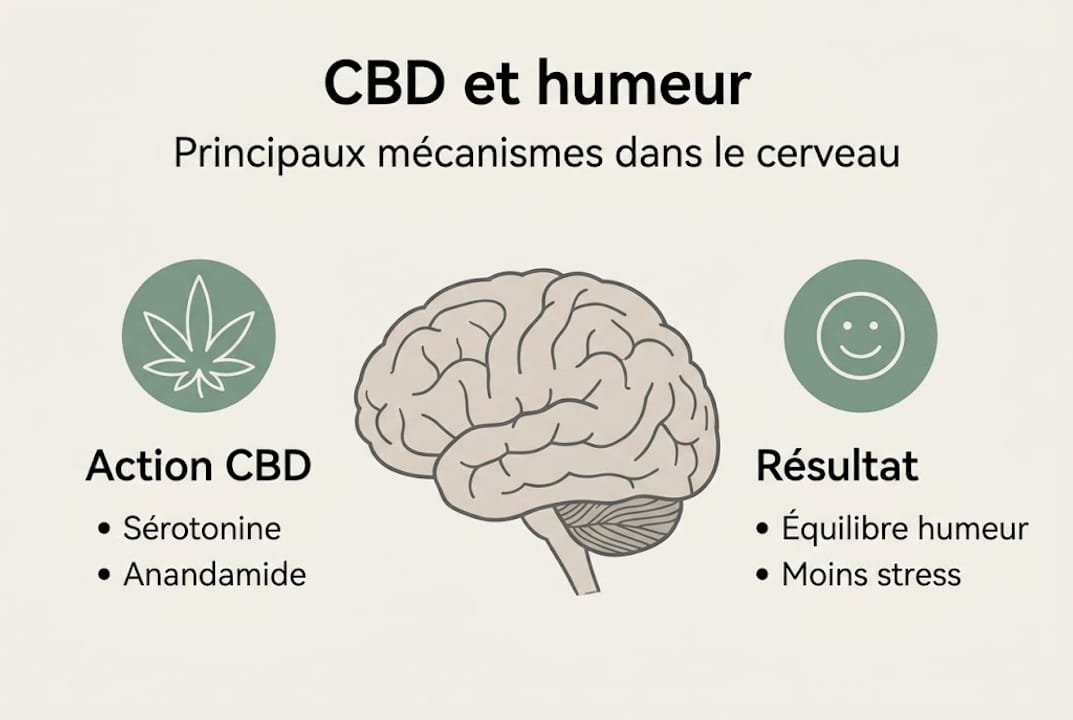
Next, CBD modulates serotonin, GABA, and glutamate and increases anandamide, neurotransmitters that are essential to emotional balance. By activating serotonin 5-HT1A receptors, it partially reproduces the mechanism of certain antidepressants, particularly selective serotonin reuptake inhibitors. This is not insignificant. It means that CBD, at natural doses, uses some of the chemical pathways used by conventional medications.
It also acts by regulating the balance between excitation and inhibition in the brain through GABA and glutamate. A brain in which these two systems are well calibrated manages stress more effectively. Finally, studies have highlighted its anti-inflammatory properties in the brain, which are particularly relevant since depression is often associated with low-grade chronic inflammation in the brain.
Here are the main mechanisms by which CBD acts on the brain:
- Increased anandamide: supports emotional stability
- Activation of 5-HT1A receptors: regulates serotonin, similarly to certain antidepressants
- GABA and glutamate modulation: balances brain excitation and inhibition
- Anti-inflammatory effect: reduces oxidative stress in brain tissue
- Endocannabinoid system support: helps maintain overall mood homeostasis
Pro tip: CBD does not flood the brain with serotonin like a synthetic drug. It gently nudges several systems at once, which explains both its favorable tolerability profile and its modest effects on major depression.
What the studies say: between promises and scientific limitations
Understanding how CBD acts on the brain is one thing. Knowing what the studies actually prove is another. And here, the data call for caution.
In animals, the results are encouraging. Studies on rats have shown measurable antidepressant effects: stimulation of neurogenesis (the creation of new neurons in the hippocampus), improved behaviors associated with learned helplessness, and reduced stress. These findings have fueled legitimate optimism in research.
But in humans, the situation is different. Animal studies show antidepressant effects, whereas results in humans remain limited and mixed. Existing clinical trials often suffer from small sample sizes, short durations, and substantial heterogeneity in populations and protocols. It is difficult to draw solid conclusions from them.
The 2026 meta-analysis covering more than 54 trials is particularly illuminating: it found no robust evidence that medical cannabis, including CBD, is effective against depression. A randomized clinical trial even showed that CBD used as an adjunct was not superior to placebo on the MADRS scale, a standard measure of depression.
| Level of evidence | Results |
|---|---|
| Animal studies | Positive antidepressant effects, stimulated neurogenesis |
| Human clinical trials | Limited results, studies often too small |
| 2026 meta-analyses | No strong evidence of efficacy for depression |
| Randomized CBD versus placebo trial | No significant difference on the MADRS scale |
“The available data on CBD and depression in humans do not currently allow us to conclude that there is demonstrated clinical efficacy.” This finding, shared by several researchers, invites us to place the uses and limitations of CBD within a realistic framework.
This does not mean that CBD is useless. It may function as a complementary support to conventional treatment, helping to better manage the stress or anxiety associated with depression. But the 2026 evidence on CBD is clear: it is not a treatment for depression. Evidence-based therapeutic support remains the backbone of any serious care plan.
Benefits, risks, and side effects of CBD for depression
The nuanced scientific picture should not obscure the fact that many people report tangible positive effects. It is useful to distinguish what is plausible from what is proven and to identify the real risks.
Documented potential benefits:
- Reduced anxiety: CBD and the brain for anxiety show more consistent results than for depression alone
- Better stress tolerance: through modulation of the ECS and the cortisol response
- Improved sleep: often disrupted in depressive states, sleep frequently benefits from CBD according to users
- Reduction of brain inflammation: indirect mood support in inflammatory profiles
CBD for mental health can provide measurable daily comfort, even if curing depression is not the goal.

Side effects to monitor:
Side effects at low doses include fatigue and dry mouth, which are generally well tolerated. At higher doses, mild digestive problems, changes in blood pressure, or increased drowsiness may occur. CBD is non-addictive, with no known withdrawal symptoms, which distinguishes it from several conventional medications.
One often-overlooked point: CBD can interact with certain medications metabolized by CYP450 enzymes in the liver. If you take antidepressants or other medications, this interaction requires a mandatory medical consultation before introducing CBD.
Pro tip: CBD oils and CBD flowers do not have the same profile. Choose oils for precise dosing and a gradual effect, especially when supporting mood.
How to use CBD as a supplement: practical recommendations
If you are considering incorporating CBD into your daily routine alongside medical supervision, here is a considered and safe approach.
-
Never stop an antidepressant treatment without your doctor’s approval. CBD does not replace existing treatments, and abruptly stopping an antidepressant can be dangerous.
-
Start with a low dose. Usual recommendations suggest starting between 10 and 40 mg per day, depending on the individual profile. The dose should be increased gradually over several weeks.
-
Choose the right form. Broad-spectrum or full-spectrum sublingual oils containing less than 0.3% THC are recommended for mood support. Sublingual absorption is rapid and the dosage is easy to control. Consult our CBD dosage guide to refine your approach.
-
Monitor drug interactions. Always inform your doctor or pharmacist that you are taking CBD. Adjustments may be necessary, particularly with anticoagulants or certain antidepressants.
-
Keep a log. Record your mood, sleep, and perceived effects each week. This allows you to objectively assess changes and fine-tune the CBD dosage according to your needs with your practitioner.
-
Maintain regular medical follow-up. CBD is a support tool, not an autopilot. Therapy, whether medication or psychological, remains the essential foundation.
Professional advice: Avoid products that do not provide independent laboratory analysis (COA certificates). The actual CBD concentration varies considerably from one product to another on the European market.
Our view: CBD, a supplement, not a miracle solution
We have been following the evolution of CBD research for several years, and we understand the hope this molecule inspires in those suffering from depression. But honesty is essential: expectations must remain proportionate to the available evidence.
CBD offers an interesting natural form of modulation, but it must never replace established treatments. Marketing claims that promise to cure depression with CBD are not only misleading but potentially dangerous for vulnerable people who might delay appropriate care.
What seems right to us: using CBD as a daily comfort tool, alongside serious therapeutic support. For some people, it reduces anxiety, improves sleep, and facilitates emotional recovery. That is already valuable, provided it does not stop there.
Finding Trusted CBD Products and Going Further
If you want to incorporate CBD into your daily routine with peace of mind, product quality is the first factor in success. Too many products on the market list inaccurate concentrations or have unclear origins.
At European CBD Shop, each product is selected for its traceability, independent laboratory testing, and compliance with European regulations. You can explore a carefully selected range from the best CBD shops in Europe, benefit from secure deliveries in the EU, the United Kingdom, and Switzerland, and access personalized CBD advice to find the form and dosage suited to your situation.
Frequently Asked Questions About CBD and Depression
Can CBD replace a conventional antidepressant in cases of depression?
No, CBD should never replace an antidepressant without your doctor’s advice. Current data indicate that it may provide complementary support, but not serve as a substitute for conventional treatments.
What are the most common side effects of CBD?
The most common are fatigue and dry mouth, with digestive issues occurring rarely. These effects at low doses are generally well tolerated and often disappear after adjusting the dose.
How long does it take to feel an effect of CBD on mood?
For mood, the initial effects are often subtle and may take 1 to 2 weeks depending on the dose and consistency. CBD acts gradually on neurotransmitters through the endocannabinoid system, which explains this delay.
Does CBD cause dependence or withdrawal symptoms?
No, there is no evidence of CBD addiction or withdrawal. CBD is non-addictive, distinguishing it from certain psychoactive medications.
Which form of CBD is best suited for supporting mood?
Broad- or full-spectrum sublingual oils with less than 0.3% THC, taken in gradually increasing doses, are recommended with medical supervision for precise control and optimal absorption.