
CBD flavonoids: effects on pain, insomnia, and anxiety
TL;DR:
- Hemp flavonoids, more powerful than aspirin, play a crucial role in health and well-being. Although they have been little studied in humans, they contribute to the entourage effect of CBD products by enhancing their anti-inflammatory and neuroprotective actions. Choose full-spectrum extracts made using CO2 extraction to preserve these valuable compounds.
Some hemp compounds may be 30 times more potent than aspirin at reducing inflammation, and yet almost no one talks about them. These compounds are flavonoids. Often overshadowed by CBD and terpenes in discussions about hemp, they nevertheless play a fascinating role in the plant and potentially in our well-being. Whether you are looking to relieve chronic pain, get quality sleep again, or ease anxiety, understanding the flavonoids in CBD can transform the way you choose your products.
Table of contents
- What is a flavonoid? Origins and functions in hemp
- Anti-inflammatory effects of flavonoids and chronic pain
- Flavonoids and CBD: impact on insomnia and anxiety
- How to incorporate CBD flavonoids into your routines
- What experts don’t tell you about CBD flavonoids
- Finding the Best CBD Products Rich in Flavonoids
- Frequently Asked Questions About CBD Flavonoids
Key Points
| Point | Details |
|---|---|
| Powerful flavonoids | Some flavonoids, such as cannflavin A, show exceptional anti-inflammatory potency. |
| Limited evidence | Human studies are lacking to isolate the effect of flavonoids on pain, insomnia, and anxiety. |
| Full spectrum preferred | To maximize the entourage effect, choose full-spectrum CBD rather than isolate. |
| CO2 extraction recommended | CO2 extraction best preserves flavonoid richness. |
| Cautious use | Be demanding about the quality and transparency of CBD products to get the most out of them. |
What is a flavonoid? Origins and functions in hemp
Flavonoids are a large family of phytochemical compounds, meaning molecules naturally produced by plants. More than 6,000 have been identified in the plant kingdom, found in fruits, vegetables, tea, red wine… and, of course, hemp. Unlike CBD (cannabidiol) or THC, flavonoids are not cannabinoids. They form a category of their own, with their own mechanisms of action.
In hemp (Cannabis sativa), flavonoids are concentrated mainly in trichomes, the tiny resin glands that cover the flowers and leaves. These are exactly the same structures that produce cannabinoids and terpenes. According to research, CO2 extraction preserves flavonoid richness better than other methods such as ethanol extraction or hot oil extraction, because it maintains low temperatures and prevents the thermal degradation of fragile molecules.
For the plant itself, flavonoids fulfill several essential biological functions:
- UV protection: they act as a natural filter against sunlight
- Defense against pests and pathogens: some flavonoids have antimicrobial properties
- Pollinator attraction: they contribute to flower coloration
- Growth regulation: they contribute to the plant’s cellular development
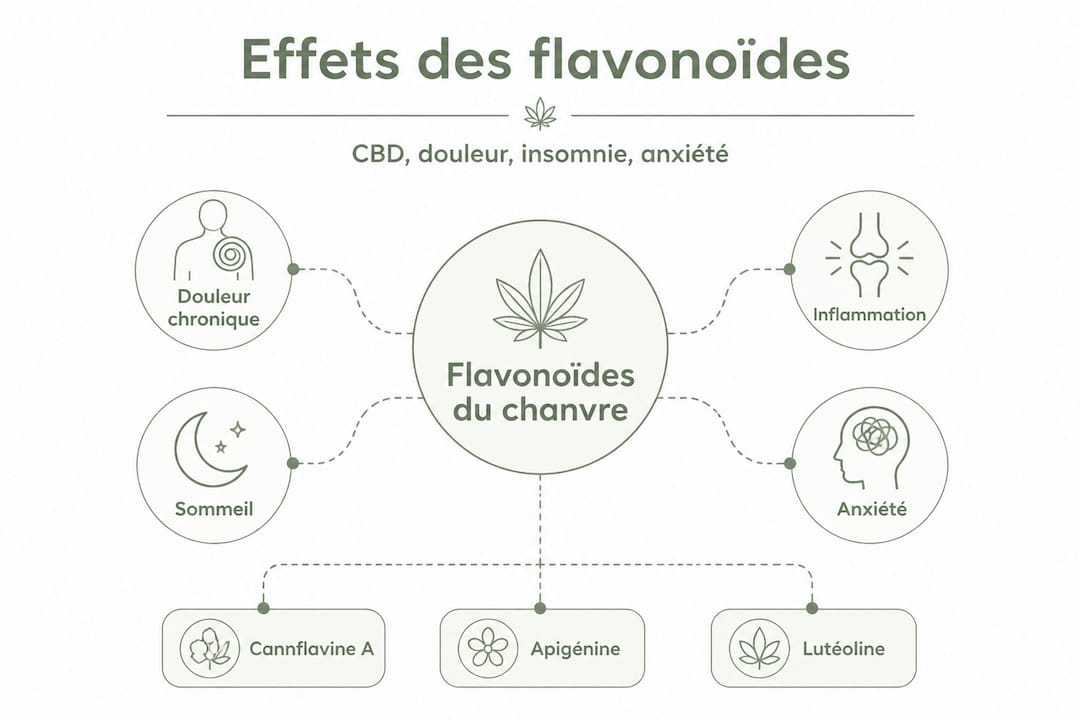
The main flavonoids identified in hemp are cannflavins (A, B, and C), apigenin, luteolin, orientin, and vitexin. Cannflavins are particularly unique to hemp and are attracting interest from scientific research. The benefits of CBD flowers are largely due to this richness in varied compounds, including flavonoids.
Apigenin is also found in chamomile. It is known for its potential calming effects. Luteolin, found in green peppers and celery, is being studied for its anti-inflammatory and neuroprotective properties. This overview shows that hemp flavonoids are not marginal players but molecules with genuinely active profiles.
Anti-inflammatory effects of flavonoids and chronic pain
Cannflavin A is arguably the most studied hemp flavonoid to date. Research published as early as the 1980s showed that this molecule has anti-inflammatory activity approximately 30 times greater than that of aspirin under laboratory conditions, notably by inhibiting the production of prostaglandin E2 (PGE2), a key mediator of inflammation and pain.
To put this into perspective: aspirin is the reference anti-inflammatory used by millions of people. Imagining a natural hemp molecule with 30 times greater potency in this specific context is truly striking. That said, this finding comes from in vitro studies (in cells), not yet from clinical trials involving humans.
“Preclinical and animal studies on the anti-inflammatory properties of hemp flavonoids show positive results, but direct evidence in humans is still lacking to fully validate these effects.”
| Molecule | Type | Measured activity | Study context |
|---|---|---|---|
| Cannflavin A | Hemp flavonoid | Anti-inflammatory (PGE2 inhibition) | In vitro |
| Aspirin | Reference medication | Conventional anti-inflammatory | Human clinical studies |
| CBD | Cannabinoid | Anti-inflammatory, analgesic | Preclinical + some human trials |
| Apigenin | General flavonoid | Potential anxiolytic, anti-inflammatory | Preclinical |
Accumulated empirical data also suggest that full-spectrum CBD is more effective than an isolate for chronic pain. This is where the entourage effect comes in: the idea that CBD, terpenes, flavonoids, and other cannabinoids work better together than separately, mutually enhancing one another.
For those suffering from chronic pain relieved by CBD, this distinction is fundamental. Choosing a CBD isolate is like using only one instrument in an orchestra. Full spectrum, on the other hand, brings all the musicians together.
Pro tip: When looking for a CBD product for chronic pain, check that the label says “full spectrum” (full-spectrum) and not just “CBD.” This detail profoundly changes the product’s active profile, particularly regarding the flavonoids it contains.
The relationship between flavonoids and CBD for chronic pain is therefore indirect but real. Flavonoids do not replace medical treatments, but their presence in a full-spectrum extract potentially enhances the product’s overall action.
Flavonoids and CBD: impact on insomnia and anxiety
It is important to be direct here: no clinical study has isolated hemp flavonoids to demonstrate their direct effect on insomnia or anxiety in humans. This transparency is important for navigating between marketing claims and scientific reality.
What we do know is that CBD itself shows promising results for these conditions. CBD-related mental health is a growing area of research, with anxiolytic effects and improved sleep observed in several protocols. However, it is not yet possible to isolate the contribution of flavonoids to these results.
However, apigenin deserves special mention. This flavonoid, found in hemp and chamomile, binds to GABA receptors in the brain—the same receptors targeted by certain anti-anxiety medications. This action is documented, even though the effective doses and precise conditions remain to be established specifically for hemp.
Here is how to choose a CBD product with flavonoids in mind for sleep and anxiety:
- Choose a full-spectrum extract. Raw extracts contain all the flavonoids naturally present in the plant, including apigenin and luteolin.
- Check the extraction method. Supercritical CO2 extraction preserves more flavonoids than other methods. This is a sign of quality.
- Read the certificate of analysis (COA). A good manufacturer provides analyses from an independent laboratory. Ideally, the terpene and flavonoid composition is detailed there.
- Start with a low dose. The impact of CBD on sleep varies from person to person. Starting slowly allows you to observe your individual responses.
- Create a regular routine. Whether it is an oil taken at bedtime or an infusion made from CBD flowers, consistency enhances the perceived effects.
Pro tip: For sleep and anxiety, keep a journal of the days when you use CBD and those when you do not. Including details such as the product type (full-spectrum vs. broad-spectrum) helps identify what really works for you. This approach is also useful for incorporating CBD into your daily routine in an informed way.
Caution is warranted when brands claim that their flavonoids “cure” insomnia or “severe anxiety.” Potential effects exist, but they are part of a supportive approach, not a medical treatment.
How to incorporate CBD flavonoids into your routines
Now that you understand the role and limitations of flavonoids, let’s move on to practical choices. Three main types of CBD products are available on the European market, and they are not equal when it comes to flavonoids.
| Extract type | Flavonoids present | Entourage effect | Ideal for |
|---|---|---|---|
| Full-spectrum (full-spectrum) | Yes, complete profile | Maximum | Chronic pain, sleep, anxiety |
| Broad-spectrum (broad-spectrum) | Partially | Moderate | THC-sensitive, daily use |
| CBD isolate | No | Absent | Precise dosage, specific testing |
The open-label study on full-spectrum CBD showed that 51 out of 88 patients achieved at least a 50% reduction in their chronic pain. This concrete figure illustrates the real advantage of full-spectrum formulas over isolates in this context.
To maximize flavonoid content, here are the key points to remember:
- Prefer whole CBD flowers to highly processed products. The fewer processing steps there are, the more flavonoids are preserved.
- Choose CO2 extraction: this is the most reliable indication of a gentle extraction process that preserves fragile compounds.
- Store your products properly: away from heat, light, and moisture, which degrade flavonoids.
- Check the plant’s origin: hemp varieties grown in Europe generally comply with strict agricultural standards and may have more consistent flavonoid profiles.
- Review the COAs (certificates of analysis) to see whether the manufacturer actually measures flavonoids or limits its testing to cannabinoids.
The benefits of CBD flowers include precisely this richness in compounds that highly purified extracts cannot always reproduce. The right dosage for insomnia and anxiety remains an essential step in personalizing your use.
What experts don’t tell you about CBD flavonoids
The science on hemp flavonoids is promising. Truly. But the reality of the market is often far removed from the laboratories, and that needs to be stated clearly.
Many brands tout the term “full-spectrum” as a marketing promise without ever documenting the actual presence of flavonoids in their products. An extract may theoretically be “full-spectrum” and still contain very low levels of flavonoids if cultivation, harvesting, or extraction were not properly controlled. The label does not guarantee the actual concentration.
What we also observe is that consumers seeking to better understand CBD for anxiety often have very high expectations, sometimes fueled by excessive claims. Flavonoids are not a miracle solution. They are components of a complex system, and their beneficial role in humans still requires years of serious clinical research.
Our position: demand transparency from your suppliers. Ask for the COAs. Compare the full profiles, not just the CBD percentages. A reputable manufacturer will always be proud to share its detailed analyses. One that does not publish them or cannot provide them deserves your distrust.
The other uncomfortable reality? The effects of flavonoids probably vary from one individual to another depending on genetics, the gut microbiome, and how each body metabolizes these compounds. What works remarkably well for one person may have little noticeable effect for another. This variability does not invalidate the value of flavonoids; it simply calls for personal observation and patience.
Finding the Best CBD Products Rich in Flavonoids
Understanding flavonoids is one thing. Finding products that truly preserve them is another. For European consumers, quality and traceability are non-negotiable criteria.
European CBD Shop selects products that meet strict quality requirements, with full-spectrum extracts derived from European hemp. Our CBD shop directory helps you identify reliable retailers with independent certifications. Among our products, the Nobilis full-spectrum CBD oil offers a particularly rich profile of cannabinoids and secondary compounds, designed to maximize the entourage effect. For those looking to support their sleep and balance, the Super Relax CBD oil is specifically formulated for evening routines. Delivery is available throughout the European Union, the United Kingdom, and Switzerland.
Frequently Asked Questions About CBD Flavonoids
Are CBD flavonoids effective for chronic pain?
In vitro studies show remarkable anti-inflammatory activity, particularly for cannflavin A, but no direct evidence in humans has yet confirmed their isolated effectiveness against chronic pain.
Do CBD flavonoids affect insomnia or anxiety?
No direct clinical study has isolated flavonoids for these conditions. The observed effects on sleep and anxiety are primarily attributed to CBD itself, potentially enhanced by the entourage effect.
How do you choose a CBD product to maximize flavonoids?
Prioritize full-spectrum extracts and check that the extraction method used is CO2, which better preserves fragile compounds such as flavonoids.
Are flavonoids present in all CBD varieties?
Yes, but their concentration varies significantly depending on the plant’s genetics, growing conditions, harvest timing, and the extraction method used by the manufacturer.
Do CBD flavonoids pose risks or cause side effects?
No side effects specific to hemp flavonoids have been identified in humans to date, largely because clinical studies on this subject remain very limited.
Recommendation
- CBD Flowers: Proven Benefits for Anxiety, Sleep, and Pain
- Benefits of CBD Hemp: Pain, Anxiety, and Insomnia 2026
- Understanding CBD Forms for Anxiety, Insomnia, and Pain
- CBD and Mental Health: Soothing Anxiety and Supporting Sleep
- CBD vs Melatonin For Sleep: Which Works and Why | Edwin’s Edibles & Elixirs