
CBD Flower Pistils and Calyxes: A Practical Guide
In short:
- Pistils indicate the visual maturity of a CBD flower, but only trichomes determine its cannabinoid concentration.
- An accurate assessment requires observing the calyces, texture, smell, and presence of trichomes, not just the color of the pistils.
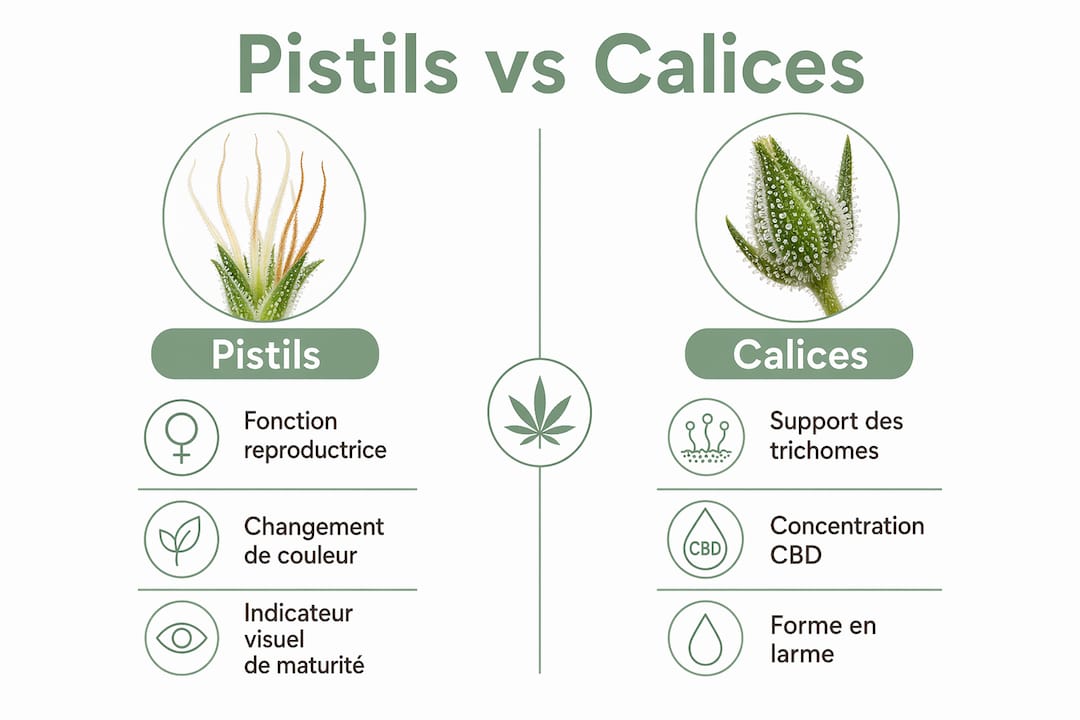
The pistils and calyces of CBD flowers are the female botanical structures that define the plant's appearance and visual maturity. The calyx is a tear-shaped covering that protects the ovary, while the pistils, also called stigmas, are the colored filaments that emerge from it. These two elements are visible to the naked eye on every quality CBD flower. Understanding their role helps you read a flower more accurately, avoid common purchasing mistakes, and distinguish appearance from what actually determines cannabinoid concentration.
What is the function of pistils and calyces in the CBD flower?
The calyx is the basic structure of the female cannabis flower. Tear-shaped, it surrounds the reproductive organs and has a high density of trichomes on its surface, these small resin glands that synthesize cannabinoids and terpenes. Most of the flower's therapeutic value is concentrated in the calyces. Their slightly oily texture to the touch is an initial sign of quality.
The pistils, meanwhile, are the female reproductive organs composed of stigmas, styles, and ovaries. Their biological role is to capture pollen to enable fertilization. Pistils do not contain significant cannabinoids: their function is purely reproductive, not chemical. This distinction is essential for any consumer seeking to assess a flower's potency.
The pistils' color changes follow a precise cycle throughout flowering:
- Weeks 1 to 5: the pistils are white, a sign of active flowering and a flower that is still developing.
- Weeks 5 to 7: they turn cream or pink, indicating gradual maturation.
- Weeks 7 to 9: they take on an orange or red hue, signaling that maturity is approaching.
- At full maturity: they become amber-brown, then dark brown in cases of over-ripening.
CBD flowers often have more pistils, which are longer and more visible than those of THC-rich varieties. This visual characteristic is a recognizable signature of legal cannabis cultivated for its CBD content.
Pro tip: Observe the density of swollen calyxes rather than just the number of pistils. Well-developed calyxes covered with trichomes indicate a flower that has reached chemical maturity, which pistils alone cannot confirm.
Why are pistils not a reliable indicator of CBD content?
Pistil color does not measure CBD concentration. This misconception is one of the most common among novice consumers. Only trichomes are reliable for assessing the chemical maturation of a flower, because they contain the cannabinoids and terpenes in their resin.
Trichomes go through three stages that can be observed with a magnifying glass or microscope:
- Translucent: the flower is too young; cannabinoids have not yet reached their peak.
- Milky white: optimal stage for a stimulating effect and maximum CBD concentration.
- Amber: cannabinoids begin to degrade, and the effect becomes more sedating.
Pistils change color under the effects of time, light, and heat, without this necessarily reflecting the flower's internal chemical state. A brown pistil does not mean a more potent flower. A white pistil does not mean a flower that is immature in terms of cannabinoids. Only trichome analysis, supplemented by a laboratory COA certificate, provides a reliable picture of actual quality.
A phenomenon called foxtailing makes visual assessment even more difficult. Foxtailing is the growth of new calyxes with white pistils on flowers that are already almost mature. It is often caused by environmental stress, such as excessive heat or overly intense light during cultivation. The visual result is misleading: the flower appears young even though it is actually at an advanced stage. An excess of white pistils can thus indicate a harvest that was too early or the presence of foxtailing, which alters the aromatic profile and bud density.
The confusion between pistils and potency comes from an overly simplistic reading of appearance. Pistils have a reproductive function, not a chemical one. Basing your choice solely on their color or abundance is like judging a wine by the color of its cork.
How can you visually recognize a quality CBD flower?
The quality of a CBD flower can be assessed on several levels simultaneously. Pistils and calyxes are part of the picture, but they are only one element among others. Here are the criteria to combine for a reliable assessment.
| Criterion | Quality CBD flower | Traditional cannabis rich in THC |
|---|---|---|
| Calyx texture | Oily, slightly soapy, resinous | Very sticky, tacky |
| Pistil color | Dark orange to brownish against a matte green background | Variable, often denser with red pistils |
| Smell | Herbal, earthy, vegetal, and natural | More pungent, resinous, sometimes chemical |
| Overall appearance | Swollen calyxes, visible trichomes, vivid colors | Very dense buds, abundant and sticky resin |
| Storage | Stable pistils, non-dull calyxes | Rapid degradation if improperly stored |
A CBD flower stored in poor conditions shows overly dark pistils, dull calyxes, and a loss of effectiveness caused by terpene oxidation. The absence of pearly reflections on the trichomes and a dull appearance are clear signs of poor storage.
Smell is an often underestimated indicator. A fresh, natural flower gives off a herbal or slightly earthy scent, with no chemical or artificial notes. An overly neutral or, conversely, overly harsh smell may reveal improper treatment or storage.
Pro tip: Beware of flowers whose pistils are uniformly dark across the entire surface, with no variation in shade. A naturally matured flower displays nuances: some areas are more orange, others browner, depending on exposure to light during cultivation.
For a more in-depth visual assessment, Cbd-certified’s CBD flower classification guide details the official criteria used to classify flowers by quality level.
What are the benefits of CBD flowers for well-being?
CBD flowers, including calyces and pistils, deliver the plant’s full cannabinoid and terpene spectrum. This synergy between compounds, often called the entourage effect, is what distinguishes a whole flower from an isolated extract. The calyces, rich in trichomes, concentrate CBD, terpenes, and flavonoids, which work together to support well-being.
The effects most sought after by European consumers are as follows:
- Relaxation and stress reduction: CBD interacts with the endocannabinoid system to modulate the stress response without causing psychoactive effects.
- Anxiety support: regular consumers report a reduction in mild to moderate anxiety with daily use of CBD flowers.
- Improved sleep: vaporizing CBD flowers in the evening is associated with faster sleep onset and less fragmented sleep.
- Muscle relief: terpenes such as myrcene and linalool, present in the calyces, contribute to muscle relaxation.
Consumption methods directly affect the preservation of active compounds. Low-temperature vaporization (between 160 °C and 185 °C) preserves terpenes and cannabinoids without combustion. Infusing CBD flowers in a hot drink with a fat (milk, oil) enables the gradual absorption of fat-soluble compounds.
Optimal storage requires an airtight container, protected from light and moisture, ideally between 15 °C and 21 °C. A well-preserved flower retains its properties for several months. To choose the right consumption method for your needs, Cbd-certified’s guide to choosing your CBD flowers offers practical recommendations based on usage profiles.
Key points
The pistils indicate the visual maturity of a CBD flower, but only trichomes, analyzed in a laboratory, measure its actual cannabinoid concentration and effective quality.
| Point | Details |
|---|---|
| Role of the calyxes | The calyxes bear the trichomes that concentrate CBD, terpenes, and cannabinoids. |
| Pistils: visual indicator only | The color of the pistils reflects reproductive maturity, not chemical potency. |
| Foxtailing: a source of error | White pistils on a mature flower indicate cultivation stress, not youth. |
| Trichomes: the only reliable indicator | Observing the trichomes with a magnifying glass remains the most reliable method for assessing maturity. |
| Storage is crucial | Dull calyxes and overly dark pistils reveal a poorly stored and degraded flower. |
What I learned by observing hundreds of CBD flowers
For years, I saw consumers choose their CBD flowers solely by the color of the pistils. Bright orange means a good flower, white means an immature flower: it is a shortcut that leads to costly disappointments.
The reality is more nuanced. A flower with orange pistils can be excellent or mediocre depending on the condition of its trichomes and the quality of its storage. I have held visually perfect flowers in my hands, with golden pistils and swollen calyxes, that had lost most of their terpenes due to improper storage. Their smell gave them away immediately.
My most useful advice: learn to assess a flower as a whole. The greasy texture of the calyxes, the distinct herbal smell, the presence of pearly trichomes visible to the naked eye, and pistils with varied hues rather than uniformly burned ones. These four combined signals are worth more than any isolated pistil.
Always buy from retailers that publish their laboratory analyses. A COA certificate tells you what your eyes cannot see: the exact CBD content, the absence of pesticides, and the complete terpene profile. It is the only real guarantee of quality.
— Rod
Certified CBD flowers, available throughout Europe
Cbd-certified selects each flower according to strict criteria: laboratory analyses, verified COA certificates, and compliance with European regulations on THC content. Each batch is inspected before being put on sale.
The online shop offers a range of certified CBD flowers covering different aromatic and terpene profiles, from light varieties for beginners to full-spectrum flowers for experienced consumers. Deliveries are available throughout the European Union, the United Kingdom, and Switzerland. Each order includes the traceability information needed to consume with confidence.
Frequently asked questions
What is the difference between pistils and trichomes in a CBD flower?
Pistils are reproductive filaments that change color with maturity, but do not contain cannabinoids. Trichomes are resin glands on the calyxes that synthesize CBD, terpenes, and other cannabinoids.
Do orange pistils mean a more potent CBD flower?
No. The orange color of the pistils simply indicates advanced reproductive maturity. CBD concentration depends on the trichomes, not the pistils, and can only be confirmed through laboratory analysis.
What is foxtailing and how can it be identified?
Foxtailing is the appearance of new calyxes with white pistils on an already mature flower, often caused by thermal or light stress during cultivation. It can be identified by elongated protrusions on the buds and white pistils localized on an otherwise colored flower.
How to store CBD flowers to preserve pistils and calyxes?
Store your flowers in an airtight container, away from light and moisture, between 15 °C and 21 °C. Poor storage causes dull calyxes, overly dark pistils, and terpene degradation, which reduces the flower’s effectiveness.
How to use CBD flowers to maximize their benefits?
Vaporization between 160 °C and 185 °C preserves terpenes and cannabinoids without combustion. Infusion with a fat allows gradual absorption. Choose the method according to your needs: vaporization for a rapid effect, infusion for a gentler and longer-lasting action.