
Safe CBD use guide: flowers and resins
TL;DR:
- CBD is attracting more and more European consumers seeking a natural alternative to relieve various conditions, but its use carries risks if not properly prepared. It is essential to choose quality products with a certificate of analysis and start with low doses, increasing them slowly under supervision. Caution is especially important for sensitive populations and when interacting with medications, to ensure effective and safe use.
CBD is attracting more and more European consumers seeking a natural alternative to relieve chronic pain, ease anxiety, or get restorative sleep. However, using CBD flowers or resins without preparation exposes users to real risks: overdosing, interactions with medications, or purchasing poor-quality products. This guide to using CBD safely takes you step by step, from product selection to monitoring your dosage, so that your experience is both effective and worry-free.
Table of contents
- Understanding the risks and precautions associated with CBD
- Preparing for use: choosing and checking your CBD products
- Starting and adjusting your CBD dosage safely
- Avoid common mistakes and manage side effects
- Why “risk-free” does not mean no precautions with CBD
- Where to find the best CBD products for safe use?
- Frequently asked questions about the safe use of CBD
Key Points
| Point | Details |
|---|---|
| Provisional safe dose | The EFSA suggests approximately 2 mg of CBD per day for an adult as a provisional safe dose. |
| Importance of medical advice | Always consult a doctor or pharmacist before starting CBD, especially if you are taking other medications. |
| Choose certified products | Choose flowers and resins with a certificate of analysis and compliance with European standards. |
| Start with a low dose | Start with 5 to 10 mg per day and increase gradually to avoid side effects. |
| Do not drive after use | Avoid driving after consuming CBD, even when the THC level is legally below 0.3%. |
Understanding the risks and precautions associated with CBD
First of all, things need to be named clearly: CBD is an active substance, not just a harmless supplement. Although its safety profile is generally favorable, some medications can interact dangerously with it, making prior medical advice essential in several situations.
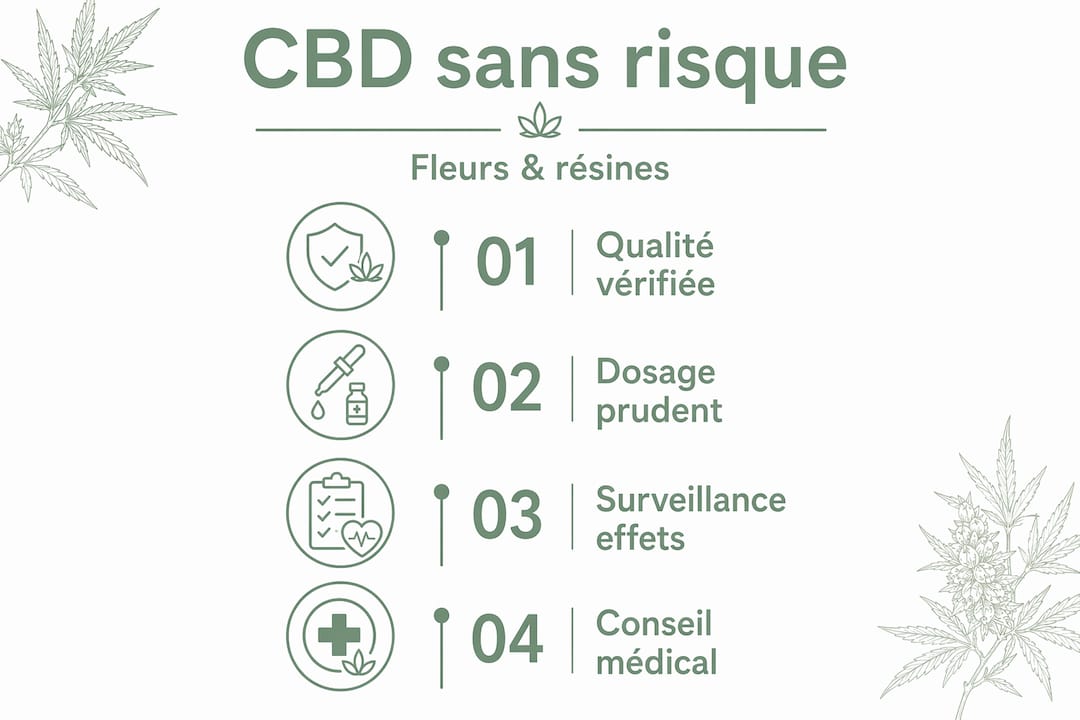
Cannabidiol (CBD) is metabolized by the liver enzymes CYP450, the same enzymes involved in processing many common medications. As a result, in the presence of CBD, the concentration of certain treatments in the blood may increase or decrease unpredictably. The medications most affected are antiepileptic drugs, immunosuppressants, and benzodiazepines.
Potential reported side effects include:
- Drowsiness and fatigue, particularly at high doses
- Dizziness and lightheadedness, especially at first
- Temporary low blood pressure, which should be monitored if you are taking cardiovascular medication
- Digestive problems: nausea, diarrhea, loss of appetite
- Possible liver damage in cases of improper or excessive use
Certain groups should exercise extra caution. Pregnant or breastfeeding women, people under 25 (whose brains are still developing), and those with liver disease are particularly at risk. If you belong to any of these groups, you must consult a doctor before starting.
Key takeaway: The most useful CBD guide for beginners is one that starts with the risks, not the benefits. Understanding what CBD can do to your body in a specific context is the first step toward safe use for people with chronic illnesses.
Now that you understand the risks, let’s look at how to properly prepare for consumption.
Preparing for use: choosing and checking your CBD products
The quality of the product you choose directly affects your safety. It is not a question of price or brand: it is a question of traceability and analytical evidence. The composition stated on the packaging does not always correspond to reality, which may expose you to non-compliant THC levels or the presence of dangerous synthetic cannabinoids.
Here are the essential criteria to check before any purchase:
- Certificate of Analysis (CoA) issued by an independent accredited laboratory, ideally available online
- THC content below 0.3%, the legal threshold in Europe
- High purity, with high-purity CBD extracts (minimums recommended by the EFSA to limit contaminants)
- Absence of pesticides, heavy metals, and residual solvents stated in the certificate
- Plant traceability: variety, geographical origin, extraction method
| Quality criterion | What it guarantees | Risk if absent |
|---|---|---|
| Certificate of analysis | Verified actual composition | Non-compliant THC, contaminants |
| THC level < 0.3 % | European legal compliance | Legal risk and psychoactive effects |
| Absence of pesticides | Health safety | Long-term poisoning |
| Origin traceability | Reliability of the cultivation | Synthetic cannabinoids |
| Extraction without residual solvents | Purity of the final product | Irritation, unexpected side effects |
Professional advice: Beware of products sold without an accessible CoA or with an illegible document. A serious manufacturer always makes its analyses available. To identify safe, high-quality CBD, check that the certificate is less than 12 months old and bears a batch number matching your packaging.
For flowers and resins in particular, concentration variability is greater than with a standardized oil. That is why learning how to choose a CBD product suited to your specific needs—whether for pain, anxiety, or sleep—makes a real difference.
After choosing a safe product, let’s look at how to start your dosage properly.
Starting and adjusting your CBD dosage safely
Safe CBD dosing is based on a simple but often overlooked principle: start low, increase slowly. This step-by-step cannabidiol method protects your body while it adapts and allows you to identify your effective dose without unnecessarily exceeding it.
Here is how to proceed in practice:
- Start with 5 to 10 mg per day. This is the recommended initial dose for most adults. For flowers or resins, this represents a very small amount infused or vaporized.
- Observe for 3 to 5 days. Note your effects, level of relief, sleep quality, and any adverse effects.
- Increase in 5 mg increments if you do not feel a significant effect and tolerate the current dose well.
- Set a personal maximum dose. Do not increase it beyond what is necessary. The benefits of CBD do not increase indefinitely with the dose.
- Keep a tracking journal. Record the dose, time taken, form used (infusion, vaporization, ingestion), and effects experienced. This rigorous tracking is the best tool for making adjustments safely.
Professional tip: Never modify two variables at the same time if you are undergoing medical treatment. If you change both the form of CBD (for example, switching from an infusion to vaporization) and your dose, you will not know which change caused an effect. Change only one thing at a time.
Rules to follow absolutely:
- Never exceed the dose recommended by your healthcare professional
- Avoid taking it at the same time as alcohol (increased risk of drowsiness)
- Wait before getting back behind the wheel
- Seek medical advice if you experience anything unusual, even if it is mild
For a complete CBD beginner’s guide tailored to your specific symptoms, specialized resources can also supplement your doctor’s advice.
Once you have adjusted your dosage, learn to avoid common mistakes and manage the risks.
Avoid common mistakes and manage side effects
Even when following a rigorous protocol, certain mistakes regularly recur among new users. Knowing about them in advance helps you avoid unpleasant surprises.
The most common mistakes to avoid:
- Drive after consuming CBD. Even with a legal product and a THC level below 0.3%, there is a real risk of testing positive for drugs and experiencing dangerous drowsiness while driving.
- Increase the dose too quickly out of impatience, thinking that “more is better.” The effects of CBD can take several days to stabilize.
- Buy without checking the quality, especially from little-known websites or those without a visible certificate of analysis.
- Modify your medical treatment at the same time without consulting your treating physician, especially regarding CBD drug interactions.
- Ignoring warning signs: persistent dizziness, unusual nausea, heart rhythm disturbances.
Important reminder: If you experience side effects lasting more than 24 to 48 hours, immediately reduce or stop taking it and consult a healthcare professional. Do not manage a reaction you do not understand on your own.
Symptoms of adverse effects to actively monitor include intense, persistent drowsiness, repeated nausea, dizziness when standing up, or a general feeling of being unwell. These signs indicate that the dose is too high or that the product is not suitable for you.
Why “risk-free” does not mean no precautions with CBD
Here is what many CBD articles miss: the expression “safe use of CBD” is often misinterpreted. It does not mean that CBD is universally harmless. It means that CBD can be used safely under the right conditions.
CBD safety depends closely on the dosage, the user’s profile, and the product’s quality. What is perfectly suitable for a healthy 35-year-old may be poorly tolerated by someone taking daily medication or whose liver is compromised.
The EFSA’s provisional recommendation is often cited as a guarantee of absolute safety. But it concerns very pure, controlled formulations, not flowers or resins as they are commonly consumed. The variability in concentration in these natural forms makes direct extrapolation difficult.
What we regularly observe: people who start with flowers purchased without verification, double their dose within a week out of impatience, and combine CBD with other substances or treatments without consulting a professional. This pattern almost always leads to avoidable adverse effects.
Our position is clear: the role of a healthcare professional is not optional. They can anticipate interactions, adjust recommendations based on your profile, and guide you toward the CBD quality in Europe that meets your actual needs. Scientific data on the long-term safety of CBD is still incomplete, and this honesty should be part of any serious guide on the subject.
Where to find the best CBD products for safe use?
Choosing a reliable CBD product means choosing the shop that sells it with the same level of care. European CBD Shop selects certified, traceable CBD flowers and resins that comply with European standards, with delivery available in the EU, the United Kingdom, and Switzerland.
Whether you are looking to relieve chronic pain, restore stable sleep, or manage your daily anxiety, you will find products in our selection accompanied by complete certificates of analysis. To find a trusted physical store near you, consult our directory of the best CBD shops in Europe. Are you in London? Discover the best addresses in London. And if you are in Belgium, our selection of the best CBD shops in BRUSSELS will help you find personalized advice.
Frequently asked questions about the safe use of CBD
What is the recommended safe daily CBD dosage for an adult?
EFSA sets a provisional daily dose of 0.0275 mg/kg, or approximately 2 mg for a 70 kg adult, but this value applies only to very pure products and does not correspond to the doses often used in practice with flowers or resins.
Can I drive after consuming CBD?
No. Even with a legal THC content, driving after taking CBD is not recommended because of the risk of drowsiness and the possibility of testing positive for drugs during a roadside check.
How can I avoid drug interactions with CBD?
Consult your doctor or pharmacist before starting, and provide them with a list of all your current medications. Healthcare professionals are best placed to assess the risks of interactions, particularly with medicines metabolized by the liver.
What are the safest forms of CBD for beginners?
Sublingual oils are easier to dose precisely than flowers or resins. Oral CBD or CBD sprays generally have lower concentration variability, which reduces the risk of accidental overdose for beginners.