
The Origins of CBD: Understanding Its Roots and Benefits
TL;DR:
- CBD was discovered in 1940, primarily extracted from non-psychoactive industrial hemp.
- Its historical use dates back more than 10,000 years, notably for its medicinal properties.
- In Europe, it is legal under conditions requiring low THC content and certified products.
CBD is everywhere: in pharmacies, specialty shops, and on social media. Yet the vast majority of consumers do not know where this molecule really comes from, how it was discovered, or why it interests modern science so much. Confusing CBD with recreational cannabis, or believing that it is a recent invention, are very common mistakes. This article offers a comprehensive overview: from the botanical and historical origins of cannabidiol to its documented effects on pain, insomnia, and anxiety, as well as the European legal framework governing its use.
Table of Contents
- The discovery of CBD: a story of science and plants
- The roots of hemp: an ancestral plant at the heart of humanity
- CBD and benefits: what modern science reveals
- CBD regulations and safety in Europe
- Our expert perspective on the true origin and future of CBD
- Going further: where to find quality CBD in Europe?
- Frequently Asked Questions About the Origin of CBD
Key Points
| Point | Details |
|---|---|
| Ancient Origins | CBD comes from hemp cultivated by humans for more than 10,000 years. |
| Moderate Beneficial Effects | CBD shows promising effects for sleep and anxiety but should be consumed cautiously. |
| Strict Legality | CBD is legal in Europe only if it complies with the 0.3% THC threshold and comes from certified varieties. |
| Safety to Monitor | Side effects and drug interactions exist, requiring medical advice. |
The discovery of CBD: a story of science and plants
After setting the scene regarding the lack of knowledge surrounding the origins of CBD, let us turn to its true scientific discovery. Cannabidiol, better known as CBD, is not an invention of the 21st century. Its discovery dates back to 1940, when American chemist Roger Adams first isolated CBD at the University of Illinois. At the time, the molecule’s exact structure had not yet been fully elucidated. It was not until 1963 that Israeli researcher Raphael Mechoulam succeeded in describing its complete chemical structure.
This definition of CBD is fundamental to understanding what distinguishes it from THC (tetrahydrocannabinol), the psychoactive molecule in cannabis. CBD, on the other hand, does not produce any euphoric effects. It acts on the body without altering perception or consciousness. It is precisely this difference that has enabled its legal growth in Europe and many countries around the world.
CBD is one of more than 100 cannabinoids identified in the Cannabis sativa L. plant, commonly known as industrial hemp. Here are the key points to remember about its botanical nature:
- Plant origin: derived from the flowers, leaves, and stems of industrial hemp
- Non-psychoactive: unlike THC, it does not cause intoxication
- Abundance: it is one of the most abundant cannabinoids in the plant
- Extraction: obtained through processes such as supercritical CO2 or ethanol extraction
- Broad-spectrum: often combined with other cannabinoids for a so-called “entourage” effect
“The Cannabis sativa L. plant contains dozens of active compounds, but CBD is the one attracting the most scientific interest for its potential therapeutic properties.”
Understanding the botanical basis of CBD also means understanding why the quality of the source plant directly influences the quality of the final product. Hemp cultivated under good conditions, without pesticides and in healthy soil, will produce a much richer and more consistent extract.
The roots of hemp: an ancestral plant at the heart of humanity
After this scientific discovery, it is essential to understand the plant origins and historical journey of hemp. Hemp is not a recent plant. It has been cultivated in Central Asia for more than 10,000 years, making it one of the first plants domesticated by humans. Traces of its use have been found in China, India, and Mesopotamia, long before the Common Era.

Its expansion into Europe followed major trade and migration routes. During the Middle Ages, hemp was cultivated extensively for its strong fibers, used to make ropes, ship sails, and clothing. Its seeds, rich in essential fatty acids, served as a staple food in several regions. Its medicinal properties were also recognized in traditional Chinese and Ayurvedic pharmacopoeias.
| Period | Region | Primary use |
|---|---|---|
| 8000 BC | Central Asia | Food, fibers |
| 2700 BC | Ancient China | Traditional medicine |
| Middle Ages | Europe | Textiles, rope-making |
| 19th century | Europe, America | Industry, paper |
| 21st century | Worldwide | CBD, wellness, nutrition |
Today, hemp cultivated for CBD production in Europe must come from the European variety catalogue. This catalogue lists authorized varieties selected for their low THC content. This requirement ensures both legal compliance and a certain level of plant traceability.
The mechanisms of action of CBD in the human body are directly linked to the phytochemical richness of this ancient plant. Understanding where hemp comes from helps us better understand why the CBD it produces is so complex and therapeutically interesting.
- Central Asia: original cradle of wild hemp
- Global expansion: spread via trade routes over several millennia
- Multiple uses: textiles, food, medical, and industrial applications
- Modern selection: certified European varieties with low THC content
CBD and benefits: what modern science reveals
Now that we know the botanical and historical origins of CBD, let’s explore why it is so sought after today. Science has seriously investigated CBD over the past two decades. The results are encouraging, even though not all effects have yet been confirmed with the same level of certainty.
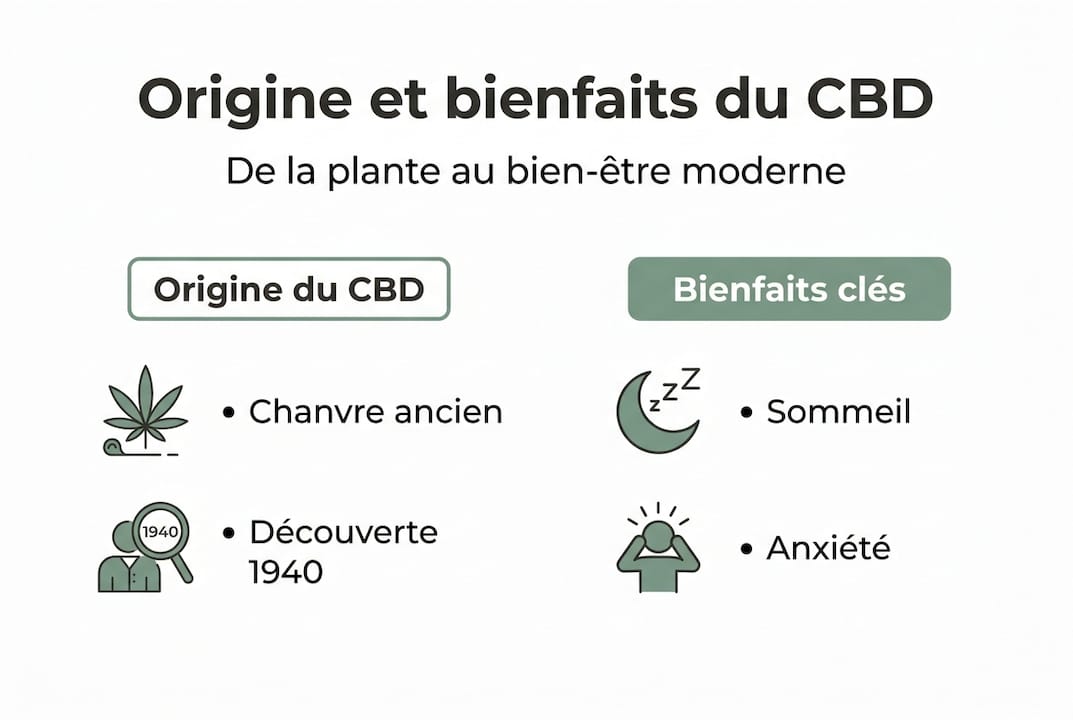
Regarding sleep, recent studies show that CBD improves sleep quality and affects anxiety through various biological mechanisms. For people suffering from stress- or chronic pain-related insomnia, CBD is an interesting alternative to conventional sleeping pills, which are often associated with dependency effects. Read our article on CBD and insomnia to learn more.
For anxiety, anxiolytic effects have been observed in preclinical and some clinical studies. Results vary depending on individuals and dosages, but the overall trend is positive. Our article on reducing anxiety with CBD details these clinical findings.
Here is a concise comparison of the documented benefits:
| Condition | Level of evidence | CBD benefit |
|---|---|---|
| Insomnia | Moderate to good | Improvement in sleep duration and quality |
| Anxiety | Moderate | Reduction of symptoms in several studies |
| Chronic pain | Preliminary | Potential anti-inflammatory and analgesic effect |
| Epilepsy | High (Epidyolex) | Reduction in seizures validated by the EMA |
The benefits of CBD flowers are particularly interesting for those seeking a rapid effect. CBD and mental health are also the subject of growing research.
- Choose full-spectrum extracts: they contain all the cannabinoids and terpenes in the plant, which enhances their overall effectiveness.
- Adjust the dosage to your profile: weight, metabolism, and the condition being treated influence the optimal dose.
- Be patient: the effects of CBD may take several days to stabilize in the body.
Pro tip: Always choose full-spectrum extracts over pure CBD isolates. The so-called “entourage effect,” produced by the synergy between cannabinoids, terpenes, and flavonoids, is generally more effective than an isolated molecule.
CBD regulations and safety in Europe
After learning about the desired effects of CBD, it is essential to consider the rules governing its consumption and safety advice. In Europe, CBD is legal provided that specific criteria are met. European regulations require a THC level below 0.3% in marketed products. This threshold ensures the absence of psychoactive effects while allowing cannabidiol to be marketed in various forms.
For more information about the legal framework, our article on the legality of CBD in Europe will provide all the necessary details.
Compliance criteria to check before buying a CBD product:
- THC level: below 0.3% (mandatory in Europe)
- Hemp source: variety listed in the European catalogue
- Certificate of analysis: provided by an independent laboratory (COA)
- Extraction method: Supercritical CO2 or food-grade ethanol recommended
- Traceability: the geographical origin of the hemp is clearly indicated
“A CBD product without an independent certificate of analysis is a product whose compliance you cannot verify. This is a non-negotiable criterion for safe consumption.”
CBD is not free from side effects. The most frequently reported are drowsiness, diarrhea, and changes in appetite. More seriously, CBD interacts with 17 classes of medication, including anticoagulants, antidepressants, and certain antiepileptic drugs. These interactions may alter the effectiveness of treatments or amplify their adverse effects.
Pro tip: If you take regular medication, always consult your doctor or pharmacist before starting CBD. Also consult our guide to CBD dosage to get started gradually and safely.
Our expert perspective on the true origin and future of CBD
After this comprehensive overview of the issues surrounding CBD, it seems essential to offer a nuanced and committed perspective. What most articles about CBD fail to mention is the reality of the differences in quality between products. The European market is flooded with extracts of widely varying quality, and uninformed consumers often have no reliable way to distinguish between them.
Marketing communication around CBD tends to highlight its benefits while minimizing drug interactions, which are nevertheless very real and potentially dangerous. This silence is not insignificant. It leads some consumers to use CBD for self-medication without informing their doctor, sometimes affecting their existing treatments.
We believe that the future of CBD lies in informed consumption, based on rigorous therapeutic approaches to CBD and open dialogue with healthcare professionals. Choosing a certified product, understanding its spectrum, and adjusting its dosage: these are simple steps that make all the difference between a positive experience and a disappointment.
Going further: where to find quality CBD in Europe?
You now have a clear understanding of the origin of CBD, its history, and its documented effects. Taking action means choosing a reliable supplier that guarantees the legal compliance, traceability, and quality of its products.
European CBD Shop delivers throughout the European Union, the United Kingdom, and Switzerland. Our selection includes laboratory-tested products, with certificates of analysis available. Discover our guide to the best CBD shops in Europe to compare the available options. To start gently, our broad-spectrum oil is particularly suitable for people seeking a balanced effect without residual THC. Quality, transparency, and compliance: these are the criteria guiding every product in our catalog.
Frequently Asked Questions About the Origin of CBD
Does CBD come from the same plant as traditional cannabis?
Yes, CBD comes from industrial hemp, a variety of Cannabis sativa L., but it contains very little THC and has no psychoactive effect. Industrial hemp is specifically selected for its low content of psychoactive molecules.
How long has hemp been used to produce active substances?
Hemp has been used for more than 10,000 years, both for its fibers and for its medicinal properties recognized in many cultural traditions. Its medical use was documented in China as early as 2700 BC.
What are the known side effects of CBD?
CBD side effects include drowsiness, diarrhea, and drug interactions with several classes of medication. It is therefore advisable to consult a healthcare professional before regular use.
Is CBD legal in France and Europe?
CBD is legal in Europe if it contains less than 0.3% THC and comes from authorized hemp varieties listed in the European catalogue. In France, this regulation has applied fully since 2021.
Can CBD replace medical treatment for anxiety or insomnia?
No, CBD does not replace medical treatment, and its effectiveness varies from person to person. It should be used alongside medical monitoring, never as a replacement for a prescription.