
Circadian rhythm and CBD: 2026 practical guide
TL;DR:
- CBD indirectly influences the circadian cycle by modulating the endocannabinoid system and neurotransmitters such as serotonin and adenosine, without acting like a traditional sleeping pill. Its effect is gradual and cumulative after 2 to 4 weeks of regular use, requiring an appropriate dose and precise timing to optimize sleep. It is a safe alternative to sleeping pills that respects sleep architecture and supports natural regulation of the biological rhythm.
CBD acts like a sleeping pill. That is what many people think. But this idea oversimplifies a much subtler reality. The relationship between the circadian cycle and CBD cannot be reduced to “take a capsule and fall asleep.” Cannabidiol interacts with your biological clock gradually, indirectly, and in a deeply personalized way. Understanding this mechanism changes everything: how you determine your dosage, when you take your CBD, and the results you can reasonably expect for your sleep and well-being.
Table of contents
- Key points
- The circadian rhythm and its central role
- CBD and the circadian cycle: mechanisms of action
- Practical recommendations for using CBD effectively
- CBD, melatonin, and sleeping pills: the real differences
- CBD and jet lag: practical applications
- My view on CBD and the circadian cycle
- Find the Right CBD Product for Your Sleep
- FAQ
Key points
| Point | Details |
|---|---|
| CBD is not a sleeping pill | It modulates the endocannabinoid system to indirectly support the circadian rhythm, without causing dependence. |
| The effects are cumulative | Regular use for 2 to 4 weeks is necessary to observe a significant improvement in sleep. |
| The dose makes all the difference | At a low dose, CBD may be stimulating; at a high dose, it promotes falling asleep. Gradual adjustment is essential. |
| The timing of intake matters | Taking CBD 30 to 60 minutes before bedtime optimizes absorption and the relaxing effect. |
| A sleep diary helps | Tracking your nights allows you to objectively assess CBD’s impact on your circadian balance. |
The circadian rhythm and its central role
The circadian rhythm is the internal clock that regulates your body over a cycle of approximately 24 hours. This biological clock coordinates much more than sleep: it controls hormone secretion, body temperature, alertness, metabolism, and even cellular repair.
Melatonin is the main player in this cycle. Produced by the pineal gland as soon as light levels drop, it signals to your body that it is time to prepare for sleep. This natural process can be disrupted by many everyday factors.
The consequences of a circadian imbalance are concrete and measurable:
- Difficulty falling asleep and frequent nighttime awakenings
- Chronic fatigue despite getting enough hours of sleep
- Irritability and reduced concentration during the day
- Hormonal disruption affecting cortisol and insulin
- Weakened immunity over the long term
Modern disruptors are numerous: late exposure to screens, irregular work schedules, transcontinental travel, and chronic stress. All of them desynchronize the internal clock and permanently impair sleep quality. It is precisely in this context that interest in CBD and the biological clock has grown in recent years.
CBD and the circadian cycle: mechanisms of action
CBD does not bind directly to the CB1 and CB2 receptors of the endocannabinoid system as THC does. Its action is modulatory: it influences how the system functions without short-circuiting it. This subtlety explains why its effects on the CBD circadian rhythm are gradual rather than immediate.
In practical terms, cannabidiol and the biological clock interact through several pathways:
- Serotonin: CBD modulates 5-HT1A receptors, influencing mood and anxiety and indirectly affecting melatonin production.
- Adenosine: by slowing the reuptake of this neurotransmitter that promotes drowsiness, CBD may support natural sleep pressure.
- Anxiety and stress: CBD reduces anxiety and stress, two of the main factors disrupting the circadian cycle.
One of the lesser-known aspects of CBD is its dose-dependent biphasic effect: at a low dose, it may have a slightly stimulating effect; at a high dose (often above 150 mg), it promotes falling asleep and prolongs sleep. This nuance is crucial for anyone who wants to use CBD to regulate sleep without producing the opposite effect.
The optimal effects appear after 2 to 4 weeks of regular use, because CBD acts cumulatively on the endocannabinoid system. It is not a switch, but a gradual regulator.

Pro tip: If you are looking to influence your sleep–wake cycle, start with a low dose in the evening and observe your reactions for two full weeks before adjusting. Changing the dose too quickly makes it difficult to identify what is working.
Practical recommendations for using CBD effectively
Using CBD to regulate sleep requires method and patience. Here is a structured approach to maximize results while staying within a safe framework.
-
Start with 10–15 mg per day. The recommended initial dose according to the 2023 FSA guidance is 10 to 15 mg/day. Increase gradually if necessary, and exercise caution above 70 mg/day for chronic use.
-
Follow the timing. Take your CBD 30 to 60 minutes before bedtime to optimize absorption and the relaxing effect. Sublingual oils act faster than gummies, which need to be taken 60 to 90 minutes before sleep.
-
Be consistent for at least 10 to 14 days. This is the minimum amount of time needed to begin observing effects on your circadian rhythm. Evaluating the effects after three days makes no sense with CBD.
-
Keep a sleep journal. Each morning, note your estimated time of falling asleep, nighttime awakenings, and energy upon waking. This is the only way to objectively assess CBD’s impact on your circadian rhythm.
-
Consider a CBD and melatonin formula. For people with late screen exposure or jet lag, combined CBD and melatonin formulations may help realign the biological clock more quickly.
-
Consult a healthcare professional before adding CBD to an existing treatment, especially if you take blood thinners or medications metabolized by the liver.
To learn more about the right dosage for insomnia, Cbd-certified offers detailed resources on its blog.
Pro tip: Combine CBD use with other circadian signals: turn off screens 30 minutes before taking your dose, dim the lights, and maintain a consistent bedtime. CBD supports your biological clock, but it cannot compensate for chaotic sleep habits.
CBD, melatonin, and sleeping pills: the real differences
Choosing between CBD, melatonin, and classic sleeping pills depends on your profile and the nature of your problem. Here is a comparison table to help clarify things.
| Criterion | CBD | Melatonin | Classic sleeping pills |
|---|---|---|---|
| Mode of action | Indirect modulator of the endocannabinoid system | Direct hormonal signal for falling asleep | Central nervous system depressant |
| Time to take effect | 2 to 4 weeks (cumulative) | Fast (30 to 60 min) | Immediate |
| Risk of dependence | None observed | Low | High for certain classes |
| Impact on sleep architecture | No alteration observed | Minimal | Reduction in REM sleep |
| Recommended use | Chronic stress, anxiety, gradual disruption | Jet lag, mild difficulty falling asleep | Severe insomnia under medical supervision |
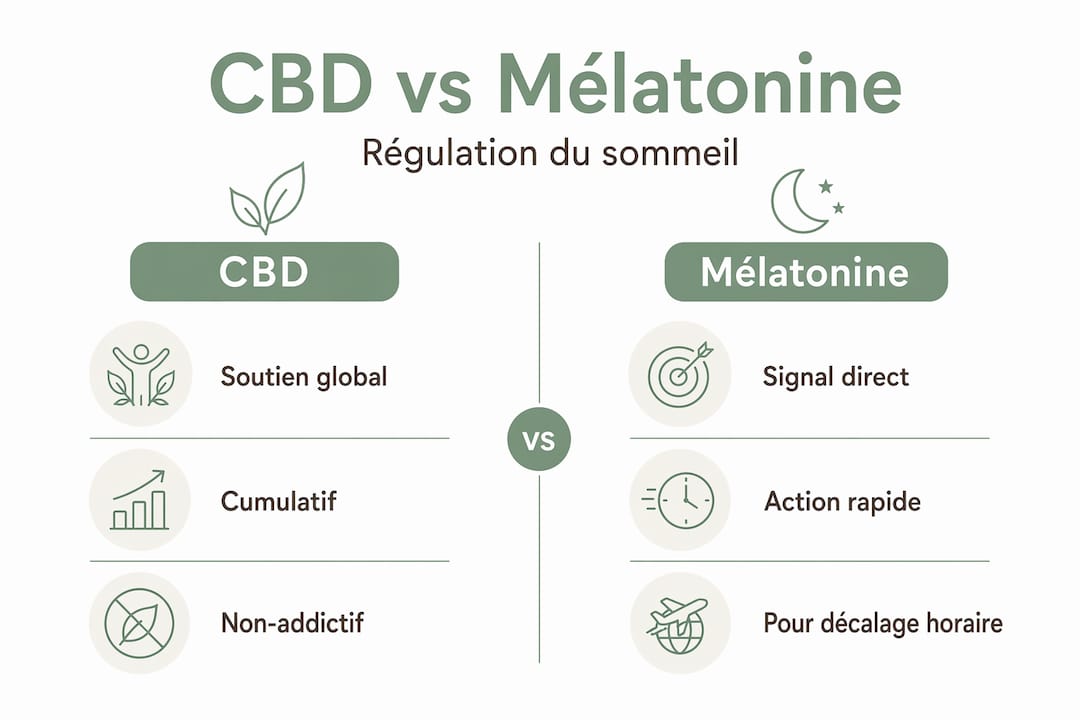
CBD offers a structural advantage over sleeping pills: it does not alter the fundamental architecture of sleep or cause dependence. This means that your deep-sleep and REM-sleep cycles remain intact, which is essential for cognitive and physical recovery.
Melatonin acts directly as a circadian signal. It is particularly effective for issues related to jet lag or irregular schedules, but its effect remains superficial if the underlying problem is stress or anxiety. That is where CBD takes over, acting on the root causes of the disruption.
CBD and jet lag: practical applications
Jet lag is one of the clearest examples of circadian disruption. Your internal clock remains aligned with your original time zone for several days, creating a mismatch between your biology and your environment.
CBD works on two fronts here: reducing travel-related anxiety and supporting sleep quality in a disrupted context. According to 2024 data, 68 to 78% of travelers report improved sleep with CBD during trips involving jet lag.
Here’s how to incorporate CBD into an effective travel routine:
- Start taking it 3 to 5 days before departure. Travelers who start before the trip make it easier to adjust to jet lag and improve their sleep quality as soon as they arrive.
- Maintain a stable dose throughout the trip and during the first few days at your destination.
- Combine it with light signals: expose yourself to natural light in the morning at your destination to accelerate resynchronization.
- Avoid caffeine after 2 p.m. at your destination and eat meals at local times to send consistent signals to your biological clock.
- Choose a quality-certified product: traceability and the actual CBD concentration are decisive for achieving consistent effects while traveling.
Product quality is not a minor detail. Poorly dosed or contaminated CBD can produce unpredictable effects, precisely when you need stability. To explore sleep cycles and CBD in detail, Cbd-certified’s resources provide a solid foundation.
My view on CBD and the circadian cycle
I’ve seen many people approach CBD with expectations more suited to sleeping pills. They take a dose one night, sleep poorly, and conclude that “it doesn’t work.” That’s the wrong way to interpret it.
What I’ve learned is that CBD acts as gradual support, not like a switch. The 66% to 79% of people who report improved sleep after 2 to 4 weeks have something in common: consistency. Not the perfect dose on the first night.
What I often find overlooked is the biphasic effect. Taking too little may keep you awake. Taking too much may knock you out without improving the actual quality of your sleep. The scientific community emphasizes the need for more rigorous clinical trials and warns against a one-size-fits-all approach. I agree: CBD is not a universal solution; it is a tool that requires observation and adjustment.
My recommendation: treat CBD as a supplement to good circadian hygiene, not as a substitute. Light, regular schedules, stress management. CBD can amplify these efforts. On its own, it has limitations.
— Rod
Find the Right CBD Product for Your Sleep
Choosing the right CBD for regulating the circadian cycle starts with product quality. Actual concentration, cultivation traceability, and the absence of residues: these criteria make the difference between reproducible results and a disappointing experience.
Cbd-certified selects rigorously tested products available for delivery throughout the EU, the United Kingdom, and Switzerland. Whether you are looking for a sublingual oil for a rapid effect or gummies for gradual release, the platform offers formats suited to every profile. Formulas combining CBD and melatonin are also available for people who want to act directly on their biological clock. To find the product that meets your needs, browse the selection of best CBD shops in Europe and get expert advice directly online.
FAQ
Can CBD Really Regulate the Circadian Cycle?
CBD acts indirectly on the circadian rhythm by reducing anxiety and stress, two major factors in circadian disruption. Its effects are gradual and become noticeable after 2 to 4 weeks of regular use.
What Dose of CBD Should You Take to Improve Sleep?
The recommended starting dose is 10 to 15 mg per day, to be adjusted gradually according to the effects observed. CBD’s biphasic effect means that a dose that is too low may stimulate rather than help with sleep.
CBD or Melatonin: Which Should You Choose for Jet Lag?
Melatonin acts directly as a sleep-onset signal and is suitable for occasional jet lag. CBD is better suited to disruptions related to chronic stress, and the two can be combined for a complementary effect.
When Should You Take CBD to Optimize Its Effect on Sleep?
Take your CBD 30 to 60 minutes before bedtime for sublingual oils, and 60 to 90 minutes beforehand for gummies, to optimize absorption and the relaxing effect.
Does CBD Cause Dependence or Disrupt Deep Sleep?
No. Unlike conventional sleeping pills, CBD does not alter the fundamental architecture of sleep or cause dependence, making it a viable long-term option.