
Incorporating CBD into your daily routine: a practical wellness guide
TL;DR:
- CBD naturally helps manage stress, sleep, and chronic pain.
- It is advisable to start with low doses and gradually adjust them according to the effects you experience.
- Consistency and personalized monitoring are essential for optimizing its daily benefits.
You are doing everything right: you limit coffee, try to go to bed early, and practice a few breathing exercises. Yet anxiety returns, sleep remains fragile, and some pain persists. Many European consumers find themselves in this situation and are looking for a natural, consistent, and easy-to-maintain solution. CBD is attracting increasing attention, particularly thanks to promising recent studies on managing stress, sleep, and chronic pain. This guide takes you step by step through incorporating CBD into your daily routine in an informed, safe, and genuinely effective way.
Table of contents
- Understanding the basics of CBD and its daily effects
- Preparing for integration: choosing the forms and setting the dosage
- Incorporating CBD into your daily routine: instructions and tips
- Expected effects, long-term monitoring, and adjustments
- Our perspective on effectively incorporating CBD
- Where to find reliable CBD products for your routine
- Frequently asked questions about incorporating CBD into daily life
Key Points
| Point | Details |
|---|---|
| Start low, adjust slowly | Start with a low dose and increase gradually to observe your reactions and avoid tolerance. |
| Adapt the form of CBD | Choose between oils, capsules, topicals, or edibles according to your needs and habits for optimal daily use. |
| Take precautions into account | Follow regulations, avoid CBD before the age of 25 and during pregnancy, and do not use it while taking medication without medical advice. |
| Assess its effectiveness over time | Note how you feel so you can adjust the dose and method, as monitoring is essential for maximizing the benefits of CBD. |
Understanding the basics of CBD and its daily effects
CBD, or cannabidiol, is a natural compound extracted from the hemp plant. Unlike THC, it produces no psychoactive effects. It primarily acts on the endocannabinoid system, a network of receptors throughout the body that regulates essential functions such as mood, pain, sleep, and the stress response.
To better understand what CBD can do for you, here are the most documented effects according to your needs:
- Anxiety: Acute doses of 300 to 600 mg have shown anxiolytic effects in clinical settings. Lower doses used daily rely more on personal experiences than on formal clinical trials.
- Sleep: The benefits of CBD hemp include a notable improvement in sleep quality, particularly among people with underlying anxiety.
- Chronic pain: Studies show moderate effectiveness, especially for neuropathic and inflammatory pain.
One particularly telling finding: according to a study by Shannon (2019), 66% of patients reported improved sleep after taking between 25 and 75 mg of CBD per day for one month. This is a concrete result, but it is important to bear in mind that the populations studied, doses, and durations vary considerably from one study to another.
The impact of CBD on mental health remains an evolving field. The scientific evidence is promising but still incomplete for some uses, particularly the low doses used on a daily basis. This does not mean that CBD is ineffective, but that each person responds differently depending on their profile, physiology, and lifestyle habits.
In summary, CBD is not a one-size-fits-all solution. It is one tool among many, and deserves to be used methodically and patiently to get the most out of it.
Preparing for integration: choosing the forms and setting the dosage
Before getting started, it is helpful to choose the CBD form best suited to your lifestyle. Each format has its advantages depending on your intended goal.
| Form | Onset time | Duration of effects | Ideal for |
|---|---|---|---|
| Sublingual oil | 15 to 45 min | 4 to 6 h | Anxiety, sleep |
| Capsules | 45 to 90 min | 6 to 8 h | Precise dosage, pain |
| Topicals (creams) | 20 to 60 min | 2 to 4 h | Localized pain |
| Infusions | 30 to 60 min | 3 to 5 h | Relaxation, evening ritual |
| Gummies / edibles | 45 to 90 min | 6 to 8 h | Ease of use, taste |
To understand the forms of CBD and their specific characteristics, it is important to know your primary goal before choosing.
Regarding dosage, the fundamental principle is simple: start low and increase slowly. A starting dose of 10 to 25 mg per day is generally recommended, to be adjusted gradually based on how you feel. To dose your CBD properly, it is better to increase in 5 mg increments every 3 to 5 days rather than jumping directly to high doses.

From a regulatory standpoint, EFSA has set a provisional safe level of 0.0275 mg/kg/day, or about 2 mg for a 70 kg adult. This threshold is highly conservative and concerns CBD-enriched foods, not supplements. It is useful to know, without treating it as an absolute limit for your personal use.
A few important precautions to follow:
- Do not use CBD if you are under 25 or pregnant.
- Consult a doctor if you take medication, especially blood thinners or antiepileptic drugs.
- Buy only products with independent certificates of analysis (COAs).
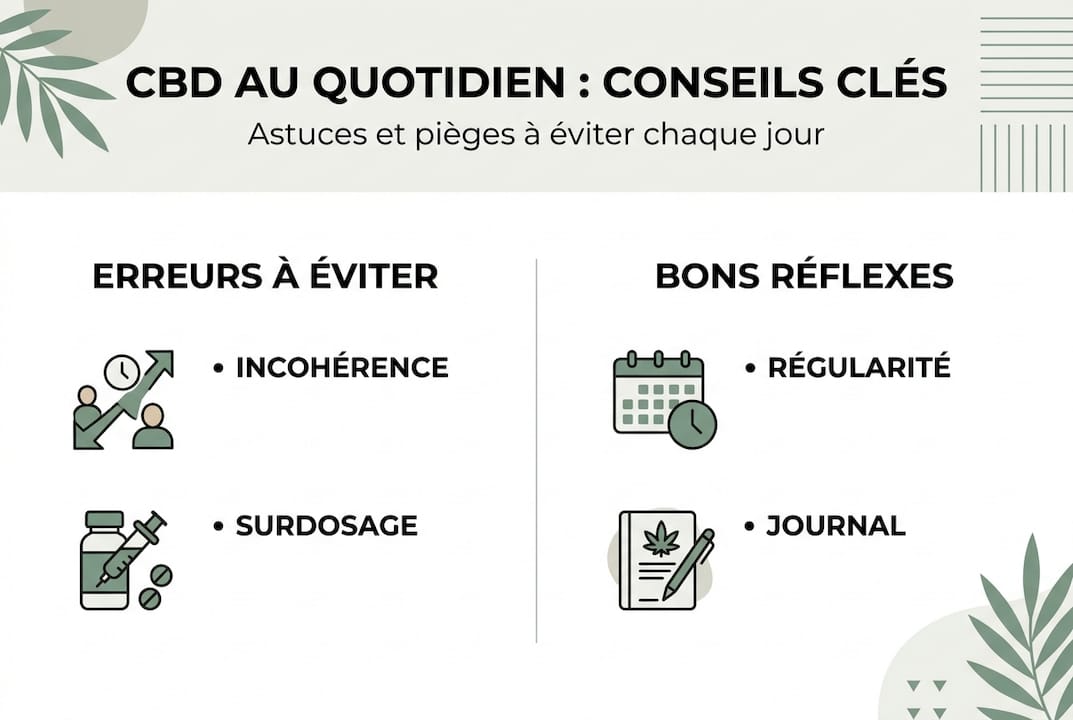
Pro tip: Take CBD at the same time every day. This consistency will help you observe more stable effects and better identify what works for you over time. Also consult resources on the CBD wellness routine to structure your approach.
Incorporating CBD into your daily routine: instructions and tips
Once you have chosen your form and dose, here is how to structure your day to incorporate CBD naturally and effectively.
- In the morning: A dose of sublingual oil upon waking, held under the tongue for 60 seconds before swallowing, helps you start the day more serenely. Ideal for managing anticipatory anxiety.
- At noon: A capsule taken with a meal can prolong the effect of the morning dose and support concentration in the afternoon.
- In the evening: A second dose of oil or a CBD infusion about an hour before bedtime promotes relaxation and prepares you for sleep. This is often the most effective time for people suffering from insomnia.
- After exercise: A topical product applied locally to painful areas or a CBD gummy taken within 30 minutes of exercising may accelerate muscle recovery.
Here is a summary table of typical dosages by use, based on recommended integration methods:
| Goal | Recommended daily dose | Best time |
|---|---|---|
| Mild anxiety | 10 to 20 mg | Morning |
| Insomnia | 20 to 40 mg | 1 hour before bedtime |
| Chronic pain | 25 to 50 mg | Morning + evening |
| Athletic recovery | 15 to 30 mg | After exercise |
Pro tip: Keep a journal during the first two weeks. Note the dose, time of use, and how you feel regarding sleep, mood, and pain. This simple tracking allows you to add CBD to your daily routine in a truly personalized way.
The most common mistakes to avoid are inconsistent use (skipping days), overdosing out of impatience, and stopping abruptly after a few days without visible results. CBD takes time. To choose the right products from the outset, the CBD product selection workflow can guide you effectively.
Expected effects, long-term monitoring, and adjustments
CBD does not act like a conventional medication. The effects are often subtle at first, then become more consistent with regular use.
- Weeks 1 to 2: You may notice a slight improvement in sleep quality or a reduction in daytime tension. These early signals are worth noting in your journal.
- Weeks 3 to 4: The effects stabilize. This is a good time to assess whether the dose is appropriate or whether an adjustment is needed.
- Beyond one month: If no benefit is perceived, it may be helpful to change the form, gradually increase the dose, or consult a healthcare professional.
Certain factors directly influence the results: individual metabolism, product quality, consistency of use, and overall lifestyle habits. Combining CBD with good sleep practices and regular physical activity amplifies the benefits, as highlighted by pharmacology experts.
Beware of drug interactions: CBD can interfere with certain treatments, such as valproate. If you take regular medication, talk to your doctor before starting.
“CBD is not an alternative to a healthy lifestyle. It is a supplement that can support your efforts, not replace them. Always consult a healthcare professional if your symptoms persist or worsen.”
To refine your approach, the anxiety dosage guide and resources on the therapeutic use of CBD in Europe will provide valuable guidance. The scientific review available on PMC remains a solid reference for understanding the current state of knowledge.
Our perspective on effectively incorporating CBD
It is often said that a small dose of CBD is enough to fix everything. This is an oversimplification that can discourage people who feel nothing after a few days at 5 mg. The reality is more nuanced: clinical trials generally use doses far higher than those many people consume daily, and anecdotal results do not replace robust data.
The regulatory contradiction surrounding dosages is real. The EFSA recommends 2 mg per day for food safety, but sleep studies use 25 to 75 mg. This tension between regulations and real-world practice is worth understanding.
What we observe among our customers is that incorporating CBD is a personalized process. The role of terpenes in CBD, for example, influences a product’s overall effect far beyond its cannabidiol content alone. Choosing a full-spectrum product rather than an isolate can make a real difference. Don’t look for a miracle solution. Look for your solution, developed methodically and patiently.
Where to find reliable CBD products for your routine
To support you on your CBD journey, here’s where to find safe and effective products.
Choosing a reliable supplier is just as important as choosing the right dose. At European CBD Shop, all products are selected with independent certificates of analysis, guaranteeing quality and regulatory compliance for the EU, the United Kingdom, and Switzerland.
To start your routine, discover our CBN CBG CBD oil, ideal for sleep and recovery. If you prefer a convenient and tasty format, our vegan CBD gummies are perfect for a hassle-free daily dose. Also explore our selection in the best CBD shops to find the product that exactly matches your needs.
Frequently asked questions about incorporating CBD into daily life
What CBD dose is safe for daily use?
In Europe, the EFSA sets a provisional safe level of 2 mg per day for a 70 kg adult, but most users start between 10 and 25 mg per day, gradually adjusting it according to their needs and how they feel.
Can I take CBD if I am already undergoing medical treatment?
It is not recommended to start without medical advice, as drug interactions are possible, particularly with medications such as valproate, which is used in neurology.
Why start with a low dose of CBD?
Starting with a low dose of 10 to 25 mg helps avoid the risk of rapid tolerance and accurately identify the minimum effective dose for your profile.
At what age can CBD be incorporated into your routine?
The EFSA states that CBD is not recommended before age 25 or during pregnancy because there is insufficient data on these populations.
How long does it take to feel the effects of CBD?
The first effects generally appear within a few days to two weeks, according to Shannon’s 2019 study, in which 66% of patients reported improved sleep after one month at 25–75 mg per day.