
Why CBD is not a narcotic
TL;DR:
- CBD is not a narcotic drug because it causes neither intoxication nor dependence, as recognized by the European Union and France. Legality is based primarily on a THC threshold below 0.3%, and strict regulations mainly concern food products, which are still prohibited in France under the Novel Food Regulation. It is essential to choose certified products that comply with these thresholds to consume safely and legally.
CBD is regularly confused with narcotic drugs, and this misconception is still widespread across Europe. Yet the answer is clear: the reason CBD is not a narcotic drug lies in well-established scientific and legal realities. CBD causes neither intoxication, dependence, nor altered consciousness. European and French institutions have officially recognized this. Understanding this distinction helps you avoid unnecessary concerns and make informed choices, whether you are a consumer or simply curious.
Table of Contents
- Key Points
- What CBD Really Is
- The legal framework for CBD in Europe and France
- Effects on the body and differences from narcotics
- Recent controversies: the ban on CBD-infused food products
- Practical advice for consuming CBD legally
- My opinion on CBD legislation in Europe
- Find certified and compliant CBD products
- FAQ
Key Points
| Point | Details |
|---|---|
| CBD and Narcotic Drugs: Two Distinct Categories | CBD is not classified as a narcotic drug because it produces neither psychotropic effects nor dependence. |
| Legal THC Threshold of 0.3% | A CBD product is legal in France and the EU if its THC content remains below 0.3%. |
| CJEU Decision Confirmed | The Court of Justice of the European Union has officially ruled that CBD does not meet the criteria for a narcotic drug. |
| Saliva Tests: A Little-Known Risk | Roadside tests do not distinguish CBD from THC, which can create difficult situations for consumers. |
| Choosing Certified Products | Opting for products with a certificate of analysis protects your health and legal standing. |
What CBD Really Is
CBD, or cannabidiol, is one of the many natural compounds extracted from the Cannabis sativa plant. Unlike THC (tetrahydrocannabinol), it does not act on the same brain receptors and does not produce the “high” sought for recreational use. This molecular difference is fundamental to understanding why CBD occupies a separate place in regulation.
Chemically, CBD and THC share the same molecular formula (C21H30O2), but their structures are different. THC binds directly to CB1 receptors in the brain, producing euphoria and altered perception. CBD, on the other hand, acts on serotonin to produce a calming effect, without ever causing intoxication.
Here is what is known about CBD's profile today:
- Origin: extracted from the aerial parts of the plant Cannabis sativa L. (flowers, leaves, stems)
- Effects: mild relaxation, sleep support, stress management, without classic psychotropic effects
- Dependence: no recreational or addictive effects recognized by health authorities
- Therapeutic use: used notably in the treatment of certain forms of epilepsy (Epidyolex medicine)
- Non-toxic CBD: no lethal toxicity documented at commonly consumed doses
This scientific basis is precisely what European judges and legislators relied on to distinguish it from narcotics.
The legal framework for CBD in Europe and France
The legality of CBD rests on one central criterion: the THC content. In France, CBD is legal if the THC content in the final product does not exceed 0.3%. Above this threshold, the product falls into the category of narcotics and its holder faces criminal penalties.
| Situation | THC content | Legal status |
|---|---|---|
| Standard CBD product | Below 0.3% | Legal in France and the EU |
| Unregulated CBD product | Between 0.3% and 1% | Gray area, potentially illegal |
| Recreational cannabis | Above 1% | Narcotic, illegal |
| CBD-based medicine (Epidyolex) | Variable, controlled | Legal with a prescription |
The most important decision in this area came from the Court of Justice of the EU, which ruled in 2020 that CBD is not a narcotic because it does not produce psychotropic effects. This decision forced France to revise its regulations, which at the time prohibited CBD extracted from the flower. The Constitutional Council and the Court of Cassation followed suit in their interpretation: CBD complying with the THC threshold cannot be classified as a narcotic.
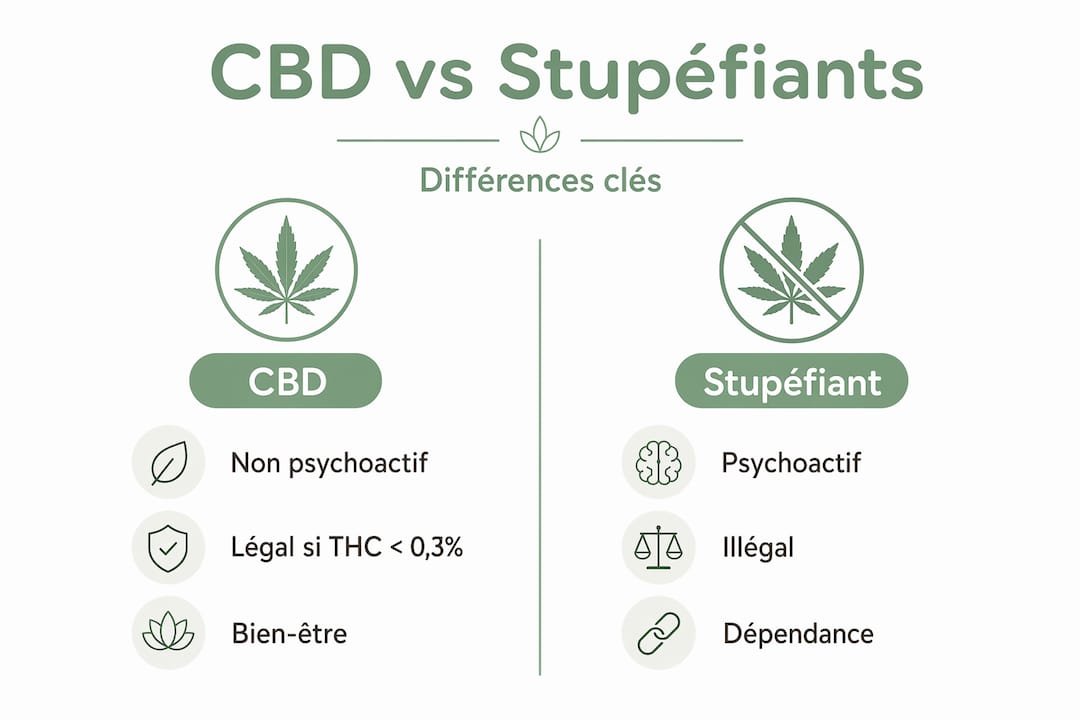
Despite this progress, inconsistencies remain. France, for example, allows the sale of CBD flowers in stores while maintaining certain restrictions on food products enriched with CBD. To understand these nuances, see our guide to the legality of CBD in France.
Professional tip: Always keep your purchase receipt and the product's certificate of analysis. In the event of an inspection, these documents prove that your CBD complies with legal THC limits.
Effects on the body and differences from narcotics
The boundary between CBD and narcotics is not merely legal. It is primarily physiological. THC alters the perception of time, space, and emotions. It can cause anxiety, paranoia, and, in the long term, psychological dependence. CBD, on the other hand, acts differently at every level of the nervous system.

CBD's mechanism primarily involves the serotonin system and TRPV1 receptors, which are associated with pain and inflammation management. It does not saturate the CB1 receptors responsible for cannabis intoxication. This is precisely why health authorities recognize that CBD does not cause intoxication or dependence in the pharmacological sense of the term.
That said, a few points deserve your attention:
- Poorly controlled products: the lack of quality control in some shops may result in THC levels exceeding legal limits, exposing consumers to real health and legal risks
- Saliva tests: roadside tests do not distinguish between CBD and THC. As a result, a full-spectrum CBD consumer may test positive for THC, even if the product is legal
- Driving: caution is essential. A positive saliva test can result in penalties of up to 3 years in prison and a €9,000 fine, regardless of the type of product consumed
Professional tip: If you drive regularly, choose CBD products made with isolate or broad-spectrum CBD with no detectable THC. This is the only reliable way to avoid a positive roadside drug test.
To learn more about the differences between CBD and THC in terms of effects, read our article on non-psychoactive CBD.
Recent controversies: the ban on CBD-infused food products
The CBD sector in France has faced a paradoxical situation since May 2026. CBD flowers and oils remain freely available for sale (within THC limits), but CBD food products are prohibited due to the lack of authorization under the European Union’s Novel Food regulation.
This regulation requires food containing a novel ingredient (such as CBD) to obtain prior authorization from the European Food Safety Authority (EFSA) before being marketed. However, this authorization has not yet been granted for food-grade CBD. France, by applying this regulation strictly, has therefore removed candy, herbal teas, biscuits, and other CBD-enriched products from store shelves.
The economic impact is real and immediate. Some shop owners estimate that these products accounted for up to 40% of their turnover. Professional associations are challenging this decision, pointing out that CBD is authorized for sale in other forms in the same country. This is the paradox of legislation that allows CBD to be vaporized but prohibits eating it.
| Form of CBD | Legal status in France (2026) |
|---|---|
| Flowers and resins | Authorized (if THC < 0.3%) |
| Oils and tinctures | Authorized |
| Capsules and supplements | Authorized under certain conditions |
| Food products (candy, herbal teas) | Prohibited (Novel Food) |
| CBD cosmetics | Authorized |
The outlook remains uncertain. EFSA is continuing its assessment of food-grade CBD, and future authorization remains possible. For consumers, this means adapting their habits and focusing on legally available formats.
Practical advice for consuming CBD legally
Understanding why CBD is not a narcotic is one thing. Making the right choices every day is another. Here is a practical approach to consuming CBD safely and legally in Europe.
-
Check the certificate of analysis (COA): every reputable CBD product has an independent laboratory report confirming its THC content. Choosing a product with a COA is the best protection against unpleasant legal and health-related surprises.
-
Understand the types of spectra: full-spectrum contains all cannabinoids (including traces of THC), broad-spectrum eliminates THC, and isolate is 99% pure CBD. To avoid any risk while driving, choose isolate or broad-spectrum.
-
Respect legal thresholds: buy only from retailers that guarantee a THC content below 0.3%. This threshold is your legal safeguard in France and almost all of the EU.
-
Keep your proof of purchase: a dated invoice or receipt, accompanied by the product’s COA, is your best defense in the event of a police check.
-
Learn about local regulations: thresholds vary slightly among European countries. Switzerland allows up to 1% THC in CBD products, while some countries apply a threshold of 0.2%. Read our article on CBD regulations in Europe before traveling with your products.
My opinion on CBD legislation in Europe
What strikes me most about this matter is the gap between scientific clarity and regulatory confusion. The science has been clear for years: CBD is not a narcotic, it does not cause intoxication, and no one consumes it to “get high.” Yet I see every day that serious, well-intentioned consumers find themselves in absurd situations, such as testing positive on a saliva test even though they have never touched recreational cannabis.
What I find particularly poorly managed is the issue of food products. Banning CBD herbal teas while authorizing the same molecules in the form of oil or flower sends a contradictory signal to both consumers and professionals. The French CBD industry is losing millions, and for what? A European administrative procedure that has not yet been completed.
I remain convinced that the future depends on serious European harmonization. Countries that have clarified their rules have seen healthy, well-regulated markets emerge, with quality products. France has the tools to do the same. What is chiefly lacking is consistent political will and better dialogue with industry stakeholders.
For consumers, my advice remains simple: choose reliable sources, always ask for the certificate of analysis, and stay informed about legal developments. CBD deserves a better reputation than the one that inconsistent regulation still imposes on it today.
— Rod
Find certified and compliant CBD products
If you have read this article this far, you now know why CBD is not a narcotic and how to protect yourself legally. The next step is to choose genuinely compliant products, with verified THC levels and accessible certificates of analysis.
Cbd-certified offers a selection of rigorously tested CBD products that comply with current French and European regulations. Every product available on the website comes with an independent laboratory certificate of analysis. Deliveries cover the entire EU, the United Kingdom, and Switzerland. Whether you are looking for oils, flowers, or capsules, you will find a range in the CBD shop in Europe designed for consumers who want to combine well-being with legal security. Also explore our local options available in Eindhoven for a convenient local experience.
FAQ
Is CBD legal in France in 2026?
Yes, CBD is legal in France if the product’s THC level does not exceed 0.3%. CBD flowers, oils, and capsules are permitted, but food products containing CBD remain banned pending Novel Food authorization.
Can CBD cause a positive saliva test result?
Yes. Roadside saliva tests detect the presence of THC, not CBD itself. A full-spectrum CBD product may contain trace amounts of THC that trigger a positive result, even if the product is legal.
What is the difference between CBD and THC?
THC is the psychoactive compound in cannabis that causes intoxication and can lead to dependence. CBD is non-intoxicating, does not cause dependence, and primarily acts on the serotonergic system for a calming effect.
Why are CBD-infused foods banned in France?
The European Novel Food regulation requires prior authorization for any food containing a novel ingredient. Food products containing CBD have not yet received authorization from EFSA, resulting in their provisional ban in France since May 2026.
How do you choose truly legal and safe CBD?
Choose products accompanied by a certificate of analysis (COA) from an independent laboratory confirming a THC level below 0.3%. Prefer isolate or broad-spectrum products if you drive regularly.