
CBD’s impact on melatonin: a complete guide to better sleep
TL;DR:
- CBD does not directly increase melatonin production; it mainly works by reducing stress and anxiety, which may promote natural sleep. In Europe, melatonin doses are limited to 0.5 mg for jet lag and 1 mg for falling asleep, with targeted effects validated only at these doses. The combination of CBD and melatonin should be monitored to avoid enzymatic interactions and the risk of excessive sedation, especially in the absence of solid clinical evidence.
Many consumers believe that CBD acts as a natural melatonin booster. This belief is widespread, understandable, and largely inaccurate. CBD’s impact on melatonin is far subtler than a simple direct hormone-stimulating effect. This guide separates fact from fiction by drawing on the European scientific and regulatory framework, helping you understand what CBD can really do for your sleep—and what it cannot do.
Table of contents
- Understanding the role of melatonin in sleep
- How does CBD really affect sleep and melatonin?
- Regulatory limitations and clinical precautions for combining CBD and melatonin in Europe
- User profile and practical advice for optimizing the use of CBD in combination with melatonin
- Why the link between CBD and melatonin is often misunderstood
- Where to find the best CBD products for natural sleep in Europe
- Frequently asked questions about CBD’s impact on melatonin
Key Points
| Point | Details |
|---|---|
| CBD’s indirect effect | CBD improves sleep mainly by reducing stress and anxiety rather than directly increasing melatonin. |
| Regulated dosages | In Europe, only melatonin doses of 0.5 mg and 1 mg have officially recognized health claims. |
| Interaction risks | Combining CBD and melatonin requires caution because of enzymatic interactions and additive sedative effects. |
| Individual variability | The effectiveness of CBD varies depending on the cause of sleep problems and is more pronounced in people experiencing stress. |
| Effective choices and monitoring | For natural sleep, choose certified products and follow a personalized approach with a professional. |
Understanding the role of melatonin in sleep
To better understand the potential effect of CBD on sleep, you first need to clearly understand the exact role of melatonin and its regulatory limitations.
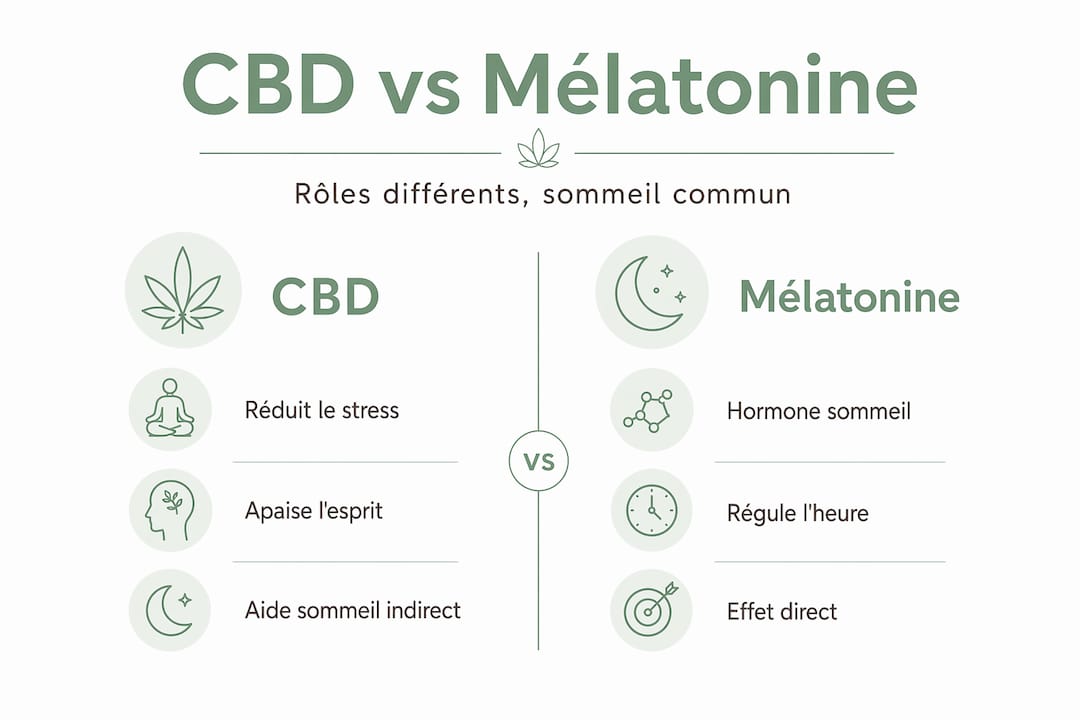
Melatonin is a hormone produced by the pineal gland, a small structure in the center of the brain. Its production follows a precise circadian rhythm: it increases as the light fades in the evening, reaches a peak in the middle of the night, then drops as morning approaches. This natural process acts as a biological signal indicating to the body that it is time to sleep.
In Europe, authorized health claims for melatonin are strictly regulated by the European Food Safety Authority (EFSA). There are only two EFSA-authorized health claims: reducing the time needed to fall asleep at 1 mg, and reducing the effects of jet lag at 0.5 mg. No more, no less. This legal framework is important because it establishes what food supplements may legally promise.
Here is what this means for you in practical terms:
- 0.5 mg of melatonin: validated dosage for alleviating the effects of jet lag during transmeridian travel.
- 1 mg of melatonin: validated dosage for reducing the time needed to fall asleep.
- Higher doses: no additional health claims are recognized in Europe, even if some products contain more.
- Unvalidated effects: improved sleep quality, total sleep duration, and sleep-cycle architecture are not approved claims.
This regulatory framework reveals a reality that is often overlooked: even melatonin alone has highly targeted effects that are validated only at specific doses. Understanding this completely changes how products combining CBD and melatonin should be evaluated.
How does CBD really affect sleep and melatonin?
Now that the physiological foundation has been established, let’s explore what science says about CBD and why its mode of action on sleep is fundamentally different from that of melatonin.
CBD (cannabidiol) is not a sleeping pill. It does not directly trigger melatonin secretion and does not replace its hormonal action. What CBD does, however, is indirectly modulate the nervous system to promote a state of relaxation, thereby facilitating the natural secretion of melatonin without acting directly as a sleeping pill. In other words, if your insomnia is fueled by stress or mental agitation, CBD may create the internal conditions conducive to more natural sleep onset.
The available clinical data support this. A study involving 25 mg of CBD per day for one month showed improved sleep in 66.7% of participants, primarily through a reduction in stress and anxiety, with significant individual variability. This figure should be interpreted with nuance: it does not mean that everyone will respond in the same way.
Here are the main mechanisms currently identified:
- Cortisol reduction: CBD attenuates evening cortisol spikes (the stress hormone), which are one of the most common obstacles to the natural secretion of melatonin.
- Action on the endocannabinoid system: CBD interacts with CB1 and CB2 receptors, which are involved in regulating mood, anxiety, and the sleep–wake cycle.
- Documented anxiolytic effect: the effects of CBD on anxiety and sleep are the most robust in the current scientific literature.
- No direct effect on the pineal gland: no study demonstrates that CBD biologically stimulates melatonin production.
The actual impact of CBD on sleep therefore primarily involves addressing the underlying causes of insomnia, particularly stress. For insomnia with purely physiological causes (sleep apnea, severe chronic pain), the effects are much less well documented, as also indicated by this analysis of CBD's effects on insomnia.
Professional advice: If you try CBD for sleep, record your stress level and thoughts at bedtime in a journal for two weeks. You will more clearly identify whether your insomnia is anxiety-related, allowing you to better assess whether CBD is suitable for your situation.
Regulatory limitations and clinical precautions for combining CBD and melatonin in Europe
The market for products combining CBD and melatonin is growing rapidly. Gummies, capsules, oils: the range is extensive. However, the legal framework and clinical data call for critical evaluation.
In Europe, health claims associated with melatonin remain strictly limited to doses validated by EFSA. No additional claims related to the addition of CBD are officially recognized. Manufacturers therefore cannot legally claim that a CBD+melatonin product improves overall sleep quality or enhances melatonin's effects.
From a clinical perspective, here are the key precautions to be aware of before starting combined use:
- Lack of standardized studies: products combining CBD and melatonin lack rigorous clinical validation and require monitoring for potential interactions, particularly those involving CYP enzymes involved in CBD metabolism.
- Enzymatic interactions: CBD is metabolized by CYP enzymes (particularly CYP2C19 and CYP3A), which can lead to clinically relevant drug interactions. If you take other medications, this interaction should be monitored with your doctor.
- Additive sedative effect: combining CBD and melatonin may produce an enhanced sedative effect. This may seem desirable, but excessive sedation impairs the quality of deep sleep cycles.
- Lack of product standardization: concentrations vary considerably from one product to another, making it difficult to reproduce results from one brand to another.
Regarding the therapeutic use of CBD in Europe, it is recognized in several contexts but remains subject to varying national regulations from one country to another. In France, Belgium, the Netherlands, and Switzerland, the rules differ regarding permitted THC levels and approved forms of sale.
Pro tip: Before combining CBD and melatonin, make a complete list of your current medications and share it with a healthcare professional. Interactions via CYP enzymes can be significant even with substances considered natural.
User profile and practical advice for optimizing the use of CBD in combination with melatonin
Not everyone will derive the same benefit from CBD for sleep. The key is to determine whether your profile matches the cases in which CBD is best documented.

CBD is more effective for insomnia related to stress or anxiety than for insomnia with a purely physiological cause. This point is fundamental and often overlooked in product marketing. If your insomnia manifests as racing thoughts, difficulty switching off, or persistent mental tension at bedtime, CBD may be relevant.
The profiles most likely to respond positively:
- People experiencing situational insomnia (work overload, a period of intense stress).
- Consumers with mild to moderate chronic anxiety who are not taking extensive medication.
- People in generally good health who are not currently taking enzyme-modulating medication.
- Consumers seeking a natural alternative to conventional sleeping pills, as part of an overall sleep hygiene approach.
In practical terms, here is a comparative table of typical dosages and expected effects, based on the available data. Typical products contain 5 to 25 mg of CBD and 1 to 5 mg of melatonin, without rigorous standardization, making personalized monitoring essential.
| Substance | Typical dosage | Main documented effect | Estimated onset of action |
|---|---|---|---|
| Melatonin alone | 0.5 to 1 mg | Reduced time to fall asleep | 30 to 60 minutes |
| CBD alone | 15 to 25 mg | Reduced nighttime stress/anxiety | 30 to 90 minutes |
| CBD + melatonin | 5 to 25 mg CBD / 1 to 3 mg melatonin | Combined effect (potential sedation) | 30 to 60 minutes |
To optimize your CBD sleep routine, start with a low dose and increase it gradually. For CBD dosing for insomnia and anxiety, the general rule is to start at 10 mg and observe the effects for a full week before adjusting.
Pro tip: Take CBD 45 to 60 minutes before bedtime, in a fast-absorbing format such as a sublingual oil. This maximizes its availability when your body naturally begins secreting melatonin.
Why the link between CBD and melatonin is often misunderstood
There is persistent confusion between what you feel after taking CBD and what is actually happening hormonally. This distinction is rarely explained clearly, and that is a problem.
When someone takes a CBD product before bed and feels drowsy, they naturally conclude that CBD stimulated their melatonin. However, this perceived increase in drowsiness associated with CBD may result more from pharmacological interactions and additive sedative effects than from direct biological modulation of melatonin. This is a distinction that changes everything, especially if you combine CBD with other substances.
Marketing plays a problematic role here. Phrases such as “promotes natural melatonin production” or “supports your biological clock” are appealing but not scientifically validated in the regulatory sense of the term. They exploit confusion between a perceived effect and a proven biological mechanism.
Our recommendation: compare CBD with conventional sleeping pills not based on their immediate effects, but on their long-term profile. This CBD and sleeping pill comparison reveals that CBD has a better long-term tolerability profile, with no documented dependence at usual therapeutic doses. However, it does not replace a structured medical treatment and should not be presented as such.
The true value of CBD for sleep lies in its action on upstream causes: stress, rumination, and tension. It is a complementary approach, not a substitute for melatonin or a sleeping pill.
Where to find the best CBD products for natural sleep in Europe
Here are some reliable options to start or improve your CBD experience with confidence.
If you are looking for quality CBD products suited to sleep disorders, choosing the source is just as important as the dosage. European CBD Shop offers a carefully selected range of laboratory-tested products, available for delivery throughout the European Union, the United Kingdom, and Switzerland.
Whether you prefer to order online or discover products in-store, you will find personalized advice on the best CBD shops in Europe to help guide your choice based on your profile and sleep goals. If you are based in the United Kingdom, selected addresses at the CBD shop in Edinburgh or the CBD shop in London will allow you to find certified products with complete transparency, along with support tailored to your needs.
Frequently asked questions about CBD’s impact on melatonin
Does CBD directly increase my melatonin production?
No. CBD works primarily by reducing stress and anxiety, which may indirectly promote better natural melatonin secretion. The modulation is indirect, via the nervous system, with no proven effect on hormone secretion itself.
What melatonin doses are authorized for validated effects in Europe?
The EFSA approves only 0.5 mg for jet lag and 1 mg to reduce the time it takes to fall asleep. These are the only doses with a recognized health claim in Europe for food supplements.
Can I combine CBD and melatonin safely?
The combination is possible but requires increased caution. Clinical monitoring is recommended to manage enzyme interactions and possible drowsiness. Consult a healthcare professional before starting, especially if you are taking other medications.
Is CBD effective for all types of insomnia?
No. CBD mainly improves sleep for people with stress-related insomnia, with much less documented evidence for insomnia caused purely by physiological factors such as sleep apnea.